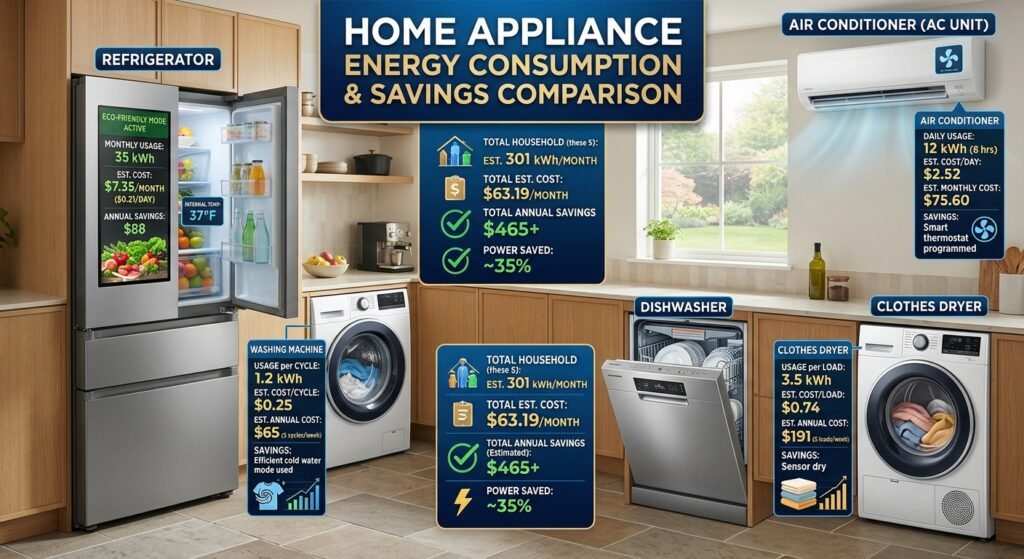
How much electricity do home appliances use? It depends on the appliance type, energy efficiency, usage frequency, and local electricity rates. This guide compares the energy consumption and running costs of refrigerators, washing machines, dishwashers, air conditioners, and dryers, with practical tips to help reduce household electricity bills.
Understanding Home Appliance Energy Consumption and Running Costs
The answer depends on the appliance type, energy efficiency, usage time, and your local electricity rate. Understanding appliance energy consumption can help you compare running costs and make smarter energy-saving decisions. Home appliances make everyday life easier, but they can also account for a considerable portion of household electricity consumption. Refrigerators operate around the clock, washing machines and dishwashers use electricity during regular cycles, and air conditioners and dryers can consume substantial amounts of energy depending on how frequently they run.
Understanding how much electricity home appliances use is an important step toward controlling monthly utility bills. It also helps households decide when to replace an older appliance, which energy-saving features are worth paying for, and how everyday habits can reduce unnecessary consumption.
The good news is that reducing electricity use does not always require buying new appliances. Choosing appropriate settings, improving maintenance, avoiding unnecessary operation and comparing energy labels can make a meaningful difference.
This guide explains how to calculate appliance electricity consumption, estimate running costs, compare energy-efficient and standard models, and reduce electricity use across the home. It covers refrigerators, washing machines, air conditioners, dishwashers and clothes dryers, along with practical buying and maintenance advice for households in the United States, the United Kingdom and Europe.
If you are planning a more efficient home, start with our Complete Guide to a Smarter, More Efficient Home. Knowing how much electricity do home appliances use can help homeowners understand their monthly energy bills and identify high-consumption appliances.
Affiliate Disclosure
SmartAirHQ participates in the Amazon Services LLC Associates Program, an affiliate advertising program designed to provide a means for sites to earn advertising fees by advertising and linking to Amazon.com.
As an Amazon Associate, SmartAirHQ earns from qualifying purchases. This means we may receive a commission when you purchase through qualifying affiliate links, at no additional cost to you.
Our product suggestions are intended to help readers explore relevant options. Product selection should always be based on your requirements, specifications and independent evaluation.
Understanding Home Appliance Electricity Consumption
Before comparing individual appliances, it helps to understand three basic electrical measurements: watts, kilowatts and kilowatt-hours.
Watts (W) measure electrical power. A higher wattage generally means an appliance can use electricity more quickly while operating.
Kilowatts (kW) represent 1,000 watts.
Kilowatt-hours (kWh) measure the amount of electricity consumed over time. Electricity companies generally use kWh to calculate household energy bills.
For example, a 1,000-watt appliance operating continuously for one hour consumes 1 kWh. However, an appliance rated at 1,000 watts does not necessarily draw that amount continuously. Refrigerators cycle on and off, while variable-speed air conditioners adjust their output according to cooling demand.
Understanding Common Electricity Measurements
| Measurement | Meaning | Example |
|---|---|---|
| Watt (W) | Electrical power | 500 W |
| Kilowatt (kW) | 1,000 watts | 1 kW |
| Kilowatt-hour (kWh) | Energy used over time | 1 kW for one hour |
| Electricity tariff | Price per kWh | $0.18/kWh |
| Annual consumption | Electricity used in one year | 400 kWh/year |
How to Calculate Appliance Electricity Usage
Use this formula to estimate electricity consumption:
Energy consumption (kWh) = Power (W) × Operating hours ÷ 1,000
For appliances used in cycles, calculate consumption per cycle and multiply it by the number of cycles.
For example, a 1,500-watt appliance operating for two hours uses:
1,500 × 2 ÷ 1,000 = 3 kWh.
To calculate the estimated electricity cost:
Running cost = Electricity consumption (kWh) × Electricity price per kWh
If your appliance uses 3 kWh and your electricity tariff is $0.18 per kWh:
3 × $0.18 = $0.54.
This is an illustrative calculation, not a universal appliance cost. Your actual bill depends on your electricity tariff, taxes, usage and appliance performance.
Electricity Consumption and Cost Examples
| Electricity used | At $0.15/kWh | At $0.20/kWh | At $0.30/kWh |
|---|---|---|---|
| 10 kWh | $1.50 | $2.00 | $3.00 |
| 25 kWh | $3.75 | $5.00 | $7.50 |
| 50 kWh | $7.50 | $10.00 | $15.00 |
| 100 kWh | $15.00 | $20.00 | $30.00 |
| 200 kWh | $30.00 | $40.00 | $60.00 |
| 500 kWh | $75.00 | $100.00 | $150.00 |
These figures demonstrate how the same appliance consumption can produce different bills in different countries and regions.
What Information Should You Collect?
| Information | Where to find it | Why it matters |
|---|---|---|
| Rated wattage | Appliance label | Estimates power demand |
| Annual kWh | Energy label | Helps compare models |
| Cycle consumption | Product specifications | Estimates per-use costs |
| Operating hours | Usage records | Calculates energy use |
| Electricity tariff | Utility bill | Calculates actual cost |
| Appliance age | Purchase records | Helps evaluate replacement |
For a more accurate estimate, use the appliance’s energy label or manufacturer specifications rather than assuming its maximum rated wattage represents continuous consumption.
How Much Electricity Does a Refrigerator Use?
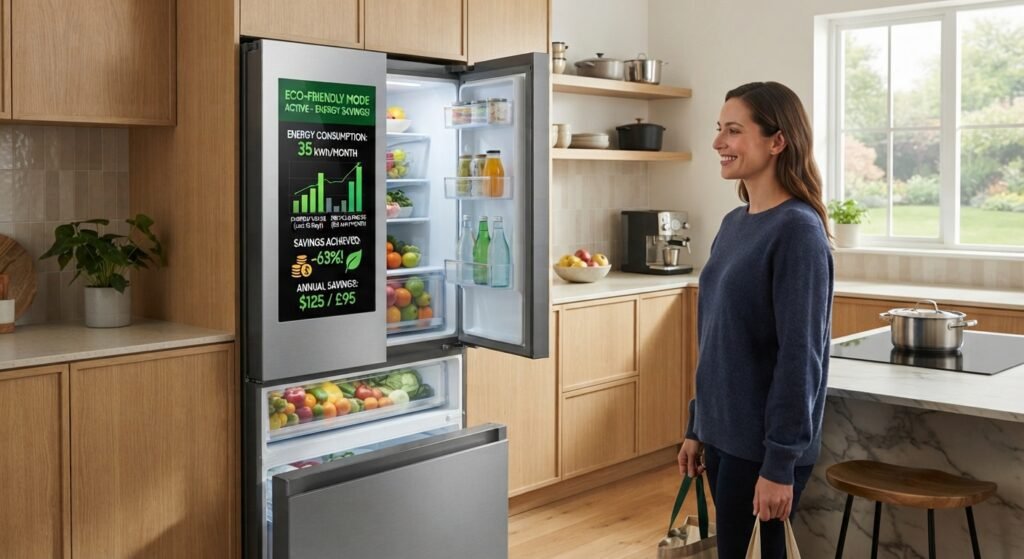
A refrigerator is different from many household appliances because it operates throughout the day and night. Its compressor switches on and off to maintain the selected temperature, meaning its actual electricity consumption changes with operating conditions.
The amount of electricity a refrigerator uses depends on its capacity, compressor technology, insulation, temperature settings, door-opening frequency, surrounding temperature and maintenance condition.
Large refrigerators, side-by-side models and units with additional cooling features may consume more electricity than smaller, simpler models. However, a newer efficient refrigerator can sometimes use less electricity than an older, smaller unit.
To understand how much electricity do home appliances use, start by checking your refrigerator’s annual energy consumption in kWh.
Factors That Affect Refrigerator Electricity Consumption
| Factor | Potential effect | Practical response |
|---|---|---|
| Refrigerator size | Larger capacity can require more cooling | Choose suitable capacity |
| Compressor efficiency | Affects electricity demand | Compare annual kWh |
| Door openings | Allows warm air inside | Avoid unnecessary openings |
| Room temperature | Can increase cooling demand | Provide suitable ventilation |
| Door seals | Damaged seals allow cold air to escape | Inspect and replace damaged seals |
| Temperature settings | Excessively cold settings can waste energy | Follow manufacturer guidance |
| Dust around condenser | Can interfere with heat removal | Clean as instructed |
How to Make Your Refrigerator More Energy Efficient
1. Maintain appropriate temperatures
Avoid unnecessarily low temperature settings. Follow the manufacturer’s recommendations and use a refrigerator thermometer if needed.
2. Check door seals
A loose or damaged gasket allows warm air to enter. Inspect the seals regularly and replace damaged components.
3. Allow proper ventilation
Do not block the ventilation openings. Follow the installation clearances specified by the manufacturer.
4. Avoid keeping the door open
Decide what you need before opening the refrigerator. This reduces the amount of warm air entering the compartment.
5. Keep the appliance maintained
Clean accessible components according to the manufacturer’s instructions. Disconnect the appliance before performing maintenance that requires access to electrical or mechanical parts.
6. Compare annual energy consumption when replacing it
Look beyond the purchase price. Compare capacity, annual kWh, useful features and expected running costs.
Refrigerator Energy-Saving Actions
| Action | What it addresses | Priority |
|---|---|---|
| Check door seals | Cold-air leakage | High |
| Maintain ventilation | Heat removal | High |
| Avoid unnecessary door openings | Warm-air entry | High |
| Follow recommended settings | Excessive cooling | High |
| Clean accessible condenser areas | Dust accumulation | Medium |
| Compare energy labels | Long-term running costs | High |
Useful buying options:
- 🛍️ Shop energy-efficient refrigerators on Amazon.
- 🔎 Find French-door refrigerators on Amazon.
- ⭐ Explore top-freezer refrigerators on Amazon.
- 🏠 Find refrigerator thermometers on Amazon.
- 🛒 Check replacement refrigerator door seals on Amazon.
For official appliance purchasing guidance, see the US Department of Energy’s Purchasing Energy-Efficient Residential Refrigerators.
How Much Electricity Does a Washing Machine Use?
A washing machine consumes electricity mainly through its motor, control system, pump and, in many models, the water-heating system.
The amount used per load depends on the wash temperature, cycle length, load size, machine design and selected settings. Heating water can increase electricity consumption, which is why cold-water or lower-temperature cycles may help reduce energy use when suitable for the laundry.
Front-load and top-load washing machines can have different consumption patterns. Rather than assuming one type is always more efficient, compare their tested energy consumption and water usage.
Comparing different models helps explain how much electricity do home appliances use during regular household operation.
Washing Machine Electricity Consumption Factors
| Factor | How it affects usage | Energy-saving approach |
|---|---|---|
| Water temperature | Heating water requires energy | Use cold or lower-temperature cycles when appropriate |
| Load size | Small loads may waste capacity | Wash suitable full loads |
| Cycle selection | Some cycles run longer | Select an appropriate cycle |
| Spin speed | Affects remaining moisture | Use suitable spin settings |
| Machine condition | Poor maintenance can affect operation | Clean and maintain regularly |
| Extra rinse | Adds water and operating time | Use only when needed |
Practical Ways to Reduce Washing Machine Electricity Use
- Wash clothes in cold water when the fabric and detergent allow it.
- Use eco or energy-saving cycles where appropriate.
- Avoid running very small loads unnecessarily.
- Follow the recommended detergent quantity.
- Clean the filter and detergent drawer according to the manual.
- Use an appropriate spin setting to reduce moisture before tumble drying.
A washing machine that is used frequently can benefit from better operating habits without requiring an immediate replacement.
Explore washing machine options:
- ✨ Explore energy-efficient washing machines on Amazon.
- 🔗 See front-load washing machines on Amazon
- 📋 Compare high-efficiency top-load washers on Amazon.
- 🔍 Browse washing machine cleaning products on Amazon.
You can also read our Best Washing Machine Buying Guide for a closer look at purchasing considerations.
How Much Does a Dishwasher Cost to Run?
A dishwasher uses electricity to operate its pump, spray system, control electronics and, depending on the model and cycle, water-heating and drying functions.
Its running cost depends on the selected programme, water temperature, load size, drying method, cycle frequency and electricity price.
An energy-efficient dishwasher can reduce electricity and water consumption, but the most useful comparison is between models of similar capacity and tested performance.
Calculating Dishwasher Electricity Costs
Suppose a dishwasher uses an illustrative 0.8 kWh per cycle and runs five times each week.
Weekly consumption:
0.8 × 5 = 4 kWh.
Annual consumption:
4 × 52 = 208 kWh.
At an electricity price of $0.18 per kWh:
208 × $0.18 = $37.44 per year.
This example is for demonstrating the calculation. Use the actual model’s energy-label or tested cycle consumption for a realistic estimate.
Dishwasher Running-Cost Example
| Measurement | Illustrative result |
|---|---|
| Electricity per cycle | 0.8 kWh |
| Cycles per week | 5 |
| Weekly consumption | 4 kWh |
| Annual consumption | 208 kWh |
| Example electricity tariff | $0.18/kWh |
| Estimated annual electricity cost | $37.44 |
The example does not include water charges, detergent, repairs or the purchase price.
Dishwasher Energy-Saving Practices
| Practice | Potential benefit | What to remember |
|---|---|---|
| Run suitable full loads | Uses capacity more effectively | Do not overload |
| Select eco programmes | May reduce energy and water use | Cycles can take longer |
| Avoid unnecessary pre-rinsing | Reduces additional water use | Scrape off large food pieces |
| Use air-dry options | Can reduce heated drying | Check the model’s options |
| Clean filters | Helps maintain performance | Follow the manual |
| Choose appropriate temperature | Avoids unnecessary heating | Match programme to dishes |
Compare useful dishwasher accessories and models:
- 🛍️ Shop ENERGY STAR dishwashers on Amazon.
- 🔎 Find compact dishwashers on Amazon.
- ⭐ Explore dishwasher detergent on Amazon.
- 🏠 Find dishwasher cleaning products on Amazon.
For a technical comparison, consult the ENERGY STAR Dishwasher Key Product Criteria.
If you experience cleaning problems, our existing Why Is My Dishwasher Not Cleaning Properly? guide covers that separate troubleshooting intent.
How Much Electricity Does an Air Conditioner Use?
Air conditioners can be significant electricity users, particularly in regions with long, hot summers. Their consumption depends on cooling capacity, efficiency, outdoor temperature, insulation, room size, thermostat settings and operating hours.
A unit’s rated input power is useful for estimating electricity consumption, but it should not be confused with its cooling capacity.
For example, a cooling capacity expressed in BTU/h describes the amount of heat the unit can remove. It is not the same as the electrical power it consumes.
Inverter air conditioners can adjust compressor speed according to cooling demand. This may reduce electricity consumption compared with systems that repeatedly operate at full output, depending on the conditions and model.
Factors That Influence Air Conditioner Electricity Use
| Factor | Effect on consumption | Practical improvement |
|---|---|---|
| Cooling capacity | Affects electrical demand | Choose appropriate capacity |
| Outdoor temperature | Changes cooling workload | Improve shading |
| Room insulation | Poor insulation increases heat gain | Seal air leaks |
| Thermostat setting | Lower settings can increase demand | Choose a comfortable setting |
| Filter condition | Restricted airflow affects performance | Clean filters as instructed |
| Operating hours | Longer use increases total consumption | Use schedules where practical |
| Refrigerant condition | System faults can reduce performance | Arrange qualified servicing |
Example: Estimating Air Conditioner Running Costs
Suppose an air conditioner has an average electrical input of 1 kW while operating and runs for eight hours.
1 kW × 8 hours = 8 kWh.
At $0.18 per kWh:
8 × $0.18 = $1.44 for that operating period.
Actual inverter consumption can vary considerably during operation, so use measured consumption or manufacturer data where available.
Illustrative Air Conditioner Electricity Scenarios
| Average input power | Operating time | Electricity consumed |
|---|---|---|
| 0.5 kW | 4 hours | 2 kWh |
| 0.75 kW | 6 hours | 4.5 kWh |
| 1 kW | 8 hours | 8 kWh |
| 1.5 kW | 8 hours | 12 kWh |
| 2 kW | 10 hours | 20 kWh |
These are mathematical scenarios, not typical consumption claims for specific AC sizes.
Ways to Reduce Air Conditioner Electricity Consumption
- Set a comfortable temperature rather than unnecessarily low cooling.
- Keep doors and windows closed while cooling.
- Clean filters regularly.
- Use curtains or blinds to reduce direct solar heat.
- Improve insulation and seal gaps around windows.
- Use timers or schedules to avoid unnecessary operation.
- Choose an appropriately sized, efficient model.
- Arrange professional maintenance when cooling performance changes.
Explore air-conditioning products:
- 🛍️ Shop inverter air conditioners on Amazon.
- 🔎 Find window air conditioners on Amazon.
- ⭐ Explore programmable thermostats on Amazon.
- 🛒 Check replacement AC filters on Amazon.
For a more detailed product comparison, see our Smart Inverter AC Buying Guide.
How Much Electricity Does a Clothes Dryer Use?
Electric clothes dryers can consume considerable electricity because they generate heat and move air through wet clothing.
Their consumption depends on dryer technology, load size, moisture level, cycle settings, ventilation, maintenance and how frequently the appliance is used.
A conventional electric resistance dryer and a heat pump dryer can have very different energy requirements.
A heat pump dryer reuses heat through a refrigeration-based system rather than relying entirely on conventional resistance heating. This can make it more energy-efficient, although purchase prices, cycle times and operating conditions vary.
Comparing Clothes Dryer Technologies
| Dryer type | Heating approach | Main consideration |
|---|---|---|
| Vented electric dryer | Electric heating and exhaust ventilation | Requires suitable external venting |
| Condenser dryer | Condenses moisture into collected water or drainage | Does not normally require an external exhaust duct |
| Heat pump dryer | Recovers and reuses heat | Often lower electricity consumption, but may cost more upfront |
| Gas dryer | Uses gas for heating and electricity for controls and motor | Fuel costs and installation requirements matter |
Example: Heat Pump Dryer vs Conventional Electric Dryer
The following example illustrates how to compare two models using hypothetical per-load consumption.
Assume both dryers are used four times per week.
| Measurement | Conventional electric dryer | Heat pump dryer |
|---|---|---|
| Illustrative electricity per load | 3 kWh | 1.5 kWh |
| Loads per week | 4 | 4 |
| Annual loads | 208 | 208 |
| Annual electricity use | 624 kWh | 312 kWh |
| Electricity price | $0.18/kWh | $0.18/kWh |
| Estimated annual electricity cost | $112.32 | $56.16 |
Under these assumptions, the heat pump dryer uses 312 kWh less electricity per year.
These are illustrative figures, not guaranteed savings or universal performance values. Compare the actual energy labels of the models you are considering.
Heat Pump Dryer: Pros and Cons
Advantages
- Can use less electricity than conventional electric resistance dryers.
- Reuses heat during operation.
- Does not normally require the same external exhaust arrangement as a vented dryer.
- Can be useful in homes where external venting is difficult.
- Provides an alternative for households seeking lower drying energy consumption.
Disadvantages
- Usually has a higher purchase price than basic vented models.
- Some models have longer cycle times.
- Filters and heat exchangers require regular maintenance.
- Performance and running costs depend on model and usage.
- Repair and replacement costs should be considered.
What to Compare Before Buying a Dryer
| Buying factor | Why it matters |
|---|---|
| Annual kWh or energy-label figure | Estimates running costs |
| Capacity | Helps match the machine to household loads |
| Dryer technology | Affects energy use and installation |
| Cycle duration | Influences convenience |
| Filter maintenance | Affects continued performance |
| Purchase price | Determines initial investment |
| Warranty | Helps evaluate ownership costs |
Browse dryer options:
- ✨ Explore heat pump dryers on Amazon.
- 🔗 See condenser clothes dryers on Amazon.
- 📋 Compare vented electric dryers on Amazon.
- 🔍 Browse dryer lint filters on Amazon.
Most Energy-Efficient Appliances for Your Home
The most efficient appliance is not necessarily the one with the highest advertised star rating or the lowest purchase price.
A useful comparison considers the appliance’s energy consumption, size, capacity, operating conditions and expected usage.
For example, a large refrigerator with a good efficiency rating may still use more total electricity than a smaller refrigerator. Similarly, an efficient dryer used every day may consume more electricity over a year than an inefficient appliance used occasionally.
Which Appliances Deserve an Energy-Efficiency Check?
| Appliance | Why it deserves attention | What to compare |
|---|---|---|
| Refrigerator | Operates continuously | Annual kWh |
| Freezer | Operates continuously | Annual kWh and capacity |
| Air conditioner | Can run for extended periods | Seasonal efficiency and input power |
| Clothes dryer | Uses electricity for heating | Energy per cycle and annual use |
| Dishwasher | Uses electricity and water | kWh per cycle or annual use |
| Washing machine | Uses motors and sometimes water heating | kWh per cycle and water use |
| Electric oven | Uses electricity for heating | Energy per cooking cycle |
| Dehumidifier | May operate for many hours | Energy factor and rated power |
How to Compare Two Appliances Properly
Do not compare products using star ratings alone if the products differ significantly in capacity or type.
Instead:
- Compare products of similar capacity.
- Check the annual or per-cycle kWh figure.
- Compare water consumption where relevant.
- Consider your expected frequency of use.
- Calculate estimated annual electricity costs.
- Compare the purchase-price difference.
- Check warranty and maintenance requirements.
Energy-Efficient vs Standard Appliance Example
Suppose two comparable refrigerators have the following hypothetical annual electricity consumption:
| Measurement | Standard model | Efficient model |
|---|---|---|
| Annual electricity use | 600 kWh | 400 kWh |
| Example electricity price | $0.18/kWh | $0.18/kWh |
| Annual electricity cost | $108 | $72 |
| Annual energy difference | — | 200 kWh |
| Annual cost difference | — | $36 |
If the efficient model costs $180 more to purchase, its simple electricity-cost payback would be:
$180 ÷ $36 = 5 years.
This calculation ignores changes in electricity prices, financing, repairs, product lifespan and the time value of money. It also assumes both models meet your household’s needs equally well.
Energy-Efficient vs Standard Appliances: Are They Worth It?
An energy-efficient appliance may cost more upfront but reduce electricity consumption over its useful life.
Whether the extra cost is worthwhile depends on the purchase-price difference, annual energy savings, electricity tariff and how long you expect to keep the appliance.
The best way to evaluate an upgrade is to calculate its potential payback period.
Simple payback period = Extra purchase cost ÷ Annual running-cost savings
For example, if an efficient appliance costs $150 more and saves $30 annually, its simple payback period is five years.
Appliance Upgrade Decision Checklist
| Question | Why it matters |
|---|---|
| Is the existing appliance inefficient? | Establishes the potential benefit |
| How much electricity will the replacement use? | Estimates savings |
| What is the purchase-price difference? | Establishes initial investment |
| How often will it operate? | Affects annual savings |
| Does it have suitable capacity? | Prevents buying an unsuitable model |
| What is the expected ownership period? | Helps assess payback |
| Are maintenance costs different? | Improves total-cost comparison |
An efficient appliance is most attractive when it offers meaningful savings without compromising capacity, reliability or household requirements.
Understanding Appliance Energy Labels in the USA and Europe
Energy labels make it easier to compare products, but their formats and testing methods differ between markets.
In the United States, the ENERGY STAR programme identifies qualifying energy-efficient products, while EnergyGuide labels provide estimated annual energy use and operating-cost information for certain appliances.
In the European Union, the A-to-G energy label helps consumers compare the energy performance of regulated products. Depending on the appliance category, the label may also show annual or per-cycle energy consumption, capacity, water use and noise information.
The EU label was rescaled for several appliance groups in 2021. Therefore, older A+, A++ and A+++ labels should not be directly compared with the newer A-to-G scale.
Understanding Different Energy-Label Systems
| Market | Label or programme | Useful information |
|---|---|---|
| United States | ENERGY STAR | Identifies qualifying efficient products |
| United States | EnergyGuide | Estimated energy use and operating costs |
| European Union | A-to-G energy label | Efficiency class and product-specific consumption |
| United Kingdom | A-to-G energy label | Energy class and relevant product information |
| Australia | Energy Rating Label | Star rating and estimated annual consumption |
When comparing appliances across countries, use the underlying energy-consumption figures and relevant test conditions rather than assuming that two different rating systems are interchangeable.
Official information is available through the Australian Government’s Energy Rating Label guidance and the US ENERGY STAR programme.
How to Reduce Electricity Consumption Across Your Home
Energy savings do not depend entirely on buying expensive appliances. Everyday habits and basic maintenance can help reduce unnecessary consumption.
Start by identifying which appliances operate for the longest periods and which use heating or cooling elements. These are often worthwhile places to investigate first.
Practical Home Appliance Energy-Saving Checklist
| Action | Applies to | Main objective |
|---|---|---|
| Use suitable lower-temperature cycles | Washer | Reduce water-heating energy |
| Wash appropriate full loads | Washer and dishwasher | Avoid unnecessary cycles |
| Clean filters | AC and dryer | Maintain airflow |
| Maintain door seals | Refrigerator | Reduce cold-air leakage |
| Use eco programmes | Dishwasher and washer | Reduce energy where suitable |
| Avoid unnecessary drying | Dishwasher | Reduce heated drying |
| Improve room insulation | Air conditioner | Reduce cooling demand |
| Maintain appliance ventilation | Refrigerator and dryer | Support proper operation |
| Compare annual kWh | All major appliances | Identify efficient replacements |
| Monitor actual usage | Selected appliances | Find unexpected consumption |
Where to Start With Energy Savings
| Household situation | First area to investigate |
|---|---|
| High summer electricity bills | Air-conditioning usage |
| Frequent laundry | Washing and drying cycles |
| Large household | Refrigerator, freezer and laundry capacity |
| Older kitchen appliances | Energy-label comparisons |
| High standby consumption | Unnecessary standby devices |
| Unexpected electricity increases | Appliance-level monitoring |
A smart energy monitor can help identify consumption patterns and show how different appliances affect household electricity use. Make sure any monitoring device is suitable for the electrical rating and installation method involved. High-power appliances may require professionally installed monitoring rather than an ordinary smart plug.
Useful monitoring products:
- 🛍️ Shop home energy monitors on Amazon.
- 🔎 Find smart energy monitoring plugs on Amazon.
- ⭐ Explore whole-home electricity monitors on Amazon.
- 🛒 Check plug-in power meters on Amazon.
For more practical ideas, explore our Smart Energy-Saving Devices for Home guide and Smart Energy Monitor Buying Guide.
You can also read How to Reduce Electricity Consumption at Home.
How to Track Your Home Appliance Energy Consumption
Estimating electricity consumption is useful, but tracking actual usage can help identify which appliances contribute most to your bill.
Start by recording the appliance’s energy-label figure, operating frequency and electricity tariff. Where suitable, use a compatible energy monitor to measure real-world consumption.
Remember that a plug-in meter is not suitable for every appliance. High-power appliances such as ovens, dryers and air conditioners may require appropriately rated equipment or professional monitoring.
Simple Monthly Appliance Energy Tracking Sheet
| Appliance | Estimated kWh | Actual kWh | Monthly cost |
|---|---|---|---|
| Refrigerator | Enter value | Enter value | kWh × tariff |
| Washing machine | Enter value | Enter value | kWh × tariff |
| Dishwasher | Enter value | Enter value | kWh × tariff |
| Air conditioner | Enter value | Enter value | kWh × tariff |
| Clothes dryer | Enter value | Enter value | kWh × tariff |
| Other appliances | Enter value | Enter value | kWh × tariff |
Monthly Energy Audit Process
| Step | What to do | Expected outcome |
|---|---|---|
| 1 | Record the electricity tariff | Establish cost per kWh |
| 2 | List major appliances | Identify equipment |
| 3 | Collect energy-label information | Establish reference consumption |
| 4 | Record usage frequency | Understand operating patterns |
| 5 | Measure compatible appliances | Obtain actual consumption |
| 6 | Calculate estimated costs | Compare expenses |
| 7 | Apply energy-saving changes | Reduce unnecessary usage |
| 8 | Review the next bill | Evaluate the results |
For households in Pakistan, the National Energy Efficiency and Conservation Authority also provides an Electricity Consumption Calculator that can help estimate appliance usage and potential savings.
Common Mistakes That Increase Appliance Electricity Consumption
Some electricity-wasting habits are easy to overlook. An appliance may appear efficient but still consume unnecessary energy when it is poorly maintained or used incorrectly.
Common Energy-Wasting Habits
| Mistake | Why it can waste energy | Better approach |
|---|---|---|
| Running half-empty loads frequently | More cycles may be needed | Combine suitable loads |
| Selecting unnecessarily hot wash cycles | Requires additional heating | Use suitable lower temperatures |
| Leaving refrigerator doors open | Warm air enters | Open only when needed |
| Ignoring clogged filters | Can restrict airflow | Maintain filters |
| Using excessive cooling | Increases cooling demand | Choose a comfortable setting |
| Ignoring dryer maintenance | Can affect airflow and operation | Clean filters as directed |
| Buying oversized appliances | May increase unnecessary consumption | Match capacity to requirements |
| Comparing star ratings without checking kWh | Can lead to misleading comparisons | Compare tested consumption |
How to Choose Energy-Efficient Appliances When Replacing Old Ones
Replacing an appliance should be a considered decision rather than an automatic response to a high electricity bill.
First, check whether the existing appliance has a repairable issue. A damaged door seal, blocked filter or incorrect setting may explain poor performance.
If replacement makes financial sense, compare similar products using their energy consumption figures.
Final Appliance Buying Checklist
| Buying consideration | What to check |
|---|---|
| Energy consumption | Annual or per-cycle kWh |
| Capacity | Household requirements |
| Energy label | Applicable regional rating |
| Operating cost | Estimated cost at your tariff |
| Purchase price | Total upfront expense |
| Maintenance | Filters, cleaning and servicing |
| Warranty | Coverage and duration |
| Installation | Space, ventilation and electrical requirements |
| Long-term value | Expected energy savings |
A well-chosen appliance should balance efficiency, capacity, reliability and purchase price.
Frequently Asked Questions
1. Which home appliances use the most electricity?
There is no universal ranking because usage depends on household habits, appliance efficiency and climate. Air conditioners, electric dryers, water heaters, refrigerators and other frequently operated appliances can make significant contributions to household consumption.
2. How can I calculate how much electricity an appliance uses?
Multiply its power in watts by the number of operating hours and divide by 1,000. For annual usage, multiply the result by the number of operating days. For appliances that cycle on and off, use measured or tested energy consumption where possible.
3. Do energy-efficient appliances really save money?
They can reduce running costs when their actual electricity consumption is lower than that of a comparable standard model. Compare the purchase-price difference with the expected annual savings before upgrading.
4. Does an inverter refrigerator use less electricity?
An inverter compressor can adjust its operating speed according to cooling demand. This may improve efficiency, but actual savings depend on the refrigerator’s design, capacity, insulation, temperature settings and operating environment.
5. Are heat pump dryers more energy-efficient than conventional electric dryers?
Heat pump dryers generally use less electricity than conventional electric resistance dryers because they recover and reuse heat. However, compare the actual energy-label figures and operating conditions of the models you are considering.
6. Does running a dishwasher use more electricity than washing dishes by hand?
The answer depends on the dishwasher’s efficiency, water-heating method, programme, load size and the amount of hot water used when washing by hand. A modern efficient dishwasher can use relatively little water, but you should compare total water and energy consumption rather than assuming one method always wins.
7. What does kWh mean on an appliance energy label?
A kilowatt-hour measures the amount of electricity consumed. Annual kWh figures help compare how much electricity similar appliances may use under standardised test conditions.
8. Are smart plugs useful for monitoring electricity consumption?
Compatible smart plugs with energy-monitoring features can measure the electricity used by suitable plug-in appliances. They should only be used within their rated electrical limits and are not appropriate for every high-power appliance.
9. Should I replace an old appliance to save electricity?
Not necessarily. Check its condition, maintenance requirements, electricity use and repair costs first. Compare the estimated savings of a replacement against its purchase and installation costs.
10. How can I reduce my monthly electricity bill without buying new appliances?
Use appropriate wash settings, avoid unnecessary cycles, maintain filters and seals, reduce unnecessary cooling, improve insulation and switch off equipment that does not need to remain powered.
“Once you understand how much electricity do home appliances use, you can make better decisions about appliance efficiency, running costs, and long-term savings.
Final Thoughts
Understanding how much electricity home appliances use can help households make better purchasing decisions and control their running costs.
Refrigerators, washing machines, dishwashers, air conditioners and clothes dryers all have different consumption patterns. Their actual electricity use depends on model specifications, operating conditions, maintenance and household habits.
The most effective approach is to measure or estimate consumption, compare similar appliances using reliable energy labels, and focus on practical changes that reduce unnecessary electricity use.
You do not have to replace every appliance to make your home more efficient. Better settings, regular maintenance, appropriate usage and informed purchasing decisions can all contribute to lower household energy consumption.
For more practical advice on creating an efficient and connected home, explore the Complete Guide to a Smarter, More Efficient Home.