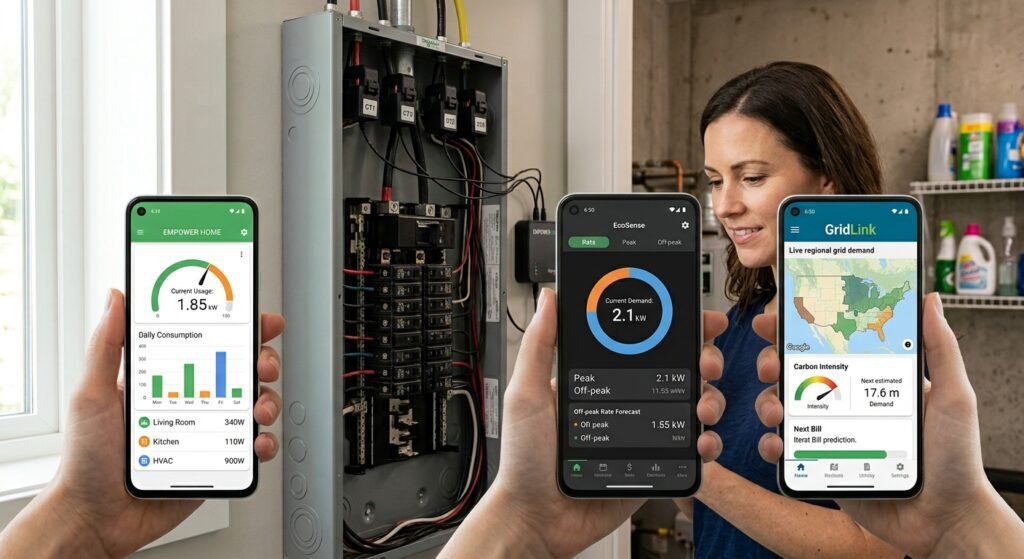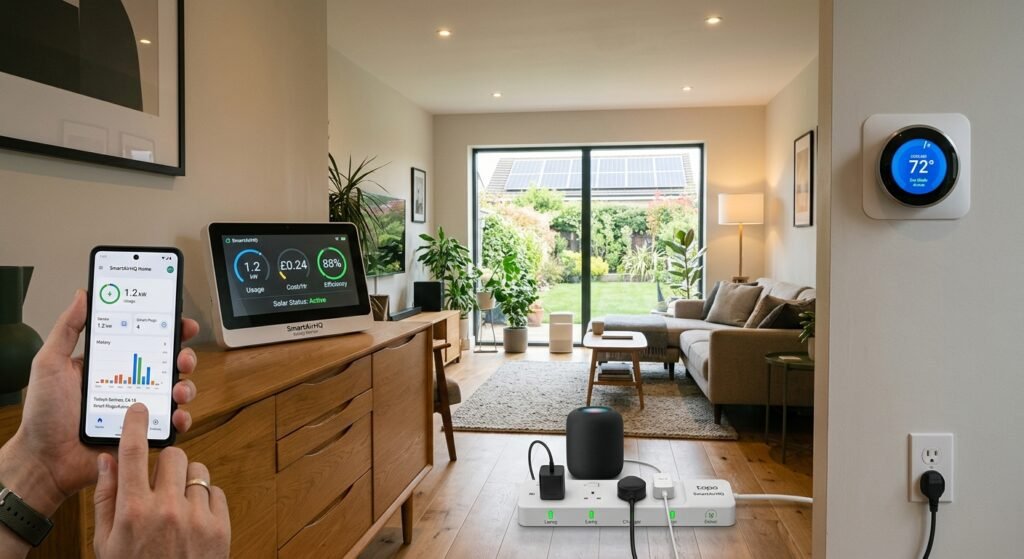
If your electricity bill keeps rising, smart technology can help you understand and manage where energy is being used. Smart energy saving devices for home use can provide better visibility, automate certain tasks, reduce unnecessary standby consumption, and improve control over heating, cooling, lighting, and connected appliances.
From energy-monitoring smart plugs and whole-home energy monitors to smart thermostats, power strips, and connected lighting, these devices serve different purposes. The right combination depends on whether you want to measure electricity use, eliminate unnecessary standby power, automate schedules, or improve heating and cooling efficiency.
This guide covers 15 practical smart energy-saving devices for the home, explains what each category does, and shows what to consider before buying. If you want a deeper look specifically at electricity monitoring, see our Smart Energy Monitor Buying Guide.
Affiliate disclosure: This article contains affiliate links. If you purchase through qualifying links, SmartAirHQ may earn a commission at no additional cost to you. Prices, availability, specifications, and seller information can change, so verify current product details before purchasing.
Smart Energy Saving Devices at a Glance
Smart energy devices do not all save electricity in the same way. Some measure consumption, some automatically control equipment, and others make it easier to switch devices off when they are not needed.
| Device Type | Main Purpose | Best For | Energy-Saving Role |
|---|---|---|---|
| Energy-Monitoring Smart Plug | Measures and controls one device | Appliances and electronics | Identifies usage and enables schedules |
| Whole-Home Energy Monitor | Tracks household electricity | Homeowners | Shows where major energy loads occur |
| Circuit-Level Monitor | Tracks selected circuits | HVAC, EV, water heating | Identifies major electrical loads |
| Smart Power Strip | Controls multiple devices | Entertainment and office setups | Helps reduce unnecessary standby power |
| Smart Thermostat | Automates HVAC settings | Heating and cooling | Adjusts operation around schedules and occupancy |
| Smart AC Controller | Controls compatible AC units | Mini-split or IR-controlled ACs | Automates cooling operation |
| Smart LED Bulbs | Controls connected lighting | Indoor and outdoor lighting | Reduces unnecessary lighting operation |
| Smart Light Switch | Controls fixed lighting | Rooms with multiple fixtures | Enables schedules and remote control |
| Temperature Sensor | Measures room conditions | Multi-room homes | Provides additional information for climate control |
| Smart Home Energy Management System | Coordinates multiple devices | Advanced smart homes | Connects energy information with automation |
How Smart Energy Devices Actually Save Energy
The biggest advantage of connected energy devices is not that the device itself magically consumes less electricity. Instead, smart technology can give you information or control that helps prevent unnecessary consumption.
For example, an energy-monitoring smart plug can show how much electricity a connected appliance uses. A smart thermostat can adjust heating or cooling according to a schedule or occupancy-related features. A smart power strip can make it easier to disconnect groups of electronics when they are not needed.
ENERGY STAR notes that compatible smart thermostats can provide scheduling, remote control, temperature information, and occupancy-related features designed to help manage heating and cooling.
5 Ways Smart Devices Can Help
- Measure electricity use so you know which devices deserve attention.
- Automate schedules so equipment does not run unnecessarily.
- Reduce standby consumption from groups of connected electronics.
- Improve HVAC control by managing heating and cooling around actual routines.
- Create useful energy data that helps you compare changes over time.
The important principle is simple: measure first, automate second, and verify the result.
15 Smart Energy Saving Devices for Home
The following categories cover different energy-management needs. Instead of treating one device as the universal solution, match the product to the type of energy problem you are trying to solve.
1. Energy-Monitoring Smart Plugs
Energy-monitoring smart plugs are one of the easiest ways to investigate electricity use at the appliance level. They sit between an outlet and a compatible plug-in device and can provide information about power consumption.
For example, the TP-Link Tapo P110M provides energy tracking, electricity-cost estimation, scheduling, remote control, and Matter support.
Best for: TVs, computers, entertainment systems, office equipment, fans, and other compatible plug-in loads.
Amazon: Browse Energy-Monitoring Smart Plugs
2. Whole-Home Energy Monitors
A whole-home energy monitor provides a broader view of household electricity consumption. Depending on the system, current sensors can measure electricity entering the home and additional sensors can provide circuit-level information.
These monitors are particularly useful when you want to understand why total household electricity use is high rather than measuring only one appliance.
Best for: Homeowners investigating overall energy consumption.
Amazon: Browse Home Energy Monitors
For a deeper comparison of whole-home, circuit-level, and plug-in monitoring, read our Smart Energy Monitor Buying Guide.
3. Circuit-Level Energy Monitors
Circuit-level monitoring provides more detail than a basic whole-home reading. Compatible current sensors can isolate selected circuits, such as HVAC equipment, electric water heating, kitchen circuits, or EV charging.
This is especially useful when major electrical loads are hard-wired and cannot conveniently be measured with an ordinary smart plug.
Best for: Homeowners who want to identify which major circuits consume the most electricity.
Amazon: Browse Circuit-Level Energy Monitors
4. Smart Power Strips
Smart power strips are useful when several electronics are located together. Instead of managing each device separately, a compatible power strip can provide centralized control and scheduling.
They can be particularly useful for entertainment centers, home offices, and computer setups where several devices may otherwise remain connected continuously.
Best for: Groups of electronics with predictable usage schedules.
Amazon: Browse Smart Power Strips
For a deeper explanation of standby electricity, read our guide to Phantom Energy: What It Is and How to Reduce It at Home.
5. Smart Thermostats
Smart thermostats are designed to make heating and cooling control more responsive to schedules, remote commands, and, on compatible models, occupancy or learning features.
ENERGY STAR says certified smart thermostats are independently evaluated using real-world data and can provide features such as scheduling, remote control, and occupancy-related adjustments.
Best for: Homes where heating and cooling represent a significant portion of energy use.
Amazon: Browse ENERGY STAR Smart Thermostats
Before buying, verify compatibility with your HVAC system. Some systems have specific wiring, equipment, or communication requirements.
6. Smart AC Controllers
A smart AC controller can add connected scheduling and remote control to compatible air conditioners, particularly certain mini-split, window, portable, or infrared-remote-controlled systems.
These devices can be useful when the main goal is preventing an AC from operating unnecessarily or controlling it remotely.
Best for: Compatible air conditioners without built-in smart control.
Amazon: Browse Smart AC Controllers
For more information, see our Smart AC Controllers for Climate Control guide.
7. Smart LED Bulbs
Smart LED bulbs combine efficient lighting technology with connected control. Depending on the product, you can schedule lights, dim them, control them remotely, or integrate them with a smart-home system.
ENERGY STAR notes that connected smart lighting can use scheduling, location-based controls, and sensors to help prevent lights from remaining on unnecessarily.
Best for: Rooms where lights are frequently left on or where automated schedules are useful.
Amazon: Browse Smart LED Bulbs
8. Smart Light Switches
A smart switch can control fixed lighting fixtures that may not be practical to replace with individual smart bulbs.
They are particularly useful for rooms with multiple lights or for households that want wall-switch control combined with app-based scheduling.
Best for: Ceiling lights, fixed fixtures, and rooms with multiple connected lights.
Amazon: Browse Smart Light Switches
9. Room Temperature Sensors
A temperature sensor does not directly reduce electricity consumption. Its value comes from providing additional information to a compatible climate-control system.
A sensor can be useful when the temperature at the main thermostat does not represent conditions in another frequently occupied room.
Best for: Larger homes, rooms with temperature differences, and compatible smart thermostat systems.
Amazon: Browse Smart Temperature Sensors
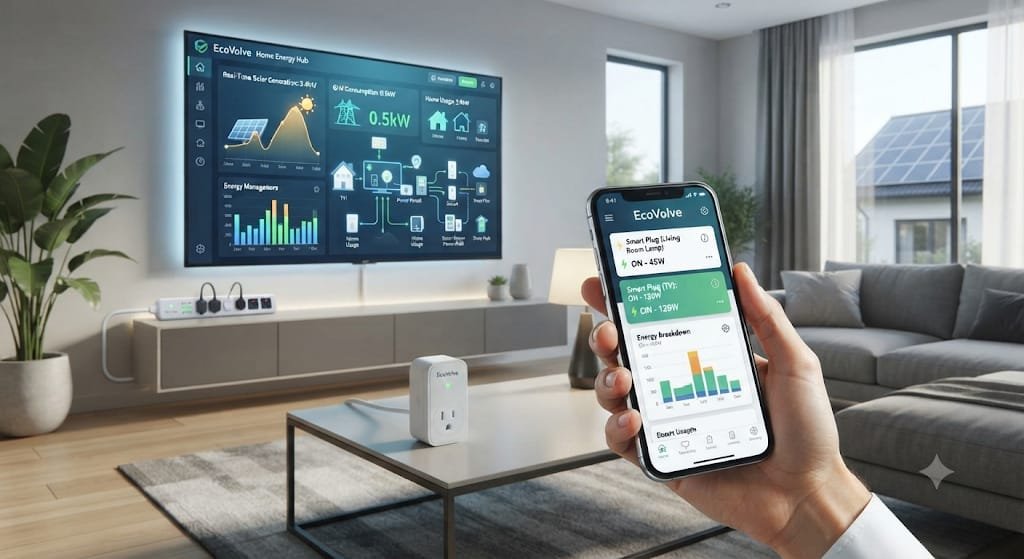
10. Smart Energy Management Systems
A smart home energy-management system can combine information from multiple connected devices and, depending on the platform, coordinate energy-related actions.
This type of setup is more advanced than buying one smart plug. It can become useful when a home includes multiple energy technologies such as solar, EV charging, smart thermostats, connected lighting, and energy monitors.
Best for: Advanced smart homes with multiple connected energy devices.
11. Smart Plugs With Scheduling
Not every smart plug needs detailed energy monitoring to be useful. A basic smart plug can automate when compatible devices turn on or off.
This is useful for equipment with predictable schedules where remote control or automatic shutoff is more important than measuring electricity consumption.
Best for: Lamps, small electronics, fans, and other compatible devices.
Amazon: Browse Smart Plugs With Scheduling
12. Smart Power Controllers for Home Offices
Home offices can contain multiple devices that remain powered for long periods: monitors, computers, printers, speakers, chargers, and networking equipment.
A combination of smart plugs, power strips, and automatic schedules can make it easier to manage equipment that does not need to remain fully active around the clock.
Best for: Home offices and computer workstations.
Amazon: Browse Smart Power Management Devices
13. Smart Controls for Entertainment Systems
Televisions, streaming devices, game consoles, speakers, and related equipment can form a group of connected electronics. A smart power strip or compatible smart plug can make centralized control easier.
The objective should not be to disconnect equipment that genuinely needs continuous operation. Instead, identify devices that can safely enter a lower-power or off state when they are not being used.
Amazon: Browse Smart Entertainment Power Strips
14. Energy-Monitoring Plugs for Standby Power
A small plug-in energy monitor can be particularly useful when you suspect an appliance or electronic device is consuming more standby electricity than expected.
Instead of guessing, measure the device and decide whether its standby consumption is significant enough to address.
Best for: Electronics, office equipment, chargers, and other plug-in devices.
Amazon: Browse Plug-In Energy Meters
15. Smart Sensors for Energy Automation
Motion, occupancy, temperature, and other sensors can provide information that compatible smart-home systems use to automate devices.
For example, a motion sensor may help control lighting in a room that is frequently left illuminated. A temperature sensor may provide additional information to a compatible HVAC system.
Best for: Advanced automation where energy control depends on occupancy or environmental conditions.
Amazon: Browse Smart Home Sensors
Which Smart Energy Device Should You Buy?
The right device depends on the question you are trying to answer. Buying an expensive energy-management system when you only need to measure one appliance can add unnecessary complexity.
| Your Goal | Device to Consider | Why |
|---|---|---|
| Measure one appliance | Energy-monitoring smart plug | Direct appliance-level measurement |
| Understand whole-home usage | Whole-home energy monitor | Provides broader household data |
| Find major electrical loads | Circuit-level monitor | Separates selected circuits |
| Reduce standby power | Smart power strip | Centralizes control of grouped electronics |
| Automate heating and cooling | Smart thermostat | Controls compatible HVAC schedules and settings |
| Control a compatible split AC | Smart AC controller | Adds connected control to compatible units |
| Automate lighting | Smart bulbs or switches | Enables schedules and remote control |
| Monitor room conditions | Temperature sensor | Adds information for compatible climate systems |
| Manage multiple energy devices | Energy-management platform | Coordinates connected energy data and automation |
Smart Energy Device Features to Compare
Features should be evaluated according to what you actually need. A device with dozens of features is not necessarily more useful than a simple product that solves your specific problem.
| Feature | Why It Matters | Most Useful For |
|---|---|---|
| Energy Monitoring | Shows actual electricity consumption | Appliances and energy investigations |
| Scheduling | Automates operation | Devices with predictable routines |
| Remote Control | Allows control away from home | Vacation and forgotten devices |
| Energy Cost Estimates | Converts usage into estimated cost | Electricity-budget tracking |
| Matter Support | Can improve smart-home interoperability | Multi-platform smart homes |
| Occupancy Detection | Responds to room use | Lighting and compatible climate systems |
| Historical Data | Shows patterns over time | Long-term energy analysis |
| Solar Support | Tracks more complex energy flows | Solar-equipped homes |
| EV Compatibility | Helps isolate EV charging | Electric-vehicle owners |
| Local/API Access | Enables advanced integrations | Technical smart-home users |
How Much Can Smart Energy Devices Actually Save?
There is no universal savings figure that applies to every home. The result depends on the device, the equipment it controls, household behavior, local electricity prices, climate, and how consistently automation is used.
A smart plug that turns off a rarely used lamp will have a very different effect from a smart thermostat controlling a heavily used HVAC system.
The most reliable approach is to measure first. If a device uses 50 watts continuously, for example:
50 W × 24 hours × 365 days ÷ 1,000 = 438 kWh per year
The financial cost then depends on your electricity rate.
This is why an energy monitor can be valuable: it helps replace assumptions with actual measurements.
For broader strategies, read How to Reduce Electricity: 15 Easy Energy-Saving Tips.
Smart Energy Saving Devices vs. Traditional Controls
Smart technology is not automatically more efficient than traditional equipment. Its advantage comes from additional information, automation, scheduling, and control.
| Traditional Approach | Smart Approach | Potential Advantage |
|---|---|---|
| Manually switch devices off | Automated schedules | Less dependence on memory |
| Check electricity bill monthly | Monitor usage throughout the day | Faster visibility into consumption |
| Fixed thermostat schedule | Connected thermostat | Remote and adaptive control |
| Manually control lights | Smart lighting | Scheduling and automation |
| Unplug groups of electronics | Smart power strip | Centralized control |
| Guess which appliance uses energy | Measure with smart plug | Data-based decisions |
| Check room temperature manually | Connected sensor | Continuous temperature information |
Smart devices work best when they solve a specific control problem rather than being installed simply because they are connected.
How to Build a Smart Energy-Saving Setup
You do not need to purchase everything at once. A staged approach can reduce unnecessary spending and help you understand which technologies provide useful information.
Step 1: Measure
Start by understanding where electricity is being used. A whole-home monitor can show overall demand, while energy-monitoring smart plugs can investigate individual appliances.
Step 2: Prioritize
Focus first on major or recurring energy loads rather than trying to eliminate every tiny standby load.
Step 3: Automate
Once you understand the problem, add scheduling, smart plugs, thermostats, lighting controls, or other automation where it makes sense.
Step 4: Compare
Monitor the result after making a change. Compare similar periods whenever possible.
Step 5: Expand
Only add additional devices when they solve another identifiable problem.
This approach creates a smarter energy system without turning the home into an unnecessarily complicated collection of gadgets.
Smart Energy Device Installation Checklist
Before buying or installing any smart energy device, check the following:
| Check | What to Verify |
|---|---|
| Electrical Compatibility | Voltage, current, outlet type, and electrical configuration |
| Load Rating | Maximum supported electrical load |
| HVAC Compatibility | Heating/cooling system type and wiring |
| Network Requirements | Wi-Fi band, hub, or other connection requirements |
| Smart-Home Ecosystem | Alexa, Google Home, Apple Home, Matter, or other platform |
| Installation Method | Plug-in, wall switch, thermostat wiring, or electrical-panel installation |
| Data Access | Real-time readings, history, exports, or app-only data |
| Subscription | Whether advanced features require recurring payments |
| Regional Model | Correct version for your country and electrical system |
| Safety | Manufacturer limits and installation instructions |
Electrical-panel equipment and HVAC controls can involve safety and compatibility considerations. Follow the manufacturer’s installation requirements and use qualified professional help when appropriate.
Common Mistakes When Buying Energy-Saving Devices
Buying a Smart Plug for a Hard-Wired Appliance
A smart plug is not a substitute for circuit-level monitoring. Major equipment such as central HVAC systems or electric water heaters may require a different monitoring or control approach.
Assuming Every Smart Device Saves Electricity
A connected device does not automatically reduce consumption. The energy benefit generally comes from how the device is configured and used.
Choosing Features Instead of a Use Case
Do not pay for features you will never use. Start with the energy problem you want to solve.
Ignoring Compatibility
This is particularly important with thermostats, HVAC controllers, smart switches, and electrical-panel equipment.
Automating Everything at Once
Too many automations can become difficult to understand. Build the system gradually and verify each change.
Forgetting to Measure the Result
If you make an energy-saving change, compare the data afterward. Otherwise, you may not know whether the change actually mattered.
Smart Energy Saving Devices for Renters
Renters can still benefit from energy-saving technology without modifying an electrical panel or permanently changing HVAC equipment.
Good starting points include:
- Energy-monitoring smart plugs
- Smart power strips
- Smart LED bulbs
- Plug-in temperature sensors
- Compatible smart AC controllers
- Portable energy meters
Panel-mounted energy monitors, hard-wired smart switches, and some thermostats may require landlord approval or professional installation.
Smart Energy Saving Devices for Homeowners
Homeowners have more options because they can potentially install permanent equipment and make broader system changes.
Depending on the home, this can include:
- Whole-home energy monitoring
- Circuit-level monitoring
- Smart thermostats
- Smart HVAC controls
- Smart lighting switches
- Solar-energy monitoring
- EV charging monitoring
- Advanced home energy-management systems
The best setup depends on the home’s electrical system, HVAC equipment, energy goals, and budget.
Frequently Asked Questions
What are the best smart energy saving devices for home use?
The right device depends on the energy problem. Smart plugs are useful for individual appliances, energy monitors provide consumption data, smart power strips help manage groups of electronics, and smart thermostats can automate compatible heating and cooling systems.
Do smart plugs really save electricity?
A smart plug does not automatically reduce electricity consumption. It can help by providing measurement, schedules, remote control, and automatic shutoff features on compatible devices.
What device can tell me which appliances use the most electricity?
An energy-monitoring smart plug can measure compatible individual appliances. A whole-home or circuit-level energy monitor can provide broader information about household and major-circuit consumption.
Can smart thermostats reduce energy use?
Compatible smart thermostats can help manage heating and cooling through schedules, remote control, and other features. ENERGY STAR-certified models are independently evaluated using real-world data for energy savings.
Are smart power strips worth using?
They can be useful for groups of electronics that do not need to remain fully powered when you are away or asleep. Their value depends on the devices connected to them and how the strip is configured.
What is the easiest energy-saving smart device to install?
For most compatible plug-in appliances, a smart plug is among the simplest options because it normally does not require electrical-panel work.
Can smart energy devices work with Alexa or Google Home?
Many connected devices support major smart-home platforms, but compatibility varies by model. Check the exact product specification before purchasing.
Do smart energy devices work with Matter?
Some newer smart-home products support Matter, but Matter support does not automatically mean every energy-related data feature will appear in every ecosystem. Verify the exact device and platform capabilities.
Should I buy an energy monitor or smart plug?
Buy an energy monitor when you want broader household or circuit-level information. Choose an energy-monitoring smart plug when you want to investigate individual plug-in appliances.
Do I need a professional to install smart energy devices?
Simple plug-in devices usually require minimal installation. Electrical-panel monitors, hard-wired switches, and some HVAC controls may require professional installation. Always follow manufacturer requirements.
8-Point Smart Energy Device Buying Checklist
Before purchasing, ask:
- What energy problem am I trying to solve?
- Do I need measurement, control, automation, or all three?
- Is the device compatible with my electrical system?
- Does it support my preferred smart-home platform?
- Does it require a hub or subscription?
- Can I access useful historical energy data?
- Is the installation suitable for my home?
- Can the system expand if my needs change?
If you cannot identify a clear reason for buying the device, it may not be the right addition to your smart home.
Explore More Smart Energy Guides
Want more practical ways to understand and reduce household electricity use? Explore the Smart Energy section on SmartAirHQ for energy-monitoring guides, electricity-saving strategies, and related smart-home solutions.
Final Thought: Build a Smarter Energy-Saving Home
The most useful smart energy saving devices for home use are not necessarily the most expensive or feature-packed. Their value comes from solving specific energy-management problems.
Start with measurement if you do not know where your electricity is going. Add smart plugs or power strips when you need better control of individual devices. Consider smart thermostats or compatible climate controls when heating and cooling are major energy concerns. For more advanced homes, whole-home monitoring and connected energy-management systems can bring multiple energy sources and devices together.
The goal is simple: measure what matters, automate what makes sense, and verify the results.
By building your smart energy system gradually, you can avoid unnecessary purchases while creating a home that is easier to monitor, control, and manage.