Imagine millions of people asking AI questions every second, generating images, creating videos, writing code, analyzing documents, and running automated tasks. Now imagine all of that happening inside buildings filled with powerful computers that require electricity around the clock.
How much electricity does AI consume? The answer depends on the type of AI task, the computing power required, and the energy used by data centres to run and cool their servers. As artificial intelligence becomes more widely used, its growing electricity demand is raising important questions about power grids, energy costs, and the future of global electricity consumption.
Artificial intelligence may look like software on your phone or computer, but behind every response is a physical infrastructure of processors, servers, networking equipment, cooling systems, and power facilities.
The scale is already significant. According to the International Energy Agency (IEA), global data centre electricity consumption reached approximately 485 terawatt-hours (TWh) in 2025 and is projected to approach 950 TWh by 2030—nearly doubling in just five years. AI-focused data centres are expected to grow even faster.
But here’s the surprising part: a simple AI text question can consume very little electricity, while more complex AI tasks may use hundreds or even thousands of times more energy.
So, how much electricity does AI actually consume? Does every ChatGPT question use a meaningful amount of power? Could AI data centres increase electricity bills, strain local power grids, or create new environmental problems?
Let’s examine the real numbers, what drives AI energy consumption, and what companies and governments can do to prevent AI growth from becoming an electricity problem.
How Much Electricity Does Artificial Intelligence Consume?
There is no single electricity-consumption figure for artificial intelligence because different AI systems perform different tasks using different hardware, models, and computing methods.
A simple text response, a complex reasoning task, an AI-generated image, and a video generated from a text prompt do not require the same amount of processing.
AI also consumes electricity at two major stages:
- Training: Teaching an AI model using massive datasets and computational resources.
- Inference: Using a trained model to answer questions, generate content, analyze information, or perform tasks.
Training can require enormous computing resources over extended periods. Inference happens every time users interact with deployed AI systems, and the cumulative electricity demand can become significant when usage scales to millions or billions of tasks.
Why AI electricity consumption is increasing
| Main driver | Why it increases electricity demand |
|---|---|
| More AI users | Millions of additional requests create more computing workloads |
| Larger models | Some models require more processing and memory |
| Complex reasoning | AI may perform additional computational steps before responding |
| AI agents | Agents may run multiple models, tools, searches, and repeated tasks |
| Image generation | Producing visual outputs requires additional computation |
| Video generation | Generating many frames and maintaining motion requires intensive processing |
| AI training | Developing and updating advanced models can require large computing clusters |
The most important point is that AI electricity consumption is not determined simply by how many people use AI. It also depends on what they ask AI to do, which model is used, how efficiently it runs, and how much additional computation is performed behind the scenes.
How Much Electricity Does One AI Question Use?
This is one of the most searched and misunderstood aspects of artificial intelligence.
People often share claims that every AI question consumes a fixed amount of electricity. However, there is no universal electricity cost for one AI query.
A short text question may require relatively little computing. A complicated reasoning request, a long document analysis, or a multi-step autonomous task can consume substantially more.
The IEA’s 2026 analysis shows that energy consumption per AI task has improved significantly, while new, energy-intensive AI applications are becoming more popular.
The IEA’s latest analysis of energy and AI explains why electricity consumption can vary significantly between simple text generation and more complex AI workloads.
Indicative AI electricity consumption by task
The following figures are indicative GPU electricity consumption from IEA analysis—not universal energy costs for every AI service.
| AI model or task | GPU electricity estimate |
|---|---|
| Medium language model text generation | 0.05 Wh |
| Large mixture-of-experts text model | 0.31 Wh |
| Agentic AI task | 1.14 Wh |
| Reasoning-intensive AI task | 7.6 Wh |
| Agentic task with reasoning | 50 Wh |
These figures represent particular models and workload assumptions. The agentic estimates represent multi-step tasks, not one ordinary chat message. They measure GPU electricity, not the complete electricity consumption of a data centre, including cooling, networking, power losses, and other infrastructure.
<text>Source: IEA analysis of indicative inference GPU electricity consumption; workload assumptions differ by model and task.</text>
Why the same AI can consume different amounts of electricity
| User request | Why energy consumption may differ |
|---|---|
| Write a short email | Relatively straightforward text generation |
| Explain a difficult scientific question | More complex output and potentially more computation |
| Analyze a long PDF | Additional input processing and larger context |
| Generate an image | Visual generation computation |
| Create an AI video | Processing many frames and motion information |
| Research a topic using an AI agent | Multiple steps, searches, tool calls, and repeated model processing |
This explains why a simple question and a complex AI workflow should never be treated as having identical electricity costs.
The shocking comparison is not that every AI question uses enormous electricity. It’s that the energy required by some AI tasks can be dramatically greater than that of simple text generation.
What Happens Inside an AI Data Centre?
AI does not run inside an invisible cloud. It operates inside physical data centres containing thousands of computing systems.
When you send an AI prompt, your request may be routed through a network to a data centre where specialized hardware processes the input and generates a response.
What powers an AI data centre?
| Component | Function | Electricity requirement |
|---|---|---|
| GPUs and AI accelerators | Perform complex AI calculations | Very high under intensive workloads |
| CPUs | Manage system operations and supporting processes | Variable |
| Memory | Stores information needed during processing | Continuous power demand |
| Storage systems | Store models, datasets, and information | Continuous, workload-dependent |
| Networking equipment | Connect servers and transfer data | Continuous |
| Cooling equipment | Remove heat from servers | Depends on facility design and conditions |
| Power infrastructure | Converts, distributes, and protects electricity | Adds losses and auxiliary demand |
An AI data centre is not simply a room full of computers. It is a complex electricity-consuming facility designed to keep powerful hardware operating safely, reliably, and continuously.
As AI hardware becomes more powerful and densely packed, facilities must handle higher electrical loads, more heat, and greater demands on power delivery.
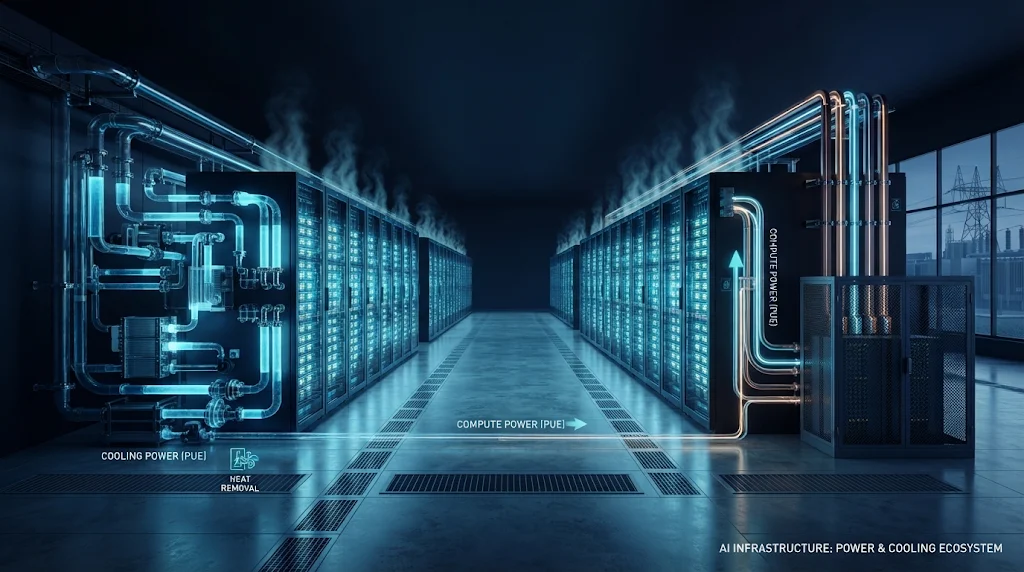
How Much Electricity Goes to AI Computing Versus Cooling?
One of the biggest mistakes in AI energy discussions is assuming that all data centre electricity powers AI calculations.
The electricity consumed by a data centre includes IT equipment and the infrastructure that supports it.
In modern facilities, servers account for around 60% of electricity demand on average, although the share varies considerably between facilities. The rest includes cooling, networking, storage, power conversion, and other supporting infrastructure.
For a deeper understanding of the infrastructure behind AI electricity demand, explore the IEA’s report on energy demand from AI and data centres.
Where data centre electricity is used
| Electricity-consuming area | What it does |
|---|---|
| Computing servers | AI calculations, model training, and inference |
| Cooling systems | Remove heat and maintain safe operating temperatures |
| Storage and networking | Move, store, and retrieve information |
| Power systems | Convert, distribute, and protect electricity |
| Other facility systems | Lighting, monitoring, controls, and supporting equipment |
The exact percentage depends on the facility. Older data centres may require more energy for cooling and power overheads, while newer facilities may use advanced cooling, efficient electrical systems, and optimized hardware.
Why cooling matters
AI processors generate substantial heat when operating at high power. If that heat is not removed efficiently, equipment may overheat, slow down, or fail.
Data centres therefore use technologies such as:
- High-efficiency air cooling
- Hot-aisle and cold-aisle containment
- Liquid cooling
- Direct-to-chip cooling
- Advanced temperature and airflow controls
- Heat recovery systems where practical
Reducing cooling electricity can improve the overall efficiency of an AI facility, but cooling improvements alone cannot solve the problem if computing demand keeps growing faster.
Why AI Images and Videos Can Consume Much More Energy
Text is only one part of the AI revolution.
AI tools now generate photographs, illustrations, animations, video clips, 3D assets, voices, and interactive content. These tasks can involve significantly more computation than producing a short text response.
AI task energy intensity
| AI activity | Relative computing intensity |
|---|---|
| Simple text response | Generally low |
| Long or complex text | Higher, depending on model and workload |
| Deep reasoning | Potentially much higher |
| AI image generation | More intensive than simple text |
| AI video generation | Often substantially more intensive |
| Multi-step AI agent | May perform numerous repeated model calls |
The IEA reports that energy-intensive tasks, including video generation, reasoning, and agentic applications, can consume hundreds or even thousands of times more energy per request than simple text generation in some cases.
That does not mean every video request consumes the same amount. Resolution, duration, frame rate, model architecture, hardware, output quality, and generation method all affect the result.
Why AI video is particularly demanding
An AI-generated video may require a system to produce and process numerous visual frames while maintaining consistency between scenes, objects, and motion.
A longer video or higher-resolution output may increase computing requirements. Additional refinement, regeneration, and complex prompts may also add to the workload.
This is why the future energy demand of AI will depend not only on the number of users but also on the types of AI services people increasingly use.
How Big Is AI Data Centre Electricity Demand Compared With Countries?
The scale becomes easier to understand when electricity is measured in terawatt-hours instead of individual AI queries.
A terawatt-hour equals one billion kilowatt-hours (kWh). It is a quantity of electricity consumed over time, not a measure of instantaneous power.
The IEA estimates global data centre electricity consumption at approximately 485 TWh in 2025. Its central outlook projects around 950 TWh in 2030.
Data centre electricity demand: the growth outlook
| Year | Global data centre electricity consumption |
|---|---|
| 2024 | Approximately 415 TWh |
| 2025 | Approximately 485 TWh |
| 2030 | Approximately 950 TWh |
| 2035 | Around 1,200 TWh in the IEA’s 2025 base-case outlook |
<text>Note: The 2035 estimate comes from the earlier IEA Energy and AI base-case outlook. Forecasts are scenarios, not guaranteed future outcomes, and estimates may change as AI technology and electricity infrastructure evolve.</text>
The projected 2030 electricity demand of approximately 950 TWh is comparable to the annual electricity consumption of a large industrialized country. The IEA’s 2025 report specifically compares this projected data centre consumption with Japan’s electricity consumption.
Why this comparison matters
A single data centre may appear small compared with global electricity consumption. However, several facilities concentrated within the same region can create a major new electricity load.
The challenge is not just how much electricity AI consumes globally. It is also:
- Where the data centres are built
- How quickly they connect to the electricity grid
- Whether local generation can meet their demand
- Whether transmission lines can deliver power
- Whether other consumers must compete for limited electricity
A global percentage can appear manageable while a particular city or region experiences serious infrastructure pressure.
Why AI’s Electricity Problem Is Bigger in Some Cities Than the Rest of the World
AI data centres are not distributed evenly around the planet. They tend to cluster in locations with access to fibre networks, land, infrastructure, investment, cooling options, and electricity.
This concentration can create a local problem even when data centres represent a relatively small share of global electricity consumption.
One technology that can support this type of flexible electricity system is a virtual power plant, which coordinates distributed energy resources to help balance electricity supply and demand.
What happens when data centres concentrate in one region?
| Local challenge | Potential consequence |
|---|---|
| Rapid increase in electricity demand | Local grids need additional capacity |
| Limited transmission infrastructure | Delays in connecting new facilities |
| Transformer shortages | Longer construction and connection timelines |
| Multiple projects competing for power | Greater pressure on grid planning |
| Peak demand increases | Greater need for flexible generation and storage |
| Higher infrastructure investment | Costs and financing questions for utilities and communities |
Data centres can create demand for new substations, transmission upgrades, transformers, generation capacity, and energy storage.
If infrastructure expansion is delayed, projects may face connection restrictions or waiting periods. Local electricity systems must balance new industrial demand with homes, hospitals, businesses, public transport, and existing industries.
Could AI data centres increase electricity bills?
Potentially—but the impact depends on the local electricity market, how infrastructure is financed, regulations, the timing of new generation, and whether data centre operators pay their fair share of system costs.
There is no universal rule that every new data centre automatically raises household bills.
If new facilities bring their own generation, pay for dedicated infrastructure, improve grid flexibility, and help finance additional capacity, they may reduce pressure on other consumers.
However, if major upgrades are needed and costs are unfairly allocated, residential and commercial customers may face additional financial pressure.
The local impact is more important than one global percentage
A data centre might represent a small percentage of worldwide electricity consumption while being one of the largest new electricity customers in its local utility area.
That is why governments and electricity providers increasingly need location-specific planning rather than relying only on global AI energy projections.
How Can AI Companies Reduce Electricity Consumption?
AI companies have several opportunities to reduce the electricity required for their services without necessarily reducing the quality or usefulness of their products.
The best strategy is not simply to make every AI model smaller. It is to use the right model, hardware, software, and infrastructure for each task.
Measuring electricity consumption is an important step toward identifying energy waste. Our smart energy monitor buying guide explains how monitoring devices help track electricity usage.
Practical solutions for AI companies
| Solution | How it reduces electricity demand |
|---|---|
| Smaller models for simple tasks | Avoids using large models when unnecessary |
| Efficient model architecture | Reduces computational work per response |
| Optimized inference | Improves processing efficiency |
| Hardware efficiency | Delivers more computing performance per unit of electricity |
| Better workload scheduling | Moves flexible tasks to more suitable periods |
| Reduce unnecessary repeated requests | Avoids redundant computation |
| Caching frequently requested information | Prevents repeated processing of identical requests |
| Efficient data centre cooling | Reduces supporting electricity demand |
| Higher server utilization | Avoids operating underused equipment unnecessarily |
| Energy transparency | Helps companies identify inefficient workloads |
The right model for the right task
A basic request such as summarizing a short paragraph may not require the most advanced reasoning model available.
Likewise, a complex engineering analysis may genuinely benefit from a more capable model.
AI providers can improve energy efficiency by matching computing resources to task difficulty. Using a smaller model for straightforward tasks and a more capable system only when needed can reduce unnecessary processing.
Why efficiency alone is not enough
More efficient AI can become cheaper and faster, encouraging people to use it more frequently.
This creates a possible rebound effect: energy consumption per task declines, but the total number and complexity of tasks increase enough to offset some of the savings.
The goal therefore needs to be both:
- Reduce electricity consumption per AI task.
- Manage total demand growth and the increasing complexity of AI applications.
What Should Governments and Electricity Providers Prepare For?
AI development is moving faster than many electricity infrastructure projects can be planned, approved, financed, and constructed.
A data centre can be built on a relatively short timeline compared with the time required for new transmission lines, substations, or major power generation projects.
This creates a planning challenge for energy authorities, utilities, governments, and local communities.
What needs to change?
| Planning priority | What governments and utilities can do |
|---|---|
| Grid capacity | Assess regional demand before approving large new facilities |
| Transparent energy reporting | Require clear disclosure of electricity use and demand forecasts |
| Cost responsibility | Ensure data centres pay appropriate costs for infrastructure they require |
| Flexible demand | Encourage facilities to shift non-urgent workloads when electricity systems are under pressure |
| Energy storage | Support batteries and other flexibility resources where they provide system value |
| Clean electricity | Encourage credible additional low-emission supply and responsible procurement |
| Long-term planning | Coordinate data centre development with generation and transmission investments |
| Community impact | Assess electricity, water, land, noise, and affordability impacts |
Can AI data centres help the electricity grid?
Yes, under the right conditions.
Some facilities could use batteries, flexible computing workloads, backup systems, and demand response to reduce pressure on the grid during peak periods.
AI computing is not always completely flexible because some tasks require immediate responses. However, training jobs, batch processing, and certain non-urgent workloads may be shifted to times when electricity is more available or lower-carbon.
Data centres could eventually become more active participants in electricity systems instead of operating as inflexible consumers.
What Will Power AI Data Centres in the Future?
AI data centres will not be powered by a single energy source.
Their electricity comes from the power systems where they are located, which may include fossil fuels, nuclear energy, hydropower, wind, solar, and other sources.
Renewable energy is becoming an important part of the data centre expansion story, but the reliability requirements of AI computing mean facilities also need dependable electricity around the clock.
Energy sources supporting AI infrastructure
| Energy source | Potential role |
|---|---|
| Solar power | Supplies electricity during daylight hours |
| Wind power | Provides electricity when wind conditions allow |
| Hydropower | Offers renewable generation and, in some systems, flexibility |
| Natural gas | Can provide dispatchable electricity where available |
| Nuclear energy | Provides low-carbon, firm electricity |
| Battery storage | Shifts electricity across time and helps manage fluctuations |
| Grid electricity | Supplies energy from the wider interconnected power system |
The IEA’s analysis of electricity supply for data centres identifies renewables, natural gas, and nuclear as important contributors to future demand.
Why renewable energy alone is not the complete answer
Solar and wind output varies with weather and time. Data centres need reliable power, so renewable generation may be combined with grid supply, batteries, dispatchable generation, and other technologies.
The most responsible approach is to increase clean electricity supply, improve grid capacity, reduce unnecessary computing demand, and ensure that the power system can reliably serve all customers.
How Much Electricity Could AI and Data Centres Consume by 2030?
The IEA’s 2026 central projection estimates global data centre electricity consumption will increase from approximately 485 TWh in 2025 to around 950 TWh in 2030.
That is almost a doubling within five years.
The projected growth
| Indicator | 2025 | 2030 projection |
|---|---|---|
| Global data centre electricity demand | 485 TWh | 950 TWh |
| Approximate change | — | Nearly 2× |
| Share of global electricity | — | Around 3% by 2030 |
| AI-focused data centre consumption | — | Projected to triple from 2025 |
These are data centre totals, not AI-only electricity consumption. Data centres also support cloud computing, storage, networking, and other digital services.
AI is an important driver of the projected growth, but attributing all data centre electricity to AI would exaggerate AI’s share.
Why forecasts could change
The final electricity demand could be higher or lower depending on:
- AI adoption rates
- Model efficiency improvements
- Hardware developments
- The growth of reasoning and autonomous AI agents
- Data centre construction delays
- Grid connection availability
- Electricity prices
- Investment decisions
- New energy technologies
The biggest uncertainty is how quickly AI demand grows compared with improvements in computing efficiency.
How to Spot Misleading AI Electricity Statistics
AI energy consumption is a popular topic, which means dramatic statistics often spread without enough context.
Some claims may be based on outdated studies, specific models, individual tasks, or incomplete measurements.
Before believing a viral AI energy statistic, ask these questions.
AI energy-statistic verification checklist
| Question | Why it matters |
|---|---|
| What year is the data from? | Older AI models may not represent current systems |
| Is it one query or a whole data centre? | These are completely different scales |
| Is the figure measured or estimated? | Estimates may use assumptions rather than direct measurements |
| Does it include cooling? | GPU-only figures are not facility-wide consumption |
| What kind of AI task was measured? | Text, image, video, and reasoning differ significantly |
| Which model and hardware were used? | Results vary between systems |
| What is the unit? | Wh, kWh, MW, and TWh describe different quantities |
| Is the comparison fair? | A short text prompt should not be compared with a lengthy video-generation task without context |
| Is the source credible? | Prefer transparent technical research and established energy organizations |
Understand these electricity units
| Unit | Meaning | Example |
|---|---|---|
| Wh | Small amount of electricity | Energy used by a particular task |
| kWh | 1,000 Wh | Common household electricity-billing unit |
| MWh | 1,000 kWh | Large commercial electricity usage |
| GWh | 1 million kWh | Large facility or regional energy usage |
| TWh | 1 billion kWh | National or global electricity consumption |
One of the biggest mistakes is comparing a single AI query measured in watt-hours with an entire data centre measured in terawatt-hours and treating them as equivalent types of statistics.
What Can Ordinary People Do About AI’s Energy Consumption?
Ordinary users do not control data centre infrastructure, but they can make more informed choices about how they use AI.
There is no need to stop using useful AI tools simply because they consume electricity. The goal is sensible use rather than unnecessary repetition.
Homeowners can also explore smart energy-saving devices for home to find practical ways to monitor and manage household electricity use.
Practical ways to use AI more efficiently
- Use the appropriate AI tool for the task instead of automatically choosing the most complex one.
- Avoid regenerating content repeatedly when the first result is sufficient.
- Give clear prompts to reduce unnecessary back-and-forth.
- Avoid generating multiple high-resolution images or long videos when they are not needed.
- Reuse useful results rather than repeating the same request.
- Understand that complex reasoning, agentic workflows, and media generation can require more resources than simple text.
For readers interested in broader household electricity savings, improving energy use at home is a separate but practical opportunity. SmartAirHQ’s guide to how to reduce electricity consumption explains ways to reduce everyday electricity waste without confusing household energy use with data centre energy consumption.
Is AI’s Electricity Consumption a Problem or an Opportunity?
AI’s electricity consumption is neither automatically harmless nor automatically disastrous.
Artificial intelligence can help improve energy systems, optimize industrial processes, forecast electricity demand, improve building efficiency, accelerate scientific research, and reduce waste in some applications.
At the same time, expanding data centre demand can create real challenges involving electricity affordability, grid reliability, generation capacity, emissions, water use, and infrastructure investment.
The outcome depends on how AI is developed and powered.
The risks and opportunities
| Potential opportunity | Potential challenge |
|---|---|
| Better energy forecasting | Higher electricity demand |
| Optimized manufacturing | Grid congestion |
| Smart building management | Local affordability concerns |
| Faster scientific research | Additional infrastructure costs |
| Improved renewable integration | Power supply and reliability challenges |
| Efficient logistics | Resource use and environmental impact |
The most important question is not simply whether AI consumes electricity.
It is whether society can expand AI in a way that delivers genuine value while improving computing efficiency, adding responsible electricity supply, supporting local power systems, and protecting consumers from unfair infrastructure costs.
AI may become one of the most important technologies of the coming decades. Its success will depend not only on smarter models but also on how intelligently we manage the energy needed to power them.
Frequently Asked Questions
How much electricity does AI consume per question?
There is no universal number. Simple text generation may use very little electricity, while reasoning, agentic tasks, image generation, and video generation can require substantially more. The result depends on the model, hardware, task complexity, and output.
Does ChatGPT use electricity every time I ask a question?
Yes. Your request is processed by computing hardware in data centres that uses electricity. The amount depends on the request, model, hardware, and infrastructure.
Does AI consume more electricity than Google Search?
There is no single reliable comparison that applies to every AI request and every Google Search. The IEA says simple AI text queries have become relatively energy-efficient, while complex AI tasks can require much more electricity than basic text generation.
Why do AI data centres need so much cooling?
AI chips generate heat during computation. Cooling equipment moves that heat away from servers so that they can operate safely and reliably. The electricity needed for cooling depends on the data centre’s design, climate, hardware, and operating conditions.
Will AI increase electricity prices?
It may contribute to electricity price pressure in regions where data centres grow quickly and infrastructure is limited. The effect on households depends on local grid investment, regulation, energy supply, electricity markets, and how the costs are allocated.
Will AI data centres be powered by renewable energy?
Some are using or procuring renewable electricity, while data centres also draw from grids that include other generation sources. Future electricity supply will likely include a mix of renewables, nuclear, natural gas, storage, and grid electricity, depending on location.
How much electricity will data centres consume in 2030?
The IEA’s 2026 central projection estimates approximately 950 TWh of global data centre electricity consumption in 2030, or around 3% of worldwide electricity demand.
Is AI bad for the environment?
AI has environmental impacts from electricity use, infrastructure, hardware production, and potentially water consumption. It can also help improve energy efficiency and solve environmental problems. Its overall impact depends on how AI is developed, powered, and used.
Final Thoughts
Artificial intelligence is changing how people work, learn, create, and solve problems. But every digital service ultimately depends on physical infrastructure, and AI is creating new demands for computing power and electricity.
The latest projections suggest data centre electricity consumption could nearly double by 2030. Yet the energy required for an individual AI task can vary dramatically, and efficiency improvements are changing the picture rapidly.
The real AI energy challenge is not simply how much electricity one question consumes. It is how millions of increasingly complex tasks, billions of users, and rapidly expanding data centres will fit into the world’s electricity systems.
The future of AI will depend on making it smarter, more efficient, and more responsible—not just more powerful.
Affiliate Disclosure
SmartAirHQ may earn a commission if you purchase through links in our articles. This does not affect our editorial independence or recommendations. We only recommend products when they genuinely provide value to readers.