
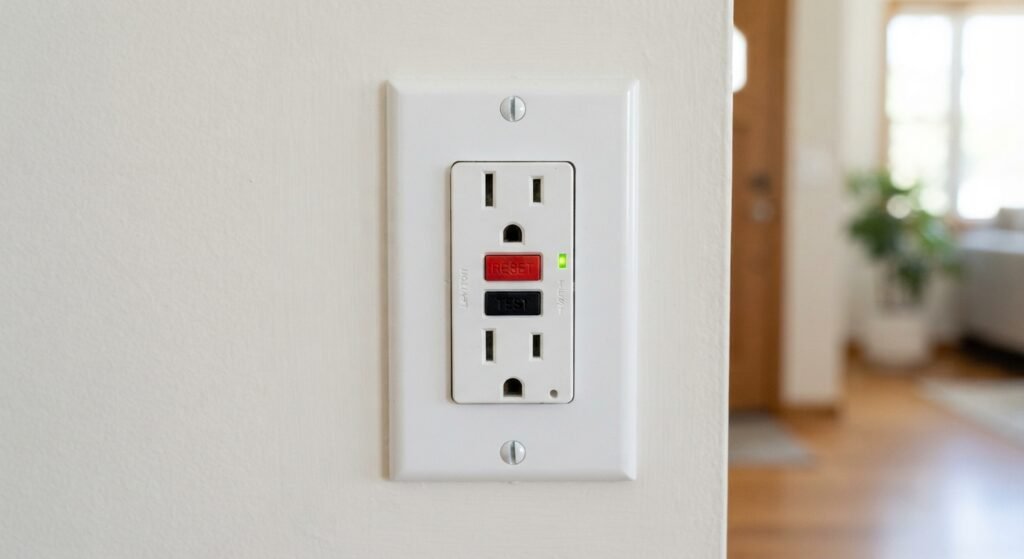
A GFCI outlet is an important electrical safety device designed to reduce the risk of electric shock when electricity comes into contact with an unintended path, such as through wet equipment or a person. You will commonly find GFCI outlets in bathrooms, kitchens, garages, basements, and outdoor areas where moisture can increase electrical hazards.
If you have noticed the TEST and RESET buttons on a wall receptacle, you may already have a GFCI installed in your home. Understanding how it works, when it is needed, and why it sometimes trips can help you make better decisions about household electrical safety.
This guide explains what a GFCI outlet does, how it compares with a regular outlet and circuit breaker, how to test it, what to do when it keeps tripping, and which features to consider when choosing a replacement or portable device.
Affiliate disclosure: This article contains affiliate links. As an Amazon Associate, SmartAirHQ may earn from qualifying purchases at no additional cost to you. We may receive a commission when you purchase through qualifying links. Our recommendations should be evaluated alongside the product specifications, safety certifications, and installation requirements relevant to your situation.
What Is a GFCI Outlet?
GFCI stands for Ground-Fault Circuit Interrupter. It is an electrical safety device that monitors current flowing through a circuit and disconnects power when it detects a potentially dangerous imbalance.
Under normal operating conditions, the current traveling out through the circuit’s hot conductor should match the current returning through the neutral conductor. If some current takes an unintended path, the GFCI detects the difference and trips rapidly.
For example, damaged insulation, wet equipment, or contact with an energized component can create a ground-fault hazard. A functioning GFCI is designed to interrupt power quickly enough to reduce the risk of severe electric shock.
A GFCI receptacle usually has two buttons:
- TEST: Checks whether the device can interrupt power.
- RESET: Restores power after a successful test or after a fault has been cleared.
GFCI protection is also available through circuit breakers and portable devices. The best option depends on the electrical installation and how the equipment will be used.
For more background, consult the U.S. Consumer Product Safety Commission’s GFCI fact sheet.
How Does a GFCI Outlet Work?
A GFCI continuously compares the current flowing through the circuit conductors. When it detects a difference that meets its trip criteria, it opens the circuit and interrupts the power supply.
This response is different from that of a conventional circuit breaker. A standard breaker primarily protects against excessive current caused by overloads and short circuits. A GFCI focuses on ground-fault conditions that can expose people to dangerous electrical current.
A GFCI does not eliminate every electrical hazard. It does not replace appropriate overcurrent protection, properly installed wiring, safe appliances, or other required protective devices.
What Do the TEST and RESET Buttons Do?
The TEST button simulates a ground-fault condition so you can check whether the device trips. The RESET button restores operation after the cause of a trip has been resolved and the device can reset correctly.
The Electrical Safety Foundation International recommends monthly testing of GFCI protection. Its home electrical safety guidance explains the basic test procedure and what to do when a device fails.
A simple check is to plug in a small lamp, confirm that it is on, press TEST, and verify that the lamp turns off. Press RESET and confirm that power returns.
If the device fails to interrupt power during testing or will not reset, do not rely on it for protection. Arrange for the device and installation to be checked.
GFCI vs. Regular Outlet: What Is the Difference?
A regular outlet supplies electrical power but does not provide built-in GFCI ground-fault protection. A GFCI receptacle adds that protective function and typically includes TEST and RESET buttons.
Table 1: GFCI Outlet vs. Regular Outlet
| Feature | GFCI Outlet | Regular Outlet |
|---|---|---|
| Supplies electrical power | Yes | Yes |
| Built-in ground-fault protection | Yes | No |
| TEST and RESET buttons | Usually | Usually not |
| Protection against certain shock hazards | Yes, when correctly installed and functioning | No built-in GFCI protection |
| Can protect downstream receptacles | Yes, when correctly wired | No built-in GFCI protection |
| Requires periodic functional testing | Yes, follow manufacturer guidance | Not typically tested using a GFCI test procedure |
| Common application | Areas where GFCI protection is required or appropriate | Locations where the applicable installation permits a standard receptacle |
A standard outlet is not automatically unsafe in every location. The important consideration is whether the receptacle has the protection required for its location and installation.
Quick tip: If you are checking an older home, do not assume that a receptacle without TEST and RESET buttons lacks GFCI protection. An upstream GFCI receptacle or a GFCI breaker may protect it. Have the circuit checked if you are unsure.
GFCI vs. Circuit Breaker: Are They the Same?
A conventional circuit breaker and a GFCI perform different protective functions. A standard breaker responds to overcurrent, while a GFCI detects a ground-fault current imbalance.
A GFCI circuit breaker combines ground-fault protection with circuit-breaker functionality and is installed in the electrical panel. Depending on the circuit and installation, it can protect multiple outlets and other equipment supplied by that branch circuit.
Table 2: GFCI Receptacle vs. Standard Breaker vs. GFCI Breaker
| Feature | GFCI Receptacle | Standard Breaker | GFCI Breaker |
|---|---|---|---|
| Installed at | Wall receptacle | Electrical panel | Electrical panel |
| Ground-fault protection | Yes | No, not by itself | Yes |
| Overcurrent protection | Depends on the associated circuit protection | Yes | Yes |
| Can protect additional downstream outlets | Yes, when correctly wired | Does not provide GFCI protection | Yes, on its protected circuit |
| Suitable for permanent installations | Yes | Yes | Yes |
| Compatibility considerations | Receptacle and circuit requirements | Panel and circuit requirements | Exact panel and breaker compatibility |
A GFCI receptacle should not be treated as a replacement for a conventional breaker. They address different protection needs.
If you are considering a panel-level upgrade, have a qualified electrician verify breaker compatibility, circuit requirements, and the protection needed for the installation.
GFI vs. GFCI: Is There a Difference?
GFI and GFCI are commonly used to describe the same type of ground-fault protection.
- GFCI: Ground-Fault Circuit Interrupter.
- GFI: Ground-Fault Interrupter.
You may encounter either abbreviation when shopping for receptacles or discussing electrical safety. Focus on the device’s actual specifications, certification, intended application, and installation requirements rather than the abbreviation alone.
Where Should You Use a GFCI Outlet?
GFCI protection is particularly important where people may encounter electrical equipment and moisture at the same time.
In the United States, applicable electrical codes require GFCI protection in many locations, including certain bathroom, kitchen, garage, basement, laundry, and outdoor receptacles. The exact requirements depend on the adopted code edition, local rules, the type of space, and the specific installation.
Common areas to evaluate include:
- Bathroom receptacles.
- Kitchen countertop receptacles.
- Outdoor receptacles.
- Garage receptacles.
- Unfinished basement and crawlspace receptacles.
- Laundry and utility areas where protection is required.
- Receptacles near sinks and other wet or damp locations.
Outdoor installations may also require weather-resistant electrical equipment and appropriate weatherproof covers. A cover that protects an outlet only when it is closed may not be suitable for every application where equipment remains plugged in.
For general safety guidance, review the CPSC GFCI fact sheet and the ESFI electrical safety resources.
Need more help with household electrical projects? Explore the SmartAirHQ Lighting & Electrical category for related home electrical guides.
Why Does a GFCI Keep Tripping?
When a GFCI keeps tripping, it may have detected moisture, leakage current, a faulty appliance, damaged wiring, or another problem. The device itself may also be defective.
Repeated tripping should not be ignored or treated as a nuisance to bypass. It is a signal that the cause needs to be identified.
Possible causes include:
- Moisture entering an outdoor receptacle or electrical enclosure.
- A damaged appliance or power cord.
- A connected device with an electrical fault.
- Leakage current from connected equipment.
- A wiring problem or a fault involving downstream receptacles.
- A damaged or failing GFCI device.
What Should You Do When a GFCI Trips?
- Unplug connected equipment if it is safe to do so. Do not touch wet plugs, exposed wiring, or equipment that may be energized.
- Look for visible damage or moisture from a safe position. Do not open the receptacle or handle wet electrical components.
- Consider whether a particular appliance triggered the trip. Do not reconnect equipment that appears damaged or repeatedly causes trips.
- Reset only after the suspected cause has been addressed. Follow the manufacturer’s instructions.
- Stop if the device trips again or will not reset. Have a qualified electrician investigate persistent or unexplained problems.
If you experience an electric shock, smell burning, notice scorching, or see sparks, stop using the affected equipment and seek appropriate professional help. Do not continue resetting the device to restore power.
For broader home electrical maintenance advice, see the SmartAirHQ guide to electrical and lighting tools.
Receptacle GFCI vs. GFCI Breaker vs. Portable GFCI
There are three common approaches to providing GFCI protection. Each serves a different purpose.
Table 3: Which Type of GFCI Should You Choose?
| Type | Installation | Best-Suited Use | Main Consideration |
|---|---|---|---|
| Receptacle GFCI | Wall outlet box | Permanent protection at a receptacle and potentially downstream | Correct LINE/LOAD wiring is essential |
| GFCI breaker | Electrical panel | Protection for the branch circuit | Must be compatible with the panel |
| Portable GFCI adapter | Between an existing receptacle and equipment | Temporary use with compatible portable equipment | Does not correct a deficient permanent installation |
| GFCI-protected extension cord | Integrated into a cord assembly | Temporary applications specified by the manufacturer | Check ratings, condition, and intended environment |
Portable GFCIs can be useful with compatible power tools and outdoor equipment. However, they should not be used as a reason to ignore a permanent installation that requires correction.
For outdoor work, verify that the complete setup—including the power source, portable protector, cord, equipment, and weather protection—is suitable for the conditions.
How to Choose a GFCI Outlet
Choosing a GFCI outlet involves more than selecting a device with TEST and RESET buttons. The receptacle must be suitable for the circuit, location, and intended use.
Consider these features before buying:
- Electrical rating: Verify the circuit rating and receptacle configuration.
- Weather resistance: Outdoor installations may require weather-resistant devices.
- Tamper resistance: Consider this feature where required or appropriate.
- Self-testing features: Some models perform automatic internal checks and may have status indicators.
- Certification: Look for appropriate certification from a recognized testing organization.
- Installation compatibility: Confirm that the device fits the intended box and wiring arrangement.
- Downstream protection: If additional receptacles will be protected, the wiring and labels must be correct.
- Manufacturer instructions: Follow the device’s specified use, testing, and maintenance requirements.
Table 4: GFCI Buying Checklist
| Feature | What to Check | Why It Matters |
|---|---|---|
| Amperage | Compatibility with circuit and installation | Helps ensure the device is appropriate |
| Weather resistance | Required rating for the environment | Important for outdoor or damp locations |
| Tamper resistance | Applicable code and intended use | Helps reduce access to energized contacts |
| Self-test function | Manufacturer’s specifications and status indicators | Adds an internal testing feature |
| Certification | Appropriate recognized safety certification | Supports confidence in product safety |
| Device type | Receptacle, breaker, or portable GFCI | Determines where and how protection is provided |
| Installation | Wiring, box, panel, and local requirements | Incorrect installation can compromise protection |
Before you buy: Do not choose a 15A or 20A device based only on price or appearance. Receptacle configuration, branch-circuit protection, permitted arrangements, and local requirements all matter. Ask a qualified electrician when compatibility is uncertain.
Best GFCI Outlet Products to Compare on Amazon
Choosing the right GFCI outlet or ground-fault protection device depends on where it will be used, the electrical circuit, and the type of protection you need. From standard GFCI receptacles for indoor installations to portable protectors for temporary outdoor equipment, each product category serves a different purpose.
To help you compare suitable options, we have organized the following Amazon shopping links by product type. Review the specifications, safety certifications, installation requirements, and customer feedback before making a purchase.
1. 15A GFCI Receptacles
A 15-amp GFCI receptacle may be suitable for compatible residential circuits where this configuration is permitted. Look for clearly marked TEST and RESET buttons, appropriate certification, and features that match the intended installation.
🛍️ Shop 15A GFCI Receptacles on Amazon
2. 20A GFCI Receptacles
A 20-amp GFCI receptacle may be appropriate for installations requiring a compatible 20-amp configuration. Before purchasing, verify the branch-circuit requirements, receptacle configuration, and applicable electrical code rather than choosing by amperage alone.
🔎 Find 20A GFCI Outlets on Amazon
3. Tamper-Resistant GFCI Outlets
Tamper-resistant GFCI receptacles combine ground-fault protection with shutter mechanisms designed to help prevent foreign objects from being inserted into the receptacle. They can be a useful option for homes with children and for installations where tamper resistance is required.
⭐ Explore Tamper-Resistant GFCI Receptacles
4. Weather-Resistant GFCI Outlets
Outdoor and damp-location installations may require weather-resistant receptacles suitable for the environment. When comparing these products, check the weather-resistance rating, certification, and compatibility with the required enclosure and cover.
🏠 Find Weather-Resistant GFCI Outlets on Amazon
5. Portable GFCI Adapters
Portable GFCI adapters provide ground-fault protection for compatible temporary electrical applications, including certain power tools and outdoor equipment. They are useful when the existing power source does not provide the required protection, provided the complete setup is appropriate for the application.
🛒 Check Portable GFCI Protectors on Amazon
6. GFCI Circuit Breakers
A GFCI circuit breaker provides ground-fault protection at the electrical panel and can protect the connected branch circuit. Because breakers must match the panel and circuit requirements, verify the exact compatibility before purchasing and have installation performed by a qualified electrician when needed.
✨ Explore GFCI Circuit Breakers on Amazon
7. Weatherproof In-Use Outlet Covers
Outdoor receptacles may require covers designed to maintain weather protection while plugs remain connected. Choose a cover compatible with the receptacle, enclosure, plug arrangement, and installation location.
🏠 Find Weatherproof In-Use Outlet Covers
8. GFCI Receptacle Testers
Plug-in receptacle testers can help identify certain wiring conditions and, on compatible installations, test GFCI operation. Their capabilities vary, and a tester cannot confirm every aspect of electrical safety or replace a proper inspection.
🔎 Explore GFCI Receptacle Testers on Amazon
9. Self-Testing GFCI Outlets
Some GFCI receptacles include automatic self-testing features that periodically check internal protective functions. Compare the manufacturer’s testing specifications, status indicators, and reset behavior to determine whether the additional feature suits your installation.
⭐ Shop Self-Testing GFCI Outlets
10. GFCI-Protected Extension Cords
GFCI-protected extension cords can be useful for compatible temporary work where portable electrical equipment requires ground-fault protection. Check the cord’s electrical rating, intended environment, protection features, and manufacturer’s instructions before use.
🛒 Explore GFCI-Protected Extension Cords
Before You Buy: Choose the Right GFCI Protection
The most suitable product is not necessarily the cheapest or the one with the most features. Before ordering, confirm that the device matches your electrical circuit, installation location, and protection requirements.
- For indoor receptacles: Compare compatible GFCI receptacles and their safety features.
- For outdoor installations: Check weather resistance, suitable covers, and environmental ratings.
- For temporary equipment: Consider a properly rated portable GFCI or GFCI-protected extension cord.
- For electrical panels: Verify exact breaker compatibility and seek professional installation when necessary.
- For routine testing: Follow the manufacturer’s test instructions and use testers only for the functions they support.
🛍️ Ready to compare your options? Browse the relevant product categories above, review the specifications carefully, and choose a device appropriate for your particular installation. If you are unsure about wiring, circuit compatibility, or code requirements, consult a qualified electrician before purchasing or installing the equipment.
Affiliate disclosure: SmartAirHQ may earn a commission from qualifying purchases made through these Amazon links, at no additional cost to you. Product listings, prices, availability, and specifications can change. Verify current details with the seller before ordering.

How to Test a GFCI Outlet Safely
Testing is important because a GFCI should not be assumed to work indefinitely simply because it supplies power.
The Electrical Safety Foundation International recommends monthly testing. Follow the manufacturer’s instructions if they specify a procedure for your model.
A basic test for a receptacle GFCI is:
- Make sure the surrounding area and your hands are dry.
- Plug in a small lamp or another suitable device that makes the power status easy to observe.
- Press RESET if needed to restore normal operation.
- Press TEST and confirm that the connected device loses power.
- Press RESET and confirm that normal operation returns.
If the test does not interrupt power, or the device will not reset, do not rely on the GFCI for protection. Have it evaluated and replaced if necessary.
Do not open the outlet, remove its cover, or work on energized wiring to investigate a failed test. A plug-in tester can provide additional information on some installations, but its readings have limitations and do not replace professional electrical evaluation.
Common GFCI Mistakes to Avoid
Even a correctly selected GFCI can fail to provide the intended protection if it is installed or used incorrectly.
Avoid these mistakes:
- Repeatedly resetting a device that continues to trip.
- Assuming a regular-looking outlet is definitely unprotected or protected without checking the circuit.
- Confusing GFCI protection with overcurrent protection.
- Ignoring damaged cords, unusual heat, discoloration, or burning smells.
- Using unsuitable electrical equipment or covers outdoors.
- Assuming a portable GFCI permanently corrects a deficient installation.
- Buying a breaker without confirming panel compatibility.
- Attempting unfamiliar electrical wiring work without appropriate training.
For additional guidance on household electrical safety, visit the ESFI home safety resource center.
When Should You Call an Electrician?
Contact a qualified electrician if a GFCI repeatedly trips without an obvious cause, fails its test, refuses to reset, shows visible damage, or is associated with a shock, burning smell, or unusual heat.
Professional help is also appropriate when you need to identify which receptacles are protected, install a GFCI breaker, correct suspected wiring faults, or bring an older installation into compliance with applicable requirements.
Electrical work can involve hidden hazards even when the outlet looks straightforward. A qualified professional can check the circuit, verify correct wiring, assess downstream protection, and determine which device is appropriate.
CTA: Make safety the priority. If you are uncertain about the circuit or the cause of repeated tripping, arrange an electrical inspection rather than experimenting with the wiring.
Smart Energy Monitoring vs. GFCI Protection
GFCI protection and energy monitoring have different purposes.
A GFCI is designed to reduce the risk of electric shock caused by certain ground-fault conditions. An energy monitor helps you understand electricity consumption, identify usage patterns, and investigate where power is being used.
An energy monitor is not a replacement for GFCI protection, a circuit breaker, or safe electrical installation.
If you want to explore household electricity tracking, read SmartAirHQ’s Smart Energy Monitor Buying Guide: 15 Best Home Power Trackers.
Explore more: You can also visit our guide to smart energy-saving devices for ways to understand and manage household energy use.
Frequently Asked Questions About GFCI Outlets
What does GFCI stand for?
GFCI stands for Ground-Fault Circuit Interrupter. It detects certain current imbalances and interrupts power to help reduce the risk of severe electric shock.
Is GFI the same as GFCI?
Generally, yes. GFI is a shorter term for Ground-Fault Interrupter, while GFCI stands for Ground-Fault Circuit Interrupter. Both terms commonly refer to the same type of protection.
Why does my GFCI outlet keep tripping?
Common causes include moisture, damaged appliances, faulty cords, leakage current, wiring problems, or a defective device. Unplug equipment if it is safe to do so and seek professional help if the problem persists.
Does a GFCI outlet replace a circuit breaker?
No. A GFCI receptacle provides ground-fault protection, while a conventional breaker primarily protects against overcurrent. A GFCI breaker combines ground-fault and overcurrent protection for its circuit.
Can one GFCI outlet protect other outlets?
Yes. A receptacle GFCI can protect additional downstream receptacles when the circuit is correctly wired to its protected load terminals. Verify the installation rather than assuming that every outlet on the circuit is protected.
How often should you test a GFCI outlet?
ESFI recommends monthly testing. Follow the manufacturer’s instructions for the specific device, and arrange for inspection if it fails to trip or reset correctly.
Can I use a portable GFCI outdoors?
A suitable portable GFCI can provide protection for compatible temporary equipment. The entire setup must be appropriate for the outdoor environment, and temporary protection should not replace required permanent electrical improvements.
What should I do if my GFCI will not reset?
Unplug connected equipment if it is safe, check for obvious moisture or damage without touching hazardous components, and follow the manufacturer’s instructions. If the device still will not reset or trips again immediately, have it inspected.
Is a GFCI outlet safer than a regular outlet?
For certain ground-fault shock hazards, a properly installed and functioning GFCI provides protection that a standard receptacle does not. It is especially important where GFCI protection is required or appropriate.
Can I install a GFCI outlet myself?
Receptacle replacement involves potentially dangerous electrical wiring. Only attempt work if you have the necessary knowledge, skills, equipment, and legal permission to do it safely. When uncertain, use a qualified electrician.
Final Thoughts: Choose the Right GFCI Protection
A GFCI outlet is an important part of household electrical safety. By detecting certain ground-fault conditions and interrupting power rapidly, it helps reduce the risk of severe electric shock in locations where electricity and moisture may come into contact.
Remember the key distinctions: GFCI vs. regular outlet is about built-in ground-fault protection; GFCI vs. circuit breaker is about different protective functions; and GFI vs. GFCI is primarily a difference in terminology.
If you are selecting a replacement, compare the electrical rating, intended location, certification, and installation requirements. Test installed GFCIs regularly, investigate repeated trips, and seek professional assistance when a fault is unclear.
The goal is not simply to purchase a GFCI outlet. It is to ensure that the correct protection is installed, tested, and maintained where it is needed.
Your next step: Review your existing receptacles, check whether their protection is appropriate for their location, and consult a qualified electrician if anything is uncertain.
Suggested Internal Links
Use these contextual links in the article:
- Lighting & Electrical category
- Electrical and lighting tools
- Smart energy monitor buying guide
- Smart energy-saving devices