
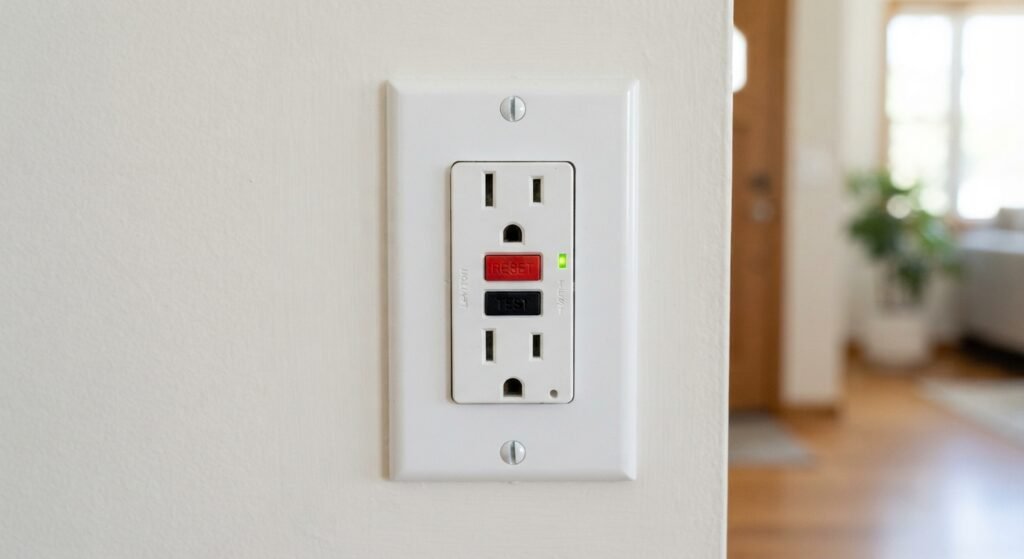
A GFCI outlet is one of the most important electrical safety devices used in homes, particularly in areas where electricity may come into contact with water. Unlike a standard receptacle, a GFCI monitors the flow of electricity and quickly disconnects power when it detects a ground fault or an imbalance between incoming and returning current.
If you have ever wondered why an outlet in your bathroom, kitchen, garage, basement, or outdoor area has TEST and RESET buttons, you are looking at a GFCI receptacle.
This guide explains what a GFCI outlet does, how it differs from a regular outlet and a GFCI circuit breaker, why a GFCI keeps tripping, what GFI vs GFCI actually means, and how to choose between a permanent receptacle and a portable or temporary GFCI.
Affiliate disclosure: This article contains affiliate links. If you purchase through qualifying links, SmartAirHQ may earn a commission at no additional cost to you.
The links throughout this guide are designed to help you browse relevant product categories. Prices, availability, specifications, and seller information can change, so verify the current product details before purchasing.
If you’re exploring more practical guides for your home, appliances, energy use, and everyday technology, take a look around SmartAirHQ to discover more helpful articles and guides across the site.
What Is a GFCI Outlet?
A Ground-Fault Circuit Interrupter (GFCI) is an electrical safety device designed to reduce the risk of severe electric shock. It continuously monitors electrical current flowing through a circuit. When it detects that some current is taking an unintended path to ground, it interrupts power rapidly. That protection is particularly important where electrical equipment may be used around water.
A receptacle-style GFCI looks similar to a conventional wall outlet but normally has two prominent buttons: TEST and RESET. Pressing TEST simulates a fault and should cause the protected power to shut off. RESET restores operation when the device is functioning correctly.
The term GFCI outlet is often used interchangeably with GFCI receptacle. Technically, GFCI protection can also be provided by a circuit breaker or portable device, so the word “outlet” should not be confused with every type of GFCI protection.
How Does a GFCI Outlet Work?
A GFCI works by comparing the amount of electrical current leaving through the circuit conductors with the amount returning. Under normal conditions, those values should correspond. If some current escapes the intended path—for example, through wet equipment or a person—the GFCI detects the imbalance and disconnects power.
The important point is that a GFCI is designed primarily to protect people from ground-fault shock hazards, rather than simply acting like an ordinary circuit breaker.
A traditional overcurrent breaker responds to conditions such as excessive current or a short circuit. A GFCI responds to a different type of problem: current leakage to ground.
The U.S. Consumer Product Safety Commission explains that GFCI protection is available in receptacles, circuit breakers, and portable devices.
U.S. Consumer Product Safety Commission
What Do the TEST and RESET Buttons Do?
The TEST button checks whether the GFCI can interrupt power as intended. When a test is performed correctly, power to the protected circuit should turn off. The RESET button restores power after a successful test or after a fault has been cleared.
A simple functional check recommended by electrical-safety guidance is:
Plug a small device such as a nightlight into the receptacle.
Press the TEST button.
Confirm that the device turns off.
Press RESET.
Confirm that power returns.
The Electrical Safety Foundation International recommends testing GFCI protection regularly and notes that a GFCI that does not test or reset properly should be replaced.
Electrical Safety Foundation International
If the device will not reset, repeatedly trips, or behaves unusually, do not assume the outlet itself is automatically defective. The connected equipment, moisture, wiring, or another fault may be responsible.
GFCI vs Regular Outlet: What Is the Difference?
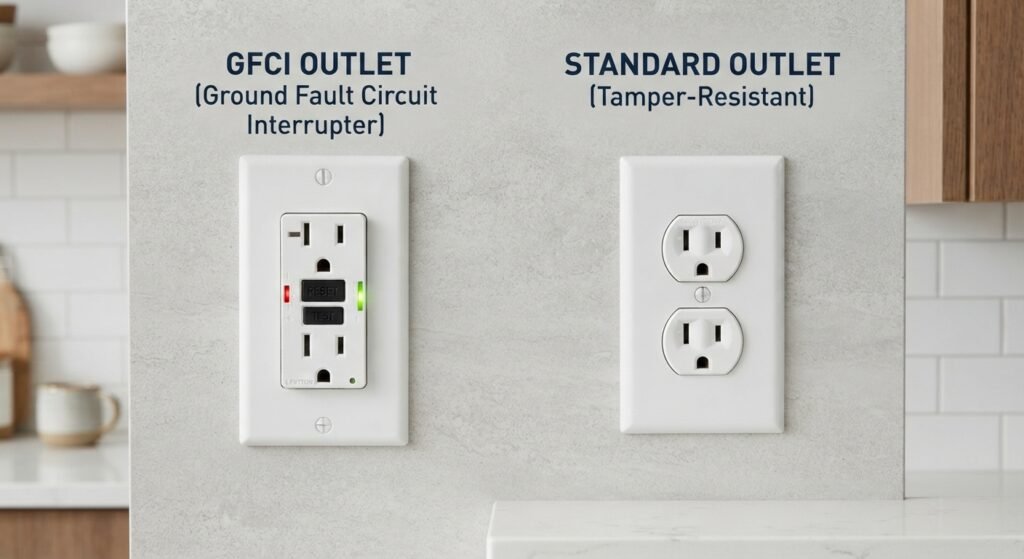
The main difference between a GFCI vs regular outlet is the type of electrical protection provided. A standard receptacle supplies power but does not provide built-in GFCI ground-fault protection. A GFCI receptacle monitors the circuit for leakage and can disconnect power when it detects a dangerous ground fault.
That distinction matters most in locations where people may simultaneously encounter electricity and moisture. Bathrooms, kitchens, garages, outdoor receptacles, and other damp or wet locations are common examples where GFCI protection is important. Applicable requirements depend on the electrical code and installation circumstances.
Feature Regular Outlet GFCI Receptacle
Supplies electrical power Yes Yes
TEST/RESET buttons Usually no Yes
Detects ground-fault current No Yes
Designed for shock protection No Yes
Common near water Only where permitted Commonly required or appropriate
Can protect downstream receptacles No Yes, when correctly wired
A GFCI outlet does not necessarily mean every electrical hazard has been eliminated. It is one layer of protection and should be used together with properly maintained wiring, equipment, cords, covers, and other electrical safety practices.
GFCI vs Circuit Breaker: Are They the Same?
A GFCI vs circuit breaker comparison can be confusing because both devices can shut off electricity, but they respond to different problems.
A conventional circuit breaker primarily protects wiring and equipment against overcurrent, such as an overload or short circuit. A GFCI is designed to detect ground-fault leakage and provide rapid protection against severe electric shock.
There is also a GFCI circuit breaker, which combines GFCI protection with breaker functionality at the electrical panel. This can provide ground-fault protection for an entire branch circuit rather than relying on one receptacle for protection.
The CPSC describes GFCI receptacles as capable of protecting one receptacle or additional receptacles farther downstream when wired appropriately, while GFCI circuit breakers can protect an entire branch circuit.
U.S. Consumer Product Safety Commission
Protection Standard Breaker GFCI Receptacle GFCI Breaker
Overload protection Yes Depends on circuit breaker Yes
Short-circuit protection Yes Depends on circuit breaker Yes
Ground-fault protection No Yes Yes
Installed at wall receptacle No Yes No
Installed in electrical panel Yes No Yes
Can protect a branch circuit Yes, for overcurrent Potentially, downstream for GFCI protection Yes
In other words, a GFCI does not simply replace the function of a circuit breaker. They address different electrical protection needs.
GFI vs GFCI: Is There a Difference?
If you search for GFI vs GFCI, you will often find that the terms are being used to describe the same basic type of protection.
GFCI stands for Ground-Fault Circuit Interrupter. GFI, or Ground-Fault Interrupter, is a shorter term commonly used for the same type of device.
In practical shopping and home-improvement conversations, you may see products described as GFCI outlets, GFI outlets, GFCI receptacles, or GFI receptacles. The important consideration is not which abbreviation appears on the package, but whether the device provides the appropriate ground-fault protection for the intended installation.
For a home project, also pay attention to the device’s electrical rating, configuration, environmental suitability, installation instructions, and applicable local requirements.
Where Should You Use a GFCI Outlet?
GFCI protection is especially important in areas where electrical equipment and water can come into close proximity. Safety guidance identifies locations such as bathrooms, kitchens, garages, outdoor receptacles, basements, crawlspaces, laundry areas, and receptacles near sinks among locations where GFCI protection may be required or commonly used under applicable electrical requirements.
Exact requirements can depend on the applicable edition of the National Electrical Code (NEC), local adoption, building type, and the specific installation. Older homes may also have electrical systems that were installed under different requirements.
Typical locations to evaluate include:
Bathroom receptacles
Kitchen countertop receptacles
Outdoor receptacles
Garage receptacles
Basement and crawlspace areas
Laundry or utility areas
Receptacles near sinks
Other damp or wet locations
Outdoor installations deserve particular attention because moisture can enter an outlet or plug connection. The CPSC recommends GFCI protection for outdoor outlets and appropriate weatherproof covers, including covers designed to remain weatherproof while in use where necessary.
If you are unsure whether an existing installation meets current requirements, a qualified electrician can evaluate the circuit and recommend the appropriate solution.
Why Does a GFCI Keep Tripping?
When a GFCI keeps tripping, it is usually telling you that it has detected a condition worth investigating. Repeated trips should not simply be treated as an inconvenience to be bypassed.
Possible causes include moisture, a damaged appliance, faulty equipment, damaged cords, leakage current, wiring problems, or a problem with the GFCI itself. An appliance connected downstream can also cause the GFCI to trip even when the receptacle appears normal.
A useful troubleshooting approach is to identify whether the problem follows a particular appliance or occurs even when nothing is connected.
What to Check When a GFCI Trips
Start with simple observations rather than immediately assuming the outlet needs replacement.
Unplug connected appliances. Remove loads from the affected receptacle and any downstream receptacles you can identify.
Look for moisture. Outdoor areas, bathrooms, kitchens, and damp locations deserve particular attention.
Check cords and plugs. Do not continue using visibly damaged electrical equipment.
Reset the GFCI. If it resets with everything unplugged, reconnect equipment one item at a time.
Identify the pattern. If one appliance consistently causes the trip, that equipment may need inspection or replacement.
Stop if the problem persists. Repeated tripping without an obvious cause can indicate a wiring, equipment, or device problem that requires professional evaluation.
The CPSC advises that an appliance that repeatedly trips a breaker or gives someone a shock should be unplugged and repaired or replaced rather than continually used.
Receptacle GFCI vs GFCI Breaker vs Portable GFCI
There are several ways to provide GFCI protection, and choosing between them depends on the circuit and how the electrical equipment is being used.
A receptacle GFCI is installed at a wall outlet and can provide protection at that location and, when correctly wired, to downstream receptacles. A GFCI circuit breaker is installed in the electrical panel and can provide protection across an entire branch circuit. A portable GFCI can be used where temporary protection is needed, such as with portable electrical equipment.
The CPSC identifies all three approaches and specifically notes portable GFCI devices as an option for providing ground-fault protection when using equipment where permanent GFCI protection is not available.
Type Best suited for Main advantage:
Receptacle GFCI Permanent wall outlet Convenient localized protection
GFCI breaker Branch circuit Circuit-wide GFCI protection
Portable GFCI Temporary or portable use Flexible protection without replacing the receptacle
The choice should be based on the actual electrical installation rather than simply selecting the cheapest option.
Portable or Temporary GFCI: When Does It Make Sense?
A portable or temporary GFCI can be useful when electrical equipment needs ground-fault protection away from a permanently protected receptacle. These devices can be particularly practical for portable tools, outdoor equipment, maintenance work, and other temporary applications.
Portable GFCIs are available in plug-in formats and are intended to provide protection between a standard receptacle and the connected equipment. CPSC guidance specifically discusses portable GFCI devices for electric tools and outdoor equipment.
They should not automatically be viewed as a substitute for correcting a deficient permanent electrical installation. If a location requires permanent GFCI protection, the appropriate permanent solution should be evaluated rather than relying indefinitely on a temporary device.
When using a portable unit, check the manufacturer’s instructions and make sure its electrical rating and environmental suitability match the equipment and application.
Feature GFCI Outlet Standard Outlet Why It Matters
| Feature | GFCI Outlet | Standard Outlet | Why It Matters |
|---|---|---|---|
| Purpose | Protects against electric shock | Provides electrical power | GFCI adds an extra layer of safety |
| How It Works | Detects an imbalance in electrical current and shuts off power | Does not detect ground faults | Helps reduce the risk of serious electrical injuries |
| TEST/RESET Buttons | Usually included | Usually not included | Makes testing and restoring protection easy |
| Wet Locations | Ideal for areas exposed to water or moisture | Generally used in dry locations | Water increases the risk of electric shock |
| Common Locations | Bathrooms, kitchens, garages, laundry areas, and outdoors | Bedrooms, living rooms, and other dry areas | Location can determine whether GFCI protection is needed |
| Ground-Fault Response | Quickly interrupts the electrical supply | Relies mainly on the circuit breaker or fuse | Fast interruption can improve personal safety |
| Cost | Usually more expensive | Usually less expensive | GFCI protection comes with a higher upfront cost |
| Safety Level | Provides ground-fault protection | No built-in GFCI protection | Especially important in areas near water |
| Maintenance | Should be tested periodically | Generally requires less testing | Regular testing helps ensure the GFCI works properly |
| When You Need One | Where required by electrical code or recommended for safety | Where GFCI protection is not required | Requirements vary depending on location and installation |
How to Choose a GFCI Outlet
Choosing a GFCI outlet is about more than finding a receptacle with TEST and RESET buttons. The device needs to be appropriate for the electrical system and the environment in which it will be installed.
Consider these factors before buying:
Electrical rating: Match the receptacle to the circuit and installation requirements.
Location: Bathroom, kitchen, garage, outdoor, and damp-area applications can have different requirements.
Weather resistance: Outdoor installations may require suitable weather-resistant equipment and covers.
Tamper resistance: Where required or appropriate, consider a tamper-resistant design.
Downstream protection: If the GFCI will protect additional receptacles, proper wiring and labeling are important.
Testing features: Look for clearly marked TEST and RESET controls.
Certification: Choose products from reputable manufacturers and look for appropriate certification from a recognized testing organization.
Installation requirements: Follow the manufacturer’s instructions and applicable electrical code.
ESFI recommends purchasing GFCIs from reputable retailers and looking for certification from an OSHA-recognized testing laboratory.
Browse Amazon for GFCI Outlet Options
If you are comparing GFCI receptacles, portable GFCI devices, or testing equipment, browsing several product categories can help you compare ratings, configurations, weather resistance, and other specifications before purchasing.
Browse Amazon
Use the following affiliate search links to compare relevant categories. Prices, availability, specifications, and sellers can change, so verify the product details on Amazon before ordering.
🛒 Check Price on Amazon
15A GFCI receptacles
20A GFCI receptacles:
Tamper-resistant GFCI outlets:
These links are intended for product discovery rather than a recommendation of any particular brand. Compare the product’s electrical specifications with your installation requirements before buying.
How to Test a GFCI Outlet Safely
Testing a GFCI outlet is a simple way to check whether its TEST and RESET functions are responding as intended. Electrical safety organizations recommend regular testing because a GFCI is a protective device and should not simply be assumed to work indefinitely.
A basic test is:
Plug in a small electrical device that you can easily observe.
Press the RESET button if necessary so the device operates.
Press the TEST button.
Confirm that the connected device loses power.
Press RESET.
Confirm that power returns.
If pressing TEST does not interrupt power, or RESET does not restore normal operation, the GFCI should not be treated as fully functional. ESFI advises that GFCIs that fail their test or reset functions should be replaced.
Do not open the receptacle or work on energized wiring simply to troubleshoot a failed test. Electrical installation and repair work should be handled by a qualified electrician when you are not trained and equipped to perform it safely.
Common GFCI Mistakes to Avoid
A GFCI provides valuable protection, but incorrect assumptions about how it works can create safety problems. One common mistake is treating repeated trips as something to defeat or ignore. A trip is a signal that the device has detected a condition that deserves attention.
Another mistake is assuming that a GFCI outlet automatically protects every electrical problem. It is designed around ground-fault protection and does not replace appropriate overcurrent protection, safe wiring, properly maintained equipment, or other electrical safeguards.
Avoid these common mistakes:
Do not repeatedly reset a GFCI without investigating persistent trips.
Do not use visibly damaged cords or appliances.
Do not assume every standard-looking outlet is GFCI protected.
Do not confuse GFCI protection with ordinary circuit-breaker protection.
Do not install an indoor-rated product in an outdoor application when the installation requires weather-resistant equipment.
Do not ignore moisture around electrical equipment.
Do not assume a portable GFCI permanently corrects an inadequate electrical installation.
Do not attempt unfamiliar electrical wiring work without appropriate qualifications.
For broader electrical safety information, the U.S. Consumer Product Safety Commission’s GFCI guidance and Electrical Safety Foundation International’s GFCI guidance are useful references.
When Should You Call an Electrician?
A GFCI problem is not always a simple outlet replacement. If a receptacle repeatedly trips with no obvious cause, refuses to reset, shows signs of heat or damage, or is associated with damaged wiring, professional evaluation is the safer choice.
You should also consider professional help when you are unsure which receptacles are protected, when a circuit has unusual behavior, or when you need to modify permanent household wiring.
GFCI installation involves more than attaching a new device to the wall. Correct line/load identification, grounding, circuit compatibility, downstream protection, enclosure requirements, and applicable electrical rules can all matter. ESFI specifically recommends having a qualified electrician install GFCIs where required if you do not already have appropriate protection.
Smart Energy Monitoring and Electrical Safety
A GFCI is designed for electrical safety, while energy monitoring serves a different purpose: understanding how much electricity your home or individual appliances consume. The two technologies should not be confused, but they can complement a broader effort to understand and manage household electricity.
If you are interested in monitoring electricity consumption alongside your home’s electrical equipment, the Smart Energy Monitor Buying Guide: 15 Best Home Power Trackers can help you explore energy-monitoring options separately from electrical shock protection.
A power monitor can help you understand consumption patterns, but it is not a replacement for GFCI protection, circuit breakers, proper wiring, or other electrical safety devices.
GFCI Outlet FAQ
Understanding the difference between a GFCI receptacle, standard outlet, breaker, and portable protector becomes much easier once the basic purpose of each device is clear. The following questions cover some of the most common issues homeowners encounter when researching GFCI protection.
What does GFCI stand for?
GFCI stands for Ground-Fault Circuit Interrupter. It is designed to detect certain ground-fault conditions and rapidly interrupt power to reduce the risk of severe electric shock.
Is a GFI the same as a GFCI?
Generally, yes. GFI and GFCI are commonly used to refer to the same type of ground-fault protection. GFCI is the more complete term.
Why does my GFCI outlet keep tripping?
Repeated trips can result from moisture, a faulty appliance, damaged equipment, leakage current, wiring problems, or a defective GFCI. Unplug connected devices and investigate the cause rather than repeatedly resetting the outlet.
Does a GFCI outlet replace a circuit breaker?
No. A GFCI receptacle and a conventional circuit breaker serve different protective functions. A GFCI focuses on ground-fault protection, while a standard breaker primarily responds to overcurrent conditions.
HCan one GFCI outlet protect other outlets?
Yes. A correctly installed receptacle GFCI can provide ground-fault protection to downstream receptacles connected to its protected load side. The exact installation should be verified by a qualified person.
How often should a GFCI be tested?
Electrical safety guidance recommends regular testing. ESFI recommends testing GFCIs monthly to verify that the TEST and RESET functions operate correctly.
Can I use a portable GFCI outdoors?
Portable GFCI protection can be useful with temporary outdoor equipment, but outdoor electrical installations also need appropriate weather protection. The CPSC recommends GFCI protection for outdoor outlets and suitable weatherproof covers.
What should I do if my GFCI will not reset?
First, unplug connected equipment and check for obvious moisture or damage. If it still will not reset, or if it immediately trips again, the problem may involve the GFCI, wiring, or connected equipment. Have the installation evaluated rather than bypassing the protection.
Is a GFCI outlet safer than a regular outlet?
For ground-fault shock hazards, a properly installed and functioning GFCI provides protection that a standard receptacle does not. It is particularly important in locations where electricity and water may come into contact.
Final Thought: Choose the Right GFCI Protection for the Job
A GFCI outlet is more than a wall receptacle with two extra buttons. It is a ground-fault protection device designed to disconnect power when it detects an unintended leakage of current. That makes it especially important in areas where electricity and moisture can come together.
The key distinctions are straightforward: a GFCI vs regular outlet comparison is primarily about ground-fault protection; GFCI vs circuit breaker is about different types of electrical protection; and GFI vs GFCI is largely a difference in terminology.
If your GFCI keeps tripping, treat that behavior as a warning rather than an annoyance. Check connected equipment and moisture, and seek professional help when the cause is unclear. For permanent installations, select equipment appropriate for the circuit and location and follow applicable electrical requirements.
For temporary applications, a portable GFCI can provide an additional layer of protection, while a receptacle GFCI or GFCI breaker may be appropriate for permanent installations depending on the circuit.
The goal is not simply to buy a GFCI outlet. It is to make sure the right type of ground-fault protection is correctly installed, tested, and maintained where it is needed.
Pinterest Pin Idea for This GFCI Outlet Guide
📌 Save on Pinterest
📌 (https://pin.it/79iRtfKzo)