
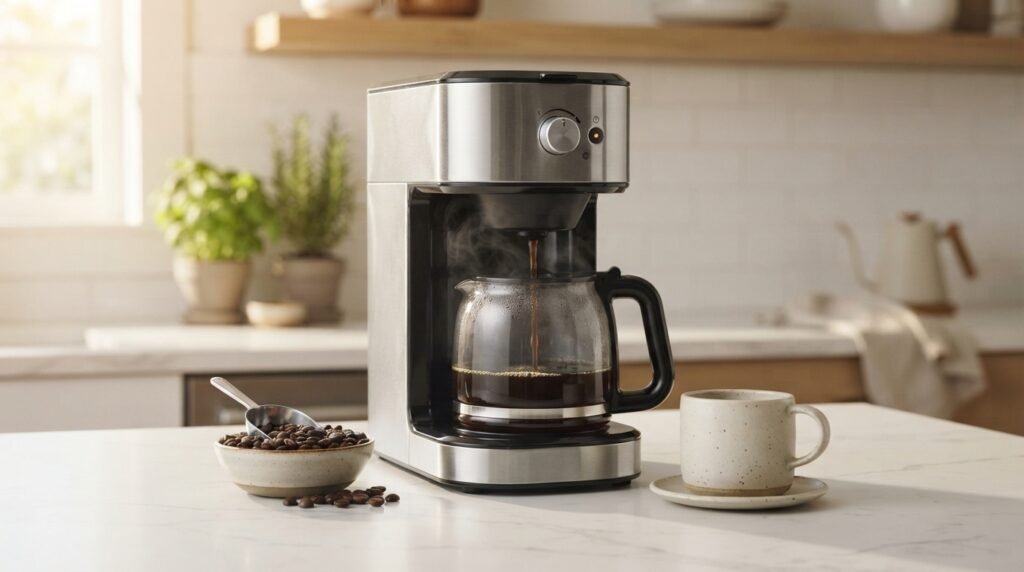
The right coffee maker can turn an ordinary morning into a better start to the day. But choosing one is not always simple. Some machines prepare a full pot for the family, others make one cup at a time, and espresso machines are designed for people who enjoy café-style drinks at home.
The biggest mistake is buying a machine because it looks impressive or has the most features. A coffee maker should match your preferred drink, household size, available kitchen space, budget and willingness to clean it.
This guide compares seven coffee machines across different brewing styles, explains what makes each worth considering, and shows you how to compare ongoing costs, maintenance, electricity use and regional compatibility. Whether you are shopping in the USA, UK, Canada, Australia or Europe, these practical checks can help you avoid an expensive mismatch.
Editorial note: SmartAirHQ has not personally laboratory-tested these machines. The recommendations below are category-based buying suggestions informed by published product specifications, manufacturer information and independent 2026 buying guides. Features and model availability can vary by country.
Best Coffee Maker Options at a Glance
If you want a quick starting point, compare these seven machines by the type of coffee you drink most often. They are not interchangeable: a premium drip brewer and an espresso machine solve different problems.
| Coffee maker | Best suited for | Main reason to consider it | Main trade-off |
|---|---|---|---|
| Technivorm Moccamaster KBGV Select | Premium drip coffee | Straightforward brewing and SCA certification | Premium price; limited automation |
| Fellow Aiden Precision Coffee Maker | Customizable filter coffee | Adjustable brewing profiles and app features | More expensive than basic drip machines |
| OXO Brew 8-Cup | Everyday drip coffee | Single-cup or carafe brewing | No extensive programmable features |
| Ninja 12-Cup Programmable Brewer | Value-focused family brewing | Larger-batch brewing and programmable convenience | Check the exact model’s settings |
| Nespresso Vertuo Lattissima | Convenient single servings | Capsule-based drinks and milk preparation | Ongoing capsule costs |
| Breville Bambino Plus | Compact home espresso | Espresso-focused design and automatic milk texturing | Requires espresso preparation and cleaning |
| De’Longhi La Specialista Touch | Hands-on espresso preparation | Guided espresso-making features | Higher cost and learning curve |
The table is a shortlist for comparison, not a universal performance ranking. Confirm the exact model number and regional specification before purchasing.
Seven Coffee Makers Worth Comparing in 2026
1. Technivorm Moccamaster KBGV Select – A Premium Choice for Drip Coffee
The Technivorm Moccamaster KBGV Select is a strong option to investigate if your household mainly drinks traditional filter coffee. Its design focuses on brewing coffee in a carafe rather than offering a large menu of automated drinks.
One useful feature is its selection between half and full carafe brewing. That makes it more flexible than a machine that is designed only for one fixed batch size.
The KBGV Select is listed in the Specialty Coffee Association’s 2026 certified home brewer directory. Certification provides a useful reference when comparing filter coffee machines, although it does not mean every model from the same brand is automatically certified.
Why consider it?
- You regularly prepare several cups of filter coffee.
- You prefer a relatively simple brewing process.
- You want a machine listed in the SCA certified home brewer directory.
- You do not need built-in milk preparation or extensive app controls.
What to consider before buying: Its premium positioning may not suit a tight budget, and people who want automatic scheduling should compare programmable alternatives.
Who should skip it? Buyers who mainly drink espresso, cappuccino or capsule-based beverages.
Want a dedicated drip brewer instead of another complicated kitchen gadget?
🛒 Check the Moccamaster KBGV Select on Amazon: Compare current listings, colours and prices
2. Fellow Aiden Precision Coffee Maker – For More Control Over Brewing
The Fellow Aiden Precision Coffee Maker is worth considering if you enjoy adjusting how your filter coffee is prepared. Its features include programmable brewing profiles and app connectivity, making it more customizable than a basic one-button drip machine.
It can appeal to coffee enthusiasts who like experimenting with brewing temperature, water distribution and different coffee beans. At the same time, its guided settings mean buyers do not necessarily need to adjust every setting manually.
The Aiden is listed in the SCA certified home equipment directory. That gives buyers another reference point when comparing its filter-brewing credentials.
Why consider it?
- You enjoy trying different coffee beans and roast levels.
- You want more control over brewing settings.
- You prefer a machine that supports both guided and customizable brewing.
- You want a thermal-carafe style setup.
What to consider before buying: It is a more feature-rich and expensive option than a simple drip coffee maker. App features and warranty support should be checked for your country.
Want more control over your morning brew?
⭐ Explore the Fellow Aiden on Amazon: Compare the Precision Coffee Maker and current offers
3. OXO Brew 8-Cup Coffee Maker – For Everyday Home Brewing
The OXO Brew 8-Cup is a practical option for households that want to prepare either a smaller serving or a larger carafe without moving to a complicated machine.
Its brewing design includes a water-distribution system intended to wet coffee grounds more evenly. The model is also listed in the SCA certified home brewer directory.
Its simple controls can be an advantage for people who prefer straightforward operation. However, buyers who want delayed-start scheduling or extensive customization should compare other machines.
Why consider it?
- You want a simple everyday drip brewer.
- You sometimes make one serving and sometimes several.
- You prefer a thermal-carafe version where available.
- You do not need a long list of smart features.
What to consider before buying: Check the exact carafe version and regional model. Do not assume every OXO 8-Cup listing has identical specifications.
Looking for a straightforward brewer without unnecessary complexity?
🔎 Find the OXO Brew 8-Cup on Amazon: Compare the available versions and prices
4. Ninja 12-Cup Programmable Brewer – For Larger Households
A larger-capacity programmable brewer can make sense when several people drink coffee throughout the day. The Ninja 12-Cup Programmable Brewer is a model to compare if your priority is preparing a larger batch rather than making individual espresso drinks.
Programmable brewing can be convenient for households that want coffee ready around a regular morning schedule. However, features differ between Ninja models, so check the exact model number rather than assuming every machine offers the same brew settings.
Why consider it?
- Several people in your home drink filter coffee.
- You regularly prepare larger batches.
- You value a programmable brewing routine.
- You want to compare a family-oriented machine with premium drip options.
What to consider before buying: A larger carafe can encourage unnecessary brewing if only one person drinks coffee. Check the minimum batch size, warming-plate behavior and cleaning instructions.
Need a larger brewer for busy mornings?
🛍️ Compare Ninja 12-Cup models on Amazon: Check current programmable coffee maker listings
5. Nespresso Vertuo Lattissima – For Convenient Single-Serve Drinks
A capsule machine can be useful when you want a quick individual drink without measuring loose coffee grounds for every serving. The Nespresso Vertuo Lattissima combines the Vertuo capsule system with milk-based drink preparation.
This type of machine is particularly appealing to people who value convenience and variety. However, capsule compatibility is important: Vertuo capsules are not interchangeable with every other Nespresso system.
Why consider it?
- You usually make one drink at a time.
- You prefer capsule-based preparation.
- You enjoy milk-based coffee options.
- You want less manual coffee preparation.
What to consider before buying: Calculate the cost of capsules, check their availability in your country and understand the machine’s cleaning requirements. The convenience of a capsule system may come with a higher cost per serving than ordinary ground coffee.
Want quick coffee without measuring grounds every morning?
✨ Explore the Nespresso Vertuo Lattissima on Amazon: Compare machine versions and capsule-compatible options
6. Breville Bambino Plus – For Compact Home Espresso
The Breville Bambino Plus is designed for people who want to prepare espresso-based drinks at home without buying a large commercial-style machine.
It is an espresso-focused appliance rather than a conventional drip coffee maker. You will need to understand coffee grinding, dosing, tamping and cleaning if you want consistent results.
Its automatic milk-texturing features can make milk-based drinks more approachable, but buyers should still learn the correct cleaning process for the milk system.
Why consider it?
- You enjoy espresso, flat whites, cappuccinos or lattes.
- You want an espresso machine with a relatively compact design.
- You are interested in learning home barista skills.
- You are comfortable with more preparation than a capsule machine requires.
What to consider before buying: Check whether the regional model matches your electrical supply. A US version should not be assumed compatible with a UK, Australian or European socket simply by changing the plug.
Ready to explore espresso at home?
☕ Check the Breville Bambino Plus on Amazon: Compare current espresso machine listings
7. De’Longhi La Specialista Touch – For Guided Espresso Preparation
The De’Longhi La Specialista Touch is worth comparing if you want a more involved espresso-making experience with guided assistance. It is aimed at people who enjoy preparing espresso and milk-based drinks rather than simply pressing a button for a filter coffee.
Its exact features depend on the version and regional model. Check the grinder, milk system, drink settings and maintenance requirements before choosing it.
Why consider it?
- You enjoy learning espresso preparation.
- You want assistance with the coffee-making process.
- You regularly prepare milk-based drinks.
- You have enough counter space for a more involved espresso setup.
What to consider before buying: It is not the simplest option for someone who only wants a quick black coffee. Compare its price and features with a compact espresso machine before deciding.
Want a more hands-on café-style setup?
🏠 Explore De’Longhi La Specialista Touch on Amazon: Compare the machine and available configurations
Which Type of Coffee Maker Should You Choose?
A product comparison becomes much easier when you first understand the brewing methods. The best coffee machine for a household depends on the drink it needs to prepare, not simply its brand or price.
| Machine type | Brewing method | Best suited for | Main consideration |
|---|---|---|---|
| Drip coffee maker | Hot water passes through ground coffee and a filter | Multiple cups of regular coffee | Batch size and carafe |
| Single-serve machine | Makes an individual serving using capsules or grounds | Quick individual drinks | Cost and availability of consumables |
| Espresso machine | Forces hot water through finely ground coffee under pressure | Espresso and milk-based drinks | Preparation and cleaning |
| Bean-to-cup machine | Grinds beans and automates brewing | Convenient freshly ground coffee | Higher purchase and maintenance costs |
| French press | Grounds steep in hot water before being separated | Manual, simple brewing | Requires manual preparation |
| Pour-over brewer | Water is poured through grounds and a filter | Manual control over extraction | Takes time and attention |
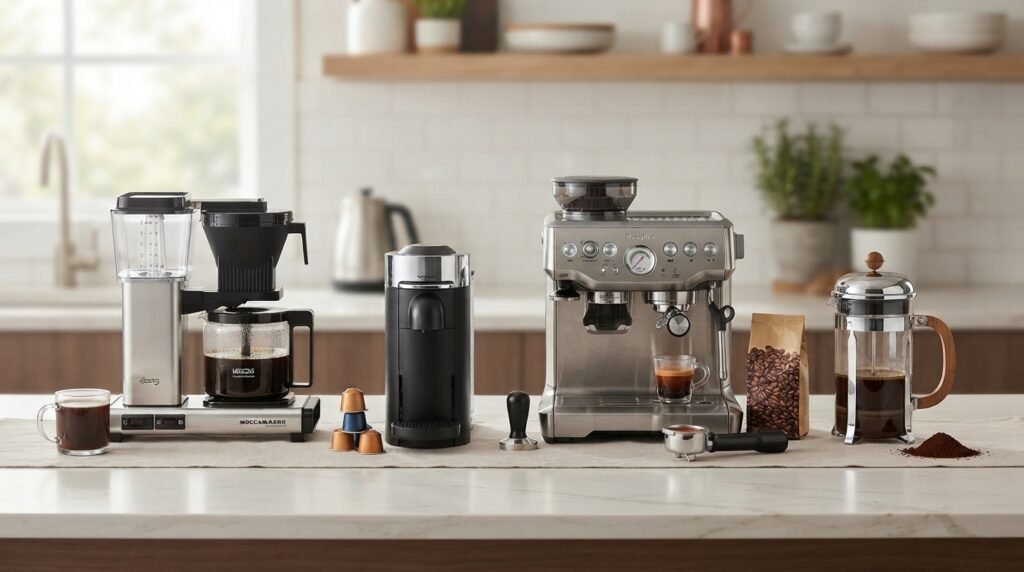
Drip Coffee Makers
A drip coffee maker is often a practical choice for people who drink regular filter coffee. It can prepare several servings in one cycle, making it useful for couples, families and home offices.
When comparing models, pay attention to brewing consistency, carafe design, batch size, filter availability and cleaning access.
Single-Serve Coffee Machines
Single-serve machines prioritize convenience. Some use capsules, while others accept ground coffee in reusable or dedicated baskets.
Before buying, calculate the cost of the coffee used for each drink. A low-cost machine may become more expensive to operate if its compatible capsules are costly or difficult to find.
Espresso and Bean-to-Cup Machines
Espresso machines are designed for concentrated coffee and drinks such as cappuccinos and lattes. Bean-to-cup machines add grinding and often automate more of the process.
If you want an automatic experience, compare bean-to-cup models with manual espresso machines. If you enjoy controlling the brewing process, a semi-automatic machine may be more rewarding.
Match the Coffee Maker to Your Household
The right capacity is just as important as the brewing method. A large machine may waste coffee in a one-person household, while a single-cup brewer may become inconvenient for a family.
| Household or lifestyle | Suitable machine | What to prioritize |
|---|---|---|
| One person | Compact drip or single-serve | Small footprint and low waste |
| Couple | 4–8 cup drip or capsule machine | Flexible serving size |
| Family | Larger drip or dual brewer | Capacity and simple operation |
| Busy professional | Programmable drip or capsule machine | Convenience |
| Espresso enthusiast | Manual or semi-automatic espresso | Grinder and extraction control |
| Small apartment | Compact drip or capsule machine | Countertop dimensions |
| Home office | Larger drip or bean-to-cup machine | Repeated daily use and cleaning |
Think about your routine before choosing. If you usually prepare one mug before leaving for work, a large carafe may not be useful. If several family members drink coffee at breakfast, a single-serve machine may slow everyone down.
What to Check Before Buying a Coffee Maker
A good-looking machine is not necessarily a good match for your kitchen. Review its specifications, operating requirements and maintenance needs before making a purchase.
| Buying factor | What to check | Why it matters |
|---|---|---|
| Brewing style | Drip, capsule, espresso or bean-to-cup | Determines the drinks you can prepare |
| Capacity | Cup size and minimum batch | Prevents over-brewing or repeated cycles |
| Temperature consistency | Published specifications and certification | Helps compare brewing performance |
| Programmability | Timer, scheduling and automatic shutoff | Adds convenience when genuinely needed |
| Grinder | Built-in or separate; adjustment options | Affects preparation and counter space |
| Carafe | Glass, thermal or single-serving | Changes heat retention and serving convenience |
| Cleaning | Removable parts and descaling process | Makes daily ownership easier |
| Warranty | Regional coverage and repair service | Protects your purchase |
| Dimensions | Width, depth, height and lid clearance | Helps ensure the machine fits |
| Consumables | Filters, capsules and cleaning products | Affects long-term cost and availability |
Why Brewing Certification Can Help
For filter coffee makers, certification can provide more useful information than a marketing claim alone.
The Specialty Coffee Association’s certified home brewer directory lists models that have completed its equipment evaluation process. Check the exact model name because certification applies to listed equipment, not every machine sold by a manufacturer.
The European Coffee Brewing Centre also publishes technical requirements for filter brewers, including brewing time, temperature and extraction-related criteria. Its domestic brewer certification standards explain the testing framework.
These references are particularly useful when comparing drip machines. They should not be used to claim that a capsule machine or espresso machine has passed a filter-brewer certification test.
Compare the Real Cost Before Purchasing
The purchase price is only one part of owning a coffee maker. Coffee beans, ground coffee, capsules, filters, cleaning products and replacement parts can affect the total cost over time.
| Cost factor | Drip machine | Capsule machine | Espresso machine | Bean-to-cup machine |
|---|---|---|---|---|
| Initial purchase | Low to premium | Low to premium | Medium to premium | Often medium to high |
| Coffee supply | Ground coffee | Compatible capsules | Ground coffee or beans | Whole beans |
| Filters | Paper or reusable, depending on model | Usually built into capsule system | Depends on machine | Depends on machine |
| Cleaning | Basket and carafe | Capsule area and descaling | Group head and accessories | Internal unit and grinder |
| Milk accessories | Usually separate | Model-dependent | Manual or automatic | Model-dependent |
| Long-term cost | Depends on coffee and filters | Can rise with capsule use | Depends on beans and maintenance | Depends on beans and maintenance |
Calculate Your Cost Per Cup
Use this simple formula:
Cost per cup = Total coffee supply cost ÷ Number of servings
For example, if a household spends $18 on coffee and prepares 60 servings from that supply:
$18 ÷ 60 = $0.30 per serving
This is an illustrative calculation, not a current product price. Add capsules, milk, filters and cleaning products where applicable.
Estimate Monthly Coffee Expenses
Monthly coffee cost = Daily servings × Cost per serving × Days per month
For example, three servings per day at an illustrative $0.30 each would cost:
3 × $0.30 × 30 = $27 per month
Use your local coffee prices to compare machines fairly. A capsule system may be convenient, but a frequent coffee drinker should compare its cost per serving against ground coffee or whole beans.
For a wider view of household appliance operating costs, read our guide to how much electricity home appliances use.
Coffee Maker Electricity Use and Energy-Saving Tips
Coffee makers use electricity mainly to heat water. Some models also use power for warming plates, grinders, milk systems, displays and standby functions.
A machine with a higher wattage does not automatically consume more electricity over an entire month. Total energy use depends on how long it operates and how often you use it.
How to Calculate Electricity Cost
Use:
Electricity cost = (Wattage ÷ 1,000) × Operating hours × Electricity price per kWh
For example, a 1,000-watt coffee maker operating for 10 minutes uses approximately:
1,000 ÷ 1,000 × 0.167 = 0.167 kWh
At an illustrative electricity price of $0.20 per kWh, that brewing session costs approximately $0.033.
Actual consumption may be different because the machine can cycle its heater, keep a warming plate on or enter standby mode.
Practical ways to avoid unnecessary energy use include:
- Prepare only the amount of coffee you expect to drink.
- Switch off the warming plate when it is no longer needed.
- Use automatic shutoff if available.
- Consider a thermal carafe if you do not need a continuously heated plate.
- Follow the manufacturer’s cleaning and descaling instructions.
- Avoid leaving a machine powered on unnecessarily.
You can explore more practical ideas in our guide to smart energy-saving devices for home.
Buying a Coffee Maker in the USA, UK, Canada, Australia and Europe
A coffee machine sold in one country may not be suitable for another. Electrical ratings, plug types, warranty coverage, capsule availability and replacement parts can vary.
| Market | Common household supply | What to verify before purchase |
|---|---|---|
| USA | Around 120V | Exact voltage, frequency and US plug |
| Canada | Around 120V | Canadian model and warranty |
| UK | Around 230V | UK plug, voltage and local service |
| Australia | Around 230–240V | Australian model and electrical compliance |
| Continental Europe | Commonly around 230V | Country-specific plug and model support |
Do Not Rely on a Plug Adapter Alone
A plug adapter changes the physical plug connection; it does not automatically convert voltage.
If a coffee maker is designed for 110–120V, do not connect it directly to a 220–240V supply unless the manufacturer explicitly confirms that the exact model supports that voltage.
Before ordering internationally, check:
- The rating label on the exact machine.
- The supported voltage and frequency.
- The plug and local electrical requirements.
- The warranty in your country.
- Availability of compatible filters, capsules and replacement parts.
- Whether app features are supported in your region.
For example, a machine listing on Amazon.com may be a US version even when a similar-looking model is sold in the UK or Europe. Always compare the product code and specifications.
Common Coffee Maker Problems and Practical First Steps
Even a well-made coffee maker needs regular cleaning and correct operation. Coffee residue, mineral deposits, blocked components and incorrect settings can affect performance.
| Problem | Possible reason | Practical first step |
|---|---|---|
| Weak coffee | Too little coffee or unsuitable grind | Adjust the coffee-to-water ratio |
| Bitter coffee | Over-extraction or grind too fine | Review grind size and brewing time |
| Slow brewing | Mineral scale or blockage | Follow the descaling instructions |
| Coffee not hot enough | Settings or heating issue | Check the manual and temperature settings |
| Water leaking | Misplaced reservoir or damaged seal | Switch off and inspect accessible parts |
| Poor espresso extraction | Grind, dose or tamping issue | Review preparation and coffee freshness |
| Milk frother not working well | Residue or blocked nozzle | Clean the milk system as instructed |
| Unusual noise | Grinder obstruction or internal fault | Stop operation and consult the manufacturer |
When Should You Stop Using the Machine?
Disconnect the appliance and seek qualified service if you notice:
- Smoke or a burning smell.
- A damaged power cord or plug.
- Repeated electrical tripping.
- Water entering electrical components.
- Unusual overheating.
- Visible damage to internal wiring.
Do not open or repair electrical components while the appliance is connected to power. Follow the manufacturer’s safety instructions.
If you need help with other household appliance problems, our home appliance troubleshooting guide provides a broader starting point.
Cleaning and Maintaining Your Coffee Maker
Cleaning requirements depend on the machine type. A drip brewer, capsule machine and espresso machine do not all have the same maintenance routine.
After Each Use
- Empty used coffee grounds or capsules.
- Rinse removable filter baskets and accessories.
- Clean the carafe or cup-contact surfaces.
- Empty the drip tray where applicable.
- Wipe away spilled coffee and milk.
Regular Cleaning
- Wash removable components according to the manual.
- Inspect the water reservoir for residue.
- Clean the grinder area if the manufacturer permits it.
- Clean milk tubes, steam wands and frothers after use.
- Check the filter basket and drip outlet for blockages.
Descaling
Mineral deposits can accumulate inside a coffee maker, particularly when hard water is used. Descale according to the manufacturer’s instructions and recommended frequency.
Do not assume vinegar is suitable for every machine. Some manufacturers specify particular cleaning solutions or procedures, and using the wrong product may damage components or affect warranty coverage.
Are Smart Coffee Makers Worth Buying?
Smart coffee makers can offer app-based scheduling, connected controls, notifications and customized brewing routines. These features can be useful, but they should not distract from the machine’s main job: making the coffee you enjoy.
If you are considering a connected kitchen appliance, compare its app support and regional availability with its actual brewing performance.
A smart feature is most useful when it solves a real problem. For example, scheduling may help a busy household, while app connectivity may be unnecessary for someone who simply presses a button each morning.
For more connected kitchen ideas, explore our smart kitchen gadgets buying guide.
Final Coffee Maker Buying Checklist
Before choosing a machine, review these points:
- Does it prepare your preferred type of coffee?
- Is the capacity appropriate for your household?
- Will it fit beneath your kitchen cabinets?
- Are the controls easy to understand?
- Can you clean and descale it without difficulty?
- Are filters, capsules or replacement parts available locally?
- Have you calculated the ongoing cost per serving?
- Does the exact model support your country’s voltage?
- Is the warranty valid in your region?
- Are the extra features worth paying for?
A few minutes spent checking these details can help you avoid buying a machine that looks impressive but does not suit your daily routine.
Frequently Asked Questions
1. What is the best coffee maker for home use in 2026?
The best option depends on your preferred drink. A drip machine is practical for multiple cups, a capsule machine is convenient for individual servings, and an espresso machine is designed for concentrated coffee and milk-based drinks. Compare capacity, maintenance, ongoing costs and regional support before choosing.
2. What is the difference between a coffee maker and a coffee machine?
The terms are often used interchangeably. Coffee maker commonly describes drip or filter appliances, while coffee machine can refer to a wider range of equipment, including espresso, capsule and bean-to-cup models.
3. Is a drip coffee maker better than a single-serve machine?
Neither is always better. A drip machine can be more practical for preparing several cups, while a single-serve machine is convenient when you usually make one drink at a time. Household size and cost per serving should guide the decision.
4. Are capsule coffee makers expensive to use?
They can have a higher ongoing cost because compatible capsules must be purchased separately. Calculate the price of your usual capsules and compare it with ground coffee or whole beans before buying.
5. Is an expensive coffee maker worth it?
A more expensive machine may offer additional controls, materials, convenience or brewing options. However, price alone does not guarantee that it will suit your preferences. Choose based on the features you will actually use.
6. How often should I clean my coffee maker?
Clean removable parts and coffee-contact surfaces regularly. Descaling frequency depends on water hardness, usage and manufacturer instructions. Espresso and milk-based machines may need additional cleaning after each use.
7. Does a coffee maker use a lot of electricity?
Electricity use depends on the machine’s wattage, operating time, warming plate and standby behavior. Check the manufacturer’s specifications and calculate consumption based on your daily routine rather than judging by wattage alone.
8. Can I use a US coffee maker in the UK or Europe?
Not automatically. Check the exact model’s voltage and frequency rating. A plug adapter does not convert voltage, so a 110–120V appliance should not be connected directly to a 220–240V supply unless the manufacturer confirms compatibility.
9. What should I look for in a programmable coffee maker?
Look for reliable scheduling, suitable capacity, automatic shutoff, simple controls and easy cleaning. Choose features that improve your daily routine instead of paying extra for functions you will rarely use.
10. Are smart coffee makers worth buying?
They can be useful if you regularly use app controls, scheduling or supported smart-home integrations. However, brewing performance, reliability, maintenance and local warranty support should remain more important than connectivity.
Conclusion: Choose a Coffee Maker That Fits Your Routine
The best coffee maker is not necessarily the most expensive machine or the one with the longest feature list. It is the one that prepares the coffee you enjoy, fits your kitchen and remains practical to maintain.
For traditional filter coffee, compare the Moccamaster, Fellow Aiden and OXO Brew. For a larger household, investigate a suitable programmable brewer. For convenient individual drinks, compare capsule costs and availability. If espresso is your priority, explore the Bambino Plus and La Specialista Touch.
Before purchasing, confirm the exact model, electrical rating, local warranty and availability of supplies. A careful comparison today can help you enjoy a more convenient coffee routine for years.
Choose the brewing style first, compare the real ownership cost second, and buy the machine that fits your home—not simply the one with the most features.
Affiliate Disclosure
SmartAirHQ participates in the Amazon Services LLC Associates Program, an affiliate advertising program designed to provide websites with a way to earn advertising fees by advertising and linking to Amazon.com. As an Amazon Associate, SmartAirHQ earns from qualifying purchases made through affiliate links. This means that when you click on an Amazon link and make a qualifying purchase, we may receive a small commission at no additional cost to you. This does not affect the price you pay, and it does not influence our editorial opinions, product recommendations, or the information we provide. We only aim to recommend products and resources that may be useful and relevant to our readers.