Can an electric car power your entire home? Yes, a compatible electric vehicle can supply electricity to your house through Vehicle-to-Home (V2H) technology, provided you have the required bidirectional charging equipment and a safe home electrical installation.
Understanding whether an electric car can power your entire home helps homeowners decide if this technology is suitable for their backup energy needs.
Can Your Electric Car Keep Your Lights On During a Power Outage?
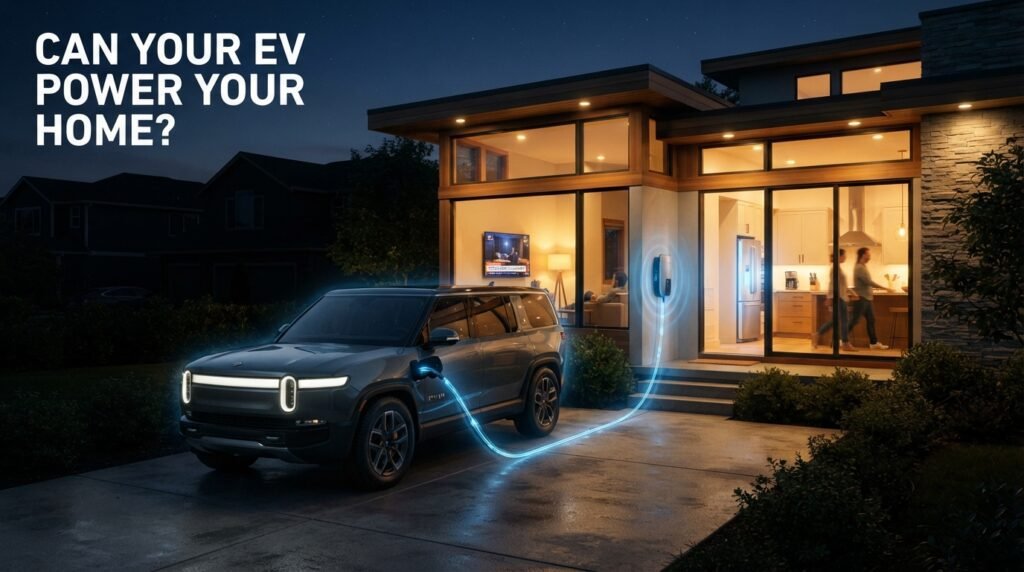
Your electric car might be more than just a vehicle—it could become a powerful backup energy source for your home. Imagine using the battery parked in your driveway to keep your refrigerator running, lights switched on, and essential appliances working when the electricity goes out.
With Vehicle-to-Home (V2H) technology, this possibility is becoming a reality. But can an EV really power an entire house, how long can its battery last, and what equipment do you need to make it happen?
Let’s explore how this fascinating technology works and whether your electric car could become your home’s next backup power solution.
Affiliate Disclosure
SmartAirHQ participates in the Amazon Associates Program. As an Amazon Associate, we earn from qualifying purchases. This means we may earn a commission when you purchase through qualifying links, at no additional cost to you.
Can an Electric Car Power Your Entire Home? Understanding V2H Technology
Imagine a power outage at night. Your refrigerator stops running, the lights go out, your internet router switches off, and your home becomes uncomfortable. But instead of relying on a noisy generator or a separate backup battery, you connect your electric car to a compatible home energy system.
Your car’s battery could potentially supply electricity to your home.
This technology is called Vehicle-to-Home (V2H). It allows a compatible electric vehicle (EV) to send stored electricity back to a house through a specially designed bidirectional charging system. Depending on the vehicle, equipment, battery capacity, and household energy consumption, it may provide backup power for essential appliances or, in some installations, much of the home.
However, there is an important catch: not every electric car can power a house. A regular EV charger is not automatically capable of sending electricity back into your home. You need a compatible vehicle, suitable bidirectional charging equipment, and a properly installed electrical connection.
In this guide, you will learn how V2H works, which appliances an EV may power, how long the battery could last, what equipment is required, how much energy your home needs, and whether using an electric car as a home battery is worth considering.
Can an Electric Car Power a House?
Yes, a compatible electric car can power a house, but only when it supports bidirectional electricity flow and is connected to an appropriate V2H system.
Most conventional EV charging setups move electricity in one direction: from the electrical grid into the vehicle’s battery. V2H technology makes it possible to reverse that flow and send stored energy from the car into a home’s electrical system.
The U.S. Department of Energy explains that bidirectional EVs can provide backup electricity to buildings or specific loads when paired with suitable equipment. Its guide to bidirectional charging and electric vehicles as mobile storage explains how these vehicles can support building resilience and energy management.
The amount of electricity available depends on the vehicle’s usable battery capacity, the system’s power output, and the appliances connected to it.
For example, an EV with a large battery may store considerably more energy than a small portable backup battery. But battery size alone does not guarantee that the car can supply enough power to operate every appliance simultaneously.
What determines whether an EV can power your home?
| Requirement | Why It Matters |
|---|---|
| Bidirectional-capable EV | The vehicle must be designed to send electricity outward |
| Compatible bidirectional charger | Allows controlled two-way energy transfer |
| Home integration equipment | Connects the EV system to suitable household circuits |
| Grid isolation protection | Prevents dangerous electricity from flowing into the utility grid during an outage |
| Sufficient battery capacity | Determines how much energy is available |
| Adequate power output | Determines how many appliances can run at the same time |
| Professional installation | Ensures the system meets applicable electrical and safety requirements |
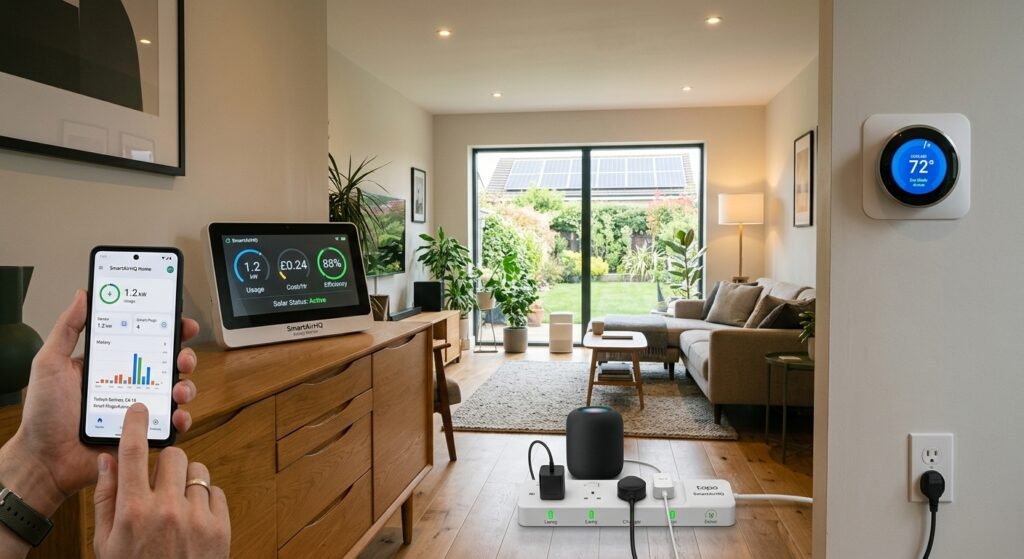
If your goal is to reduce household electricity waste as well as improve backup readiness, an energy monitor can help you understand which appliances consume the most electricity. SmartAirHQ’s smart energy monitor buying guide can help you explore ways to track household energy use.
What Is Vehicle-to-Home (V2H) Technology?
Vehicle-to-Home, commonly called V2H, is a technology that allows a compatible electric vehicle to supply electricity to a home.
Think of the EV as a large mobile battery. You charge it using electricity from the grid or, where supported, another energy source. When your home needs power, a compatible system can send some of that stored electricity back to the house.
V2H can be useful during electricity outages, periods of expensive electricity, or situations where a household wants to use stored energy more strategically.
How does V2H work?
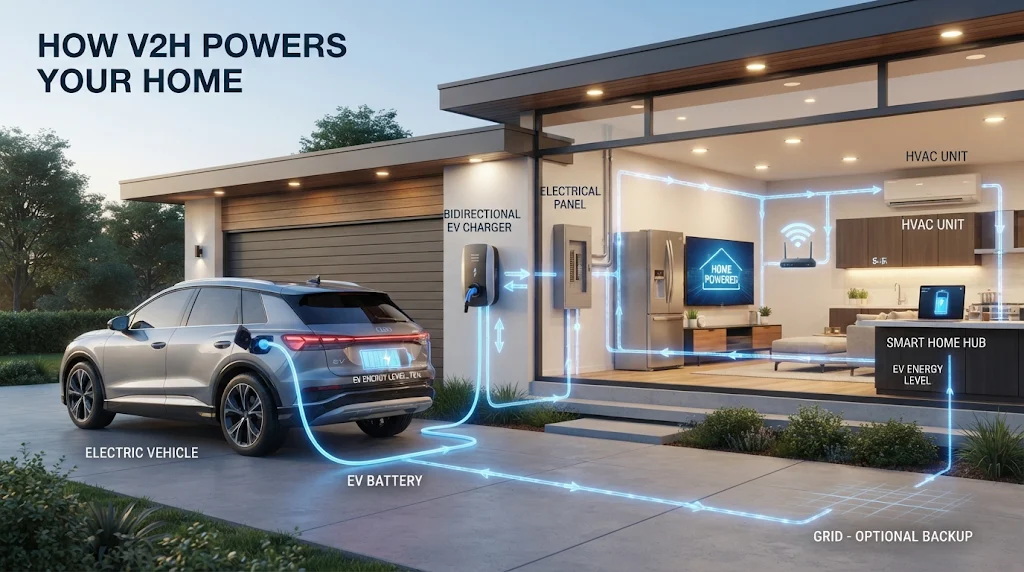
A typical V2H setup follows this process:
- The EV battery stores electricity while the vehicle is charging.
- A compatible bidirectional charger and control system manage the energy transfer.
- When the home needs backup electricity, the system changes to its approved backup operating mode.
- The home is safely isolated from the utility grid when required.
- Electricity is supplied to the home’s designated circuits or supported electrical system.
- The system monitors power flow and the vehicle’s remaining battery level.
The exact arrangement differs by vehicle and manufacturer. Some systems use equipment integrated into the vehicle, while others require additional external power-conversion and control equipment.
A regular home EV charger cannot automatically perform this function. Check the vehicle manufacturer’s specifications and the charger’s compatibility before purchasing any equipment.
V2H vs. V2L vs. V2G: What Is the Difference?
These three terms are related, but they describe different ways an electric vehicle can supply electricity.
| Technology | Full Name | Main Function | Typical Use |
|---|---|---|---|
| V2H | Vehicle-to-Home | Sends electricity from an EV to a house | Home backup power |
| V2L | Vehicle-to-Load | Supplies electricity to external devices | Appliances, tools, and portable equipment |
| V2G | Vehicle-to-Grid | Sends electricity from an EV to the electricity grid | Grid support and energy management |
| V2B | Vehicle-to-Building | Supplies electricity to a commercial or institutional building | Building backup and energy management |
| V2X | Vehicle-to-Everything | Broad term for different vehicle energy-transfer applications | Homes, buildings, devices, and grids |
V2H: Powering your home
V2H is designed to supply electricity to a home’s electrical system. Depending on the system’s capacity, it may support selected essential circuits or a larger portion of the property.
V2L: Powering individual devices
V2L allows a compatible EV to supply power to external devices through supported outlets or adapters. It may be useful for running selected appliances, camping equipment, or power tools.
However, powering a few devices through V2L is not the same as safely connecting a vehicle to a home’s electrical panel.
V2G: Sending electricity back to the grid
V2G allows compatible EVs to send electricity into the electricity network. Depending on local utility programs, regulations, and agreements, this may help support grid demand or participate in energy-management programs.
For homeowners interested in how connected energy resources can support the wider electricity network, SmartAirHQ’s guide to
virtual power plants explains how distributed energy resources can work together.
How Much Electricity Can an Electric Car Store?
An electric vehicle’s battery capacity is usually measured in kilowatt-hours (kWh). This tells you how much energy the battery can store.
For example, a vehicle with a 75 kWh battery has a nominal energy capacity of 75 kWh. The amount available to power a home may be lower because of the vehicle’s reserve settings, conversion losses, system limits, and the minimum charge level you want to preserve for driving.
| Example EV Battery Capacity | Potential Energy Stored | What It Means |
|---|---|---|
| 40 kWh | 40 kWh nominal | Smaller energy reserve |
| 60 kWh | 60 kWh nominal | Medium-sized energy reserve |
| 75 kWh | 75 kWh nominal | Larger energy reserve |
| 90 kWh | 90 kWh nominal | Substantial stored energy |
| 100 kWh | 100 kWh nominal | Very large nominal storage capacity |
These are illustrative battery sizes, not a list of guaranteed V2H-compatible vehicles. Actual usable energy available to a home will be lower and depends on the specific vehicle and system.
Is an EV battery bigger than a home battery?
Some EV batteries have a greater storage capacity than many residential home batteries. However, the comparison is not just about storage size.
A stationary home battery is designed to remain connected to a property. An EV is also a transportation asset, so its battery must retain enough energy for driving.
| Feature | Electric Vehicle Battery | Stationary Home Battery |
|---|---|---|
| Main purpose | Power an electric vehicle | Store electricity for a property |
| Mobility | Can travel with the vehicle | Installed at a fixed location |
| Storage capacity | Varies by vehicle | Varies by system |
| Backup capability | Requires compatible bidirectional technology | Designed for home energy storage |
| Transportation reserve | Important | Not applicable |
| Installation | Requires compatible vehicle and home equipment | Requires a suitable home energy installation |
An EV may offer a substantial energy reserve, but a dedicated home battery can be more convenient when you need stationary backup power every day.
How Long Can an Electric Car Power Your Home?
The backup duration depends on two main factors:
- How much usable energy the EV can supply.
- How much electricity your home consumes.
A simple estimate is:
Estimated backup time = Usable EV energy available (kWh) ÷ Household electricity use (kW)
For a daily energy estimate:
Estimated backup days = Usable EV energy available (kWh) ÷ Household daily electricity consumption (kWh)
Consider an illustrative example: a vehicle has 75 kWh of nominal battery capacity, but the system allows 60 kWh to be used for home backup. If the household consumes 20 kWh per day, the simplified estimate is three days.
Actual runtime can be shorter because of conversion losses, changing appliance demand, temperature, system limits, and the battery reserve you maintain for driving.
Example backup runtime calculations
| Energy Available to Home | Daily Household Use | Simplified Estimated Runtime |
|---|---|---|
| 30 kWh | 10 kWh/day | 3 days |
| 40 kWh | 20 kWh/day | 2 days |
| 50 kWh | 25 kWh/day | 2 days |
| 60 kWh | 20 kWh/day | 3 days |
| 60 kWh | 30 kWh/day | 2 days |
| 70 kWh | 35 kWh/day | 2 days |
These are simplified examples, not guaranteed outage durations. They assume the stated energy is available for home use and do not account for all real-world losses or changing loads.
How to estimate your own home’s backup time
You can make a more realistic estimate by following these steps:
- Check your electricity bill to find your average daily consumption in kWh.
- Check your EV manufacturer’s specifications for battery capacity.
- Find the V2H system’s permitted discharge limit and your chosen vehicle reserve.
- Estimate the electricity needed by essential appliances.
- Divide the usable energy available to your home by your estimated daily consumption.
If you want to reduce the amount of energy your home needs during an outage, start by identifying unnecessary electricity use. SmartAirHQ’s guide on how to reduce electricity consumption covers practical ways to lower household energy demand.
Which Home Appliances Can an Electric Car Power?
A V2H system may power different household appliances, but the actual selection depends on its continuous output, surge capacity, electrical configuration, and the total demand of connected devices.
Small appliances generally require less power than heating and cooling equipment. Large motors and compressors can also demand extra power when starting.
| Home Appliance | Typical Power Demand (Illustrative) | Backup Consideration |
|---|---|---|
| LED lighting | 5–15 W per bulb | Usually a low-demand load |
| Wi-Fi router | 10–20 W | Useful for communication |
| Laptop | 40–100 W | Usually manageable |
| Television | 50–200 W | Depends on model and size |
| Refrigerator | 100–300 W while running | Starting surge may be higher |
| Microwave | 800–1,500 W input | Short periods of high demand |
| Washing machine | 400–1,500 W | Heating cycles can increase demand |
| Air conditioner | 700–3,500+ W | Starting surge and system compatibility matter |
| Electric water heater | 3,000–5,500+ W | May consume a large share of available power |
| Electric oven | 2,000–5,000+ W | May be unsuitable for limited backup output |
Power figures are broad illustrative ranges. Actual consumption varies by appliance model, operating mode, voltage, and manufacturer specifications.
Can an EV run a refrigerator?
A compatible V2H setup may be able to power a refrigerator, provided the system supports its running demand and starting surge.
Refrigerators cycle on and off, so they do not normally consume their full rated power continuously. However, their compressors can briefly require more power when starting.
Can an EV power an air conditioner?
Possibly, but it depends on the air conditioner’s power demand and the V2H system’s output.
A large central air-conditioning system may require substantial starting power. Some V2H installations may not support it without additional equipment or load management.
Can an EV run an entire house?
Some systems are designed to support a broad range of household circuits, but whole-home operation should never be assumed.
A home with electric heating, multiple air conditioners, an electric oven, a water heater, and other high-demand appliances may exceed the system’s available output even if the EV battery contains plenty of energy.
What Equipment Do You Need to Power a Home With an EV?
An EV alone is not enough. A complete V2H installation requires compatible equipment that can safely manage the flow of electricity between the vehicle and the home.
| Equipment | Purpose | Important Check |
|---|---|---|
| Bidirectional-capable EV | Stores and supplies electricity | Confirm exact vehicle compatibility |
| Bidirectional EV charger | Controls two-way energy transfer | Must match the vehicle and system |
| Inverter or power-conversion system | Converts electricity into the required form | Check whether it is integrated or external |
| Transfer switch or isolation device | Separates the home from the grid during backup operation | Must meet local electrical requirements |
| Home integration gateway/controller | Manages power flow and backup operation | Check manufacturer compatibility |
| Electrical panel and protection | Distributes power to suitable circuits | Confirm capacity and installation requirements |
| Monitoring and control software | Displays system status and energy flow | Check supported features |
Why is a transfer switch important?
During a grid outage, a home backup system must prevent electricity from flowing unexpectedly back into the utility network. This is essential for protecting utility workers and maintaining safe electrical operation.
A properly designed isolation and switching arrangement allows the home to operate in its approved backup mode.
Never connect an EV directly to a household electrical panel or attempt to improvise a backfeed connection. A licensed electrician or an appropriately qualified installer must design and install the system according to local regulations.
Useful Equipment to Explore for EV Home Backup
Before purchasing any equipment, check compatibility with your exact electric vehicle and intended V2H system. These products can help with energy monitoring, EV charging research, and separate backup-power needs. However, they do not automatically enable Vehicle-to-Home functionality.
Track Individual Appliance Energy Use: Compatible smart plugs with energy-monitoring features can help you understand the electricity consumption of selected appliances.
🔎 Find Smart Energy-Monitoring Plugs on Amazon
Monitor Your Home’s Electricity Consumption: Understand how much energy your appliances use and identify opportunities to reduce electricity waste.
🛒 Explore Home Energy Monitors on Amazon.
Compare EV Charging Equipment: Explore different EV charging stations and check manufacturer specifications before choosing a charger. Remember, a standard Level 2 charger is not necessarily bidirectional.
⚡ Compare EV Charging Stations on Amazon.
Prepare for Portable Backup Power: Portable power stations can provide electricity to selected devices when used within their rated capacity. They are separate backup solutions, not substitutes for a V2H installation.
🔋 Discover Portable Power Stations on Amazon.
These products can support energy monitoring or separate portable-power needs, but they do not replace a compatible V2H installation.
Can Solar Panels Work With an Electric Car to Power a Home?
Yes. Solar panels and a bidirectional electric vehicle can complement each other in a suitable energy system.
During sunny hours, solar panels generate electricity. The home can use that electricity directly, while surplus energy may charge a compatible EV. When solar generation falls or the home needs backup power, a suitable V2H setup may allow the vehicle to supply electricity back to the property.
This arrangement can improve how a household uses its own generated energy, although the actual benefits depend on solar production, household demand, battery reserves, equipment compatibility, and local electricity tariffs.
| Energy Source | Main Role | Potential Benefit |
|---|---|---|
| Solar panels | Generate electricity | Reduce grid electricity use |
| EV battery | Store mobile energy | Provide a potential backup reserve |
| Bidirectional charger | Manage two-way energy flow | Enable compatible V2H operation |
| Home energy management system | Coordinate energy use | Help prioritize household loads |
| Utility grid | Supply or receive electricity where permitted | Additional energy flexibility |
Can solar panels recharge an EV during a power outage?
This depends on the system design. Standard grid-tied solar installations often shut down during an outage for safety unless they have suitable backup-capable inverters, controls, and isolation equipment.
A solar-plus-storage or compatible V2H system may continue operating during an outage, but only when specifically designed and installed for that purpose.
Can Using an EV as a Home Battery Reduce Electricity Bills?
Potentially, yes. A compatible V2H system may help a household use stored electricity more strategically.
For example, a household with time-of-use electricity pricing might charge its EV when electricity is cheaper and use stored energy during more expensive periods. The financial benefit depends on the difference between electricity prices, system efficiency, equipment costs, battery use, and the utility’s rules.
V2H is not automatically a money-saving solution. A homeowner must compare the potential savings with the cost of the vehicle, bidirectional charger, installation, and any additional electrical upgrades.
Potential financial benefits
| Strategy | How It May Help | What to Check |
|---|---|---|
| Charge during lower-cost periods | May reduce the cost of stored electricity | Local time-of-use tariff |
| Use EV energy during peak periods | May reduce grid purchases | Discharge limits and system efficiency |
| Use solar-generated electricity | May increase self-consumption | Solar and V2H compatibility |
| Manage household demand | May reduce peak electricity use | Monitoring and load-control features |
| Participate in grid programs | May provide incentives where available | Utility eligibility and agreements |
For more ways to reduce unnecessary household electricity consumption, explore SmartAirHQ’s guide to smart energy-saving devices for the home.
What Are the Advantages of Vehicle-to-Home Technology?
V2H offers several potential advantages for households that own a compatible electric vehicle.
1. Backup electricity during outages
A compatible EV may provide electricity to selected home circuits during a power outage, reducing reliance on a conventional generator.
2. Uses a battery you already own
If you already have a compatible EV, its battery may provide another useful function beyond transportation.
3. Supports energy management
V2H may help households shift electricity use between different periods, depending on their tariff and system capabilities.
4. Works alongside renewable energy
A suitable solar and V2H installation may allow a home to store and use more of its own generated electricity.
5. Potentially reduces dependence on the grid
A household with solar, a compatible EV, and appropriate energy-management equipment may have more flexibility during certain grid disruptions.
What Are the Disadvantages and Limitations of V2H?
Although V2H has promising potential, it is not a perfect solution for every homeowner.
| Limitation | Why It Matters | What to Consider |
|---|---|---|
| Limited vehicle compatibility | Many EVs do not support bidirectional discharge | Confirm the exact model and year |
| Additional equipment costs | A suitable charger and home integration may be expensive | Compare total installation costs |
| Installation requirements | Electrical upgrades may be necessary | Request a professional assessment |
| Battery reserve | The vehicle still needs energy for driving | Set a practical minimum charge |
| Limited power output | Large appliances may exceed system capacity | Calculate simultaneous loads |
| Regional restrictions | Regulations and utility rules differ | Check local requirements |
| Availability | Compatible systems may not be widely available in every market | Check local manufacturer support |
Does V2H damage an EV battery?
Using an EV battery for additional energy storage involves additional charging and discharging. Battery ageing is influenced by several factors, including temperature, charging patterns, depth of discharge, and battery-management controls.
The impact of V2H use will depend on the vehicle and its manufacturer’s system design. Check the warranty conditions and approved operating limits before using your EV as a regular home battery.
Which Electric Cars Can Power a Home?
There is no universal list that applies to every country and model year. Bidirectional charging features, compatible chargers, and home integration systems vary by manufacturer and market.
Some vehicle manufacturers have introduced or announced bidirectional energy features for selected models. For example, Ford’s F-150 Lightning and certain other vehicles have been associated with home-backup applications. However, availability and supported functions depend on the exact model, market, hardware, and installation package.
| Vehicle or Brand Example | What to Investigate | Before You Buy |
|---|---|---|
| Ford F-150 Lightning | Home backup integration and compatible equipment | Confirm model-year and regional support |
| Nissan LEAF | Bidirectional charging availability | Confirm charger and local-market compatibility |
| Tesla Cybertruck | Powershare and supported home equipment | Check the exact configuration and installation |
| Kia EV9 | Bidirectional features and market availability | Verify whether V2H is supported in your country |
| Other EV models | Manufacturer-specific V2H or V2L functions | Do not assume all models support V2H |
This is an illustrative research list, not a guarantee that every vehicle shown supports V2H in every market. Always verify the manufacturer’s current documentation for the exact model, model year, and country.
Tesla’s guide to bidirectional charging and Vehicle-to-Home explains the main components involved in a V2H setup and why compatible charging and home-isolation equipment matter.
Is V2H Available in the USA, UK, Canada, Australia, and Europe?
V2H availability is not the same everywhere. The vehicle, charger, electrical standards, utility rules, and installation requirements can differ between countries.
| Market | What Homeowners Should Check |
|---|---|
| USA | Vehicle compatibility, approved bidirectional equipment, local electrical codes, and utility requirements |
| UK | Compatible EV and charger, home electrical installation rules, and energy supplier requirements |
| Canada | Provincial utility requirements, electrical codes, and supported equipment |
| Australia | Local electrical standards, installer approval, and available vehicle-to-home products |
| Europe | Country-specific grid rules, vehicle compatibility, charger standards, and utility arrangements |
Before investing in V2H, check whether the manufacturer officially supports the feature in your country. A vehicle that supports bidirectional charging in one market may not offer the same functionality in another.
V2H vs. a Home Battery vs. a Generator: Which Is Better?
The best backup solution depends on your budget, electricity needs, outage frequency, and whether you already own a compatible EV.
| Feature | EV With V2H | Stationary Home Battery | Backup Generator |
|---|---|---|---|
| Energy source | EV battery | Dedicated battery | Fuel |
| Mobility | Vehicle can travel | Fixed installation | Portable or fixed, depending on model |
| Automatic backup | Depends on system | Available in supported installations | Depends on model and installation |
| Noise during operation | Generally quiet | Quiet | Usually produces noise |
| Fuel requirement | Electricity to charge EV | Electricity to charge battery | Requires fuel |
| Additional installation | Bidirectional equipment and home integration | Battery and inverter installation | Safe generator connection and installation |
| Main advantage | Uses a vehicle battery as mobile storage | Dedicated home backup | Can operate independently of grid electricity when fuel is available |
| Main limitation | Vehicle and equipment compatibility | Upfront purchase and installation cost | Fuel, maintenance, noise, and emissions |
An EV with V2H may be attractive if you already own a compatible vehicle. A stationary home battery may be more convenient for a household that needs regular backup without relying on a vehicle being parked at home.
A generator may be suitable in some locations, but it must be installed and operated safely, with proper separation from household wiring and appropriate ventilation.
Is an Electric Car a Practical Home Backup Solution?
For some households, yes. But V2H is not a universal replacement for a home battery or generator.
It is most practical when:
- You already own an EV that officially supports V2H.
- A compatible bidirectional charger is available in your market.
- Your home can accommodate the required electrical equipment.
- Your backup power needs fit within the system’s output limits.
- You can keep enough battery charge for both home backup and driving.
- The total installation cost makes sense for your household.
If your EV does not support V2H, you may still be able to use a supported V2L outlet or adapter to power selected devices. That is a different arrangement and should not be treated as a whole-home backup system.
A simple decision checklist
Before investing in V2H, ask:
- Does my exact EV model support bidirectional power output?
- Is a compatible V2H charger available in my country?
- Does the system support my home’s voltage and electrical configuration?
- Which circuits can it power during an outage?
- What is the continuous power output and starting-surge capability?
- How much usable energy can I safely draw from the vehicle?
- Will I need an electrical panel upgrade?
- Does my vehicle warranty cover the intended use?
- What permissions or utility approvals are required?
- What is the complete installed cost?
Frequently Asked Questions
1. Can any electric car power a house?
No. The EV must support the required bidirectional power function, and the home must have compatible charging and electrical integration equipment. A conventional one-way EV charger cannot automatically send electricity back into a home.
2. How many days can an electric car power a house?
It depends on usable battery energy and household consumption. For example, if 60 kWh is available for home use and a household consumes 20 kWh per day, the simplified estimate is three days. Real-world runtime may be lower because of system losses, reserve settings, and changing electricity demand.
3. Can an EV power a refrigerator during a power outage?
Yes, if the vehicle and power system support the required output. A compatible V2H system may power a refrigerator, but its compressor’s starting demand must also be considered.
4. Can an electric car power an entire house without solar panels?
Yes, a compatible V2H system can provide backup electricity without solar panels. Solar can potentially extend backup capability or help recharge the vehicle when the system is designed for that operation, but it is not a mandatory part of every V2H setup.
5. Is V2H the same as V2L?
No. V2L supplies electricity to individual external devices, while V2H supplies electricity to a home’s electrical system through compatible equipment. V2L does not automatically provide whole-home backup.
6. Can a normal EV charger send electricity back to the home?
Generally, no. A conventional one-way charger is designed to charge the vehicle. V2H requires a compatible bidirectional vehicle and charging system.
7. Is using an EV battery cheaper than buying a home battery?
It may be cost-effective for someone who already owns a compatible EV, but the answer depends on equipment and installation costs, electricity tariffs, battery use, and backup requirements. Compare the full installed cost rather than battery capacity alone.
8. Can an electric car power an air conditioner?
Potentially, but the V2H system must support the air conditioner’s running power and starting surge. Large HVAC systems may exceed the available output.
9. Does V2H work during a blackout?
A properly designed V2H installation may operate during an outage. It needs the required grid-isolation and backup controls to prevent unsafe electricity flow into the utility network.
10. Can I install a V2H system myself?
Do not attempt to connect an EV directly to your home’s electrical panel. V2H installation involves high-power electrical equipment, protection, and grid-isolation requirements. Use a qualified installer and follow local regulations.
Final Verdict: Can Your Electric Car Become a Home Battery?
An electric car can potentially do much more than transport you from one place to another. With Vehicle-to-Home technology, a compatible EV can become a mobile energy-storage resource that supplies electricity to a home during outages or supports smarter household energy management.
However, the technology depends on more than battery size. You need a compatible vehicle, bidirectional charging equipment, safe home integration, and enough available power for your essential appliances.
For homeowners who already own a compatible EV, V2H may offer an additional way to improve energy flexibility and backup readiness. For everyone else, checking vehicle compatibility and total installation costs should come before purchasing equipment.
The future of home energy may not rely on just one battery installed beside your house. It may also involve the large battery already parked in your driveway.