
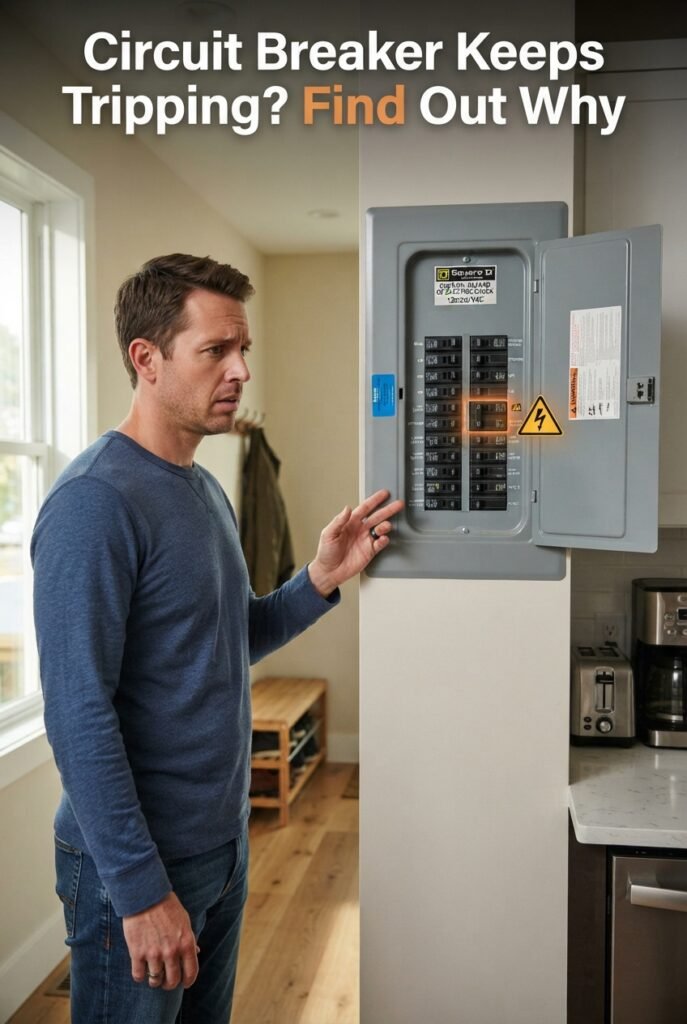
If your circuit breaker keeps tripping, it is usually trying to protect your home from an electrical problem rather than randomly shutting off power. The most common causes include an overloaded circuit, a short circuit, a ground fault, an arc fault, a faulty appliance, damaged wiring, or a breaker that needs professional attention. Circuit breakers are designed to interrupt current when electrical conditions become unsafe. (eSports Foundation International)
The important thing is not to keep resetting the breaker without finding out why it trips. A single trip after connecting several high-power appliances may point to an overload, while a breaker that trips immediately after reset can indicate a more serious fault. This guide explains how to identify the likely cause, what you can safely check, when to stop troubleshooting, and when an electrician should inspect the circuit.
For more practical electrical, energy, and home-appliance information, you can also explore [For complete website]For complete website.
Why Does a Circuit Breaker Keep Tripping?
A circuit breaker trips when the electrical current or fault condition reaches a level that causes the protective device to disconnect the circuit. In simple terms, the breaker is designed to prevent unsafe electrical conditions from continuing. An overloaded circuit can happen when too many appliances operate on the same circuit, while a short circuit or other fault can cause the breaker to trip much more quickly. (eSports Foundation International)
The timing of the trip can provide a useful clue. If the breaker trips only after several appliances have been running for a while, the circuit may be overloaded. If it trips immediately when a particular appliance is switched on, that appliance or its circuit may have a fault. If the breaker will not remain on even with appliances disconnected, professional inspection is the safer choice.
The Most Common Causes at a Glance
Several different electrical conditions can produce similar symptoms, so avoid assuming that replacing the breaker will automatically solve the problem. The table below provides a starting point for identifying what may be happening.
| What you notice | Possible cause | Best next step |
|---|---|---|
| Trips after several appliances are running | Circuit overload | Reduce the electrical load |
| Trips immediately when one appliance starts | Appliance fault or short circuit | Disconnect the appliance and stop using it |
| Trips when moisture is present | Ground fault/GFCI protection | Keep the area dry and investigate the affected equipment |
| AFCI breaker trips repeatedly | Possible arc fault or wiring/appliance issue | Have the circuit inspected |
| Breaker will not stay on | Persistent electrical fault | Stop resetting and contact a qualified electrician |
| Warm, discolored, buzzing, or burning-smelling outlet | Potential wiring or connection problem | Turn off power if safe and seek professional help |
Frequent trips should be treated as a warning rather than an inconvenience. ESFI notes that frequent breaker trips can indicate an electrical problem requiring inspection. (eSports Foundation International)
Is the Circuit Overloaded?
An overloaded circuit is one of the first things to consider when a breaker repeatedly trips. Every branch circuit has a limit, and appliances such as heaters, air conditioners, microwaves, kettles, hair dryers, and other high-power equipment can consume substantial electrical capacity. Running several demanding appliances simultaneously can push a circuit beyond what it can safely supply, causing the breaker to interrupt power. (eSports Foundation International)
Overloading does not necessarily mean that one appliance is defective. Sometimes the appliances are working normally but are simply sharing a circuit that cannot comfortably support their combined demand. Moving one appliance to a different properly wired circuit may resolve the problem, but adding or modifying circuits should be handled according to applicable electrical requirements by a qualified professional.
Signs That Point to an Overloaded Circuit
An overload often follows a recognizable pattern. The breaker may remain on while the circuit is lightly used, then trip after several appliances are switched on. Lights may dim when a large load starts, and outlets or switches may show other warning signs.
Watch for:
- The breaker trips when several appliances operate simultaneously.
- The problem disappears when one high-power appliance is unplugged.
- Lights dim or fluctuate when large electrical loads start.
- Several high-wattage appliances share the same circuit.
- The breaker trips after an appliance has been running for some time.
- Extension cords or multi-outlet devices are being used to power several demanding appliances.
ESFI identifies frequent breaker trips, dimming lights, warm or discolored plates, buzzing, sizzling, and burning odors as warning signs associated with electrical overload or other electrical problems. (eSports Foundation International)
Could a Short Circuit Be Causing the Breaker to Trip?
A short circuit is more serious than simply using too many appliances. It occurs when electrical conductors create an unintended low-resistance path, allowing current to rise rapidly. The breaker can respond by opening the circuit to stop the unsafe condition. A short circuit may involve damaged appliance wiring, damaged cords, wiring problems, or another electrical fault. (U.S. Consumer Product Safety Commission)
If the breaker trips immediately after you reset it, particularly when the circuit has little or no normal load, do not repeatedly force the breaker back on. Disconnecting accessible appliances may help determine whether a particular device is involved, but faults inside walls, outlets, junction boxes, panels, or appliances should not be diagnosed by trial and error.
What to Do When the Breaker Trips Immediately
When a breaker trips instantly, treat the situation more cautiously than an obvious overload. Turn off or unplug accessible appliances connected to that circuit, then identify whether the breaker can be reset normally according to the panel manufacturer’s instructions.
If it trips again with the load removed, stop resetting it. A persistent fault may require testing with professional electrical equipment and inspection by a qualified electrician. The CPSC specifically advises investigating why a breaker trips instead of simply continuing to reset it. (U.S. Consumer Product Safety Commission)
Could a Faulty Appliance Be Tripping the Breaker?
Sometimes the circuit itself is not the primary problem. A malfunctioning appliance can cause a breaker to trip when the appliance is connected or switched on. This can happen with appliances containing motors, heating elements, compressors, electronic power supplies, or damaged internal wiring.
A useful clue is whether the breaker trips consistently when one particular appliance is used. If the same appliance causes the problem while other normal loads operate without incident, disconnect it and stop using it until it has been properly checked. The CPSC recommends disconnecting an electrical product when problems develop and having it examined by a competent repair professional. (U.S. Consumer Product Safety Commission)
Do not defeat the breaker, use an oversized protective device, or repeatedly reconnect a suspicious appliance just to see whether it trips again. A protective trip is valuable information about the electrical system.
What Are Ground Faults, GFCI Trips, and Arc Faults?
Not every breaker trip is caused by excessive current from ordinary appliance use. Some protective devices are designed to detect specific electrical hazards. GFCI protection responds to unwanted current paths associated with ground faults, helping reduce electric-shock risk. AFCI protection is designed to detect certain dangerous arcing conditions that can occur in wiring and electrical equipment. (eSports Foundation International)
This distinction matters because a circuit can trip even when you have not obviously overloaded it. A GFCI-related trip may occur in an area where electricity and moisture are present, while an AFCI trip can point toward an arc-related problem involving wiring or connected equipment.
When a GFCI Keeps Tripping
GFCI protection is commonly associated with locations where electrical equipment may encounter water. If a GFCI repeatedly trips, do not simply keep pressing the reset button. Disconnect accessible devices from the affected receptacle or circuit and consider whether moisture, a damaged appliance, or another fault could be involved.
If the GFCI continues to trip after obvious loads have been removed, professional troubleshooting is appropriate. GFCI protection is intended to interrupt power when it detects an unwanted current path, so repeated trips should not be treated as a nuisance that should be bypassed. (eSports Foundation International)
When an AFCI Breaker Keeps Tripping
An AFCI breaker is intended to provide protection against certain arc-fault conditions. Repeated AFCI trips may therefore indicate an appliance, cord, connection, or wiring issue rather than a simple overload.
If an AFCI breaker repeatedly trips, avoid disabling or replacing the protection simply to keep the circuit energized. ESFI reports that electrical contractors frequently encounter wiring issues, overloaded circuits, and inadequate protection when investigating breaker-trip problems. (eSports Foundation International)
How to Safely Troubleshoot a Tripping Circuit Breaker
You can perform a limited amount of observation and basic troubleshooting without opening the electrical panel or working on energized wiring. The goal is to identify obvious load-related causes while avoiding electrical work that requires specialized knowledge. Never remove the panel cover or handle exposed wiring simply to investigate a breaker that keeps tripping.
Start by observing what was happening immediately before the trip. Note which appliances were operating, whether the trip occurred immediately or after several minutes, and whether a particular appliance consistently triggers the problem. That information can be extremely useful if an electrician needs to diagnose the circuit.
Step 1 — Reduce the Electrical Load
Turn off and unplug accessible appliances connected to the affected circuit. Pay particular attention to high-power equipment such as heaters, cooking appliances, air conditioners, and other devices that draw significant current.
Once the load has been reduced, the breaker may be able to remain on if the original issue was simply excessive demand. However, this does not prove that the electrical installation is adequate for the appliances you want to use. If the circuit regularly becomes overloaded, the long-term solution may involve redistributing loads or having an electrician evaluate whether an additional properly designed circuit is needed.
Step 2 — Identify Whether One Appliance Is the Trigger
If the breaker remains on after appliances are disconnected, reconnect or operate equipment cautiously rather than switching everything on at once. If one particular appliance consistently causes the breaker to trip, leave that appliance disconnected.
Look for obvious warning signs such as a damaged cord, unusual smell, visible damage, overheating, unusual sounds, or abnormal operation. Do not attempt to repair internal appliance wiring unless you have the appropriate training and equipment.
A product that repeatedly trips a breaker deserves attention even if it appears to work normally between trips. Electrical protection devices can interrupt power because of conditions that are not obvious during a quick visual inspection.
Step 3 — Reset the Breaker Correctly
Some breakers move to an intermediate position when they trip. ESFI explains that a tripped breaker can generally be reset by moving it to the OFF position and then back to ON after the underlying problem has been addressed. (eSports Foundation International)
If the breaker resets and stays on after the load has been removed, monitor the circuit rather than immediately reconnecting every appliance. If it trips again, especially without an obvious overload, stop resetting it and arrange for professional diagnosis.
When Should You Stop Troubleshooting and Call an Electrician?
The safest approach is to keep homeowner troubleshooting limited to observation, unplugging accessible equipment, reducing loads, and using controls as intended. Electrical panels, wiring, outlets, junction boxes, and protective devices can present serious shock and fire hazards. A breaker that repeatedly trips deserves a proper diagnosis rather than repeated resets.
Contact a qualified electrician when the breaker trips repeatedly, trips immediately, will not remain on, or appears to be associated with wiring problems. Professional help is especially important if you notice burning smells, buzzing or sizzling, heat, discoloration, damaged outlets, visible wiring damage, or signs of arcing. ESFI recommends professional inspection when frequent breaker trips indicate a possible electrical problem. (eSports Foundation International)
You should also seek professional evaluation if the circuit no longer appears capable of supporting normal household use. Adding another high-power appliance to an already overloaded circuit is not a substitute for correcting the underlying electrical capacity or installation problem.
Warning Signs That Mean You Should Not Keep Resetting the Breaker
A breaker that trips is giving you information. Repeatedly resetting it without investigating the cause can allow an electrical problem to continue. CPSC guidance emphasizes determining why a fuse blows or breaker trips instead of simply restoring power repeatedly. (U.S. Consumer Product Safety Commission)
Stop troubleshooting and seek professional assistance if you notice:
- Burning odors from outlets, switches, appliances, or the panel.
- Buzzing, sizzling, or crackling sounds.
- Hot or unusually warm outlets, switches, cords, or electrical equipment.
- Discoloration, melting, or scorch marks.
- A breaker that trips immediately every time.
- A breaker that will not stay reset.
- Visible damage to wiring or electrical equipment.
- Repeated trips with ordinary loads that previously worked normally.
- Electrical shocks, tingles, or unexplained electrical behavior.
These signs can indicate a problem that should not be addressed by swapping components or increasing breaker capacity.
Common Mistakes to Avoid When a Breaker Keeps Tripping
The biggest mistake is treating the breaker as the problem instead of treating it as a protective device responding to a problem. A breaker that trips may be doing exactly what it was designed to do. ESFI describes circuit breakers as devices that interrupt current when conditions exceed safe limits, helping protect wiring from overheating. (eSports Foundation International)
Avoid these shortcuts:
- Do not repeatedly reset a breaker that immediately trips.
- Do not install a larger breaker simply to stop nuisance trips.
- Do not continue using an appliance that repeatedly causes trips.
- Do not ignore burning smells, heat, buzzing, or discoloration.
- Do not overload a circuit with multiple high-power appliances.
- Do not use extension cords as a permanent solution for inadequate circuit capacity.
- Do not open the electrical panel or work on wiring unless you are qualified to do so.
CPSC guidance specifically warns against overloading circuits and recommends having problematic electrical products examined by a competent repair professional. (U.S. Consumer Product Safety Commission)
Tools That Can Help You Understand the Problem
Basic electrical testing tools can be useful for qualified users, but owning a tester does not make panel work or electrical repairs automatically safe. A homeowner can often benefit from simple tools for identifying outlet conditions or observing voltage, while more advanced diagnosis should be left to a qualified electrician.
If you are shopping for electrical troubleshooting equipment, choose tools appropriate to the task and follow the manufacturer’s instructions. Useful categories include a non-contact voltage tester, multimeter, outlet tester, clamp meter, circuit breaker finder, and insulated hand tools. These tools can help with identification and measurement, but they should not be used as a reason to bypass professional electrical diagnosis.
Interested in practical household repair and maintenance
For readers interested in practical household repair and maintenance topics, the SmartAirHQ tools and repair category provides a natural place to explore related guides.
Browse Amazon
If you need basic tools for identifying electrical problems, browsing the right equipment category can make comparison easier. Look for products appropriate to your experience level and intended task rather than choosing a tool solely because it has a long feature list. Remember that electrical testing around energized circuits requires appropriate training and safety practices.
🛒 Check Price on Amazon
Electrical testers and troubleshooting tools on Amazon — Check Price
🛒 Browse a Non-Contact Voltage Tester
Non-contact voltage testers on Amazon
🛒 Browse Digital Multimeters
🛒 Browse Outlet Testers
🛒 Browse GFCI Testers
🛒 Browse Circuit Breaker Finders
Circuit breaker finders on Amazon
🛒 Browse Clamp Meters
🛒 Browse Insulated Screwdriver Sets
Insulated screwdriver sets on Amazon
🛒 Browse Electrical Wire Strippers
🛒 Browse Electrical Tool Kits
Electrical tool kits on Amazon
🛒 Browse Circuit Breaker Panels and Accessories
Circuit breaker panel accessories on Amazon
🛒 Browse Electrical Safety Equipment
Electrical safety equipment on Amazon
🛒 Open the Amazon Store
Affiliate disclosure: This article contains affiliate links. If you purchase through qualifying links, SmartAirHQ may earn a commission at no additional cost to you.
The links throughout this guide are designed to help you browse relevant electrical tools and equipment categories. Prices, availability, specifications, and seller information can change, so verify the current product details before purchasing.
🛒Buy on Amazon
How to Prevent Repeated Circuit Breaker Trips
Preventing repeated trips starts with understanding which appliances share each circuit. Labeling the electrical panel can make it easier to identify which outlets and equipment are supplied by each breaker. Avoid placing several high-demand appliances on the same circuit, and do not use extension cords or multi-outlet adapters as a permanent substitute for properly designed electrical circuits. (eSports Foundation International)
If your home has had significant electrical modifications, a major appliance added, or persistent circuit problems, professional inspection can help determine whether the electrical installation is suitable for the current loads. ESFI recommends qualified electrical evaluation when older systems or significant electrical changes may warrant inspection. (eSports Foundation International)
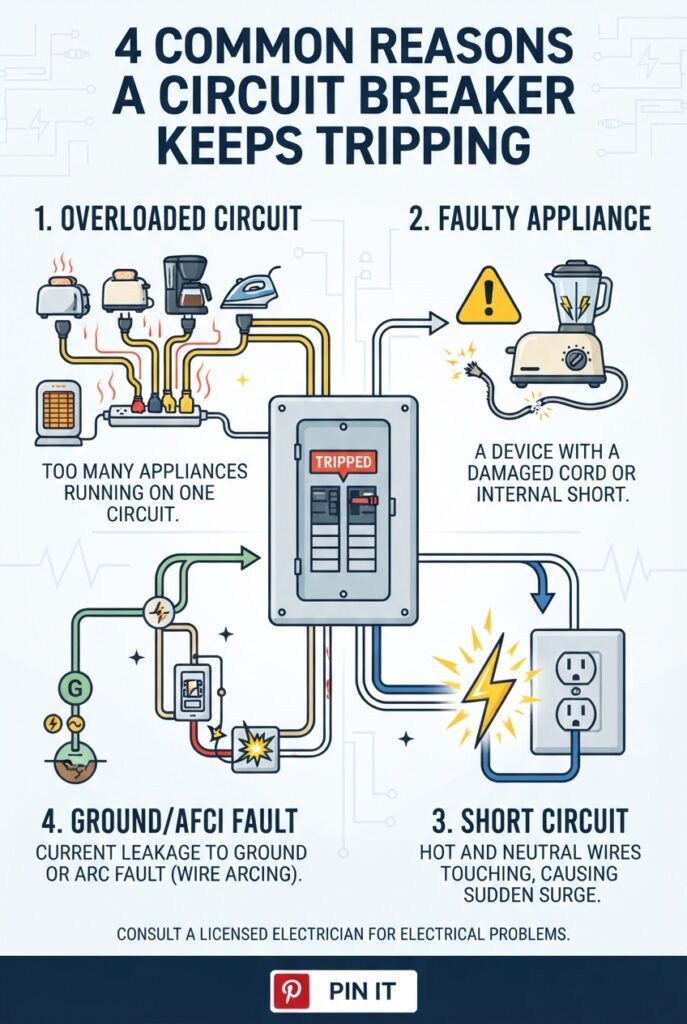
How Appliance Power Can Contribute to an Overloaded Circuit
Understanding appliance power can make an overloaded circuit easier to recognize. Electrical equipment is commonly labeled with information such as voltage, amperage, or wattage. The combined demand of multiple devices operating at the same time matters because they share the capacity of the circuit supplying them.
For example, if several high-demand appliances are connected to one circuit, their combined electrical demand can exceed the circuit’s safe operating capacity. ESFI explains that a circuit can be overloaded when products connected to it demand more power than the circuit can safely deliver. (eSports Foundation International)
This is also why simply moving an appliance to another nearby outlet may not solve the problem if both outlets are connected to the same branch circuit. The breaker protects the circuit, not an individual outlet.
A Simple Decision Guide for a Tripping Breaker
When a circuit breaker keeps tripping, the sequence below can help you decide what to do without turning a simple troubleshooting situation into an unsafe repair attempt. Begin with observation rather than immediately replacing anything. Identify the affected circuit, consider what appliances were operating, and look for obvious warning signs.
Then use this decision path:
Breaker trips after several appliances run:
Reduce the load and avoid operating multiple high-power appliances on that circuit simultaneously.
Breaker trips whenever one appliance is switched on:
Disconnect that appliance and stop using it until the appliance can be checked.
Breaker trips immediately with appliances disconnected:
Do not repeatedly reset it. Arrange professional electrical diagnosis.
GFCI repeatedly trips:
Disconnect accessible loads and investigate the affected equipment or moisture conditions. Seek professional help if the problem persists.
AFCI repeatedly trips:
Treat repeated trips as a possible wiring, appliance, or arc-fault concern and arrange appropriate inspection.
You notice heat, burning, buzzing, discoloration, or electrical shock:
Stop troubleshooting and obtain professional assistance.
This approach keeps the focus on identifying the cause rather than simply restoring electricity.
Related SmartAirHQ Reading for Better Lighting Decisions
Electrical circuits and lighting are closely connected because lighting loads contribute to the total electrical demand on a circuit. If you are also comparing lighting products, understanding lumens can help you evaluate brightness without relying only on wattage. Wattage describes energy consumption, while lumens describe light output.
You can read the previous SmartAirHQ guide on what lumens mean for light output to better understand lighting specifications when choosing bulbs and fixtures. This is particularly useful when replacing older lighting with more efficient options while keeping the focus on appropriate electrical loading.
Frequently Asked Questions About a Circuit Breaker That Keeps Tripping
Repeated breaker trips naturally raise several questions, especially when the breaker seems to reset normally and then trips again. The key principle is that a breaker trip should be understood as a protective response, not automatically treated as a defective switch. The answer depends on when the breaker trips, what equipment is connected, and whether there are signs of an electrical fault.
Why does my breaker trip even when only one appliance is running?
One appliance can still cause a trip if it has a fault, draws significant current, or the circuit has another electrical problem. If the breaker consistently trips when that appliance starts, disconnect it and have the appliance or circuit professionally evaluated.
Should I keep resetting a breaker that keeps tripping?
No. If a breaker repeatedly trips, particularly immediately after being reset, investigate the underlying cause instead of repeatedly restoring power. Persistent trips can indicate overloads, short circuits, ground faults, arc faults, wiring problems, or equipment faults. (U.S. Consumer Product Safety Commission)
Can too many appliances make a circuit breaker trip?
Yes. Multiple appliances operating on the same branch circuit can create an overload when their combined electrical demand exceeds the circuit’s safe capacity. Reducing the load may resolve an overload, but persistent capacity problems should be evaluated professionally. (eSports Foundation International)
Why does my breaker trip immediately after I turn it on?
An immediate trip can indicate a persistent fault, short circuit, appliance problem, or another condition that requires investigation. Disconnect accessible loads and avoid repeatedly resetting the breaker if it continues to trip.
Can a bad appliance trip the circuit breaker?
Yes. A malfunctioning appliance or damaged power cord can cause electrical problems that make the protective device trip. If one appliance repeatedly causes the breaker to trip, disconnect it and have it checked rather than continuing to use it. (U.S. Consumer Product Safety Commission)
Is a frequently tripping breaker dangerous?
It can indicate a potentially unsafe electrical condition. The trip itself is a protective function, but the underlying reason should not be ignored. Warning signs such as burning smells, heat, buzzing, discoloration, or repeated immediate trips warrant professional attention.
Final Thought: Find the Cause Instead of Fighting the Breaker
When a circuit breaker keeps tripping, the best solution is not to keep switching it back on. First consider whether the circuit is overloaded, whether a particular appliance is responsible, and whether the trip involves GFCI or AFCI protection. If the breaker continues to trip after obvious loads have been removed, professional electrical diagnosis is the safer next step.
A properly functioning breaker is an important part of electrical protection. Treat repeated trips as useful warning information, reduce unnecessary electrical loads, disconnect suspicious appliances, and never bypass protective devices simply to keep power flowing. When the cause is unclear or warning signs are present, a qualified electrician can identify the underlying problem and determine the appropriate repair.
Explore SmartAirHQ for Practical Home & Appliance Guides
For more practical guidance on home appliances, electrical troubleshooting, energy efficiency, tools, repairs, and smart home solutions, visit SmartAirHQ. Explore helpful, easy-to-follow articles designed to help homeowners understand their appliances, solve common household problems, choose useful tools, and make smarter decisions for their homes.
Suggested Pinterest text overlay:
“Circuit Breaker Keeps Tripping? Find Out Why”
Pinterest-friendly visual concept: Use a clean vertical graphic showing a home electrical panel with one tripped breaker, a small warning icon, and three short callouts: Overload • Faulty Appliance • Wiring Problem. Keep the main keyword prominent and use a clear, high-contrast design so the pin remains readable on mobile.
Suggested Pinterest URL:
SmartAirHQ
📌 Save on Pinterest
📌 (https://pin.it/1U56hjmnR)
Pinterest account: smartairhq