A torque wrench is one of the most useful tools when a fastener needs to be tightened to a specific torque rather than simply made “as tight as possible.” The correct torque can help prevent loose fasteners, overtightening, damaged threads, and unnecessary stress on components. Whether you work on a vehicle, bicycle, small engine, machinery, or DIY project, understanding how torque wrenches work and how to use them correctly can make fastening work more consistent.
This guide explains what a torque wrench does, the main types available, how to select the right one, how to use it properly, common mistakes to avoid, and how to store and maintain it.
Affiliate disclosure: This article contains affiliate links. If you purchase through qualifying links, SmartAirHQ may earn a commission at no additional cost to you.
The links throughout this guide are designed to help you browse relevant products and tool categories. Prices, availability, specifications, and seller information can change, so verify the current product details before purchasing.
What Is a Torque Wrench and Why Is It Important?
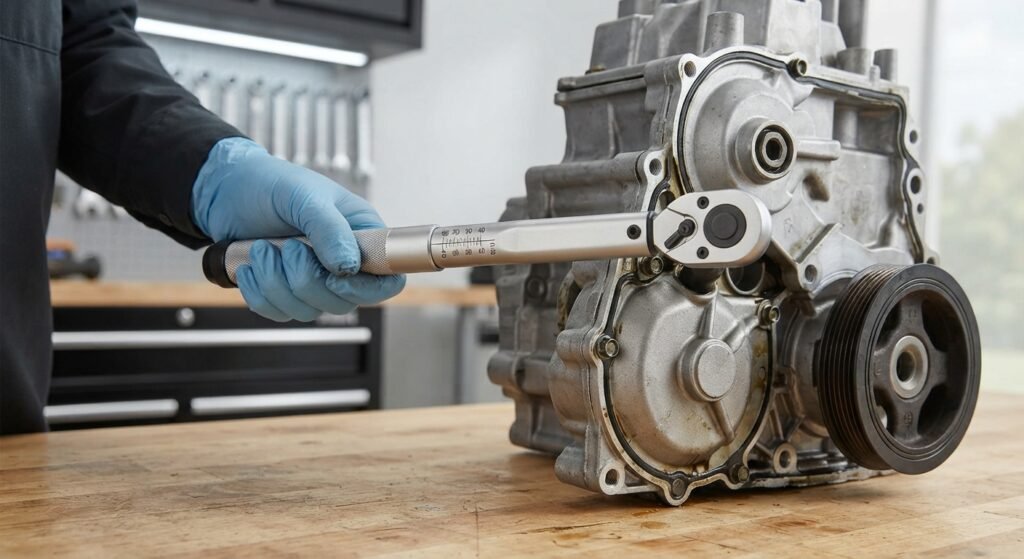
A torque wrench is a hand tool designed to apply a specified amount of rotational force to a fastener. Instead of relying only on feel, you use the tool according to a torque specification supplied for the particular application. Torque may be expressed in units such as foot-pounds (ft-lb), inch-pounds (in-lb), or newton-meters (Nm). The correct setting depends on the fastener and the manufacturer’s instructions.
Torque control matters because both insufficient and excessive tightening can create problems. A fastener that is not tightened enough may loosen under vibration or movement, while excessive torque can damage threads, fasteners, or the components being assembled. (Lowe’s)
For More Information Visit the Link Below
For readers interested in practical tools and home technology, you can also explore the wider collection of guides in the Smart Gadgets category.
How Does a Torque Wrench Work?
A torque wrench measures or controls the amount of force applied while turning a fastener. The exact mechanism depends on the design. A click-style wrench uses a mechanical mechanism that signals when the selected torque has been reached. A digital model uses electronic measurement and a display, while a beam wrench uses a pointer and graduated scale.
The important principle is simple: the wrench helps you stop tightening at a defined torque value. The tool itself does not determine the correct torque for your project. You must obtain the correct specification from the equipment, vehicle, bicycle, machine, or component manufacturer.
Torque wrenches also have operating ranges. A wrench designed for relatively low torque should not be treated as a substitute for a high-range tool, and exceeding the manufacturer’s limits can damage the instrument.
Types of Torque Wrenches Explained
Torque wrenches are available in several designs, but click, digital, beam, and split-beam models are among the most useful categories for general users. Choosing between them depends on the torque range you need, how frequently you use the tool, how easy you want the reading process to be, and the environment in which you work.
There is no single “best” design for every job. A simple mechanical wrench can be practical for occasional automotive or workshop work, while a digital model may be attractive when you want a clear display and audible, visual, or vibration alerts. Manufacturer instructions should always take priority over generalized operating advice. (Lowe’s)
Click-Type Torque Wrench
A click torque wrench is a popular choice for automotive, mechanical, and DIY applications. You set the required torque on the handle, tighten the fastener, and stop when the wrench produces its characteristic click. The click provides a tactile and audible indication that the selected torque has been reached.
One advantage is that you do not have to continuously watch a display while tightening. However, you must stop applying force immediately after the click. Continuing to pull after the signal can increase the applied torque beyond the desired value. After completing the job, many conventional click-style wrenches should be returned to their lowest setting according to the manufacturer’s storage instructions. (Lowe’s)
Digital Torque Wrench
A digital torque wrench replaces the traditional mechanical scale with an electronic display. Depending on the model, it may provide audible alerts, lights, vibration, multiple measurement units, or other indicators as you approach and reach the target torque.
Digital tools can be convenient when you want a highly visible numerical reading or need to work with different torque units. They are particularly useful when the user prefers electronic feedback rather than interpreting a mechanical scale. Battery requirements, operating instructions, and calibration procedures vary, so the manufacturer’s manual is important for reliable use. (Lowe’s)
Beam Torque Wrench
A beam torque wrench uses a pointer and scale to show the torque being applied. Unlike a click wrench, it generally does not require the user to preset a target value on a rotating handle. Instead, the user watches the pointer while applying force smoothly.
The design is mechanically straightforward, but reading the scale can be more difficult depending on the working position and visibility. A beam wrench can be useful when you want a direct visual indication of applied torque, but accurate reading requires proper alignment with the scale. (Lowe’s)
Split-Beam Torque Wrench
A split-beam torque wrench is another mechanical design commonly used for controlled fastening. Its construction differs from a conventional micrometer-style click wrench, and many users appreciate the straightforward setting process and durability of the mechanism.
When comparing a split-beam model with another torque wrench, focus on the tool’s torque range, drive size, accuracy specification, adjustment method, and manufacturer’s instructions rather than assuming one design is automatically superior.
Torque Wrench Drive Size and Torque Range
Drive size is one of the first specifications to consider when selecting a torque wrench. Common drive sizes include 1/4-inch, 3/8-inch, and 1/2-inch, with larger sizes generally suited to higher-torque applications. The correct choice depends on the fasteners, sockets, and torque values involved in your work.
A small drive can be useful for lower-torque applications, while a 1/2-inch drive is common for heavier automotive work. However, drive size alone does not determine how much torque a wrench can safely apply. Always compare the actual torque range with the specification required by your project. (Lowe’s)
| Drive size | Typical use category | What to check |
|---|---|---|
| 1/4-inch | Small fasteners, electronics, bicycles, precision work | Low torque range |
| 3/8-inch | General mechanical and automotive work | Mid-range torque |
| 1/2-inch | Automotive and heavier fastening | Higher torque range |
| Larger drives | Heavy-duty applications | Manufacturer’s torque capacity |
These are general categories rather than fixed rules. The tool’s published torque range should always be the deciding factor.
How to Choose the Right Torque Wrench
Choosing a torque wrench becomes much easier when you start with the application rather than the tool’s appearance or price. First identify the torque values you actually need. Then choose a wrench whose useful operating range comfortably covers those specifications. You should also consider drive size, measurement units, accuracy, adjustment style, construction, storage, and how frequently the tool will be used.
Accuracy is especially important when controlled tightening matters. Product specifications may express accuracy as a percentage, so a smaller stated error range generally indicates a tighter accuracy specification. (Lowe’s)
Match the Torque Range to Your Application
Do not select a wrench simply because its maximum torque number looks impressive. The important question is whether the torque values you regularly use fall within the appropriate working range of the tool.
For example, a person working mainly on bicycles and small mechanical assemblies may have different requirements from someone servicing vehicle wheel fasteners. If your projects cover widely separated torque values, using two appropriately ranged tools may be more practical than forcing one wrench to cover everything.
Consider Accuracy and Calibration
Accuracy is an important consideration for anyone who depends on controlled fastening. Torque tools can require verification and calibration, particularly when they are used frequently or when the application is important enough that the applied torque must be dependable.
ISO 6789 is an internationally recognized standard covering requirements and verification procedures for hand torque tools. Calibration should be handled according to the manufacturer’s recommendations and the requirements of the application. (Norbar)
Choose the Right Handle and Readout
A comfortable handle and easy-to-read adjustment system can make a noticeable difference during repeated work. Click wrenches are convenient because the signal can be felt and heard, while digital models can provide a numerical display and additional alerts.
If you frequently work in awkward positions, think about whether you can clearly read the scale or display and whether you can maintain the recommended grip and loading position. Good ergonomics should support accurate use rather than simply making the tool look more advanced.
How to Use a Torque Wrench Correctly
Using a torque wrench correctly is more than setting a number and pulling the handle. The fastener should be suitable for the application, the socket should fit properly, the specified torque should come from a reliable source, and force should be applied in the manner described by the tool manufacturer.
Before beginning, inspect the wrench and socket for visible damage. Clean the fastener threads when appropriate, and do not add lubricant unless the equipment instructions call for it because lubrication can affect the tightening relationship between torque and clamping force. (Lowe’s)
Step 1 — Find the Correct Torque Specification
Start with the manufacturer’s torque specification for the exact fastener or assembly. Do not guess based on the size of the bolt or how tight the previous installation felt.
The specification may be given in Nm, ft-lb, or in-lb. If conversion is necessary, use a reliable conversion method and confirm the unit displayed on your wrench before tightening. A wrong unit can result in a substantially different setting, so this is one of the most important checks before starting.
Step 2 — Select the Correct Socket
Choose a socket that properly fits the fastener. A poorly fitting socket can damage the fastener and make controlled tightening more difficult.
Attach the socket securely to the square drive. Check that the socket and wrench are compatible with the application and that neither component is cracked, damaged, or excessively worn.
Step 3 — Set the Torque Value
For a micrometer-style click wrench, unlock the adjustment mechanism according to the instructions, align the major scale with the desired value, then make the finer adjustment using the rotating handle. Lock the setting before tightening.
The exact markings differ between models, so do not assume every torque wrench uses the same scale. A manufacturer’s manual is the best source for learning how to interpret a particular tool. (Lowe’s)
Step 4 — Tighten Smoothly
Place the socket squarely on the fastener and apply steady force through the wrench’s intended grip point. Avoid jerking the handle or changing your grip position unnecessarily.
With a click wrench, stop immediately when the wrench signals that the target has been reached. With a beam wrench, watch the pointer and stop when it reaches the specified value. With a digital wrench, follow the display and alert instructions for that model. (Lowe’s)
Step 5 — Stop at the Target Torque
Once the target has been reached, do not continue tightening simply to make the fastener “extra secure.” A torque wrench is designed to achieve a specified value, not to encourage additional tightening after the target is reached.
If the fastener requires a particular sequence or additional angle after torque is achieved, follow the equipment manufacturer’s procedure rather than improvising.
Common Torque Wrench Mistakes to Avoid
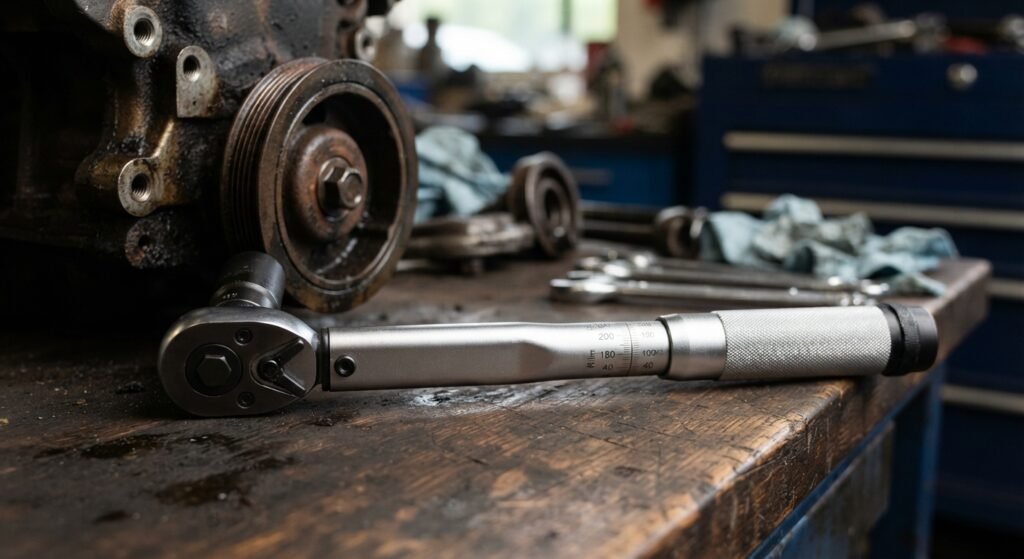
Many torque-related problems come from using the correct tool incorrectly. One of the most common mistakes is treating a torque wrench like an ordinary ratchet. Torque wrenches are precision tools, and their intended operation, loading point, torque range, and storage procedure matter.
Another common mistake is assuming that hearing a click means you should click the wrench repeatedly. A click is a signal to stop applying force, not an instruction to continue tightening. Using the wrench outside its intended range or using it to loosen stubborn fasteners can also affect performance. (Lowe’s)
Avoid these mistakes:
- Do not use a torque wrench as a breaker bar for loosening stubborn fasteners.
- Do not exceed the wrench’s maximum torque rating.
- Do not keep pulling after a click.
- Do not guess the torque specification.
- Do not use a damaged socket or fastener.
- Do not change the grip position unnecessarily.
- Do not add lubricant unless the application specifies it.
- Do not store an adjustable wrench at an inappropriate setting.
- Do not ignore calibration or verification requirements.
- Do not assume every torque wrench is operated in exactly the same way.
If you are building a broader DIY toolkit
If you are building a broader DIY toolkit, the complete website tour of SmartAirHQ can help you explore other tool and smart-gadget resources.
Can You Use a Torque Wrench to Loosen Bolts?
In general, a torque wrench should not be used as your everyday loosening tool. A standard wrench, ratchet, or breaker bar is more appropriate for removing fasteners. Using a torque wrench for loosening can expose the mechanism to forces outside its intended operating purpose and may affect its accuracy over time.
For a fastener that is stuck, use an appropriate loosening tool rather than forcing the torque wrench beyond its intended function. After loosening, switch back to the torque wrench when you are ready to install and tighten the fastener to the specified value. (Lowe’s)
Torque Wrench Care, Storage, and Calibration
Proper maintenance helps preserve the performance of a torque wrench. The tool should be protected from impacts, dirt, moisture, and unnecessary mechanical stress. After use, clean it as recommended by the manufacturer and store it in a suitable case or protected location.
Calibration is particularly important when the tool is used regularly or where torque accuracy has significant consequences. Norbar notes that calibration requirements can depend on factors such as frequency of use, application criticality, environment, and quality-system requirements; ISO 6789 provides recognized requirements for hand torque tools. (Norbar)
How Should a Click Torque Wrench Be Stored?
For many conventional adjustable click torque wrenches, the manufacturer recommends reducing the setting to the lowest specified value before storage. This helps protect the internal mechanism, but the exact procedure should come from the tool’s manual because designs vary.
Keep the wrench in its protective case when possible. Avoid throwing it into a toolbox where it can be repeatedly struck by heavy tools.
When Should a Torque Wrench Be Calibrated?
There is no single interval that is appropriate for every user and application. Calibration frequency can depend on usage, environment, application criticality, and the manufacturer’s recommendations.
Professional torque-control environments may have formal calibration schedules. For occasional DIY use, following the tool manufacturer’s guidance and having the tool checked when accuracy is in doubt is a sensible approach. Calibration procedures should be performed with suitable equipment rather than improvised at home. (Norbar)
Using Torque Wrenches With Extensions and Crowfoot Adapters
Extensions and adapters require attention because changing the geometry between the wrench and fastener can alter the effective leverage. A simple straight extension on the square drive does not necessarily have the same effect as adding a crowfoot or another tool that increases the effective length.
For example, a crowfoot positioned at 90 degrees to the torque wrench can preserve the effective length in the configuration described by TEKTON, while other orientations can require a correction. Always follow the adapter manufacturer’s or torque-wrench manufacturer’s calculation method rather than assuming every extension can be ignored. (TEKTON Tools)
This is especially important when a specified torque is critical. If you are unsure whether an adapter changes the effective torque, check the manufacturer’s guidance before tightening.
Torque Wrench vs Regular Wrench
A regular wrench and a torque wrench perform related but different jobs. A standard wrench or ratchet is primarily intended to turn fasteners efficiently. A torque wrench adds controlled measurement or indication so the user can stop at a defined torque.
| Feature | Regular wrench/ratchet | Torque wrench |
|---|---|---|
| General tightening | Yes | Yes |
| Precise torque setting | No | Yes |
| Removing stubborn fasteners | Suitable with appropriate tool | Generally not recommended |
| Torque feedback | Usually none | Mechanical or electronic |
| Best use | General fastening | Specified-torque fastening |
For routine installation where no torque specification exists, a regular wrench may be sufficient. When the manufacturer’s instructions specify a torque value, a torque wrench is the appropriate tool for controlled tightening.
Best Torque Wrench Features to Look For
The right features depend on how you intend to use the tool. Rather than buying the most complicated model available, prioritize specifications that directly match your work. Torque range and accuracy are usually more important than cosmetic features, while drive size determines compatibility with your sockets and fasteners.
For frequent use, also consider the readability of the scale, locking mechanism, handle comfort, storage case, measurement units, and availability of manufacturer documentation. A well-documented tool is easier to use consistently because you can verify its adjustment, maintenance, and calibration procedures when needed.
A practical buying checklist includes:
- Suitable torque range
- Appropriate drive size
- Clearly marked scale or display
- Stated accuracy
- Comfortable grip
- Reliable adjustment mechanism
- Protective storage case
- Manufacturer instructions
- Calibration or verification information
- Socket compatibility
Browse Amazon
If you are ready to compare torque wrenches, these Amazon browsing links can help you explore different sizes and styles. Always compare the current torque range, accuracy specification, drive size, included accessories, seller information, and customer feedback before purchasing.
1. 1/2-Inch Torque Wrench — A practical starting point for shoppers looking for a larger-drive wrench commonly associated with heavier mechanical work.
Browse 1/2-Inch Torque Wrenches on Amazon
2. 3/8-Inch Torque Wrench — Explore compact options for general automotive and mechanical applications.
Browse 3/8-Inch Torque Wrenches on Amazon
3. 1/4-Inch Torque Wrench — Useful for shoppers searching for lower-torque tools and smaller fastening applications.
Browse 1/4-Inch Torque Wrenches on Amazon
4. Digital Torque Wrench — Compare electronic models with digital displays and different alert features.
Browse Digital Torque Wrenches on Amazon
5. Click Torque Wrench — Browse traditional click-style models for controlled mechanical fastening.
Browse Click Torque Wrenches on Amazon
6. Beam Torque Wrench — Compare beam-style designs if you prefer a visible mechanical scale.
Browse Beam Torque Wrenches on Amazon
7. Automotive Torque Wrench — Explore torque tools intended for automotive maintenance and repair applications.
Browse Automotive Torque Wrenches on Amazon
8. Bike Torque Wrench — Compare smaller torque tools designed around bicycle maintenance needs.
Browse Bike Torque Wrenches on Amazon
9. Torque Wrench Set — Look for sets that combine a torque wrench with sockets or accessories.
Browse Torque Wrench Sets on Amazon
10. Micrometer Torque Wrench — Explore adjustable micrometer-style models and compare their scales and torque ranges.
Browse Micrometer Torque Wrenches on Amazon
11. High-Torque Wrench — Browse models intended for applications requiring higher torque ranges.
Browse High-Torque Wrenches on Amazon
12. Torque Wrench Accessories — Find compatible sockets, adapters, cases, and related accessories after choosing your wrench.
Browse Torque Wrench Accessories on Amazon
🛒 Check Price on Amazon
When you have identified the torque range and drive size that fit your project, you can use the button below to continue browsing Amazon.
Torque Wrench Buying Checklist
Before purchasing, take a moment to write down the torque specifications you encounter most often. This simple step prevents a common buying mistake: selecting a tool based on its appearance or maximum rating without checking whether its useful range actually matches the work.
A good torque wrench should fit the application rather than forcing the application to fit the tool. Check the drive size, torque units, usable range, stated accuracy, adjustment mechanism, and manufacturer’s documentation. If you expect to use the wrench frequently, also consider how easy it is to set, read, store, and maintain.
For related tool-selection content
For related tool-selection content, the Best Stud Finder: Complete Buying Guide offers another example of how to compare specifications before purchasing a tool.
Frequently Asked Questions About Torque Wrenches
A torque wrench often seems straightforward until you actually need to select, set, or maintain one. The following questions cover some of the most common practical issues. The answers are intentionally concise, but the manufacturer’s instructions for your specific model should always take priority because torque wrench mechanisms and operating procedures can differ.
What is the main purpose of a torque wrench?
A torque wrench is used to tighten a fastener to a specified torque rather than relying only on hand feel.
Can I use a torque wrench as a normal ratchet?
It is better to use a standard ratchet for routine turning and loosening. A torque wrench should be reserved for controlled tightening.
Should I keep tightening after a torque wrench clicks?
No. With a click-style wrench, stop applying force when the target signal occurs. Continuing to pull can increase the applied torque. (Lowe’s)
Which torque wrench drive size should I buy?
Choose the drive size that matches your sockets and application. The torque range is just as important as the physical drive size.
Is a digital torque wrench better than a click wrench?
Not automatically. Digital models provide electronic readings and alerts, while click models offer a simple mechanical signal. The better choice depends on your application, preferences, and required accuracy.
How often should a torque wrench be calibrated?
Calibration requirements vary according to the tool, usage, environment, application, and manufacturer’s recommendations. Professional applications may require formal calibration schedules. (Norbar)
Can I use an extension with a torque wrench?
Some extensions can be used without changing the effective torque, while certain adapters, including crowfoot configurations, can change leverage. Follow the manufacturer’s instructions for the exact configuration. (TEKTON Tools)
Pinterest Tips for This Torque Wrench Guide
If you found this torque wrench guide helpful, save it to Pinterest for later. This guide covers how a torque wrench works, different torque wrench types, choosing the right torque range and drive size, proper use, common mistakes, and basic care and storage. It’s a useful reference for DIY projects, automotive work, bicycle maintenance, and workshop tasks.
Follow @smartairhq on Pinterest for more practical tool guides, smart gadget tips, buying guides, and helpful DIY resources.
📌 Save on Pinterest
Final Thought: Choose the Torque Wrench That Matches the Job
A torque wrench is valuable because it replaces guesswork with controlled tightening. The most important decision is not simply choosing the most expensive or feature-rich tool; it is selecting a wrench with an appropriate torque range, drive size, accuracy, and operating method for your actual work.
Use the correct torque specification, apply force smoothly, stop at the target, avoid using the tool as a breaker bar, and store it according to the manufacturer’s instructions. With those habits, a torque wrench can become a dependable part of an automotive, bicycle, workshop, or DIY toolkit.
For current product availability, compare the specifications carefully before buying, because prices, stock, sellers, and product configurations can change.
For an external technical reference, readers can also consult Lowe’s torque wrench guide for additional general-use guidance. (Lowe’s)