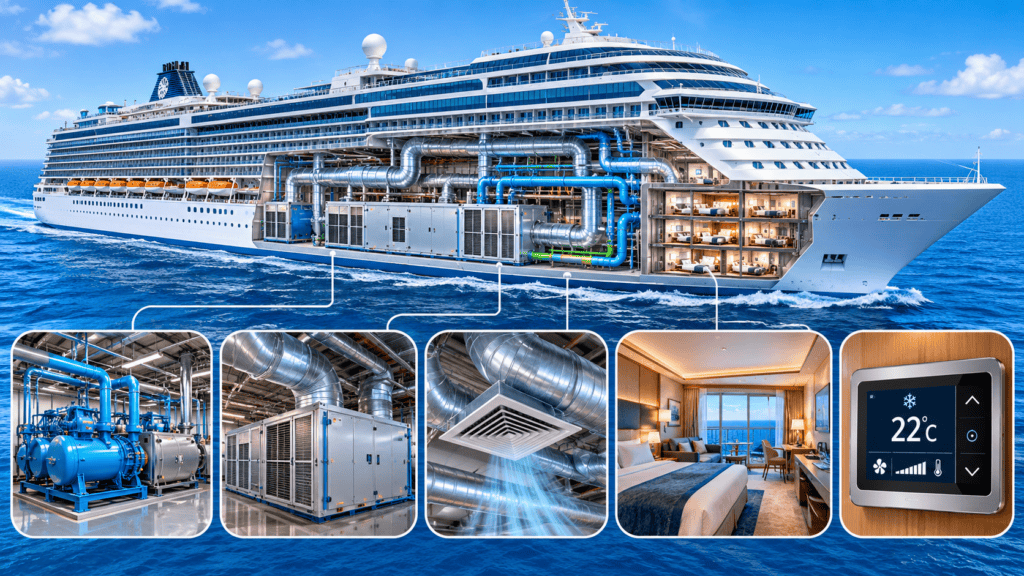
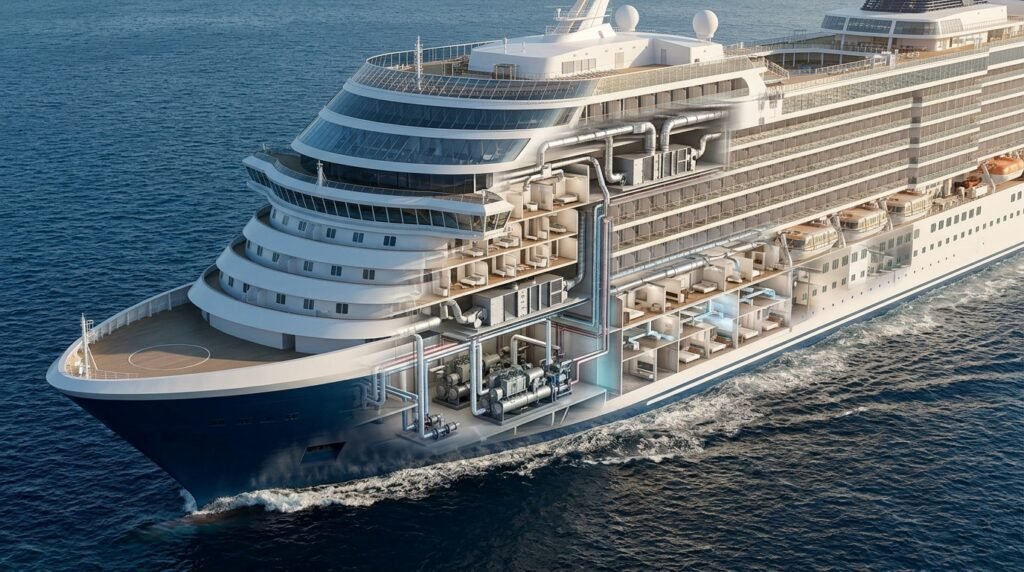
Cruise ships travel through different climates, from tropical destinations to cooler coastal regions. Despite changing outdoor temperatures, passengers expect their cabins to remain comfortable throughout the journey. This is made possible by marine heating, ventilation, and air conditioning systems designed specifically for large passenger vessels.
Cruise ship climate control involves more than simply installing an air conditioner in every cabin. A typical arrangement combines central cooling equipment, chilled-water circulation, air-handling units, cabin fan-coil units, ventilation controls, and temperature sensors. These components work together to maintain comfortable indoor conditions across thousands of passenger and crew spaces.
Unlike residential systems, marine HVAC equipment must also account for limited machinery space, ship movement, salt exposure, changing outdoor conditions, fire safety, and substantial energy requirements.
This guide explains how cruise ship cabin temperature systems work, how individual cabins receive heating and cooling, how fresh air is supplied, and why temperatures can sometimes feel different from one cabin to another.
Quick answer: Many modern cruise ships use central chilled-water cooling systems connected to air-handling units and individual cabin fan-coil units. A cabin controller can adjust the fan speed or heating and cooling output, while central equipment manages chilled water and ventilation. The exact arrangement varies by ship.
What Is Cruise Ship Climate Control?
Cruise ship climate control is the coordinated management of indoor temperature, air circulation, ventilation, and humidity aboard a passenger vessel.
Its main purpose is to maintain suitable conditions in different parts of the ship, including:
Passenger cabins and suites
Restaurants and dining rooms
Theatres and entertainment spaces
Corridors and reception areas
Fitness centers and indoor recreation areas
Crew accommodation
Technical and machinery spaces
Each area can have different heating, cooling, and ventilation requirements. A crowded restaurant, for example, produces a different amount of heat and moisture than an unoccupied passenger cabin.
The system must account for these differences while operating within the physical and energy limitations of a ship.
A marine HVAC installation also faces conditions that are less important in ordinary buildings. Salt exposure, vibration, ship movement, equipment weight, corrosion resistance, and fire protection all influence its design. ASHRAE identifies these as important considerations in shipboard air-conditioning engineering.
How Does a Cruise Ship Air Conditioning System Work?
A common cruise ship air-conditioning arrangement uses a central cooling plant connected to a network of chilled-water pipes. The chilled water supplies central air-handling equipment and individual fan-coil units installed in passenger cabins.
The cooling process can be understood in six stages:
Central chillers produce chilled water.
Pumps circulate chilled water through insulated pipework.
Air-handling units condition incoming ventilation air.
Cabin fan-coil units use chilled water to remove heat from cabin air.
Cabin controllers adjust the local heating or cooling output.
Return water travels back to the cooling plant to be cooled again.
The chilled-water circuit is separate from the air moving through the cabin. Water transfers heat through a coil, while fans move air across that coil.
This arrangement allows central equipment to serve many cabins without requiring a separate complete refrigeration system in every passenger room.
Main Components of a Cruise Ship HVAC System
Component
Main function
Why it matters
Central chillers
Produce chilled water
Provide the cooling source
Pumps
Circulate water through the system
Maintain the required water flow
Chilled-water pipes
Transport cooled water
Connect central equipment with cabin units
Air-handling units
Condition and distribute ventilation air
Supply treated fresh air
Fan-coil units
Heat or cool individual cabin air
Provide local cabin comfort
Temperature controllers
Adjust cabin heating or cooling
Allow passenger-level temperature adjustments
Sensors and valves
Monitor conditions and regulate flow
Help maintain stable operation
The exact configuration depends on the vessel’s design, capacity, age, and operating requirements. Danfoss describes fan-coil units as a common solution for cruise ship passenger cabins.
How Cruise Ship Chilled-Water Systems Produce Cooling
The central cooling plant is one of the most important parts of a ship’s climate-control arrangement.
In a typical seawater-cooled chiller installation, refrigeration equipment removes heat from the chilled-water circuit. A separate seawater cooling arrangement helps carry heat away from the refrigeration equipment.
It is important to understand that seawater is not normally circulated directly through passenger cabin cooling coils. The cabin cooling circuit uses its own treated water loop, separated from the surrounding seawater.
The Cooling Process
Step 1: Heat is collected inside the ship.
Heat enters passenger spaces through sunlight, windows, walls, lighting, electrical equipment, ventilation air, and the people occupying the rooms.
Step 2: Cabin air transfers heat to a cooling coil.
A fan moves cabin air across a heat exchanger containing chilled water. Heat transfers from the air into the water.
Step 3: Warmer water returns to the cooling plant.
The water that has absorbed heat travels through the return pipework toward the central cooling equipment.
Step 4: The chiller removes the heat.
The refrigeration cycle transfers heat away from the chilled-water circuit. A seawater-cooled arrangement can then reject this heat through a separate cooling system.
Step 5: Chilled water circulates again.
The cooled water returns to the distribution network, where it can supply cabin fan coils and central air-handling units.
Main Cooling-Plant Equipment
Equipment
What it does
Typical location or role
Chiller
Removes heat from circulating water
Central machinery area
Compressor
Drives the refrigeration cycle
Part of the chiller
Heat exchanger
Transfers heat between separate fluid circuits
Cooling and heat-rejection equipment
Circulation pump
Moves chilled water through pipework
Water distribution system
Control valve
Regulates water flow
Chiller and terminal-unit circuits
Expansion equipment
Supports correct refrigeration-cycle operation
Refrigeration circuit
The exact equipment arrangement is vessel-specific. Some ships use different cooling configurations, equipment redundancies, or control strategies.
How Fan-Coil Units Control Individual Cruise Cabins
A fan-coil unit, commonly called an FCU, is a terminal unit that can provide heating or cooling to an individual cabin.
It typically contains a fan, a heat-exchange coil, a filter, a condensate-drain arrangement, and control components. On many cruise ships, these units are installed above the cabin ceiling or within a dedicated service space.
The fan draws cabin air through the unit and moves it across the coil. Depending on the system’s operating mode, the coil can cool or heat the air before it returns to the room.
Main Parts of a Cabin Fan-Coil Unit
Part
Function
Effect on cabin comfort
Fan
Moves air through the unit
Controls air circulation
Cooling coil
Transfers heat from cabin air to chilled water
Reduces air temperature
Heating coil
Transfers heat to cabin air
Raises air temperature
Air filter
Captures some airborne particles
Helps protect the unit and maintain airflow
Condensate drain
Removes water formed during cooling
Helps prevent water accumulation
Control valve
Regulates water flow through the coil
Adjusts heating or cooling output
A cabin controller can adjust the fan speed or signal a valve actuator to change water flow. Some systems integrate these controls with a central ship management system.
This means two nearby cabins can have different temperature settings even though they receive cooling from the same central plant.
Danfoss explains that cruise ship fan-coil units can be connected to cabin temperature controllers or a ship management system. The arrangement may use two-, three-, or four-pipe configurations depending on the design.
How Passengers Adjust Their Cabin Temperature
Passengers generally interact with a cabin temperature controller rather than the central chiller or machinery equipment.
Depending on the ship, the control may be a wall-mounted dial, a digital controller, or part of a cabin management interface.
Common functions include:
Increasing or decreasing the temperature setting
Selecting heating or cooling, where available
Adjusting fan speed
Switching the unit between operating modes
Allowing the system to maintain a selected temperature range
Not every cruise ship provides the same level of control. Some allow passengers to adjust the temperature directly, while others limit the available range or centrally manage certain operating conditions.
Cabin Temperature Control Functions
Control feature
What the passenger can do
Availability
Temperature adjustment
Request a warmer or cooler cabin
Common, but range varies
Fan-speed control
Select a fan-speed setting
Depends on the controller
Operating mode
Select heating or cooling where supported
Depends on system design
Automatic operation
Allow the controller to regulate output
Available on some systems
Central management
Allow ship staff or the control system to monitor equipment
Depends on ship integration
If a cabin remains uncomfortable after adjusting its controller, passengers should contact guest services rather than opening equipment panels or attempting to modify HVAC components.
How Cruise Ships Supply Fresh Air and Manage Ventilation
Cooling and ventilation are related, but they are not the same process.
Cooling removes heat from indoor air. Ventilation supplies outdoor air and manages the movement and removal of air from occupied spaces.
Cruise ships need both processes to maintain suitable indoor conditions.
Central air-handling units can treat incoming outdoor air before distributing it through ventilation ducts. Depending on the vessel’s design, this air may be filtered, cooled, dehumidified, or otherwise conditioned before it reaches passenger spaces.
Some common cruise ship arrangements combine central ventilation air with air recirculated through local cabin fan-coil units.
Ventilation Versus Cabin Air Recirculation
Process
What happens
Main purpose
Outdoor-air supply
Fresh outdoor air enters through the ventilation system
Provides ventilation
Air filtration
Air passes through selected filters
Captures some particles
Air conditioning
Air is cooled or heated
Maintains temperature
Dehumidification
Moisture is removed from air
Helps control humidity
Cabin air recirculation
Existing cabin air passes through the fan-coil unit again
Provides additional local heating or cooling
Exhaust air removal
Air is removed from selected spaces
Helps manage indoor air conditions
Recirculated cabin air should not be confused with fresh outdoor air. A fan-coil unit can circulate room air while a separate ventilation system provides the required outdoor-air supply.
The ventilation design varies by ship and space. Restaurants, theatres, cabins, kitchens, and machinery areas do not necessarily use identical airflow arrangements.
How Cruise Ships Manage Humidity
Temperature alone does not determine whether a cabin feels comfortable. Humidity also affects how people experience indoor conditions.
Warm air can hold more water vapor than cold air. When warm, moisture-containing air is cooled, some of that moisture may condense on a cooling coil.
Cruise ship HVAC systems can remove moisture through the cooling and dehumidification process. The condensate collected at the coil is directed away through a drain system.
This is especially important because ships may operate in humid tropical climates where outdoor air contains substantial moisture.
Factors That Affect Cabin Humidity
Factor
Possible effect
HVAC response
Humid outdoor air
Increases moisture entering the ship
Condition and dehumidify ventilation air
Occupants
Add moisture through breathing and other activities
Provide suitable ventilation
Wet clothing and towels
Add moisture to the cabin
Use appropriate drying and ventilation facilities
Cooling-coil temperature
Influences moisture condensation
Regulate cooling conditions
Poor condensate drainage
Can cause water accumulation
Inspect and maintain drainage
Door openings
Allow outdoor or corridor air to enter
Maintain appropriate ventilation and pressure arrangements
Cruise ship humidity control should not be confused with residential humidity recommendations. For household moisture guidance, see SmartAirHQ Best Humidity Level for Home. The correct operating conditions aboard a ship depend on its HVAC design and operating environment.
Why Cruise Ship Cabins Sometimes Feel Too Cold or Too Warm
Even a well-designed system cannot guarantee that every passenger will experience the same level of comfort.
Cabin temperature can be influenced by sunlight, window exposure, occupancy, equipment heat, ventilation conditions, airflow, and the way a local fan-coil unit is controlled.
Common Cabin Temperature Problems
Problem
Possible cause
What passengers should do
Cabin feels too cold
Low temperature setting or excessive cooling
Adjust the controller within its available range
Cabin feels too warm
High heat gain or insufficient cooling
Check the setting and contact guest services if needed
Weak airflow
Dirty filter, fan issue, or airflow restriction
Report the issue to ship staff
Uneven temperature
Local airflow or control imbalance
Request an inspection
Unusual noise
Fan, vibration, or mechanical issue
Report the noise
Water near the unit
Possible condensate-drain problem
Notify maintenance or guest services promptly
Passengers should not block air outlets, remove filters, open ceiling panels, or attempt to repair the equipment themselves.
If the control does not respond or the room remains uncomfortable, the ship’s maintenance team can investigate the local unit and its controls.
How Cruise Ship HVAC Systems Save Energy
Heating and cooling large passenger ships requires substantial energy. Air conditioning is therefore an important consideration in overall vessel energy management.
Ship designers and operators can improve system performance through several engineering measures.
Common Energy-Efficiency Strategies
Hydronic balancing: Correctly balancing chilled-water flow helps ensure that terminal units receive the required water flow. Poor balancing can create comfort problems and waste energy.
Variable-speed fans and pumps: Adjusting motor speed to actual demand can reduce unnecessary energy use compared with operating equipment continuously at full speed.
Efficient chillers: Selecting suitable refrigeration equipment and maintaining it properly helps the central cooling plant operate effectively.
Heat recovery: Some vessel designs can recover usable heat from other systems for heating applications.
Occupancy-based control: Some systems use cabin occupancy or key-card information to adjust temperature settings when a room is unoccupied.
Central monitoring: A ship management system can help technical teams monitor equipment, identify abnormal operating conditions, and improve maintenance planning.
A technical study of cruise ship cabin energy demand describes how chilled-water circuits, central air-handling units, and individual cabin fan coils can be integrated into one coordinated arrangement.
How Cruise Ship Climate Control Differs From Home HVAC
Both ships and homes use heating, cooling, ventilation, and temperature controls. However, the equipment and engineering priorities are different.
A residential HVAC system is generally designed around a fixed building. A cruise ship must maintain indoor conditions while moving through changing marine environments and operating with limited space and substantial energy demands.
Comparison
Cruise ship HVAC
Residential HVAC
Operating environment
Moving marine vessel
Fixed building
Cooling distribution
Often central chilled-water networks
Commonly refrigerant or ducted systems
Local temperature control
Cabin fan-coil controller or integrated system
Thermostat or room controller
Ventilation
Central marine air-handling arrangements
Residential ventilation equipment
Design considerations
Corrosion, vibration, ship movement, fire safety and space
Building insulation, ductwork, equipment efficiency and comfort
Best Cruise Cabin Comfort Accessories Worth Packing
A comfortable cruise cabin can make a big difference to your overall travel experience. Although the ship’s built-in HVAC system manages cabin heating and cooling, a few carefully selected travel accessories can help you sleep better, stay organized, and feel more comfortable throughout your journey.
Whether your cabin feels a little chilly, you want better sleep, or you simply need smarter storage in a compact space, these practical cruise accessories are worth considering before departure.
We’ve selected products based on their usefulness for cruise travel, cabin comfort, portability, and everyday convenience.
1. Portable Rechargeable Travel Fan – For Extra Airflow
<text color=”secondary” size=”xs”>BEST FOR PERSONAL AIRFLOW</text>
Some passengers prefer additional airflow while sleeping or relaxing. A compact rechargeable travel fan may help provide personal air circulation without modifying the ship’s built-in air-conditioning system.
Look for:
Rechargeable battery operation
Compact and lightweight design
Adjustable fan speeds
Quiet operation for nighttime use
Stable placement or a suitable travel stand
Why consider it? It can provide extra personal airflow when the cabin feels stuffy, subject to the cruise line’s rules.
Some passengers prefer an additional layer when relaxing or sleeping in an air-conditioned cabin. A lightweight travel blanket offers extra warmth without taking up as much luggage space as a bulky blanket.
Look for:
Soft and breathable fabric
Lightweight construction
Compact folding design
Machine-washable material
A convenient storage pouch
Why consider it? It gives you an extra layer of comfort without needing to change the ship’s temperature settings.
Your choice of sleepwear can influence how comfortable you feel at night. Lightweight, breathable fabrics can be useful when sleeping in a climate-controlled cabin, particularly during warm-weather cruises.
Consider:
Breathable cotton or suitable moisture-managing fabrics
Comfortable, relaxed fit
Lightweight material
Easy-care construction
Sleepwear suitable for the destination’s climate
Why consider it? Comfortable sleepwear helps you adjust to your personal comfort preferences without relying entirely on cabin temperature adjustments.
Cruise cabins can have different lighting conditions depending on their location, window type, and your sleeping schedule. A comfortable blackout sleep mask can help reduce unwanted light when you want to rest.
Look for:
Soft fabric against the skin
Adjustable head strap
Light-blocking design
Contoured shape around the eyes
Compact travel-friendly construction
Why consider it? It can make daytime naps and nighttime sleep more convenient, particularly when your cabin receives outside light.
Sounds from corridors, neighboring cabins, and ship activities may sometimes disturb your rest. Foam earplugs are a compact accessory that can help reduce unwanted background noise.
Consider:
Soft, comfortable material
Appropriate noise-reduction rating
Multiple pairs in one package
Individual or reusable storage case
A suitable fit for your ears
Why consider it? A small pair of earplugs can be useful when you want a quieter environment for sleeping or relaxing.
Between shore excursions, pool activities, and time spent exploring the ship, having a reusable water bottle can be convenient. An insulated bottle can help maintain your preferred drink temperature for longer than an ordinary bottle.
Look for:
Double-wall insulation
Leak-resistant lid
Easy-to-clean design
Convenient carrying handle
Suitable capacity for daily use
Why consider it? It makes carrying drinking water easier during onboard activities and excursions.
Cruise cabins often have limited storage space. Magnetic hooks can help organize lightweight clothing, hats, bags, and accessories when suitable metal surfaces are available.
Before buying, check:
Magnetic strength and weight capacity
Corrosion-resistant construction
Smooth edges
Compact design
Whether the intended cabin surface is magnetic
Why consider it? It can help keep frequently used belongings organized without occupying valuable shelf space.
Keeping toiletries organized can be challenging when bathroom counters and storage areas are limited. A hanging toiletry organizer provides separate compartments for everyday personal-care items.
Look for:
Multiple compartments
Water-resistant material
Strong hanging hook
Transparent pockets for visibility
Foldable and compact construction
Why consider it? It helps reduce clutter and keeps essential items easy to find during your cruise.
A cruise wardrobe may include lightweight daytime clothing, evening outfits, swimwear, and warmer layers. Packing cubes help separate these items and make it easier to locate what you need.
Useful features include:
Different sizes for different clothing types
Durable zippers
Lightweight fabric
Breathable mesh panels
Easy-to-organize sets
Why consider it? You can separate warm-weather clothing from extra layers and keep your suitcase more organized throughout the trip.
10. Digital Thermometer and Hygrometer – Monitor Your Cabin Conditions
<text color=”secondary” size=”xs”>BEST FOR TEMPERATURE AND HUMIDITY AWARENESS</text>
<AsyncImage query=”compact digital indoor thermometer hygrometer temperature humidity monitor” aspectRatio=”16:9″ width=”100%” />
If you are curious about the temperature and relative humidity inside your cabin, a compact digital thermometer and hygrometer can help you observe both measurements.
Consider:
Clear digital display
Temperature and relative humidity readings
Compact size
Easy-to-read measurements
Battery-powered operation
Why consider it? It provides a simple way to observe cabin conditions rather than relying only on how the room feels.
This device only measures environmental conditions. It does not control the ship’s HVAC equipment or guarantee that its readings represent the entire cabin.
11. Quick-Dry Travel Towel – A Useful Extra for Warm Destinations
<text color=”secondary” size=”xs”>BEST FOR BEACH AND POOL DAYS</text>
Which Cruise Cabin Accessories Should You Buy First?
You do not need to purchase every accessory on this list. Start with the items that solve your actual travel needs.
Your travel need
Accessory to consider
Extra personal airflow
Portable rechargeable fan, if permitted
Extra warmth
Lightweight travel blanket
More comfortable sleep
Sleep mask and earplugs
Better clothing organization
Packing cubes
Limited bathroom storage
Hanging toiletry organizer
Cabin condition awareness
Digital thermometer and hygrometer
Beach and pool activities
Quick-dry travel towel
Everyday cabin convenience
Insulated water bottle and slippers
Important: Check Your Cruise Line’s Packing Rules
Before purchasing or packing electrical accessories, review your cruise line’s current prohibited-items policy. Rules can differ between companies and individual items.
Portable fans may require inspection or approval. Some electrical devices, including humidifiers, may be prohibited. Magnetic hooks and other accessories should also be used only where permitted.
Our buying tip: Choose accessories that solve a real comfort or organization problem, fit easily into your luggage, and comply with your cruise line’s rules. A few useful items are often more practical than packing unnecessary gadgets.
Affiliate disclosure: This section contains Amazon affiliate links. SmartAirHQ may earn a commission from qualifying purchases made through these links, at no additional cost to you. Product availability, specifications, and prices can change.
Cruise Ship HVAC Maintenance and Safety
A cruise ship’s climate-control system operates for long periods and serves many different spaces. Regular inspection and maintenance are essential for passenger comfort, equipment reliability, and safe operation.
Important maintenance activities can include:
Inspecting and cleaning air filters.
Checking fan motors and moving components.
Inspecting chilled-water pumps and pipe connections.
Checking control valves and actuators.
Cleaning cooling coils where required.
Inspecting condensate drains.
Monitoring temperature and humidity sensors.
Checking ventilation airflow.
Monitoring equipment performance through central control systems.
Shipboard HVAC maintenance must also account for marine corrosion, vibration, and the possibility of water leaks. These requirements make marine systems different from ordinary household air conditioners.
Passengers should report unusual smells, persistent noise, visible leaks, or poor airflow to the crew rather than attempting repairs.
Frequently Asked Questions
1. Do cruise ships have air conditioning in every cabin?
Most modern cruise ships provide heating and cooling to passenger cabins. The exact equipment and level of individual control vary by vessel.
2. How does air conditioning work on a cruise ship?
Many ships use central chillers to cool circulating water. Pumps distribute this chilled water to air-handling equipment and cabin fan-coil units, which remove heat from indoor air.
3. Can passengers control the temperature in their cruise cabins?
On many ships, passengers can adjust a cabin controller or thermostat. The available temperature range and fan settings depend on the ship’s system.
4. Do cruise ships use seawater for air conditioning?
Some marine cooling plants use seawater to reject heat from refrigeration equipment. This does not mean seawater is normally circulated directly through passenger cabin cooling coils.
5. How do cruise ships control cabin humidity?
Humidity is managed through ventilation and air-conditioning processes. When moist air passes over a sufficiently cold cooling coil, moisture can condense and drain away.
6. Do cruise ships use individual air conditioners in every room?
Some ships use individual fan-coil units in passenger cabins that connect to a central chilled-water system. This is different from installing a separate complete refrigeration system in every cabin.
7. Why can a cruise cabin feel colder than the outdoor temperature?
The HVAC system operates according to indoor conditions and its control settings, not simply the outdoor temperature. Airflow, sunlight, humidity, and personal comfort preferences also affect how a cabin feels.
8. Can I bring a portable fan on a cruise?
Rules differ between cruise lines. Some permit certain small fans after inspection, while others restrict or inspect them. Always check the current policy for your specific ship before packing one.
9. Does cruise ship air conditioning use a lot of energy?
Yes. Cooling and ventilation across a large passenger vessel can require substantial energy. Efficient chillers, properly balanced water circuits, variable-speed equipment, and central monitoring can help manage energy use.
10. Is cruise ship climate control the same as home HVAC?
No. Both systems manage indoor temperature and air quality, but marine HVAC must also account for vessel movement, corrosion, limited space, fire protection, and changing operating conditions.
Conclusion
Cruise ship cabin comfort depends on a coordinated network of central cooling equipment, chilled-water circulation, fan-coil units, ventilation systems, humidity management, and local temperature controls.
The central cooling plant provides the cooling capacity, while cabin fan-coil units help passengers maintain their preferred indoor conditions. Air-handling units supply treated ventilation air, and control systems coordinate equipment performance across the vessel.
Understanding these components explains why cruise ship climate control is much more than ordinary air conditioning. It is a specialized marine engineering system designed to maintain comfortable indoor environments while a ship travels through changing climates.
For SmartAirHQ readers, the key takeaway is that cruise ships combine central engineering with local cabin controls to manage passenger comfort efficiently and reliably.