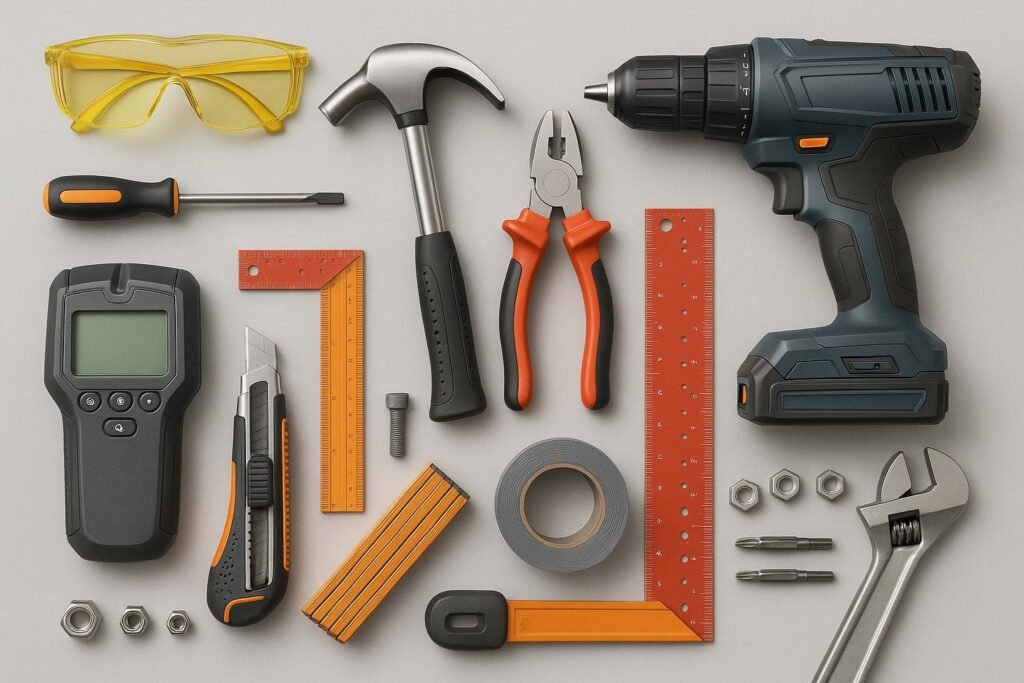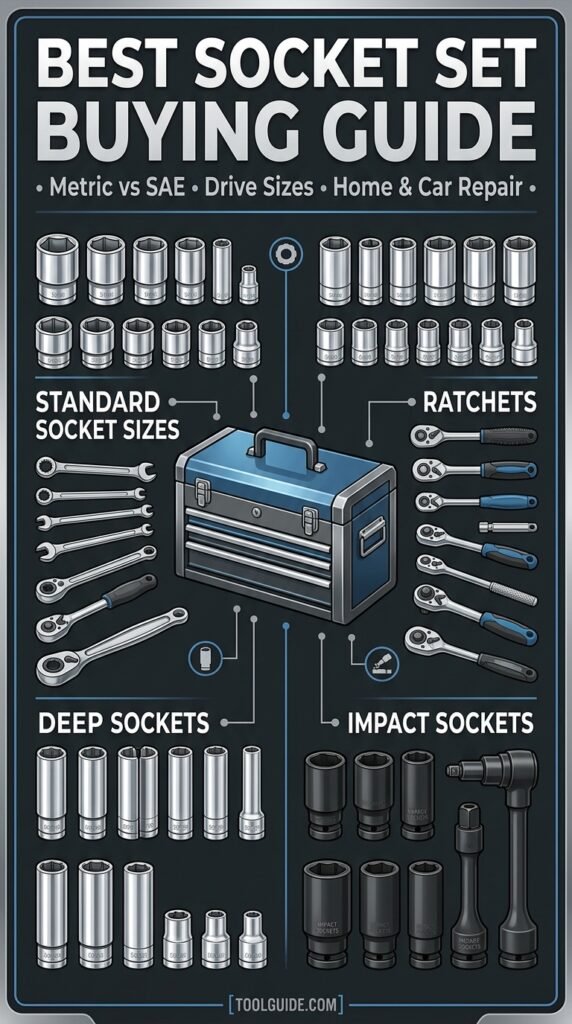
Finding the best socket set is less about buying the kit with the highest piece count and more about matching the sockets, ratchet, drive sizes, and included accessories to the work you actually do. A compact set can be ideal for household repairs, while automotive work may call for SAE and metric sockets, multiple drive sizes, deep sockets, and impact-rated options.
This guide breaks down what to look for, compares useful socket-set options for different types of buyers, and explains how to choose between a basic home kit and a more comprehensive mechanic’s set. Whether you’re searching for the best socket set for the money, a dependable set for home use, or equipment for car repair, the goal is to help you buy once and get the sizes you actually need.
Affiliate disclosure: This article contains affiliate links. If you purchase through qualifying links, SmartAirHQ may earn a commission at no additional cost to you.
Prices, availability, specifications, and seller information can change, so verify the current product details before purchasing.
Best Socket Set Picks for Different Types of Work
The right socket set depends heavily on the job. Someone assembling furniture and handling occasional household repairs does not necessarily need a large professional mechanic kit. On the other hand, someone servicing vehicles may quickly become frustrated with a small set that lacks common metric sizes, deep sockets, extensions, or a larger 1/2-inch drive.
The recommendations below are organized around common buying situations rather than simply ranking sets by the number of pieces in the case. Independent tool reviews also consistently distinguish between sets for general household work, mechanics, value-focused buyers, and impact applications. Pro Tool Reviews
Want to discover more helpful guides and recommendations? Visit SmartAirHQ to explore the rest of our website and find more practical content for your next project.
| Socket Set Type | Best For | Key Advantage | Recommended Drive |
|---|---|---|---|
| All-Around Mechanics Set | General & automotive work | Broad coverage | 1/4", 3/8", 1/2" |
| Home Socket Set | DIY & household repairs | Compact and practical | 1/4" & 3/8" |
| Budget Socket Set | Value-focused buyers | Good basic coverage | 3/8" |
| Professional Mechanics Set | Frequent automotive work | Wide size selection | 1/4", 3/8", 1/2" |
| Metric & SAE Set | Mixed applications | Covers both systems | Multiple |
| Deep Socket Set | Long studs & recessed nuts | Extra reach | 3/8" & 1/2" |
| Impact Socket Set | Impact wrench users | Designed for impact applications | 1/2" |
| Compact Socket Set | Light repairs & emergencies | Easy to store and carry | 1/4" & 3/8" |
Best Socket Set: Quick Buying Tip
The best socket set is not necessarily the set with the largest piece count. Focus on the socket sizes, drive sizes, metric and SAE coverage, ratchet quality, and accessories that match the work you actually perform.
🛒 Shop Socket Set on Amazon ```DEWALT 192-Piece Mechanics Tool Set — Best All-Around Choice
A large DEWALT mechanics set is worth considering when you want one collection that can cover household projects, maintenance, and automotive work. The commonly listed 192-piece configuration includes 1/4-, 3/8-, and 1/2-inch drive equipment along with SAE and metric coverage, making it considerably more versatile than a small single-drive set. SpruceRank
This type of kit makes the most sense for buyers who would rather have room to grow than replace a small set later. It is particularly useful when your projects range from light repairs to work involving larger fasteners.
CRAFTSMAN 135-Piece Mechanics Tool Set — Best for Home Mechanics
A CRAFTSMAN 135-piece mechanics set is a practical middle ground for people who want more than a basic household kit without moving immediately into an enormous professional collection. Reviews have highlighted its combination of SAE and metric sockets, multiple ratchet sizes, and useful assortment for general maintenance. Bob Vila+1
For a garage or home workshop, this style of set can provide a useful balance between coverage and portability. The important thing is to check the exact contents of the version you’re buying because manufacturers can offer several configurations under similar product names.
Milwaukee 3/8-Inch Drive Socket Set — Best for Frequent General Use
A 3/8-inch drive set is one of the most useful choices for people who regularly work on vehicles, machinery, household equipment, and general maintenance. Milwaukee’s 56-piece 3/8-inch ratchet and socket set has been recognized in tool testing as an especially strong all-around option, with SAE and metric coverage in the commonly reviewed configuration. Bob Vila+1
The appeal of a 3/8-inch kit is its versatility. It sits between the smaller 1/4-inch drive and heavier 1/2-inch drive, making it a useful everyday size for many fasteners.
GEARWRENCH 3/8-Inch Drive Set — Best for a Focused Tool Collection
GEARWRENCH is another strong option when you want a focused 3/8-inch drive collection rather than a huge mechanics kit. The 80550 series, for example, has been identified as a 57-piece 3/8-inch socket set with standard and stubby ratchets. ToolShed Tested
A focused set can be preferable when you already own larger tools and simply need a dependable collection of commonly used sockets. It can also make organization easier because you’re not carrying dozens of accessories you rarely use.
TEKTON 1/4-, 3/8-, and 1/2-Inch Set — Best for Broad Socket Coverage
A multi-drive TEKTON set is worth considering when broad socket coverage is more important than keeping the kit small. A large set covering 1/4-, 3/8-, and 1/2-inch drive can reduce the need to purchase additional drive sizes later.
This approach is particularly useful for people building a garage tool collection from scratch. Rather than asking how many pieces are included, look at whether the set gives you useful size coverage, both SAE and metric options where needed, shallow and deep sockets, ratchets, extensions, and the accessories required for the jobs you expect to perform.
Amazon Basics 201-Piece Mechanics Set — Best Large Budget-Oriented Option
A large Amazon Basics mechanics set can appeal to buyers who want a broad assortment without immediately moving into premium tool pricing. A commonly listed 201-piece configuration includes SAE and metric sizes and chrome-vanadium construction. SpruceRank+1
The key consideration with a large budget-oriented kit is to inspect exactly what contributes to the piece count. Adapters, bits, extensions, and duplicate socket depths can increase the number printed on the package without necessarily giving you more of the sizes you use most.
WORKPRO 20-Piece Set — Best for Basic Home Use
For occasional household repairs, a compact set can make more sense than a large mechanic’s kit. The WORKPRO 39-piece set has been highlighted as a value-oriented choice for general household jobs, with both SAE and metric sockets and 1/4- and 3/8-inch drive coverage in the reviewed configuration. Bob Vila
This type of kit is particularly suitable if you need sockets for furniture, appliances, fixtures, bicycles, light maintenance, and occasional repairs rather than regular automotive work. Its smaller size also makes it easier to store in a drawer or compact toolbox.
NEIKO 02448A — Best for Impact-Socket Applications
Impact work requires a different approach from ordinary hand-tool use. NEIKO’s 02448A is a 1/2-inch drive master impact socket set that has been listed with both SAE and metric sizes and standard and deep sockets. Bob Vila+1
If you’re using an impact wrench or similar high-torque tool, make sure the sockets are specifically intended for impact applications. Ordinary chrome hand sockets should not simply be treated as interchangeable with impact-rated sockets.
Sunex 2569 — Best for a Dedicated Impact Collection
Sunex is another name worth considering when your primary need is impact sockets rather than a general-purpose chrome socket kit. The 2569 has been identified as a 43-piece impact socket set in comparative coverage. Garage Tooled+1
A dedicated impact collection can make sense for automotive work where stubborn fasteners, lug nuts, and high-torque applications are part of the job. Before buying, check whether the included sizes match the fasteners you commonly encounter.
DEWALT Impact Driver Socket Set with Impact Extensions and Drill Adapters, Metric, 10-Piece, 3/8″ and 1/2″ Drive (DWMT74741)
A compact impact set can be more practical than buying a very large collection if you already have a general-purpose socket kit. The DEWALT DWMT74739 is commonly identified as a 23-piece 1/2-inch-drive impact socket set covering SAE and metric requirements. Garage Tooled
This kind of focused set can complement a regular mechanic’s kit. You can keep standard chrome sockets for hand-ratchet work while using dedicated impact sockets when working with an impact wrench.
Milwaukee 49-66-6806 — Compact Impact-Duty Option
Milwaukee’s 49-66-6806 is another impact-oriented option listed among commonly compared impact socket sets. The reviewed configuration includes SAE and metric sizes and standard and deep sockets, making it useful when you want a smaller dedicated impact collection rather than a full master set. Garage Tooled
For buyers who already have a conventional socket set, a smaller impact kit can fill an important gap without duplicating every socket they already own.
GEARWRENCH 84935N — Compact Metric Impact Choice
GEARWRENCH’s 84935N is listed among impact socket options and is particularly useful for shoppers looking for a compact metric-focused collection. It is identified as a 29-piece metric deep impact set in comparative coverage. Garage Tooled
A metric-only set can be useful if your work consistently involves metric fasteners. However, if you work on a wide variety of vehicles or equipment, a combined SAE and metric collection may offer better long-term flexibility.
How to Choose the Best Socket Set for Your Needs
Choosing a socket set becomes much easier when you evaluate the tools according to the jobs you perform. The most important factors are not simply brand name or piece count. Drive size, socket measurement system, socket depth, point configuration, ratchet quality, and whether the sockets are intended for hand or impact use can make a much bigger difference.
Before buying, think about the fasteners you encounter most often. A homeowner who needs occasional repairs has different requirements from a mechanic who spends hours working on vehicles every week. Matching the kit to your work prevents both under-buying and unnecessary spending.
Start With Drive Size
Drive size describes the square connection between the ratchet and socket. The three sizes most buyers encounter are 1/4 inch, 3/8 inch, and 1/2 inch.
A 1/4-inch drive is generally suited to smaller fasteners and lighter work. A 3/8-inch drive is a highly versatile middle ground and is particularly useful for general maintenance and automotive work. A 1/2-inch drive is better suited to larger fasteners and applications where more torque is required.
A complete garage setup may eventually benefit from all three, but you do not necessarily need all three when starting out.
Decide Between SAE and Metric Sockets
The measurement system is another major consideration. SAE sockets use fractional-inch measurements, while metric sockets use millimeters.
If your work involves vehicles, machinery, or equipment from different manufacturers, owning both metric and SAE sockets can prevent frustrating situations where the correct-looking socket is slightly wrong.
A good set should make its socket sizes easy to identify. Clear markings become especially valuable when you are working quickly or moving between several fasteners.
Choose Between Six-Point and Twelve-Point Sockets
Six-point sockets engage the six flats of a compatible hex fastener. Twelve-point sockets provide more engagement positions, which can make them convenient in confined spaces.
For many situations involving stubborn fasteners, six-point sockets are attractive because their geometry places engagement on the flats of the fastener rather than relying primarily on the corners. Recent comparative testing has also emphasized the distinction between six-point and twelve-point designs when evaluating socket performance. Real Buyer Experiences
Neither design is universally better. The right choice depends on the fasteners you encounter and the available working space.
Consider Shallow and Deep Sockets
Shallow sockets are the standard choice for many everyday fasteners. Deep sockets extend farther and are useful when a nut sits on a long threaded stud or when additional clearance is necessary.
If you’re purchasing a socket set for automotive work, having both shallow and deep options can be considerably more useful than simply buying a set with a huge number of small accessories.
When comparing sets, look specifically at which sizes are supplied in both depths. A large piece count does not automatically mean comprehensive deep-socket coverage.
Know When You Need Impact Sockets
Impact sockets are designed specifically for use with impact tools. They are generally distinguishable from ordinary chrome hand sockets and are intended for the repeated shock and torque associated with impact equipment.
If your primary tool is a manual ratchet wrench, a conventional hand-tool socket set is usually the relevant category. If you’re using an impact wrench, shop specifically for impact-rated sockets.
This distinction is one of the most important parts of a socket set buying guide because choosing the wrong socket type can compromise both the tool and the fastener.
Best Socket Set for the Money: What Should You Actually Pay For?
The best socket set for the money is not necessarily the least expensive kit or the one with the largest piece count. Value comes from useful coverage, appropriate drive sizes, sensible socket increments, good markings, a practical case, and tools that match your intended workload.
For a homeowner, paying for three drive sizes and hundreds of accessories may provide little additional value if most projects involve smaller fasteners. For a mechanic, however, buying a tiny set because it is inexpensive can quickly become more expensive when additional sockets and extensions are required later.
A better approach is to identify your most common jobs first, then spend your budget on the socket sizes and features that solve those jobs.
Avoid Choosing by Piece Count Alone
Piece count is an easy number to compare, but it can be misleading. A 200-piece set is not automatically twice as useful as a 100-piece set.
The total can include adapters, bits, extensions, duplicate depths, hex keys, and other accessories. Those items can be useful, but they don’t replace missing socket sizes.
Before comparing two kits, look at the actual socket-size range and the number of drive sizes included.
Prioritize Useful Size Coverage
A smaller set with carefully selected sizes can be more useful than a giant kit with gaps in the sizes you regularly need.
For automotive and mechanical work, check whether the set includes:
- Common SAE sockets
- Common metric sockets
- Both shallow and deep sockets where appropriate
- 1/4-, 3/8-, or 1/2-inch drive sizes needed for your work
- Extensions
- Universal joints where appropriate
- Spark-plug sockets if relevant to your projects
- A practical ratchet for each included drive size
This checklist is more useful than choosing a set simply because its packaging advertises a high piece count.
Best Socket Set for Home Use
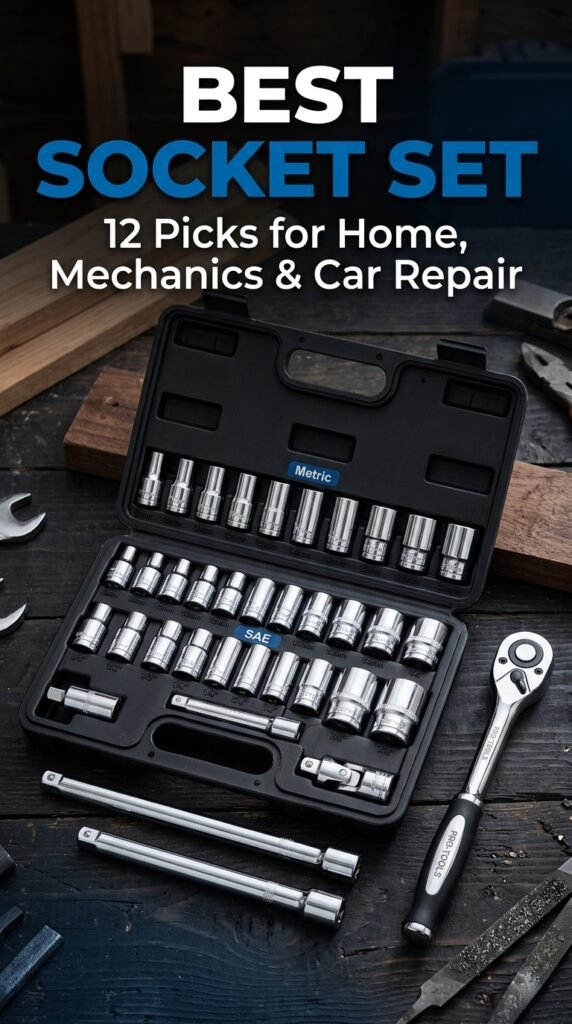
The best socket set for home use should be compact enough to store easily while covering the fasteners you’re most likely to encounter. Household jobs can range from assembling furniture to tightening hardware, maintaining equipment, repairing bicycles, and handling occasional appliance or automotive tasks.
For occasional work, a compact 1/4- and 3/8-inch collection can be enough. If you regularly work on vehicles or larger equipment, moving up to a multi-drive mechanics set is more practical. The important point is to avoid buying a professional-size kit when your actual workload only requires a small selection.
A home user should also value organization. A case with clearly marked positions makes it easier to see when a socket is missing and speeds up cleanup after a project.
Best Socket Set for Mechanics and Car Repair
The best socket set for mechanics needs broader coverage than a typical household kit. Automotive work can involve small interior fasteners, medium engine-bay hardware, larger suspension components, and specialized fasteners, so one drive size may not cover every situation.
For serious car repair, a collection with 1/4-, 3/8-, and 1/2-inch drive can be more versatile. Metric and SAE coverage may also be valuable depending on the vehicles and equipment being serviced.
Professional-style collections frequently include extensions, universal joints, deep sockets, multiple ratchets, and other accessories. However, even experienced users should prioritize the actual sizes and tools they use rather than buying purely for the largest possible piece count.
Socket Set Buying Guide: Features That Matter Most
A good socket set should make your work easier, not simply give you more tools to organize. Once you’ve determined the required drive sizes and measurement system, evaluate the details that affect everyday usability.
Look for clear size markings, sensible storage, appropriate socket depths, a comfortable ratchet, and a range that doesn’t leave obvious gaps. If you’re buying an impact set, confirm that the sockets are designed for impact use rather than assuming any dark-colored socket is suitable.
Durability also matters, but it should be considered alongside coverage. A beautifully made socket that doesn’t fit the fasteners you work with is still the wrong tool for the job.
When a fastener needs to be tightened to a specific torque specification, the right socket is only part of the job. Pairing the socket with a suitable torque wrench can help you apply the required tightening force more accurately. For more guidance, read our Torque Wrench: Complete Guide to Choosing, Using, and Maintaining One
Ratchet Quality Matters
The ratchet is the part you will often handle most. A smooth mechanism and useful swing arc can make repetitive work much easier, particularly where access is limited.
High-tooth-count ratchets can require less movement to engage the next position, which can be helpful in confined spaces. Recent tool comparisons frequently highlight ratchet tooth count and swing arc as meaningful usability factors. Real Buyer Experiences+1
Don’t judge a ratchet only by the tooth count printed on the packaging, though. Overall construction, comfort, direction control, socket retention, and how the mechanism behaves under actual use also matter.
Storage Is Part of the Tool
A socket set that is difficult to organize can become frustrating quickly. Good storage helps you identify the correct socket, prevents pieces from wandering around a toolbox, and mechanics kit, consider the physical size and weight of the case. A huge collection may offer excellent coverage but become inconvenient if you regularly need to carry it from kit can be excellent, but only when you will use the additional coverage. Otherwise, you are paying for storage space and are designed for different applications. A manual ratchet and a socket designed for hand use belong to one tool category, while an impact wrench makes it obvious when something is missing.
For a large mechanics kit, consider the physical size and weight of the case. A huge collection may offer excellent coverage but become inconvenient if you regularly need to carry it from one location to another.
For occasional home use, a compact case can be more valuable than dozens of additional accessories.
Common Socket Set Buying Mistakes to Avoid
Many disappointing socket-set purchases happen because shoppers focus on the wrong specification. The biggest mistake is usually choosing based on piece count rather than actual socket coverage.
Another common mistake is buying only SAE or only metric when the intended work requires both. Choosing a single drive size can also become limiting when projects expand into larger or smaller fasteners.
Finally, don’t use standard hand sockets with impact tools simply because the socket fits. Impact applications require sockets intended for that type of tool. Taking a few minutes to identify your intended use before buying can save money and prevent unnecessary tool duplication.
Don’t Assume the Largest Set Is the Best Set
A large kit can be excellent, but only when you will use the additional coverage. Otherwise, you are paying for storage space and accessories that may rarely leave the case.
A well-selected 50-piece set can be a better purchase than a 200-piece kit for someone who performs only occasional household maintenance. Conversely, a mechanic may find that a larger set saves money because it provides the necessary range from the beginning.
The correct size of the set is therefore determined by your work, not the number printed on the box.
Don’t Mix Up Hand Sockets and Impact Sockets
Hand sockets and impact sockets are designed for different applications. A manual ratchet and a socket designed for hand use belong to one tool category, while an impact wrench calls for impact-rated sockets.
If you are building a garage around an impact wrench, budget for a dedicated impact socket collection rather than assuming your existing chrome sockets will cover every job.
How to Build a Socket Collection Step by Step
You do not have to buy the biggest socket collection immediately. Building your tools gradually can actually produce a more useful setup because every additional purchase can be based on a real need.
Start with the drive size and socket measurements that match your most common jobs. Add extensions or deep sockets when you encounter situations where your initial collection cannot reach the fastener. If you later add an impact wrench, create a separate impact-socket collection rather than replacing every hand socket.
A practical progression looks like this:
- Start with a versatile drive size, usually 3/8 inch for general work.
- Add metric and SAE coverage if your projects require both.
- Add 1/4-inch drive for smaller fasteners and confined areas.
- Add 1/2-inch drive for larger fasteners and higher-torque applications.
- Add deep sockets when standard sockets cannot provide the required reach.
- Add impact sockets when you introduce an impact wrench.
- Expand specialized sizes only when your work requires them.
This approach keeps your toolbox practical and prevents unnecessary duplication.
Frequently Asked Questions About the Best Socket Set
Choosing between socket sets often raises the same questions about drive size, measurement systems, socket depth, and intended use. The answers below provide a quick reference for the most important decisions without turning the buying process into a complicated technical exercise.
The key principle throughout this guide is simple: choose the set based on the fasteners and tools you actually use. A homeowner, DIY enthusiast, mechanic, and professional technician can all reasonably choose different socket sets.
What is the best socket set overall?
There is no single best set for every user. A multi-drive SAE and metric mechanics kit is generally more versatile, while a compact 3/8-inch set can be better for everyday work. Choose based on your projects, required sizes, and budget.
What is the best socket set for the money?
The best value comes from a set with useful size coverage and the drive sizes you actually need. Don’t choose solely by piece count; compare socket sizes, ratchets, extensions, depths, storage, and intended use.
Is a 3/8-inch socket set enough for most people?
For many general maintenance and automotive tasks, 3/8 inch is a highly useful middle-ground drive size. However, larger fasteners may require 1/2 inch, while smaller work can benefit from 1/4 inch.
Should I buy metric or SAE sockets?
If your projects involve different types of vehicles, equipment, or household hardware, owning both can be useful. If your work is consistently limited to one measurement system, you may be able to start with that system alone.
Are deep sockets worth buying?
Yes, when you regularly encounter nuts positioned on long studs or fasteners requiring additional socket depth. For occasional basic work, shallow sockets may cover most needs.
Can I use regular sockets with an impact wrench?
You should use sockets specifically designed and rated for impact applications when operating an impact wrench. A socket fitting the drive does not automatically make it suitable for impact use.
Is a six-point or twelve-point socket better?
Six-point sockets are often preferred when secure engagement with the flats of a compatible hex fastener is important. Twelve-point sockets can offer more engagement positions in confined spaces. The better choice depends on the application.
Final Thought: Choose the Socket Set That Matches Your Work
The best socket set is the one that gives you the right combination of socket sizes, drive sizes, measurement systems, ratchets, and accessories for the jobs you actually perform. For general home use, a compact set can be more practical than a huge mechanics kit. For automotive work, broader SAE and metric coverage with multiple drive sizes provides greater flexibility.
If you’re comparing options, start with your most common projects, identify the socket sizes you need, then decide whether you require shallow, deep, or impact sockets. That process is more reliable than choosing a set simply because it has the largest piece count.
When you’re ready to compare current availability and product options, use the Amazon shopping links above and verify the current price, included pieces, sizes, seller, and product specifications before purchasing.
Save This Best Socket Set Guide on Pinterest
📌 Save on Pinterest
📌 (https://pin.it/2DMtMAmvx)
Suggested Pinterest Pin Text
Best Socket Set: 12 Picks for Every Job
- Home use
- Car repair
- Mechanics
- Best value
- Metric + SAE
- Impact sockets
- Socket sizes explained
Save this guide before buying your next socket set.
For your Pinterest presence, use your smartairhq branding consistently across the pin designs so readers can recognize the source when multiple pins appear in their feed. Sources