If you have ever searched for climate controlled storage, you have probably wondered whether it is simply a nicer name for an indoor storage unit—or whether it actually provides meaningful protection for your belongings.
In simple terms, climate-controlled storage is designed to keep the storage environment more stable than a conventional unit, particularly when it comes to temperature. Depending on the facility, the service may also include humidity management or other environmental controls. The exact conditions are not universal, so the phrase “climate controlled” should not be treated as a guarantee of a specific temperature or humidity level.
That distinction matters. A wooden table, electronic device, photograph collection, musical instrument, important documents, or antique may react very differently to months of heat, cold, and moisture than a plastic patio chair would.
This guide explains what climate controlled storage actually means, how it differs from standard and temperature-controlled storage, which belongings benefit most, what to ask a storage facility, and how to prepare your items before putting them away.
What Is Climate Controlled Storage?
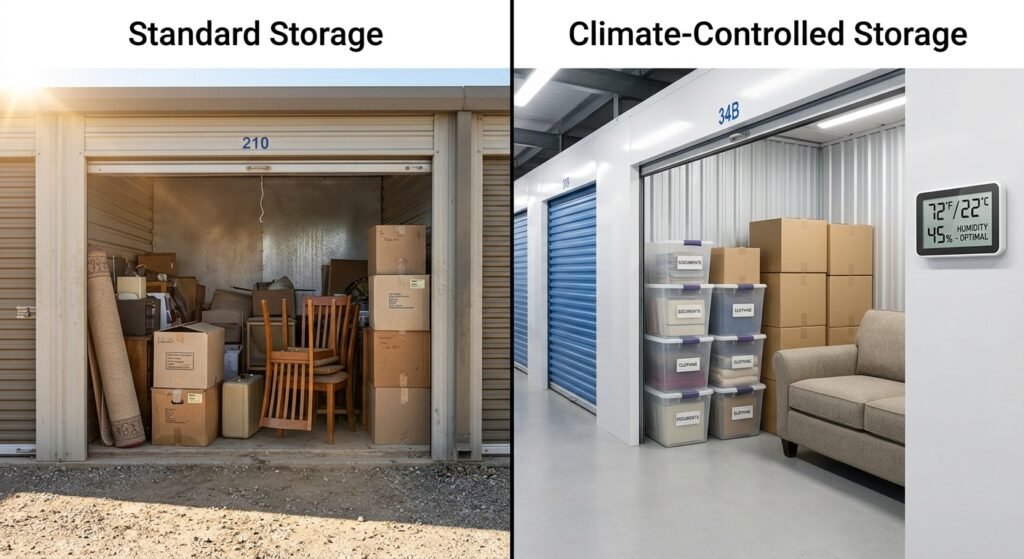
Climate controlled storage is a storage environment designed to maintain more consistent indoor conditions than a basic, non-climate-controlled unit. The primary goal is to reduce exposure to significant temperature changes and, at some facilities, manage humidity as well.
There is no single industry-wide setting that every storage company uses. For example, Extra Space Storage says its climate-controlled units typically remain between 55°F and 80°F, while U-Haul describes its climate-controlled facilities as generally maintaining 65°F to 85°F. Those differences illustrate why you should check the specifications of the individual facility rather than assuming every climate-controlled unit operates identically.
In practical terms, climate control is about stability rather than creating a perfect environment.
A climate-controlled facility may help reduce the stress caused by:
- Extreme heat
- Freezing temperatures
- Large seasonal temperature swings
- Moisture and humidity, depending on the facility
- Rapid changes between hot and cold conditions
The result is an environment that is generally better suited to belongings that are sensitive to environmental changes.
Climate Controlled Storage Meaning: Temperature Is Only Part of the Story
The phrase “climate control” can sound more precise than it actually is. One of the biggest misconceptions is that every climate-controlled storage unit automatically provides tightly regulated temperature and humidity.
That is not necessarily true.
Some facilities primarily regulate temperature, while others offer dedicated humidity-controlled storage or additional environmental systems. Public Storage, for example, describes climate-controlled units as spaces intended to maintain more consistent temperature and humidity conditions, while also noting that actual conditions can vary by facility and unit. U-Haul similarly advises customers to confirm the humidity-control features available at the specific location.
So, when evaluating storage unit climate control, ask what the facility actually controls.
Temperature control
Temperature control reduces exposure to extreme heat and cold. This can be particularly useful for materials that expand, contract, become brittle, or otherwise deteriorate when subjected to repeated temperature changes.
Humidity control
Humidity control is a separate consideration. A facility may reduce exposure to outdoor humidity simply because the unit is inside a conditioned building, but that does not necessarily mean it actively controls relative humidity.
If moisture is your biggest concern, specifically ask whether the unit is humidity controlled or dehumidified.
Understanding ideal indoor humidity levels can help you protect moisture-sensitive belongings during storage.
Climate Controlled vs Temperature Controlled Storage
The terms climate controlled storage and temperature controlled storage are sometimes used interchangeably, but they can describe different levels of environmental management.
The safest approach is to look beyond the label and find out exactly what the facility provides.
| Feature | Standard Storage | Temperature-Controlled Storage | Climate-Controlled Storage |
|---|---|---|---|
| Temperature moderation | Usually limited | Yes | Generally yes |
| Protection from extreme heat/cold | Limited | Improved | Improved |
| Humidity management | Usually no | Varies | Varies |
| Indoor location | Not always | Often | Commonly |
| Best for sensitive belongings | Limited | Moderate to high | Moderate to high, depending on specifications |
| Exact conditions guaranteed? | No | Facility dependent | Facility dependent |
The important point is that “climate controlled” does not automatically mean “humidity controlled.” Some providers offer separate dehumidified or humidity-controlled options specifically for moisture-sensitive belongings.
If your belongings are particularly sensitive, ask the facility:
- What temperature range is maintained?
- Is humidity actively controlled?
- What happens during power outages?
- Is the unit inside a conditioned building?
- Are the stated temperature and humidity ranges guaranteed?
- Does every unit receive the same environmental treatment?
Those answers are more useful than the marketing label alone.
Why Does Climate-Controlled Storage Matter?
Environmental changes can affect materials gradually. The damage may not be obvious when an item first goes into storage, but repeated exposure to heat, cold, or moisture can make certain belongings more vulnerable over time.
Wood, for example, can respond to changes in moisture and temperature. Metal can be vulnerable to corrosion when moisture is present. Paper and photographs can deteriorate when exposed to unfavorable environmental conditions. Electronics contain materials and components that may not respond well to excessive heat, cold, or humidity.
That is why climate control can be particularly valuable for long-term storage and for belongings that would be expensive, difficult, or emotionally important to replace. Storage companies commonly recommend climate-controlled environments for items such as furniture, electronics, documents, artwork, photographs, books, antiques, and musical instruments.
The key benefit is not that climate control makes an item indestructible. It is that it can reduce exposure to environmental extremes.
Climate Controlled Storage Benefits
The biggest advantage of climate-controlled storage is environmental stability. That can translate into several practical benefits, particularly when your belongings will remain stored for months or years.
1. Better protection from temperature extremes
A standard unit can experience conditions that are much closer to the outdoor environment. A climate-controlled facility moderates indoor conditions, reducing the exposure of stored belongings to extreme heat and cold.
2. Less exposure to temperature fluctuations
Constantly changing conditions can be more concerning than a stable environment. Climate-controlled storage is designed to provide a more consistent setting, which can be helpful for materials that respond poorly to repeated environmental changes.
3. Reduced moisture-related risk
This benefit depends on the facility. Indoor climate-controlled storage can provide a more stable environment than an exterior unit, but active humidity control is not universal. If humidity is a major concern, choose a facility that specifically offers humidity management.
4. Better protection for sensitive possessions
Furniture, electronics, books, documents, photographs, artwork, antiques, and musical instruments are examples of belongings commonly recommended for climate-controlled storage.
5. Greater suitability for long-term storage
The longer an item remains exposed to fluctuating environmental conditions, the more important its storage environment becomes. Climate control can be especially useful when you are storing belongings through multiple seasons.
What Items Should Go in Climate Controlled Storage?
Not everything you own needs climate control. The decision should depend on what you are storing, how long you are storing it, your local climate, and how costly or difficult the item would be to replace.
Sensitive belongings deserve more consideration because they may respond to temperature or humidity changes.
Furniture
Wood, leather, and upholstered furniture can benefit from a more stable indoor environment. Temperature and moisture changes can contribute to problems such as wood movement, material deterioration, or moisture-related issues.
Electronics
Televisions, computers, cameras, audio equipment, gaming systems, and similar devices are commonly recommended for climate-controlled environments. Electronics can be sensitive to excessive heat, cold, and moisture.
Books and documents
Paper is vulnerable to unfavorable environmental conditions over extended periods. If you are storing tax records, family documents, books, photographs, or other irreplaceable paper materials, a more stable environment can be a sensible precaution.
Photographs and media
Photographs and certain forms of recorded media can be sensitive to temperature and moisture. For irreplaceable family archives, the storage environment deserves particular attention.
Artwork and antiques
The materials used in artwork and older possessions can be sensitive to environmental fluctuations. Because replacement may be impossible or extremely expensive, climate-controlled storage can make sense for valuable or sentimental pieces.
Musical instruments
Wooden musical instruments can be particularly sensitive to environmental changes. A controlled indoor environment may provide additional protection during extended storage.
Temperature control isn’t only important in storage—it also plays a major role in maintaining a comfortable and efficient home environment. If you’re interested in automated temperature management, check out our guide on
“Why Smart Thermostats Are the Best Investment for Your Home in 2026” to learn how smart thermostats can make heating and cooling easier to manage.
When Do You Probably Not Need Climate Control?
Climate control is useful, but it is not automatically necessary for everything.
If you are storing durable, weather-resistant belongings for a relatively short period, paying extra for climate control may provide little practical benefit. The right choice depends on the item’s sensitivity and your storage conditions.
Items that may be less dependent on climate control can include certain:
- Outdoor tools
- Plastic containers
- Metal equipment designed for outdoor use
- Garden accessories
- Durable household items that are not sensitive to temperature or moisture
However, “doesn’t need climate control” should not be interpreted as “cannot be damaged.” Even durable belongings should be properly cleaned, dried, packed, and protected before storage.
The question to ask is simple: Would environmental damage be costly or difficult to reverse?
If the answer is yes, climate control becomes more attractive.
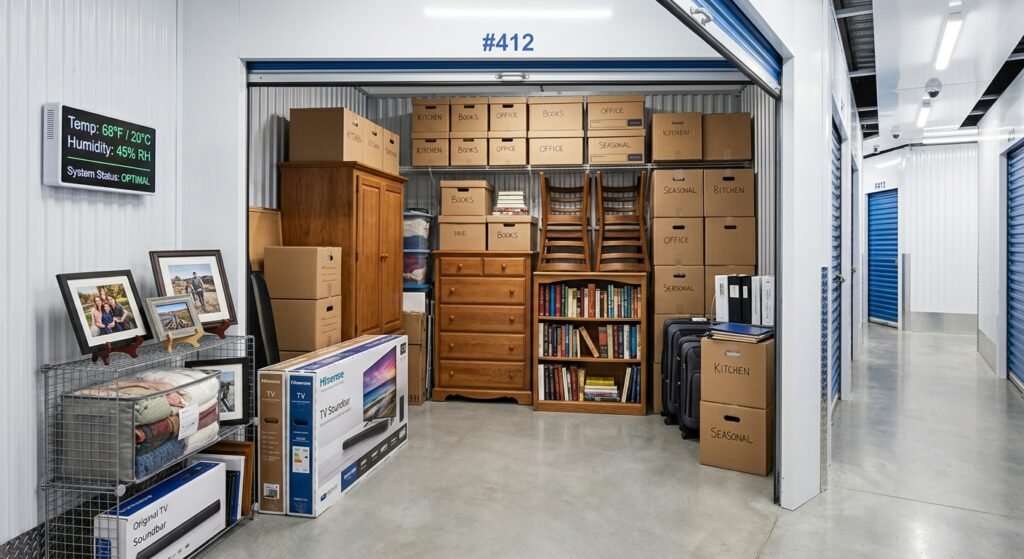
Does Climate-Controlled Storage Control Humidity?
Not always—and this is one of the most important details to understand before renting a unit.
Some climate-controlled facilities actively manage humidity, while others primarily regulate temperature. An indoor facility may also naturally provide a more stable humidity environment than an outdoor storage unit without actually using a dedicated humidity-control system.
If your belongings are highly moisture-sensitive, don’t simply ask, “Is this unit climate controlled?”
Ask instead:
“Do you actively control relative humidity, and what range do you maintain?”
If the answer is unclear, ask whether the facility offers humidity-controlled storage, dehumidified storage, or another moisture-management option.
That small conversation can prevent a major misunderstanding.
How to Choose the Right Climate-Controlled Storage Unit
Choosing a unit is easier when you evaluate the storage environment before thinking about price alone.
1. Start with your belongings
Make a list of everything you plan to store. Separate sensitive items from durable items.
Sensitive belongings might include electronics, documents, photographs, wood furniture, artwork, antiques, collectibles, books, and instruments.
2. Consider your local climate
Your need for climate control may be greater when your area experiences significant heat, cold, humidity, or seasonal fluctuations. Storage companies specifically recommend considering local weather patterns when deciding whether climate control is worthwhile.
3. Ask what “climate controlled” actually means
Do not assume all facilities use the same definition. Ask for the actual temperature range and whether humidity is actively managed.
4. Think about storage duration
A few weeks of storage is different from storing belongings for several years. Long-term storage makes environmental stability more relevant.
5. Consider the value of the contents
The financial value matters, but sentimental value matters too. A box of irreplaceable family photographs may be more important to you than a much more expensive replaceable appliance.
6. Compare the total value, not just monthly rent
A climate-controlled unit usually costs more than a basic storage option, but the additional expense may make sense when it reduces environmental exposure for belongings that are expensive or difficult to replace.
How to Prepare Items for Climate-Controlled Storage
Climate control works best when you also prepare your belongings properly. A controlled environment cannot compensate for putting wet, dirty, or poorly packed items into storage.
Before moving everything into the unit:
- Clean and dry everything thoroughly. Moisture trapped inside boxes, furniture, or containers can create problems even in a controlled environment.
- Use suitable containers. Choose packaging based on the material being stored. Cardboard may be appropriate for some belongings, while protective plastic containers can make sense for others.
- Avoid sealing damp belongings. Never package an item while it still contains surface or trapped moisture.
- Leave breathing room around furniture. Avoid packing items so tightly that air cannot circulate around them.
- Keep belongings off the floor when practical. Shelving or pallets can make organization easier and provide an additional layer of separation from the floor.
- Label every container. Clear labels reduce unnecessary opening and handling.
- Don’t overload boxes. Heavy boxes can become difficult to move and may damage the contents underneath.
- Check sensitive items periodically. If you are storing valuable or irreplaceable possessions for a long time, occasional inspections can help you identify problems early.
These steps solve a common storage mistake: assuming the facility’s climate control means you no longer need to think about preparation.
Common Climate-Controlled Storage Mistakes to Avoid
Even a good storage unit can fail to protect belongings if the storage strategy itself is poor.
Assuming every climate-controlled unit has the same settings
It doesn’t. Facilities use different temperature ranges and environmental systems. Published ranges from major providers demonstrate that specifications can vary.
Assuming climate controlled means humidity controlled
This is perhaps the biggest misconception. Always confirm whether humidity is actively managed.
Storing items while they are damp
A controlled storage environment cannot magically undo moisture that was already sealed inside a box or item.
Pushing everything against walls
Overpacking makes inspection and access difficult. It can also reduce the ability to notice leaks or other problems quickly.
Choosing climate control for everything
Climate control is not automatically the best financial choice for every possession. Evaluate the sensitivity, value, duration, and local environmental conditions of what you are storing.
Focusing only on the advertised temperature
Temperature is important, but it is not the only question. Ask about humidity, building conditions, access, monitoring, and the facility’s actual environmental specifications.
A Simple Climate-Controlled Storage Decision Guide
1. Climate-Controlled Storage: When Is It Worth It?
Climate-controlled storage is worth considering when you’re storing temperature- or humidity-sensitive belongings for several months or longer.
2. When Is Standard Storage Enough?
Standard storage may be enough for durable items that aren’t particularly sensitive to temperature or humidity changes.
3. When Is Humidity Control Especially Important?
Humidity control is especially important for moisture-sensitive items such as electronics, documents, photographs, wood furniture, and musical instruments.
| Your situation | Climate control? |
|---|---|
| Storing electronics for months | Strongly consider it |
| Storing important documents | Strongly consider it |
| Storing photographs or artwork | Strongly consider it |
| Storing wood or upholstered furniture | Worth considering |
| Storing musical instruments | Worth considering |
| Storing valuable antiques | Strongly consider it |
| Storing durable outdoor equipment temporarily | May not be necessary |
| Storing belongings through extreme seasonal weather | Worth considering |
| Storing moisture-sensitive items | Ask specifically about humidity control |
| Storing irreplaceable sentimental items | Favor the more stable environment |
This is not a universal rule. The actual storage conditions, item materials, storage duration, and local climate should guide your final decision.
Useful Storage Accessories for Climate-Controlled Storage
The most useful accessories depend on what you are storing. For a climate-sensitive storage setup, a small digital hygrometer can help you understand the environment, while appropriate containers and protective materials can make organization easier.
You can also explore related SmartAirHQ guides on humidity and temperature control for practical advice on maintaining a comfortable indoor environment.
For Amazon shoppers, these are useful categories to investigate:
- Digital hygrometers and temperature monitors
Track temperature and humidity levels so you can quickly spot environmental changes that could affect sensitive belongings. - Storage containers with secure lids
Keep stored items protected from dust, moisture, and accidental spills while providing a more organized storage setup. - Moisture absorbers
Help reduce excess moisture in enclosed storage spaces and containers, making them useful for belongings that may be vulnerable to damp conditions. - Silica gel packets
Absorb small amounts of moisture inside sealed containers, helping keep stored items dry. - Protective furniture covers
Shield furniture from dust, scratches, and everyday handling during storage. - Acid-free document storage
Provides a safer option for preserving important papers, records, and other sensitive documents over time. - Photo-storage boxes
Designed to keep photographs organized and protected from dust, light, and unnecessary handling. - Shelving and organization systems
Keep boxes and belongings elevated, organized, and easier to access when needed. - Moving blankets
Add cushioning and protection around furniture, appliances, and other bulky items during transport and storage. - Labeling supplies
Make it easy to identify boxes and find specific belongings without opening every container. - Protective packing materials
Bubble wrap, packing paper, foam, and similar materials help reduce scratches, impacts, and movement during storage. - Dehumidifiers for appropriate home or storage environments
Help remove excess moisture from suitable enclosed spaces, supporting a drier environment where humidity is a concern.
Important: These accessories do not turn a conventional storage unit into a climate-controlled facility. They should be viewed as supplementary protection, not a substitute for a properly controlled storage environment.
Questions to Ask Before Renting a Climate-Controlled Unit
Before signing a storage agreement, take a few minutes to ask specific questions. The answers can reveal whether the facility’s climate-control service matches your actual needs.
Ask:
- What temperature range does the facility maintain?
- Is the temperature range consistent throughout the year?
- Is humidity actively controlled?
- If so, what humidity range is maintained?
- Are environmental conditions monitored?
- Is the unit inside a fully conditioned building?
- Are there differences between units within the same facility?
- What happens if the HVAC or climate-control system fails?
- How frequently can I access the unit?
- Are there restrictions on what can be stored?
- Is insurance or separate coverage available or required?
- What additional monthly fee applies to climate control?
Getting clear answers before renting is much better than discovering after several months that “climate controlled” meant something different from what you expected.
External Resources for Better Storage Decisions
Climate-controlled storage specifications vary by provider, so comparing more than one facility is worthwhile. For additional information,
U-Haul International explains how its climate-controlled self-storage works and emphasizes that specific features can vary by location.
Public Storage also explains the role of climate-controlled units and notes that actual temperature and humidity conditions can vary by facility and unit.
These resources are useful starting points, but your individual storage facility should always be the final source for its current specifications.
Frequently Asked Questions About Climate Controlled Storage
What does climate controlled storage mean?
Climate-controlled storage means a storage environment designed to maintain more stable conditions than standard storage, particularly temperature. Depending on the facility, it may also include humidity management. The exact temperature and humidity conditions vary between storage providers. Some facilities actively manage both temperature and humidity, while others primarily regulate temperature.
Is climate controlled storage the same as temperature controlled storage?
Not necessarily. The terms are sometimes used interchangeably, but climate control can refer to broader environmental management. Always ask whether the facility controls temperature only or also manages humidity.
Does climate controlled storage control humidity?
It depends on the facility. Some climate-controlled spaces offer humidity management, while others primarily regulate temperature. If humidity is important for your belongings, specifically request a humidity-controlled or dehumidified option.
Are climate controlled storage units worth the extra cost?
They can be, particularly when storing sensitive, valuable, sentimental, or long-term belongings. For durable items stored temporarily, the additional cost may not be necessary.
What should not be stored in a climate controlled unit?
Climate control does not make every item suitable for storage. Items that are prohibited by the facility, hazardous materials, perishable goods, and belongings requiring specialized environmental conditions may need different arrangements. Always check the facility’s storage rules.
Is an indoor storage unit automatically climate controlled?
No. An indoor unit can simply mean that the unit is located inside a building. U-Haul specifically distinguishes indoor storage from climate-controlled storage because indoor location does not automatically mean the environment is temperature controlled.
Is climate control necessary for long-term storage?
It is often worth considering for long-term storage, especially when belongings are sensitive to temperature or humidity. The longer items remain stored, the more important the environmental conditions become.
What is the most important thing to ask a storage facility?
Ask exactly what they mean by climate controlled. Request the actual temperature range and ask whether humidity is actively monitored or controlled. This gives you much more useful information than the label alone.
Final Thought: Climate Control Is Really About Stability
So, what does climate controlled storage mean?
At its simplest, it means storing your belongings in an environment designed to be more stable than a conventional storage unit—especially with regard to temperature, and sometimes humidity.
The important word is sometimes. Climate-controlled storage is not a universal technical specification with identical conditions at every facility. Temperature ranges, humidity management, monitoring, and other features can vary considerably.
For sensitive belongings such as electronics, documents, photographs, furniture, artwork, antiques, books, and musical instruments, a more stable environment can be a sensible layer of protection.
Before renting, don’t simply ask whether a unit is climate controlled. Ask what the facility actually controls. Once you understand the temperature range, humidity management, storage conditions, and your own belongings’ needs, choosing the right storage unit becomes much easier.
Read the Complete Guide →