
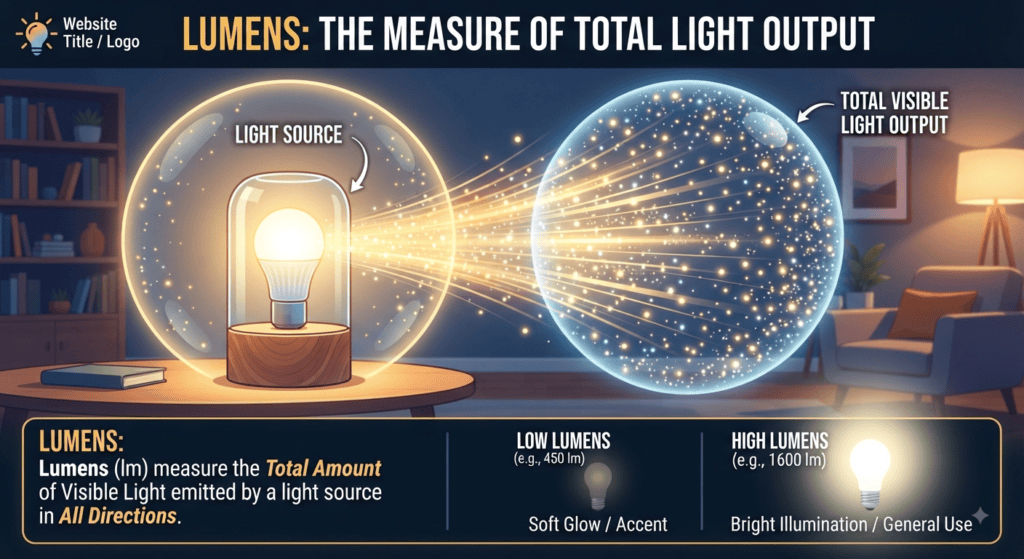
If you’re wondering what are lumens, the simplest answer is that lumens measure the total visible light produced by a light source.
what are lumens If you have ever compared light bulbs and wondered why one says 800 lumens, another says 1,600 lumens, and both use completely different wattages, the answer comes down to what each measurement actually describes.
Lumens measure the total amount of visible light produced by a light source. Watts, by contrast, measure electrical power consumption. That distinction is especially important with LED lighting, because an LED can produce substantial light output while using relatively little electricity. The U.S. Department of Energy recommends looking at lumens when comparing how much light different bulbs produce.
In this guide, you will learn the lumen meaning, what a lumen is, how lumens in lighting relate to brightness, how to understand light bulb lumens and LED lumens, and how lumens compare with watts, lux, and candela.
Affiliate disclosure: Some product links in this article are Amazon affiliate links. If you purchase through them, Smart Air HQ may earn a commission at no additional cost to you.
How to Choose a Light by Lumens
If you are still asking what are lumens, think of them as the number that tells you how much visible light a bulb or fixture produces. Understanding what are lumens makes it easier to compare LED bulbs, traditional bulbs, and different lighting fixtures without relying on wattage alone. Once you know the lumen rating you need, you can make a more informed choice based on light output, energy use, and the intended application.
What Are Lumens? Understanding Light Output
“Understanding what are lumens helps you compare modern LED bulbs more accurately.”
What Are Lumens?
A lumen (lm) is the SI unit used to measure luminous flux, meaning the total amount of visible light emitted by a source. In simple terms, lumens tell you how much visible light a lamp, bulb, flashlight, or other light source produces overall. NIST identifies the lumen as the unit of luminous flux and distinguishes it from other photometric measurements such as candela and lux.
This is why the number printed on a modern light bulb is useful when you want to compare light output. A bulb rated at 1,600 lumens produces twice the total luminous flux of a 800-lumen bulb, although that does not automatically mean it will look twice as bright in every situation. Fixture design, beam direction, room size, surface reflectivity, and viewing conditions also influence how the light is experienced.
The simplest way to remember the lumen meaning is:
Lumens = the total visible light output from a light source.
LED section
Before comparing LED products, it helps to understand what are lumens and why this measurement is more useful than wattage for comparing light output.
Lumens in Lighting: Why They Matter
When learning what are lumens, it is also important to remember that lumens describe total light output rather than electrical consumption. Knowing what are lumens helps you compare lighting products more accurately, especially when choosing between LED bulbs with different wattages but similar light output.
For everyday bulb shopping, lumens are generally much more useful than watts for answering the question, “How much light will I get?”
Lumen Meaning vs. Brightness
The terms lumens and brightness are often used together, but they are not exactly interchangeable. Lumens are an objective measurement of luminous flux, while perceived brightness depends on how light reaches your eyes and interacts with the surrounding environment.
For example, two lamps can have the same lumen rating but create noticeably different experiences. One might spread light broadly around a room, while another concentrates much of its output into a narrow beam. The total light output can be similar even though the apparent brightness of light in a particular area is different.
This distinction becomes important when choosing lighting for a bedroom, kitchen, desk, hallway, garage, or outdoor space. Instead of asking only how many lumens a bulb has, consider where the light goes and what you need it to illuminate.
Lumens in Lighting: Why They Matter
→ Existing explanation about LEDs
→ Existing checklist
Why Higher Lumens Usually Mean More Light
When comparing similar types of light sources, a higher lumen rating generally means more total visible light output. An 800-lumen bulb therefore produces more total luminous flux than a 450-lumen bulb.
However, higher lumens do not necessarily mean that a light will feel better or more suitable. Excessive light can be uncomfortable in some applications, while insufficient light can make tasks difficult.
Think of lumens as the quantity of visible light, rather than a complete description of how that light will appear.
What Is a Lumen in Simple Terms?
If you want a simple answer to “what is a lumen?”, think of lumens as a way of counting the total visible light produced by a source.
A lumen is not a measurement of electricity consumption. It is not the same thing as room illumination, and it does not describe the direction of light by itself. Instead, it measures luminous flux—a photometric quantity that accounts for the visual response of the human eye. NIST lists lumen, candela, and lux among the important photometric units used to describe visible light.
That makes lumens particularly useful for everyday lighting decisions. When a package says a light bulb produces 800 lumens, it is telling you about its rated light output rather than how much electrical power it consumes.
Lumens in Lighting: Why They Matter
Understanding lumens in lighting makes it much easier to compare bulbs and fixtures. In the past, shoppers often associated a higher wattage with a brighter bulb because incandescent bulbs had a relatively familiar relationship between electrical power and light output. Modern lighting technology has made that assumption unreliable.
LEDs demonstrate this clearly. The Department of Energy provides examples in which 800 lumens can be produced by LED lamps using substantially less power than a conventional incandescent lamp producing a similar amount of light.
When choosing a light, therefore, start with the required light output and then consider energy use.
A practical checklist is:
- Lumens: How much total light does the source produce?
- Watts: How much electrical power does it use?
- Beam pattern: Where does the light go?
- Color temperature: Does the light look warm, neutral, or cool?
- Fixture compatibility: Will the bulb physically and electrically work with the fixture?
- Dimming: Is the bulb compatible with the intended dimmer?
For readers interested in the broader relationship between lighting and household energy use, the Smart Energy category provides a natural place to explore related energy topics.
Light Bulb Lumens: How Many Do You Need?
The right number of light bulb lumens depends on the application rather than a single universal brightness number. A small accent lamp does not need the same output as a ceiling fixture intended to illuminate an entire room.
As a useful starting point, common replacement-lighting comparisons include approximately 450 lumens for a traditional 40-watt incandescent equivalent, 800 lumens for 60 watts, 1,100 lumens for 75 watts, and 1,600 lumens for 100 watts. These are comparison benchmarks, not a rule that every LED must use a particular wattage.
| Approximate light output | Traditional incandescent comparison | Typical LED power range in DOE comparison |
|---|---|---|
| 450 lumens | 40W | 4.5–7W |
| 800 lumens | 60W | 5.9–10.5W |
| 1,100 lumens | 75W | 9.5–14W |
| 1,600 lumens | 100W | 10.5–18W |
The important point is that lumens stay focused on light output while watts describe power consumption. Actual LED wattage varies by product and technology.
If you are shopping for replacement bulbs, you can browse Amazon’s current selection of 450-lumen light bulbs, 800-lumen light bulbs, or 1,600-lumen light bulbs.
LED Lumens Explained
LED lumens describe the luminous flux produced by an LED light source, just as lumens describe the output of other visible-light sources. The major difference is that LEDs can produce a given amount of light with comparatively low electrical power.
This is why the phrase “60-watt equivalent” on an LED package should not be interpreted as “this LED consumes 60 watts.” Instead, the comparison generally refers to the amount of light output associated with a traditional 60-watt incandescent bulb. An 800-lumen LED can provide a similar light-output level while consuming considerably less power.
When comparing LEDs, look for the actual lumen rating, rather than relying exclusively on an “equivalent wattage” description.
For example, you can compare 800-lumen LED bulbs, 1,100-lumen LED bulbs, and 1,600-lumen LED bulbs according to the amount of light you actually need.
Why LED Wattage Can Be Misleading
A common mistake is assuming that a 12-watt LED must be dimmer than a 20-watt LED. That conclusion does not follow from wattage alone.
Two bulbs can consume different amounts of electricity while producing similar light output. The Department of Energy’s purchasing guidance illustrates this with products producing 800 lumens at different input-power levels.
This is why modern lighting decisions are better made by considering lumens first and watts second.
H2: Lumens vs Watts: What Is the Difference?
The difference between lumens vs watts is straightforward:
| Measurement | What it tells you | Main use |
|---|---|---|
| Lumens (lm) | Total visible light output | Comparing brightness/light output |
| Watts (W) | Electrical power consumed | Comparing energy consumption |
| Lux (lx) | Illuminance on a surface | Evaluating light falling on an area |
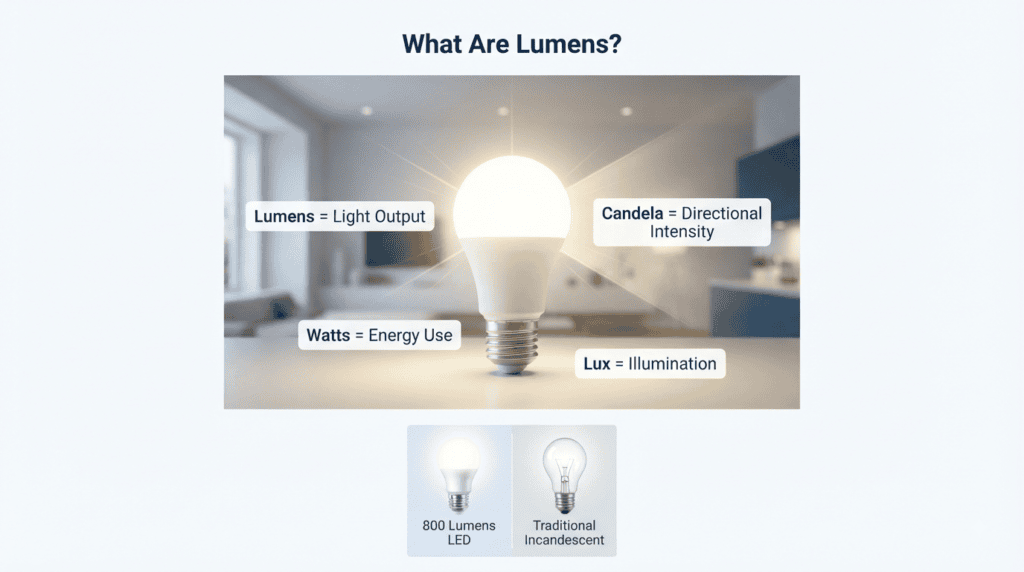
| Candela (cd) | Luminous intensity in a direction | Evaluating directional light intensity |
The confusion comes from the fact that watts were historically used as a rough proxy for bulb brightness. With modern LEDs, that shortcut no longer works reliably.
The Department of Energy specifically describes lumens as a measure of the total visible light emitted by a source and watts as a measure of power input.
So if your goal is to replace a bulb with a similar amount of light, match lumens rather than simply matching watts.
Lumens to Watts
There is no single universal lumens-to-watts conversion because the relationship depends on the light source’s efficiency, commonly expressed as luminous efficacy in lumens per watt.
The basic relationship is:
Lumens ÷ watts = lumens per watt (lm/W)
For example, if a bulb produces 800 lumens while consuming 10 watts:
800 ÷ 10 = 80 lm/W
That tells you how much luminous output the source produces for each watt of electrical power.
It does not mean that 800 lumens always equals 10 watts. Another technology or product could produce the same 800 lumens using more or less power.
H3: Watts to Lumens
The reverse question—watts to lumens—has the same limitation.
You cannot accurately determine lumens from watts alone unless you know the light source’s luminous efficacy.
The formula is:
Lumens = watts × luminous efficacy
For example, a hypothetical 10-watt light producing 80 lumens per watt would produce:
10 × 80 = 800 lumens
This is why “10 watts equals X lumens” is not a universal lighting rule. Product specifications are the better source for actual light output.
H2: Lumens vs Lux: Total Light vs Light on a Surface
The difference between lumens vs lux becomes important when you move from evaluating a light source to evaluating illumination in a particular location.
Lumens measure luminous flux—the total visible light emitted by a source. Lux measures illuminance—the amount of luminous flux falling on a given area. NIST identifies illuminance as a quantity measured in lux, with the SI relationship expressed as lumens per square meter.
This means a 1,000-lumen light does not automatically create a fixed lux level everywhere around it. The resulting illumination depends on distance, beam distribution, mounting position, and the area over which the light is spread.
A useful mental model is:
- Lumens: How much light is being produced?
- Lux: How much of that light reaches a particular surface?
That distinction is especially useful when evaluating work areas, desks, kitchens, workshops, and other spaces where actual illumination matters.
Check Price on Amazon
Affiliate disclosure: This article contains affiliate links. If you purchase through qualifying links, SmartAirHQ may earn a commission at no additional cost to you.
Why the Same Lumens Can Produce Different Illumination
Imagine two 1,000-lumen lights. One spreads its output broadly across a large room, while the other concentrates its output into a narrower area. The total luminous flux can be the same, but the illumination at a particular surface can differ significantly.
Distance also matters. As a light source moves farther from a surface, the light is distributed over a larger area, changing the resulting illuminance.
For technical lighting design, therefore, lumens alone are not enough. Lux helps describe what is happening at the surface you are trying to illuminate.
Lumens vs Candela: Total Output vs Directional Intensity
The distinction between lumens vs candela is another important part of understanding light measurements.
A lumen measures total luminous flux, while a candela (cd) measures luminous intensity in a particular direction. NIST explains that candela describes the intensity of visible light from a source in a given direction, whereas lumen represents the total amount of light emitted.
This distinction is particularly useful for directional lighting.
Consider a spotlight and an omnidirectional bulb. They could have comparable total lumen output, but the spotlight concentrates more of its light into a particular direction. Candela can therefore provide information that lumens alone cannot.
In simple terms:
- Lumens: Total light output.
- Candela: Directional luminous intensity.
- Lux: Illumination received by a surface.
These measurements describe different aspects of the same broader subject: photometry, the measurement of visible light as perceived by the human visual system.
Luminous Flux, Luminous Intensity, and Illumination Explained
Three terms often appear together when researching light measurements: luminous flux, luminous intensity, and illumination. Understanding the difference makes lighting specifications much easier to interpret.
Luminous flux is measured in lumens and describes the total visible light output. Luminous intensity is measured in candelas and describes how much light is emitted in a particular direction. Illuminance is measured in lux and describes the light arriving at a surface. NIST lists these as distinct photometric quantities rather than interchangeable measurements.
A useful way to remember them is to imagine a flashlight:
- The lumens describe its total light output.
- The candela helps describe how intensely that light is directed.
- The lux describes how much light reaches a particular surface.
That simple framework prevents many common lighting-specification mistakes.
How to Choose a Light by Lumens
Once you understand what lumens mean, choosing lighting becomes much simpler. Start by identifying the purpose of the light, then decide how much total light output you need. After that, check whether the bulb or fixture distributes that light appropriately for the space.
Do not choose a bulb solely because it has the highest lumen number. A very high-output bulb may be unnecessary for an accent lamp, while a low-output bulb may be inadequate for a task-oriented area.
When comparing products, check:
- Lumen rating for total light output.
- Wattage for electrical power consumption.
- Color temperature for the appearance of the light.
- Beam angle when using directional lighting.
- Dimming compatibility if a dimmer will be used.
- Fixture compatibility, including size and electrical requirements.
- Enclosed-fixture compatibility where applicable.
The Department of Energy also recommends checking factors such as color temperature, fixture type, and dimming compatibility rather than considering lumen output in isolation.
For comparison shopping, you can browse 60-watt-equivalent LED bulbs, 75-watt-equivalent LED bulbs, and 100-watt-equivalent LED bulbs.
Match the Light Output to the Job
Different lighting tasks call for different approaches. A decorative fixture may be selected for appearance and atmosphere, whereas a task light needs useful illumination where work is performed.
For example, you might prioritize moderate output for an accent lamp but look for substantially greater total output from a fixture intended to illuminate a large area. The exact choice depends on the room, fixture, mounting height, surfaces, and desired lighting effect.
The important principle is to avoid treating a lumen rating as a universal “good” or “bad” number. The right lumen output is the amount that suits the application.
Common Mistakes When Comparing Lumens
The most common mistake is treating lumens, watts, lux, and candela as interchangeable measurements. They are not. Each answers a different question about light.
Another mistake is assuming that a higher lumen rating always produces a better lighting result. More total light can be useful, but distribution and application matter just as much.
Watch for these common errors:
- Choosing by watts alone: Wattage tells you power consumption, not total light output.
- Assuming watts convert directly to lumens: The relationship depends on luminous efficacy.
- Comparing lumens without considering beam pattern: Directional lights distribute output differently from broad-area lights.
- Confusing lumens with lux: Lumens describe total output; lux describes illumination on a surface.
- Confusing lumens with candela: Candela describes directional luminous intensity.
- Ignoring fixture compatibility: A bulb’s lumen rating does not guarantee that it fits or works correctly in every fixture.
- Ignoring color appearance: Two bulbs with similar lumen ratings can create very different visual environments because of their color characteristics.
For additional examples of lighting products, you can compare dimmable LED bulbs, warm-white LED bulbs, and daylight LED bulbs.
A Quick Lumen Buying Checklist
Before purchasing a light bulb or fixture, use this short checklist to avoid choosing based on the wrong specification.
1. Check the lumens.
Use the lumen rating to compare total visible light output.
2. Check the wattage.
Use wattage to understand electrical power consumption, not brightness.
3. Check the fixture.
Confirm that the bulb has the correct size, base, voltage, and application compatibility.
4. Check the light distribution.
For directional products, consider beam angle and how the fixture directs its output.
5. Check color characteristics.
Choose a color appearance appropriate for the room and purpose.
6. Check dimming requirements.
If you use a dimmer, confirm that the bulb is designed to work with it.
7. Compare like with like.
A lumen comparison is most useful when comparing products intended for similar applications and light distributions.
The goal is not simply to buy the bulb with the biggest lumen number. It is to select the product that provides the right amount and distribution of light for the job.
You can also browse smart LED bulbs by lumen output if you want lighting that combines brightness specifications with connected features.
Frequently Asked Questions About Lumens
What Are Lumens Used For?
Knowing what are lumens helps you compare the amount of visible light produced by different bulbs and fixtures.
What are lumens in lighting?
Once you understand what are lumens, choosing the right light output becomes much easier.”
What are lumens in lighting?
Lumens are the SI unit of luminous flux. They describe the total amount of visible light emitted by a light source. A higher lumen rating generally indicates greater total light output.
What is a lumen?
A lumen is a unit of luminous flux used in photometry. In everyday lighting, it tells you how much visible light a bulb or fixture produces overall.
Are lumens the same as brightness?
Not exactly. Lumens measure luminous flux, while perceived brightness depends on factors such as light distribution, distance, surroundings, and how the light reaches your eyes.
Are higher lumens always better?
No. The appropriate lumen level depends on the application. A higher-output bulb can be useful where more light is needed, but excessive output may be unsuitable for some fixtures or spaces.
What is the difference between lumens and watts?
Lumens measure visible light output. Watts measure electrical power consumption. Modern LEDs demonstrate why these measurements should not be treated as interchangeable.
Can you convert lumens to watts?
Not with one universal conversion factor. The relationship depends on the light source’s luminous efficacy, so you need information about the specific technology or product.
How many lumens is a 60-watt bulb?
As a common comparison benchmark, a 60-watt incandescent bulb corresponds to about 800 lumens. The actual output of a particular bulb can vary, so its rated lumen value is the best specification to check.
What is the difference between lumens and lux?
Lumens measure total luminous flux, while lux measures illuminance—the luminous flux falling on an area. One lux is equivalent to one lumen per square meter.
What is the difference between lumens and candela?
Lumens measure total luminous flux, while candela measures luminous intensity in a particular direction. Candela is therefore especially relevant when considering directional light.
Final Thought: Lumens Are the Key Number for Comparing Light Output
Once you understand what are lumens, choosing the right light output becomes much easier.”
Understanding what are lumens becomes much easier once you separate light output from electrical consumption. Lumens tell you how much visible light a source produces, watts tell you how much electrical power it uses, lux tells you about illumination on a surface, and candela describes luminous intensity in a direction.
For everyday light-bulb shopping, start with lumens. If you want approximately the same amount of light as an older bulb, compare its lumen output rather than simply buying the same wattage. Then consider energy consumption, light distribution, color appearance, dimming, and fixture compatibility.
The most useful rule to remember is simple:
Choose lumens for the amount of light you need; use watts to understand the electricity required to produce it.
For more lighting and home-energy information, visit Smart Air HQ. For a technical reference on photometric units, NIST provides detailed explanations of the lumen, lux, and candela.
You can also compare LED light bulbs, high-lumen LED bulbs, and LED ceiling lights when you’re ready to apply what you’ve learned.
Understanding what are lumens gives you a simple starting point for choosing the right amount of light for any application.