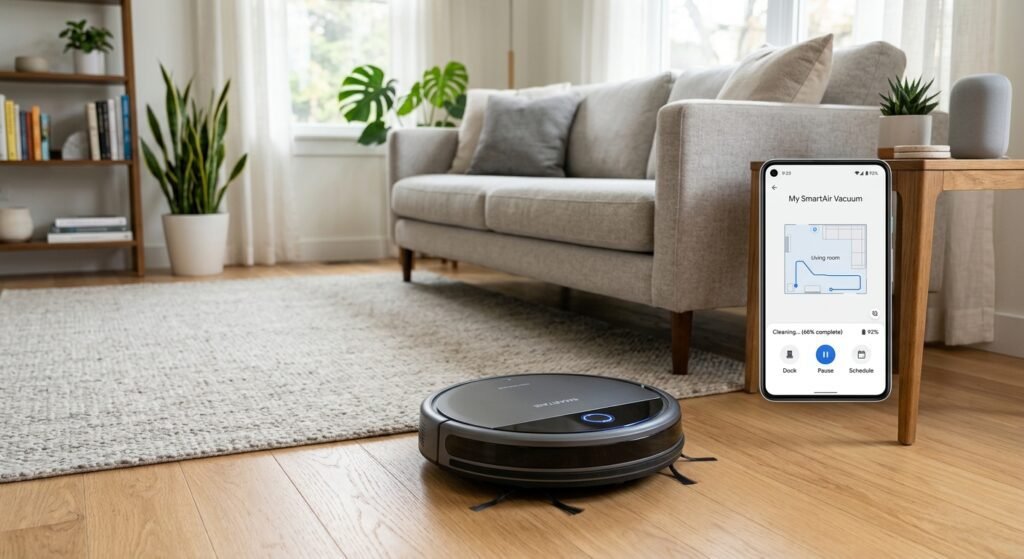
Choosing a smart robot vacuum is no longer just about finding a machine that moves around your floors and collects dust. Modern robot vacuums can map rooms, detect obstacles, vacuum carpets, mop hard floors, empty their own dustbins, wash mop pads, and follow scheduled cleaning routines with minimal daily effort.
That convenience also makes choosing the right model more complicated. Robot vacuums can differ significantly in navigation technology, suction performance, brush design, docking features, mopping systems, maintenance needs, and smart-home compatibility.
This Smart Robot Vacuum Buying Guide reviews 15 automated floor cleaners for different household needs and explains the key features to consider before buying. Rather than presenting one model as the right choice for everyone, the guide covers options for pet hair, hard floors, hands-free cleaning, smaller homes, and buyers who prefer simpler operation.
Affiliate disclosure: This article contains affiliate links. If you purchase through qualifying links, SmartAirHQ may earn a commission at no additional cost to you.
Prices, availability, specifications, and seller information can change. Always verify current product details before purchasing, and check whether features and included accessories are available in your region.
Looking for More Smart Home & Appliance Guides?
Explore SmartAirHQ for practical buying guides, smart-home advice, appliance recommendations, and helpful resources to make your home more efficient and comfortable.
Quick Comparison of 15 Automated Floor Cleaners
The right robot vacuum depends on your home, flooring, cleaning priorities, and budget. Pet owners may prioritize anti-tangle brush systems, while homes with mostly hard floors may place more importance on mopping and edge cleaning. Buyers with low furniture may need a low-profile design, while others may prefer an all-in-one docking station with automated maintenance.
Use the comparison below to quickly narrow down the options before reading the individual recommendations.
| Robot Vacuum | Best Suited For | Standout Consideration | Vacuum + Mop |
|---|---|---|---|
| Roborock Qrevo Curv | Pet hair & premium automation | Anti-tangle design and advanced dock | Yes |
| Dreame X60 Max Ultra Complete | Premium automation | Advanced navigation and high-end dock | Yes |
| Ecovacs DEEBOT T30S AI | Smart all-in-one cleaning | AI navigation and edge cleaning | Yes |
| eufy X10 Pro Omni | Families & mixed floors | AI obstacle avoidance and all-in-one station | Yes |
| Narwal Freo X Ultra | Mopping-focused homes | DirtSense and automated mop care | Yes |
| Shark Matrix Plus 2-in-1 | Practical vacuum + mop | Matrix cleaning and self-emptying | Yes |
| Roomba Combo 10 Max | iRobot ecosystem users | AutoWash dock and smart cleaning features | Yes |
| Roborock Saros 20 | Advanced navigation | Low-clearance design and liftable chassis | Yes |
| Roborock Q5 Pro+ | Vacuum-first buyers | Automated vacuuming and self-emptying | No / varies by configuration |
| eufy L60 SES | Budget-conscious automation | Self-emptying-focused design | No |
| YEEDI C12 Pro Plus | Mid-range convenience | Self-emptying station | Yes |
| SwitchBot S10 | Connected smart homes | Automation and smart-home integration | Yes |
| MOVA P10 Pro Ultra | Feature-focused buyers | Premium vacuum-and-mop approach | Yes |
| Roomba 105 Combo | Simpler Roomba entry point | Accessible vacuum-and-mop format | Yes |
| Dreame L40 Ultra Gen 2 | Value-focused premium cleaning | Strong feature set and automated dock | Yes |
The list includes different types of robot vacuums rather than suggesting that one model is right for every household. Features such as mapping, obstacle detection, self-emptying, mop washing, and automated water management can vary significantly by model and package. Always check the manufacturer’s current specifications and the configuration available in your region before purchasing.
13 Best Automated Floor Cleaners to Consider
The models below are a practical shortlist rather than a permanent ranking. Robot-vacuum lineups, prices, features, and availability can change over time and may differ by country. Use this list to compare each robot’s strengths against your floor type, pets, furniture clearance, cleaning habits, desired automation, and maintenance preferences.
1. Dreame X60 Max Ultra Complete — Best for Maximum Automation
The Dreame X60 Max Ultra Complete is positioned in the premium segment of automated floor cleaning. Its feature set is aimed at reducing manual work through advanced navigation, obstacle handling, and automated dock functions. It is worth considering if your priority is a highly automated routine covering vacuuming, mopping, navigation, and dock maintenance.
🛍️ Shop : Dreame X60 Max on Amazon.
2. ECOVACS DEEBOT T30S AI — Best for Smart Vacuum-and-Mop Features
The ECOVACS DEEBOT T30S AI combines vacuuming and mopping with features focused on mapping, obstacle handling, edge cleaning, voice control, and automated station functions. It is designed for buyers who want a connected vacuum-and-mop system with a broad range of smart-cleaning features.
🔎 Find : ECOVACS DEEBOT T30S AI on Amazon
3. eufy X10 Pro Omni — Best for Families and Mixed Flooring
The eufy X10 Pro Omni combines vacuuming, mopping, obstacle recognition, mapping, and automated station functions. Features such as LiDAR navigation, obstacle recognition, scheduled cleaning, and no-go zones can help households customize cleaning around different rooms and floor types.
⭐ Explore : eufy X10 Pro Omni on Amazon.
4. Narwal Freo X Ultra — Best for Mopping-Focused Homes
The Narwal Freo X Ultra is particularly relevant for homes where mopping is an important part of the cleaning routine. Its feature set includes dirt detection, automated mop washing and drying, detergent dispensing, LiDAR navigation, multi-level mapping, and a brush designed to help reduce hair tangling. These features make it worth comparing for homes with extensive hard flooring.
🏠 Find : Narwal Freo X Ultra on Amazon
5. Shark Matrix Plus 2-in-1 — Best for Practical Vacuum-and-Mop Cleaning
The Shark Matrix Plus 2-in-1 is worth considering if you want automated vacuuming, mopping, and self-emptying without necessarily choosing a flagship-priced model. Its Matrix cleaning system, sonic mopping, self-cleaning brushroll, edge cleaning, and HEPA filtration make it a practical option for everyday mixed-floor cleaning.
🛒 Check : Shark Matrix Plus 2-in-1 on Amazon.
6. Roomba Combo 10 Max — Best for the iRobot Ecosystem
The Roomba Combo 10 Max is designed for shoppers who want vacuuming and mopping within the iRobot ecosystem. Its automated dock, room-based cleaning, zone cleaning, dirt detection, and voice-assistant compatibility make it relevant for buyers who prioritize connected cleaning and automated maintenance.
✨ Explore : Roomba Combo 10 Max on Amazon.
7. Roborock Q5 Pro+ — Best for Vacuum-First Buyers
The Q5 Pro+ is a useful option for buyers whose priority is automated vacuuming rather than an elaborate mop system. A vacuum-first robot can make sense for homes with substantial carpet, rugs, dust, crumbs, or pet hair. When comparing it with more advanced docked models, consider whether automated mop washing and water management are actually necessary for your cleaning routine.
🔗 See : Roborock New Qrevo S on Amazon.
8. ECOVACS DEEBOT X12S OMNICYCLONE Robot Vacuum & Mop with OZMO Roller 3.0
The ECOVACS DEEBOT X12S OMNICYCLONE is designed for buyers looking for advanced automated vacuuming and mopping in one system. Its OZMO Roller 3.0 mopping technology, smart navigation, obstacle recognition, and automated cleaning functions make it a strong option for households that want to reduce hands-on floor maintenance. Before purchasing, check the exact package, dock features, included accessories, and regional specifications because configurations can vary by market.
✨ Explore : ECOVACS DEEBOT X12S on Amazon
9. Yeedi C12 Pro Plus Replacement Parts Kit — Best for Routine Maintenance
This replacement accessories kit is designed for compatible Yeedi C12 Pro Plus and C12 Plus robot vacuum models. The 13-piece kit includes replacement components such as brush rolls, side brushes, and filters to help maintain cleaning performance and replace worn or dirty parts. Before ordering, confirm your exact Yeedi model and check the package contents to make sure the included accessories are compatible with your robot vacuum.
🛒 Check Price : YEEDI C12 Pro Plus on Amazon
10. Switch Bot S10 — Best for Connected Smart-Home Automation
The SwitchBot S10 is particularly relevant for buyers who place a high priority on smart-home integration. When comparing this type of robot, look beyond suction specifications and consider app controls, scheduling, room management, smart-home compatibility, docking requirements, and ongoing maintenance.
🏠 Find : Switch Bot S10 on Amazon
11. MOVA P10 Pro Ultra — Best for Feature-Rich Cleaning
The MOVA P10 Pro Ultra is worth comparing for shoppers interested in premium-style vacuuming, mopping, navigation, and automated dock features. Pay particular attention to the exact model generation, included dock, accessory costs, and regional specifications before ordering.
⭐ Explore: MOVA P10 Pro Ultra on Amazon
12. Roomba 105 Combo — Best for a Simpler Roomba Experience
The Roomba 105 Combo is aimed at buyers who want the Roomba brand in a more accessible format while still getting vacuum-and-mop functionality. It can be a practical choice for shoppers who want smart scheduling and basic automation without necessarily requiring the most sophisticated docking system.
🔎 Find : Roomba 105 on Amazon
13. Dreame L40 Ultra Gen 2 — Best for Feature-Rich Premium Cleaning
The Dreame L40 Ultra Gen 2 provides another comparison point between basic robot vacuums and newer flagship models. Buyers comparing premium options should look at its navigation, vacuuming, mopping, docking automation, maintenance requirements, and ongoing accessory costs rather than focusing on a single specification.
🛍️ Shop : Dreame L40 Ultra Gen 2 on Amazon.
Quick Comparison of 15 Automated Floor Cleaners & Browse Amazon
The right robot vacuum depends on your home, flooring, cleaning priorities, and budget. Pet owners may prioritize anti-tangle brush systems, while homes with mostly hard floors may place more importance on mopping and edge cleaning. Buyers with low furniture may need a low-profile design, while others may prefer an all-in-one docking station with automated maintenance.
Use the comparison below to quickly narrow down the options before reading the individual recommendations.
| Robot Vacuum | Best Suited For | Standout Consideration | Vacuum + Mop |
|---|---|---|---|
| Roborock Qrevo Curv | Pet hair & premium automation | Anti-tangle design and advanced dock | Yes |
| Dreame X60 Max Ultra Complete | Premium automation | Advanced navigation and high-end dock | Yes |
| Ecovacs DEEBOT T30S AI | Smart all-in-one cleaning | AI navigation and edge cleaning | Yes |
| eufy X10 Pro Omni | Families & mixed floors | AI obstacle avoidance and all-in-one station | Yes |
| Narwal Freo X Ultra | Mopping-focused homes | DirtSense and automated mop care | Yes |
| Shark Matrix Plus 2-in-1 | Practical vacuum + mop | Matrix cleaning and self-emptying | Yes |
| Roomba Combo 10 Max | iRobot ecosystem users | AutoWash dock and smart cleaning features | Yes |
| Roborock Saros 20 | Advanced navigation | Low-clearance design and liftable chassis | Yes |
| Roborock Q5 Pro+ | Vacuum-first buyers | Automated vacuuming and self-emptying | No / varies by configuration |
| eufy L60 SES | Budget-conscious automation | Self-emptying-focused design | No |
| YEEDI C12 Pro Plus | Mid-range convenience | Self-emptying station | Yes |
| SwitchBot S10 | Connected smart homes |
How to Choose the Right Robot Vacuum for Your Home
The right robot vacuum should solve your home’s specific cleaning needs rather than simply offer the longest list of features. Start with your floor type, then consider pets, furniture clearance, room layout, cleaning frequency, maintenance requirements, and available space. A less expensive model that fits your home may be more practical than a flagship robot whose dock is too large or whose advanced features you may never use.
Before buying, consider these priorities:
- Mostly carpet: Prioritize brush design, suction performance, carpet detection, and hair management.
- Mostly hard floors: Look for effective mopping, edge cleaning, water management, and mop-lifting features.
- Homes with pets: Look for anti-tangle brush systems, reliable debris pickup, and convenient dustbin or self-emptying options.
- Large homes: Prioritize accurate mapping, room selection, battery management, and automatic recharge and resume.
- Small apartments: Measure both the robot and its docking station, especially if floor or storage space is limited.
- Homes with lots of furniture: Check the robot’s height, clearance requirements, and obstacle-navigation capabilities.
- Minimum maintenance: Consider an all-in-one dock with automatic dust emptying, mop washing, drying, and water management.
Complete Your Home Appliance Research
Looking for more home appliance buying advice? Explore SmartAirHQ’s Best Washing Machine Guide for practical tips on features, cleaning performance, and choosing a model that fits your household.
Robot Vacuum Features That Actually Matter
Modern robot vacuums can advertise dozens of features, but not all of them have the same impact on everyday cleaning. Navigation, brush design, dust management, mopping performance, and maintenance automation usually deserve more attention than flashy app features. The right combination depends on your home, and a feature is valuable only when it addresses a real cleaning problem.
Navigation and Mapping
Navigation determines whether a robot cleans systematically or spends too much time wandering around. LiDAR, cameras, structured-light sensors, and other detection systems can help robots understand rooms and obstacles. Multi-level mapping can also matter in multi-story homes. More sensors do not automatically guarantee perfect cleaning, so consider your room layout, furniture density, and the types of objects normally left on the floor.
Suction Power and Brush Design
Suction figures can be useful for comparing models within a manufacturer’s lineup, but they should not be treated as the sole measure of cleaning quality. Brush design, airflow, floor contact, navigation, and cleaning passes all influence results. Pet owners should pay particular attention to anti-tangle systems because a robot that constantly collects hair around its brush can create more maintenance work than expected.
Mopping System
Robot mopping systems vary substantially. Some use a basic damp pad, while more advanced machines use rotating pads, pressure, automated washing, drying, detergent dispensing, or dirt detection. If your home is primarily carpeted, paying a large premium for advanced mopping may not make sense. For tile, vinyl, laminate-compatible cleaning routines, or other hard-floor environments, mopping capability can become much more important.
Self-Emptying and Dock Automation
A self-emptying dock reduces how often you need to manually empty the robot’s dustbin. Higher-end stations can also wash and dry mop pads, refill clean water, collect dirty water, and perform other maintenance tasks. These features can significantly reduce hands-on work, but they also increase the size and complexity of the dock. Always check whether you have enough floor space for the complete docking station.
App Controls and Smart-Home Integration
App controls are useful when they allow you to create room-specific schedules, no-go zones, cleaning zones, suction levels, mop settings, or multi-floor maps. Voice control can be convenient, but it should be considered an extra rather than the primary reason to buy. Before purchasing, also check regional app support, Wi-Fi requirements, software features, and whether your preferred smart-home platform is compatible.
For more connected appliance ideas, explore our Smart Kitchen Gadgets Buying Guide for practical recommendations and buying tips.
Discover More Smart Home Technology
Explore SmartAirHQ’s Smart Gadgets section for practical buying guides, product insights, and recommendations for connected devices that can make everyday home tasks easier.
Robot Vacuum Buying Guide by Floor Type
Your flooring should influence your robot vacuum choice more than a generic “best robot vacuum” ranking. Hard floors, carpets, rugs, thresholds, and mixed surfaces create different cleaning requirements. A robot that performs well in an open hard-floor apartment may not be the best fit for a home with thick rugs, multiple floor transitions, and significant pet hair.
Hard Floors
Prioritize edge cleaning, mopping performance, obstacle navigation, and the ability to keep wet cleaning away from areas that should remain dry.
Carpeted Rooms
Focus on brush design, suction performance, carpet detection, debris pickup, and whether the robot can prevent mop pads from contacting carpet.
Mixed Flooring
Look for a robot that can recognize different floor types and adjust its cleaning behavior. Mop lifting can be particularly useful because it helps reduce the chance of a wet mop contacting carpeted areas.
Rugs and Thresholds
Measure your home’s floor transitions rather than assuming a robot will cross every threshold. Advertised threshold capability can depend on the specific height and shape of the transition, so your home’s actual floor conditions still matter.
Robot Vacuums for Pet Hair: What to Prioritize
Pet owners should look beyond raw suction numbers when choosing a robot vacuum. Pet hair can wrap around roller brushes, collect around side brushes, fill dustbins quickly, and increase filter maintenance. A robot with anti-tangle brush technology can reduce some of this recurring maintenance, while a self-emptying dock can be especially useful when the robot runs frequently and collects large amounts of fur and debris.
When shopping for a robot vacuum for pet hair, prioritize:
- Anti-tangle main and side brushes
- Easy-to-remove brush assemblies
- Large dustbin capacity or self-emptying
- Strong edge and corner cleaning
- Effective carpet cleaning
- Obstacle avoidance around toys and pet items
- Easy access to filters and replacement parts
Several models in this guide, including the Roborock Qrevo Curv, Narwal Freo X Ultra, Shark Matrix Plus 2-in-1, and eufy X10 Pro Omni, include features that may be useful for homes with pets and frequent hair cleanup. However, manufacturer claims should be considered alongside independent testing, user reviews, and your home’s specific flooring and cleaning conditions.
How Much Automation Do You Really Need?
More automation is not always better for every household. A premium docking station may empty the dustbin, wash and dry mop pads, refill water, and manage other cleaning tasks automatically, but it also requires more floor space and includes additional components that may need occasional maintenance. A simpler robot can be perfectly adequate if your main goal is scheduled vacuuming with minimal manual effort.
Think of robot vacuum automation in four levels:
- Basic: Scheduled vacuuming and automatic charging.
- Intermediate: Room mapping, room selection, no-go zones, and self-emptying.
- Advanced: Vacuuming and mopping with automated water handling, mop washing, and drying.
- Premium: Advanced obstacle recognition, sophisticated navigation, adaptive cleaning, and highly automated dock maintenance.
How Much Automation Do You Really Need?
More automation is not always better for every household. A premium docking station may empty the dustbin, wash and dry mop pads, refill water, and manage other cleaning tasks automatically, but it also requires more floor space and includes additional components that may need occasional maintenance. A simpler robot can be perfectly adequate if your main goal is scheduled vacuuming with minimal manual effort.
Think of robot vacuum automation in four levels:
- Basic: Scheduled vacuuming and automatic charging.
- Intermediate: Room mapping, room selection, no-go zones, and self-emptying.
- Advanced: Vacuuming and mopping with automated water handling, mop washing, and drying.
- Premium: Advanced obstacle recognition, sophisticated navigation, adaptive cleaning, and highly automated dock maintenance.
Choose the level of automation that solves your actual cleaning needs. Paying for additional features may not provide much practical benefit if you rarely use them, while households that prioritize hands-free cleaning may find advanced dock automation worth considering.Choose the level of automation that solves your actual cleaning needs. Paying for additional features may not provide much practical benefit if you rarely use them, while households that prioritize hands-free cleaning may find advanced dock automation worth considering.
How to Set Up a Robot Vacuum for Better Results
Proper setup can make a noticeable difference in how reliably a robot vacuum cleans your home. Start by giving the robot a clear docking location, removing obvious hazards, completing its initial mapping process, and creating practical room boundaries. Avoid placing the dock where furniture, walls, or narrow passages could make it difficult for the robot to return, dock, or leave reliably.
A practical setup routine includes:
- Choose a clear dock location: Leave enough open space around the dock for the robot to approach and maneuver.
- Remove cables and small objects: Clear the initial mapping area of cords, clothing, toys, and other objects that could interfere with navigation.
- Run the first mapping cycle: Follow the manufacturer’s instructions and allow the robot to complete its initial map.
- Name rooms and create cleaning zones: Use these features if supported by the robot’s app.
- Create no-go or no-mop areas: Restrict areas where the robot should not vacuum or mop.
- Set a realistic cleaning schedule: Match cleaning frequency to household traffic, pets, and floor type.
- Inspect brushes and filters regularly: Clean or replace components according to the manufacturer’s maintenance guidance.
- Keep the dock clean: Automatic maintenance reduces manual work, but the docking station itself may still require occasional cleaning.
The goal is not to make your entire home perfectly robot-proof. Instead, focus on removing recurring obstacles and maintaining the areas that most often interrupt automated cleaning.
How to Set Up a Robot Vacuum for Better Results
Proper setup can make a noticeable difference in how reliably a robot vacuum cleans your home. Start by giving the robot a clear docking location, removing obvious hazards, completing its initial mapping process, and creating practical room boundaries. Avoid placing the dock where furniture, walls, or narrow passages could make it difficult for the robot to return, dock, or leave reliably.
A practical setup routine includes:
- Choose a clear dock location: Leave enough open space around the dock for the robot to approach and maneuver.
- Remove cables and small objects: Clear the initial mapping area of cords, clothing, toys, and other objects that could interfere with navigation.
- Run the first mapping cycle: Follow the manufacturer’s instructions and allow the robot to complete its initial map.
- Name rooms and create cleaning zones: Use these features if supported by the robot’s app.
- Create no-go or no-mop areas: Restrict areas where the robot should not vacuum or mop.
- Set a realistic cleaning schedule: Match cleaning frequency to household traffic, pets, and floor type.
- Inspect brushes and filters regularly: Clean or replace components according to the manufacturer’s maintenance guidance.
- Keep the dock clean: Automatic maintenance reduces manual work, but the docking station itself may still require occasional cleaning.
The goal is not to make your entire home perfectly robot-proof. Instead, focus on removing recurring obstacles and maintaining the areas that most often interrupt automated cleaning.
Privacy, Apps, Cameras, and Smart Robot Vacuum Security
Smart robot vacuums can collect more information than a traditional vacuum because they may connect to Wi-Fi, use mobile apps, create maps of your home, or include cameras and other sensors. Before buying, consider what data the robot collects, how the manufacturer stores it, and which connected features you actually need.
Pay attention to these privacy and security considerations:
- Home mapping data: Some robots create detailed maps that can reveal room layouts and cleaning areas. Check how the manufacturer stores, uses, and protects this information.
- Cameras and visual sensors: Camera-equipped models may collect visual information while navigating. If privacy is a major concern, compare models that use different navigation technologies.
- Mobile app permissions: Review the permissions requested by the companion app and only enable access that is necessary for the features you use.
- Cloud connectivity: Some smart features may depend on manufacturer cloud services. Check what happens if internet access is unavailable or the service changes.
- Account security: Use a strong, unique password and enable two-factor authentication when the manufacturer provides it.
- Software updates: Keep the robot, mobile app, and related accounts updated to receive available security and reliability improvements.
- Microphones and voice assistants: If a model supports voice control, check whether it includes a microphone and review the available privacy controls.
- Data deletion: Before buying, check whether you can delete stored maps, account information, or other personal data through the app or manufacturer’s privacy settings.
A robot vacuum does not need every connected feature to clean effectively. If privacy is a priority, compare the navigation technology, camera and microphone hardware, required cloud services, app permissions, and available privacy controls before purchasing.
A smart robot vacuum can contain more technology than a traditional vacuum cleaner, including cameras, microphones, maps, cloud-connected apps, and Wi-Fi functionality depending on the model. That does not mean you should avoid smart cleaning devices, but it does mean you should understand what your chosen robot collects, which features require an account, and how the manufacturer handles software and privacy.
Before buying a camera-equipped or connected model, review the manufacturer’s privacy documentation and app permissions. Consider whether you actually need remote video or voice features. A robot with fewer connected features may be preferable for someone who values simplicity and reduced digital exposure.
Frequently Asked Questions About Smart Robot Vacuums
Robot vacuum buyers often have practical questions about price, maintenance, mopping, Wi-Fi, and the features that actually matter. These answers address common buying considerations without assuming that one robot vacuum is right for every household.
Are Robot Vacuums Worth Buying?
Robot vacuums can be worthwhile if you value frequent automated floor cleaning and want to reduce the need for manual vacuuming. Their value depends on how well the robot matches your flooring, furniture layout, pets, cleaning frequency, and preferred level of automation.
Is a Self-Emptying Robot Vacuum Worth the Extra Cost?
A self-emptying robot vacuum can be useful if you want less routine maintenance or have pets and high levels of debris. If you are comfortable emptying the robot’s dustbin regularly, a self-emptying dock may not be necessary.
Do Robot Vacuums Work on Carpet?
Many robot vacuums can clean carpets effectively. For carpeted homes, consider brush design, suction performance, carpet detection, debris pickup, and whether the robot can keep wet mop pads away from carpet when transitioning between floor types.
Are Robot Vacuum Mops Actually Useful?
Robot mops can be useful for routine hard-floor maintenance, particularly when the robot can automatically wash, dry, or otherwise maintain its mop system. However, they should not automatically be considered a replacement for every type of deep manual floor cleaning.
Do Robot Vacuums Need Wi-Fi?
Wi-Fi requirements vary by model. Features such as app-based scheduling, remote control, map management, and smart-home integration may require network connectivity. Check the manufacturer’s requirements for the specific model before purchasing.
What Is the Most Important Robot Vacuum Feature?
There is no single feature that matters most for every household. Pet owners may prioritize anti-tangle brush systems, while large homes may benefit more from accurate mapping and navigation. Hard-floor homes may prioritize mopping and edge cleaning, while busy households may value self-emptying and automated dock maintenance.
How Often Should a Robot Vacuum Run?
The ideal schedule depends on household traffic, pets, floor type, and how quickly debris accumulates. Frequent light cleaning can help maintain floors between deeper cleanings, but the schedule should be adjusted to your home’s specific needs.
Final Thought: Choose the Robot That Matches Your Cleaning Routine
The right robot vacuum is not necessarily the most expensive model or the one with the longest specification list. It is the one that fits your actual home and cleaning routine.
Start with your flooring, pets, furniture clearance, home layout, cleaning frequency, and maintenance preferences. Then decide which features genuinely matter to you, such as self-emptying, advanced mopping, obstacle avoidance, multi-level mapping, or smart-home controls.
Before purchasing, compare the models that match your priorities, measure the available space for both the robot and its dock, check replacement-part and maintenance requirements, and verify the exact configuration available in your region.
The smartest purchase is the one that helps reduce your cleaning workload without adding unnecessary complexity or features you are unlikely to use. Use this guide to narrow your options, then verify current product details before ordering.