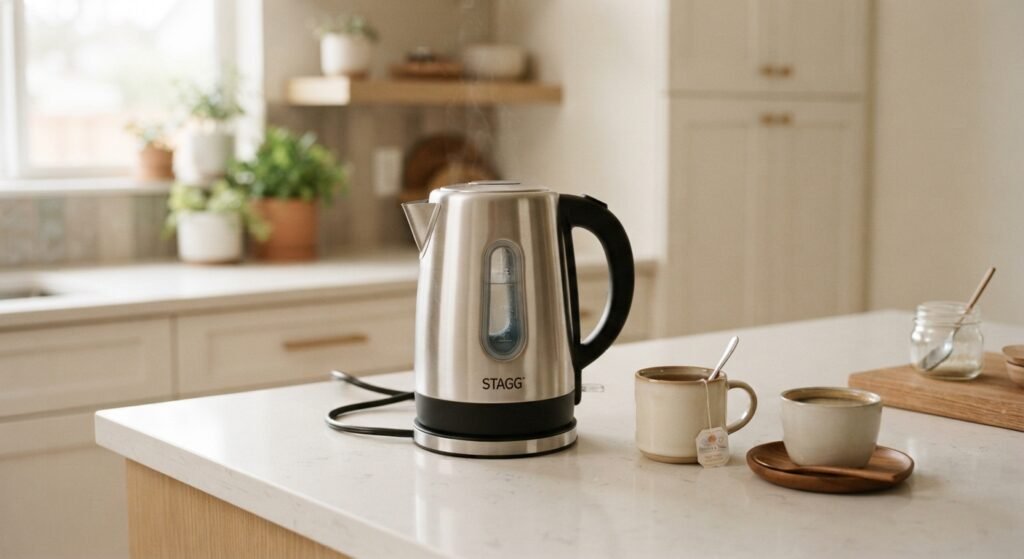
Choosing the best electric kettle depends on more than how quickly it boils water. The right model should match your daily routine, offer the capacity you need, heat efficiently, feel comfortable to pour, and include reliable safety features.
Whether you need a simple kettle for tea and coffee or a model with precise temperature control, this guide will help you compare the features that matter most. We’ll look at boiling speed, capacity, wattage, temperature settings, materials, safety features, cleaning, and ease of use so you can choose a kettle that fits your needs without paying extra for features you may never use.
What Makes the Best Electric Kettle?
The best electric kettle is the one that matches the way you actually use hot water. Instead of choosing a model based on the number of features it offers, focus first on the factors that affect everyday performance: capacity, heating speed, temperature control, safety, material, ease of pouring, and cleaning.
A compact kettle may be ideal for one or two cups, while a larger model can be more practical for families or frequent cooking. If you prepare different types of tea or coffee, adjustable temperature settings may also be worth considering. For simple boiling, however, a basic model with reliable safety features may be all you need.
Start With Your Everyday Hot-Water Needs
Think about what you normally use an electric kettle for before comparing models. Tea, coffee, hot chocolate, instant meals, and cooking can all influence the capacity and features you need.
Consider:
- How much water do you usually boil at once?
- How many people will use the kettle?
- Do you need specific temperatures for tea or coffee?
- Do you value faster boiling or energy-conscious operation?
- How often will the kettle need cleaning?
Answering these questions can quickly narrow down your options and prevent you from paying for features that do not fit your routine.
Prioritize the Features That Matter Most
Electric kettles range from simple one-touch models to advanced appliances with temperature presets, keep-warm functions, digital displays, and specialized pouring designs. These extras can be useful, but they should come after the basics.
Prioritize a suitable capacity, efficient heating, automatic shutoff, boil-dry protection, comfortable handling, durable construction, and easy maintenance. Then consider additional features based on how you use the kettle.
This approach makes it easier to compare models based on practical value rather than simply choosing the kettle with the longest feature list.
How to Choose the Right Electric Kettle
Choosing the right electric kettle is easier when you compare models using the same practical criteria. Instead of choosing based only on brand, appearance, or the number of features, focus on the specifications and design details that affect everyday use.
The most important factors include capacity, heating power, temperature control, safety features, material, ease of pouring, and cleaning. Comparing these factors together can help you find a kettle that fits your routine without paying for features you may not need.
Choose the Right Kettle Capacity
Capacity determines how much water you can heat in one cycle. A smaller kettle can be practical for one person or occasional use, while a larger model may be more convenient for families or households that prepare several cups at once.
Don’t automatically choose the largest kettle available. If you usually heat only one or two servings, a smaller model can take up less counter space and help you avoid heating more water than necessary.
A clearly marked water-level indicator is also useful because it makes filling the kettle more accurate and helps you heat an appropriate amount of water.
Consider Heating Power and Boiling Speed
Heating power, measured in watts, is an important specification when comparing electric kettles. However, wattage alone does not determine how quickly a kettle will boil water. The amount of water being heated and the kettle’s overall design also affect heating time.
If you normally heat a small amount of water, convenience and capacity may matter more than choosing the highest wattage. If you regularly prepare several cups, look for a combination of suitable capacity and efficient heating performance.
For a fair comparison, consider wattage, capacity, boiling performance, and your typical usage together rather than choosing a kettle simply because it has a higher power rating.
Decide Whether Temperature Control Matters
Adjustable temperature control can be useful if you prepare different beverages or recipes that require water below a full boil. Some electric kettles allow you to select a specific temperature or choose from preset temperature levels.
Temperature control may be useful for:
- Tea preparation
- Coffee preparation
- Hot chocolate
- Recipes that require hot water
- Households with different beverage preferences
If you mainly need boiling water, however, temperature control may not be essential. A simpler kettle can be easier to operate and may offer better value for your needs.
Look for Automatic Shutoff and Boil-Dry Protection
Safety features should be an important part of your buying decision. Automatic shutoff is designed to stop the heating cycle when the kettle reaches its intended operating condition, while boil-dry protection is designed to help prevent continued heating when there is insufficient water.
Also look for a stable power base, secure lid, comfortable handle, and spout that provides controlled pouring.
Before buying an unfamiliar appliance, you can also check official product-safety information and recalls through the U.S. Consumer Product Safety Commission (CPSC).
Compare Kettle Materials
Electric kettles are commonly made from stainless steel, glass, plastic, or combinations of these materials. Each option has different characteristics, so consider how the material fits your priorities for durability, weight, visibility, and cleaning.
| Material | Potential Benefits | Considerations |
|---|---|---|
| Stainless steel | Durable-feeling construction and widely available | Exterior may become hot depending on the design |
| Glass | Lets you see the water level and interior | Requires more careful handling |
| Plastic | Lightweight and often easy to handle | Quality and heat resistance can vary |
| Mixed materials | Can combine different design characteristics | More components may require additional cleaning |
Don’t evaluate material alone. Check the kettle’s interior, handle, lid, spout, base, and cleaning access as part of the overall design.
Check the Handle, Lid, Spout, and Base
Small design details can have a significant effect on everyday usability. A comfortable handle should provide a secure grip when the kettle is full, while a well-designed spout can make pouring hot water easier and more controlled.
The lid should be easy to open when filling and cleaning. For cordless kettles, the power base should feel stable and allow the kettle to be lifted and replaced easily.
If possible, consider the kettle’s ergonomics in addition to its specifications. Handle comfort, balance, lid operation, pouring control, and base stability can matter every day, particularly if you use the kettle frequently.
Best Electric Kettle Types for Different Users
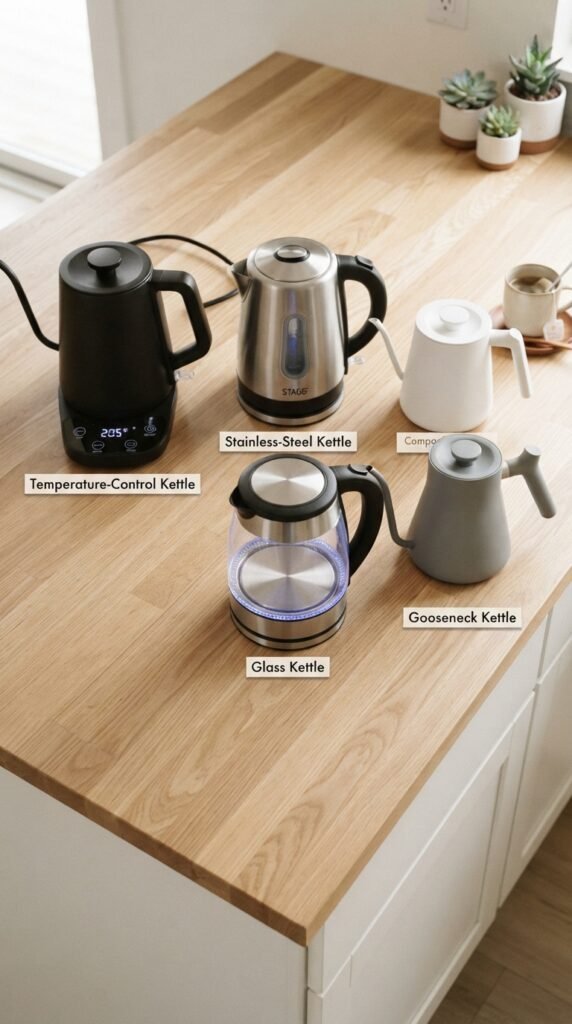
Electric kettles are available in different designs and feature sets, so the right type depends on how you plan to use it. A simple boil-only kettle may be enough for everyday tea and cooking, while temperature-control models can provide more flexibility for different beverages.
Material and size also matter. Glass models provide visibility, stainless-steel kettles offer an opaque and durable-feeling design, and compact models can be useful when counter or storage space is limited.
Use the categories below to identify the type that best matches your everyday needs before comparing individual models.
Basic Electric Kettle
A basic electric kettle is designed for people who mainly want a simple way to heat water without complicated controls. It can be a practical choice for everyday tea, coffee, instant meals, and other kitchen tasks.
When comparing basic models, focus on capacity, heating performance, automatic shutoff, boil-dry protection, water-level markings, comfortable handling, and easy cleaning.
Consider this type if: you mainly need straightforward boiling and don’t require adjustable temperature settings.
Temperature-Control Electric Kettle
Temperature-control kettles allow you to select different water temperatures instead of always heating water to a full boil. This can be useful for different types of tea, coffee, hot chocolate, and recipes.
When comparing models, check the available temperature settings, how easily they can be selected, and whether the display or controls are easy to use.
Consider this type if: you regularly prepare beverages that benefit from different water temperatures.
Glass Electric Kettle
Glass electric kettles have a transparent body that lets you see the water level and interior while the kettle is in use. They can also suit shoppers who prefer a modern, visible design.
When choosing a glass model, pay attention to the handle, lid, base, and connections between components. Because the body is glass, careful handling is also important.
Consider this type if: you value visibility and want to see the amount of water inside the kettle.
Stainless-Steel Electric Kettle
Stainless-steel kettles are widely available in both basic and feature-rich designs. They can provide a sturdy, opaque construction and fit a variety of kitchen styles.
When comparing stainless-steel models, consider handle comfort, exterior heat, lid operation, spout design, weight, and cleaning access rather than focusing only on the material.
Consider this type if: you prefer an opaque kettle with a durable-feeling metal construction.
Compact Electric Kettle
Compact electric kettles are designed for situations where counter space, storage, or portability matters. They can be useful in small kitchens, offices, dormitories, guest spaces, and other areas with limited room.
The main trade-off is capacity. A smaller kettle may be convenient for one or two servings but less suitable for households that regularly prepare several cups at once.
Consider this type if: saving space is more important than having a large water capacity.
Which Electric Kettle Features Are Worth Paying For?
Not every electric kettle feature is worth paying extra for. The right upgrade depends on how often you will use it and whether it solves a real problem in your daily routine.
For most shoppers, automatic shutoff, boil-dry protection, suitable capacity, comfortable handling, and easy cleaning are more important than a long list of premium functions. Other features, such as temperature control and keep-warm settings, become more valuable when you will use them regularly.
| Feature | Worth Paying For When | May Not Be Necessary When |
|---|---|---|
| Temperature control | You prepare different teas, coffee, or recipes | You mainly need boiling water |
| Keep-warm function | You frequently need water at a maintained temperature | You use the kettle once per preparation |
| Automatic shutoff | You want convenient everyday operation | Generally a useful safety feature to prioritize |
| Boil-dry protection | You want an additional safety feature | — |
| Clear water markings | You regularly measure specific amounts of water | You rarely care about precise volume |
| Cordless power base | You value easier lifting and pouring | You don’t mind a corded design |
| Fast heating | You frequently need hot water quickly | Speed is not important to your routine |
| Digital display | You want visible temperature or settings | You prefer simple controls |
Focus on Features You Will Actually Use
A more expensive kettle is not automatically a better purchase. Before paying extra, consider whether a feature will make your normal routine easier, faster, or more convenient.
If you mainly boil water for tea or cooking, a reliable kettle with the right capacity and essential safety features may provide everything you need. If you regularly prepare different beverages, however, temperature control or a keep-warm function may justify spending more.
The goal is not to buy the kettle with the most features. It is to choose the features that provide useful value for the way you actually use the appliance.
How to Compare Electric Kettles Before Buying
When two or more electric kettles appear similar, compare them using the same practical criteria. This makes it easier to identify meaningful differences and avoid choosing a model simply because it has more features or a higher price.
Look at capacity, heating performance, temperature control, safety, construction, ergonomics, cleaning, dimensions, and overall value. Then give greater weight to the factors that matter most for your own routine.
| Buying Factor | What to Check |
|---|---|
| Capacity | Does it hold enough water for your normal use without taking up unnecessary space? |
| Heating performance | Does the heating speed and power suit how frequently you use the kettle? |
| Temperature control | Do you need specific temperatures for tea, coffee, or recipes? |
| Safety | Does it include automatic shutoff and boil-dry protection? |
| Material | Does the glass, stainless steel, plastic, or mixed construction fit your preferences? |
| Handle | Is it comfortable and secure when the kettle is full? |
| Spout | Does it provide controlled, comfortable pouring? |
| Lid | Is it easy to open, fill, and clean? |
| Water indicator | Are the markings clear and easy to read? |
| Cleaning | Can you easily access the interior and remove buildup? |
| Storage | Will the kettle and power base fit comfortably in your available space? |
| Value | Are you paying for features you will actually use? |
Compare the Features That Matter to You
Not every specification deserves equal weight. For example, someone with limited counter space may care more about dimensions, while a tea enthusiast may prioritize temperature control.
Before making a purchase, identify your two or three most important requirements and use them as the basis for comparing models. This can help you find a kettle that offers the right combination of performance, convenience, safety, and value rather than simply choosing the model with the longest feature list.
How to Use an Electric Kettle Efficiently
Using an electric kettle efficiently starts with heating an amount of water that matches what you actually need. Filling a large kettle for a single cup can require more energy than necessary because the appliance must heat the extra water as well.
Use the kettle’s water-level markings when available and never exceed the manufacturer’s maximum fill line. Keep the lid properly closed during heating and make sure the kettle is positioned securely on its power base.
Everyday Electric Kettle Tips
For efficient and safe everyday use:
- Heat only the amount of water you reasonably need.
- Use the water-level markings to avoid unnecessary overfilling.
- Do not exceed the manufacturer’s maximum fill level.
- Never operate the kettle without sufficient water.
- Keep the kettle and surrounding area dry.
- Place the kettle securely on its power base before heating.
- Follow the operating and safety instructions provided by the manufacturer.
- Avoid repeatedly reheating water unless you have a practical reason to do so.
Using an appropriate amount of water can make everyday kettle use more efficient while also reducing unnecessary heating time.
How to Clean and Descale an Electric Kettle
Regular cleaning can help maintain an electric kettle and reduce the buildup of mineral deposits. The amount of buildup depends on factors such as water hardness, how frequently the kettle is used, and the design of the appliance.
Always check your kettle’s manufacturer instructions before cleaning or descaling because materials, heating elements, filters, seals, and recommended cleaning methods can vary between models.
Simple Electric Kettle Cleaning Routine
For routine maintenance:
- Empty the kettle and allow it to cool completely.
- Follow the manufacturer’s recommended descaling method when mineral buildup is visible or when descaling is otherwise required.
- Rinse the interior thoroughly after descaling according to the manufacturer’s instructions.
- Wipe the exterior with a suitable damp cloth.
- Keep the power base and electrical connections dry unless the manufacturer specifically states that they can be exposed to water.
- Inspect the lid, spout, filter, and interior periodically for mineral deposits or residue.
Avoid abrasive cleaners, aggressive scrubbing, or unapproved cleaning methods that could damage the kettle’s interior, finish, seals, or heating components.
Consider Cleaning Before You Buy
Cleaning should also be part of your buying decision. A kettle with an accessible opening, removable filter, visible interior, or other maintenance-friendly design may be easier to keep clean over time.
If you live in an area with hard water, pay particular attention to how easily the kettle can be descaled and whether the manufacturer provides clear maintenance instructions.
Common Electric Kettle Buying Mistakes to Avoid
Choosing an electric kettle based only on appearance, price, or a single specification can lead to an inconvenient purchase. A kettle may look attractive but still have an uncomfortable handle, awkward lid, unclear water markings, or a capacity that does not suit your household.
Before buying, consider these common mistakes and check that the kettle fits your actual routine.
Choosing the Wrong Capacity
A kettle that is too small may require repeated heating cycles, while an unnecessarily large model can take up more counter space and encourage you to heat more water than needed.
Choose a capacity based on how much water you normally prepare rather than simply choosing the largest model.
Focusing Only on Wattage
Higher wattage can contribute to faster heating, but it does not tell you everything about a kettle’s performance. The amount of water being heated and the kettle’s overall design also matter.
Compare wattage, capacity, and intended use together.
Ignoring Safety Features
Don’t overlook features such as automatic shutoff and boil-dry protection. Also consider the stability of the base, handle, lid, and overall design.
Paying for Features You Won’t Use
Temperature control, keep-warm functions, displays, and other extras can be useful, but they are not necessary for everyone.
If you mainly boil water, paying significantly more for advanced controls may provide little practical benefit.
Forgetting About Size and Storage
Check the kettle’s physical dimensions before purchasing, especially if counter or cabinet space is limited. Remember to consider the space needed for the power base and for lifting the kettle comfortably.
Overlooking Cleaning and Descaling
Mineral buildup can occur over time, particularly when using hard water. Check whether the interior, filter, lid, and other areas are reasonably accessible for cleaning and follow the manufacturer’s maintenance instructions.
Assuming a Higher Price Means Better Quality
Price can reflect capacity, materials, controls, design, or other features, but a higher price does not automatically mean a kettle is better suited to your needs.
Compare the features and construction you actually need rather than using price as a shortcut for quality.
Choosing Material Without Considering Everyday Use
Glass, stainless steel, plastic, and mixed-material kettles each have different characteristics. Consider weight, visibility, exterior heat, handling, durability, and cleaning requirements before choosing a material.
Buying Without Checking Current Product Information
Product specifications, included features, dimensions, prices, and availability can change. Review the current product information and manufacturer specifications before making your final purchase decision.
The best way to avoid these mistakes is to start with your everyday needs and then compare kettles using the same practical criteria.
Electric Kettle vs. Stovetop Kettle
Electric and stovetop kettles can both heat water, but they work differently and suit different kitchen routines. An electric kettle has a built-in heating element and connects directly to an electrical outlet, while a stovetop kettle is heated on a separate cooking surface.
The better option depends on how you prepare hot water, the space available in your kitchen, and which features you value most.
| Factor | Electric Kettle | Stovetop Kettle |
|---|---|---|
| Heating method | Built-in electrical heating element | Separate stove or cooking surface |
| Convenience | Designed specifically for heating water | Requires a separate heat source |
| Temperature control | Some models offer adjustable temperatures | Usually depends on the user and stove |
| Portability | Can be moved easily but requires electrical power | Can be used wherever a suitable cooking surface is available |
| Counter space | Requires storage space for the kettle and power base | Does not require a dedicated electrical base |
| Automatic shutoff | Common on electric models | Usually requires manual attention |
| Capacity options | Available in many sizes | Available in many sizes |
| Cleaning | Depends on kettle design | Depends on kettle design |
| Best suited to | Frequent, convenient water heating | People who prefer traditional stovetop cookware |
When an Electric Kettle Makes Sense
An electric kettle can be practical if you regularly prepare tea, coffee, instant meals, or other hot-water tasks and want a dedicated appliance.
It may also be useful if you want features such as automatic shutoff, boil-dry protection, or adjustable temperature control, depending on the model.
When a Stovetop Kettle Makes Sense
A stovetop kettle may suit people who prefer traditional cookware, already have a convenient cooking surface available, or don’t want another electrical appliance and power base on the counter.
It can also make sense if you rarely need hot water and don’t consider dedicated electric-kettle features important.
Which Should You Choose?
Start with your routine rather than assuming one type is better. If you value dedicated convenience and features such as automatic shutoff or temperature control, an electric kettle may fit your needs. If you prefer traditional cookware and don’t need those features, a stovetop kettle may be more suitable.
The important factors are how often you heat water, how much convenience you want, the space available, and which method fits naturally into your kitchen routine.
Best Electric Kettle Buying Checklist
Before buying an electric kettle, use this quick checklist to make sure the model matches your needs. You don’t need every available feature—the goal is to choose a kettle that provides the right combination of capacity, performance, safety, convenience, and value.
Electric Kettle Buying Checklist
- ☐ Does the capacity match my normal water usage?
- ☐ Do I actually need adjustable temperature control?
- ☐ Does it have automatic shutoff?
- ☐ Does it include boil-dry protection?
- ☐ Is the handle comfortable and secure?
- ☐ Does the spout provide controlled pouring?
- ☐ Is the water-level indicator easy to read?
- ☐ Is the lid convenient to open and clean?
- ☐ Can the interior and filter be cleaned easily?
- ☐ Does the material suit my preferences?
- ☐ Will the kettle and power base fit comfortably in my kitchen?
- ☐ Does the heating performance suit my routine?
- ☐ Am I paying for features I will actually use?
- ☐ Have I checked the current manufacturer specifications and product information?
If a kettle meets your most important requirements without unnecessary features, it can be a practical choice for your household.
Save This Checklist for Your Next Kettle Purchase
You can also use this checklist when comparing multiple models. Checking the same factors for each kettle makes it easier to identify meaningful differences and choose based on your actual priorities rather than appearance or marketing claims.
Electric Kettle Categories to Browse on Amazon
Once you understand which features matter to you, browsing by kettle type can make product comparison easier. The categories below can help you narrow your search based on temperature control, material, capacity, pouring style, and everyday use.
Temperature-Control Electric Kettles
Ideal for shoppers who want adjustable water temperatures for different teas, coffee, or recipes.
🛍️ Shop : Temperature-Control Electric Kettles on Amazon
Stainless Steel Electric Kettles
A practical option if you prefer an opaque metal design and a durable-feeling construction.
🔎 Find : Stainless Steel Electric Kettles on Amazon
Glass Electric Kettles
Useful if you want to see the water level and interior while the kettle is being used.
⭐ Explore : Glass Electric Kettles on Amazon
1.7-Liter Electric Kettles
A larger capacity can be useful for households that regularly prepare several cups of hot water at once.
🏠 Find : 1.7-Liter Electric Kettles on Amazon
1-Liter Electric Kettles
A smaller capacity may suit individuals, couples, offices, or kitchens where counter space is limited.
🛒 Check : 1-Liter Electric Kettles on Amazon
Gooseneck Electric Kettles
Gooseneck spouts are designed for more controlled pouring and may appeal to people who prepare pour-over coffee.✨ Explore
✨ Explore : Gooseneck Electric Kettles on Amazon
Electric Tea Kettles
These can be useful for shoppers who primarily use an electric kettle for tea and other everyday hot-water needs.
🔗 See: Electric Tea Kettles on Amazon
Electric Kettles for Coffee
If coffee preparation is your priority, compare features such as temperature control, pouring control, and capacity.
🛍️ Shop: Electric Kettles for Coffee on Amazon
Compact Electric Kettles
Compact models can be useful for small kitchens, offices, dormitories, guest spaces, or anyone with limited storage.
🔎 Find: Compact Electric Kettles on Amazon
Cordless Electric Kettles
Cordless designs with a separate power base can make lifting and pouring more convenient.
⭐ Explore : Cordless Electric Kettles on Amazon
Compare Current Amazon Options
Product availability, prices, specifications, customer reviews, and sellers can change over time. Before purchasing, compare the current product information and make sure the kettle matches your required capacity, features, safety functions, and kitchen space.
Affiliate disclosure: This article contains affiliate links. If you purchase through qualifying links, SmartAirHQ may earn a commission at no additional cost to you.
Amazon Product Information
The Amazon links above use the SmartAirHQ Associates tracking ID. Product prices, availability, specifications, customer reviews, and seller information can change over time, so always check the individual Amazon listing for the latest information before purchasing.
Affiliate disclosure: This article contains affiliate links. If you purchase through qualifying links, SmartAirHQ may earn a commission at no additional cost to you.
Explore More Smart Home and Appliance Guides
An electric kettle is just one of many appliances and smart-home technologies that can make everyday tasks more convenient. If you’re researching practical solutions for your home, explore more guides from SmartAirHQ covering [Home Appliances], [Smart Energy], and [Climate Control].
Frequently Asked Questions About the Best Electric Kettle
The most common electric-kettle questions involve capacity, temperature control, materials, cleaning, safety, and everyday value. These answers cover the practical factors to consider before choosing a model.
What is the best electric kettle for everyday use?
For everyday use, look for a kettle with a suitable capacity, automatic shutoff, boil-dry protection, comfortable handling, and easy cleaning. Temperature control can be useful if you regularly prepare beverages that require different water temperatures.
Is temperature control worth it in an electric kettle?
Temperature control can be useful if you regularly prepare different teas, coffee, or recipes that require specific water temperatures. If you mainly need boiling water, a simpler kettle may provide everything you need.
What size electric kettle should I buy?
Choose a capacity based on how much water you normally heat at one time. A compact kettle can work well for individual use, while a larger capacity may be more convenient for households that prepare several cups at once.
Is a glass or stainless steel electric kettle better?
Neither material is automatically better for every user. Glass allows you to see the water level and interior, while stainless steel provides an opaque, metal construction. Consider the complete design, including the handle, lid, spout, base, weight, and cleaning access.
How often should I clean an electric kettle?
Cleaning frequency depends on factors such as how often you use the kettle and the characteristics of your water. Check the kettle regularly for mineral buildup and follow the manufacturer’s recommended cleaning and descaling instructions.
What safety features should I look for in an electric kettle?
Automatic shutoff and boil-dry protection are useful safety features to consider. Also look for a stable power base, secure lid, comfortable handle, and controlled spout design for safer everyday handling.
Can an electric kettle be used for more than tea?
Yes. Electric kettles can be useful for preparing coffee, hot chocolate, instant meals, and hot water for some cooking tasks. Always follow the manufacturer’s instructions regarding appropriate uses and maximum fill levels.
Should I buy the most powerful electric kettle?
Not necessarily. Wattage is only one factor in kettle performance. Consider capacity, heating performance, temperature controls, safety features, handling, and your normal usage before choosing a model based mainly on power.
Final Thoughts: Choosing the Best Electric Kettle
The best electric kettle is not necessarily the largest, most powerful, or most expensive model. The right choice is the one that fits your daily routine, available space, preferred capacity, and the features you will actually use.
Start by choosing the right capacity and checking essential safety features such as automatic shutoff and boil-dry protection. Then consider heating performance, temperature control, material, pouring comfort, cleaning, and overall usability.
If you regularly prepare different teas, coffee, or recipes, adjustable temperature settings may be worth prioritizing. If you mainly need boiling water for everyday use, a simpler kettle may provide everything you need.
Before making your final choice, compare models using the same practical criteria and check the manufacturer’s current specifications. Focusing on how a kettle will perform in your everyday routine can help you avoid unnecessary features and choose a model that offers useful long-term value.