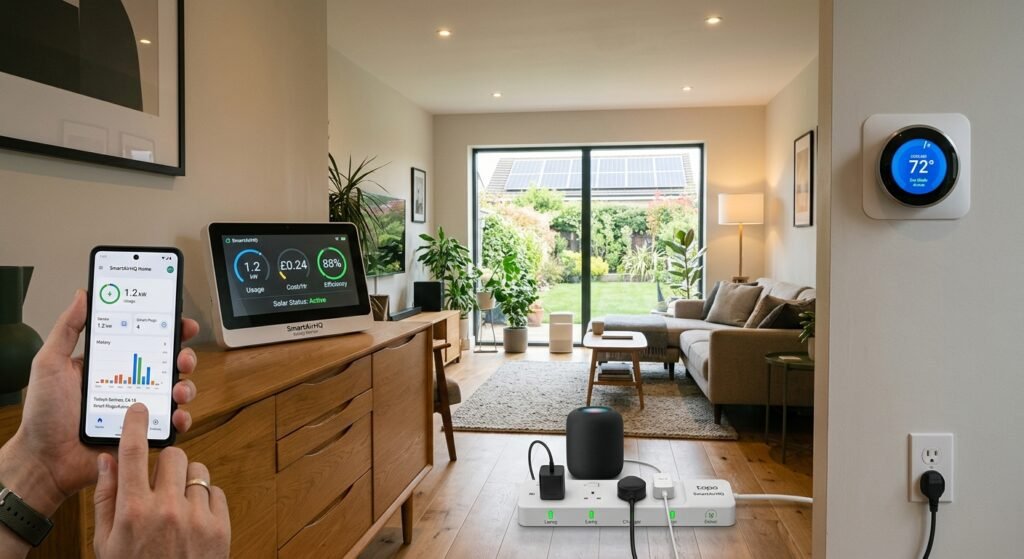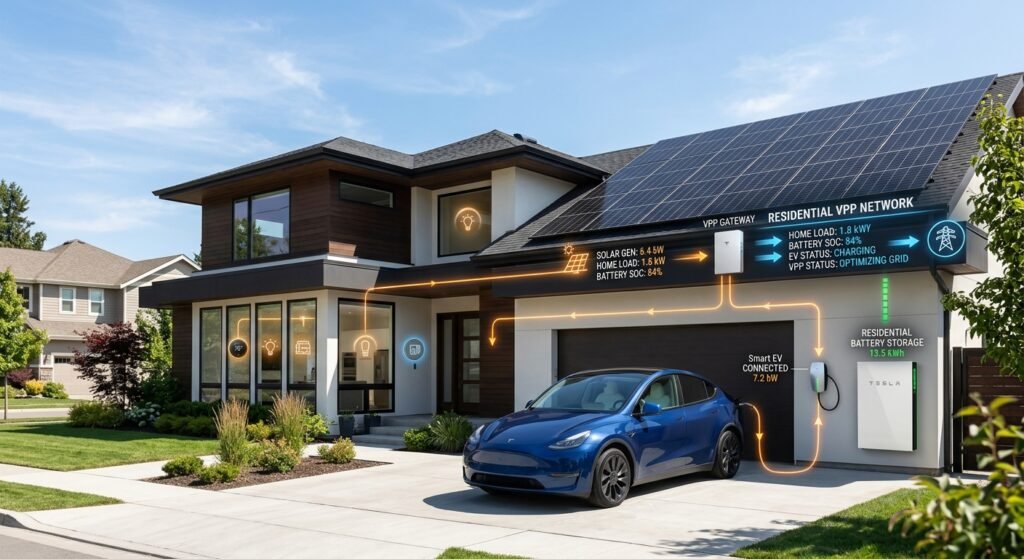
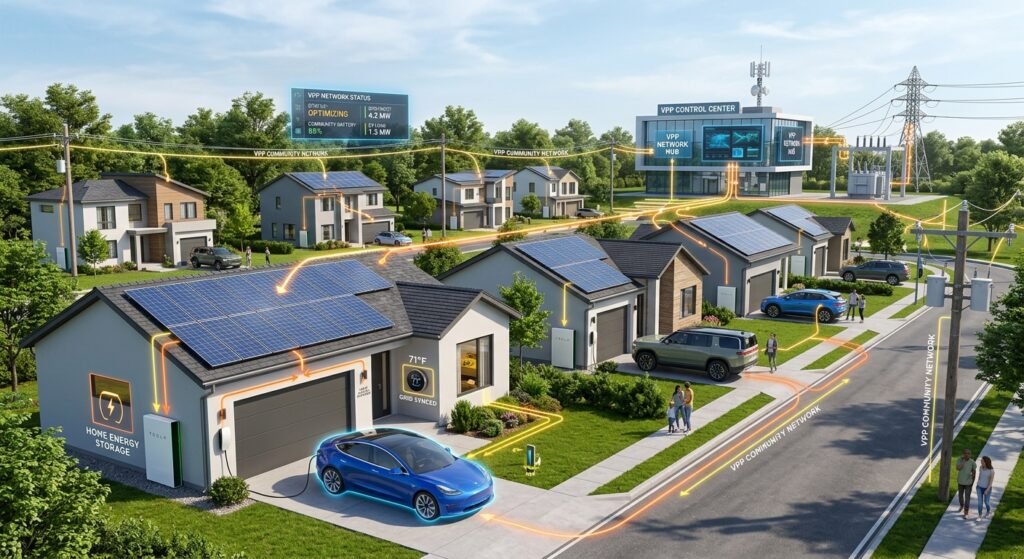
Imagine thousands of homes, batteries, electric vehicles, solar panels, smart thermostats, water heaters, and other connected devices working together as if they were one large power plant.
There may be no giant building, smokestack, or single generator.
Instead, software connects and coordinates many smaller energy resources spread across different homes and businesses.
This concept is called a Virtual Power Plant (VPP).
Virtual power plants are becoming an important part of modern energy systems because electricity generation and consumption are becoming increasingly distributed. Rooftop solar, home batteries, electric vehicles, smart appliances, and flexible loads can now participate in coordinated energy programs rather than operating completely independently. The U.S. Department of Energy describes VPPs as aggregations of distributed energy resources that can balance electricity supply and demand and provide grid services similar to traditional power plants.
In this guide, we will explain what a VPP is, how a virtual power plant works, what devices can participate, how homeowners can benefit, how VPPs support the electrical grid, the difference between VPPs and microgrids, potential challenges, and where this technology is heading.
If you are exploring smart energy technology, this guide is also a useful starting point before researching home batteries, solar power, EV charging, smart energy monitoring, demand response, and smart-home energy management.
Quick Answer: What Is a Virtual Power Plant?
A Virtual Power Plant (VPP) is a network of distributed energy resources that are connected through software and coordinated as one flexible energy system.
Instead of relying on one large centralized generator, a VPP can combine resources such as:
- Rooftop solar panels
- Home battery storage
- Electric vehicles
- Smart EV chargers
- Smart thermostats
- Electric water heaters
- Smart appliances
- Commercial batteries
- Flexible commercial loads
- Industrial energy systems
The individual devices remain at their original locations, but VPP software coordinates them to change electricity consumption, store electricity, or supply electricity when needed.
For example, thousands of participating homes might reduce electricity demand for a short period during a grid peak. Homes with batteries may discharge stored electricity, while EV charging may be delayed until a lower-demand period.
The combined effect can be similar to adding a large flexible power resource to the electricity system.
DOE notes that VPPs can aggregate hundreds, thousands, or potentially millions of distributed resources to provide grid-scale services.
How Does a Virtual Power Plant Work?
A VPP generally works through four major layers:
- Energy devices
- Communication and data
- VPP software
- Grid or market coordination
The devices generate, store, or consume electricity.
Sensors and communication systems provide information about their status.
VPP software analyzes this information and determines how participating resources can respond.
The VPP operator or aggregator then coordinates those resources according to grid conditions, electricity prices, program rules, customer preferences, or other requirements.
Simple VPP Example
Imagine 10,000 homes participating in a VPP.
Each home may have:
- Solar panels
- A home battery
- An EV
- A smart thermostat
At 6 PM, electricity demand rises.
Instead of asking every household to manually change its behavior, the VPP platform could coordinate participating devices according to the program’s rules.
Some batteries may discharge.
Some EV charging may be delayed.
Some thermostats may slightly adjust their operation.
Some homes may continue using their stored solar energy.
Individually, each action may be relatively small.
Together, thousands of small actions can create a much larger grid response.
VPP at a Glance
| Element | What It Does |
|---|---|
| Solar panels | Generate electricity |
| Home batteries | Store and release electricity |
| EVs | Consume or potentially supply electricity depending on technology |
| Smart chargers | Control when EV charging occurs |
| Smart thermostats | Adjust heating or cooling loads |
| Water heaters | Provide flexible electrical demand |
| Smart appliances | Shift some electricity use |
| VPP software | Coordinates participating resources |
| Sensors | Provide energy and device information |
| Utility/grid operator | Uses available flexibility or grid services |
The exact resources available depend on the VPP program, location, utility rules, equipment, and customer agreement.
What Is the Difference Between a VPP and a Traditional Power Plant?
A traditional power plant generally produces electricity from a centralized facility.
A VPP works differently.
Instead of one physical generator, it coordinates many distributed resources.
Traditional Power Plant
A traditional plant might have:
- One physical site
- Large generators
- Centralized control
- Fuel or another energy source
- Transmission infrastructure
- A defined generation capacity
Virtual Power Plant
A VPP may have:
- Thousands of participating locations
- Solar panels
- Batteries
- EVs
- Smart appliances
- Flexible loads
- Digital communication
- Software-based coordination
The key difference is where the resources are located and how they are coordinated.
A VPP does not necessarily replace traditional generation. Instead, it can provide additional flexibility and grid services alongside conventional infrastructure.
DOE specifically describes VPPs as distributed resources that can provide utility-scale and utility-grade grid services similar to a traditional power plant.
What Devices Can Participate in a VPP?
One of the most interesting parts of VPP technology is that many different energy devices can potentially become part of the system.
1. Rooftop Solar Panels
Solar panels can generate electricity locally.
When solar production is high, a VPP may coordinate solar generation with batteries, household loads, or other resources.
Solar alone does not provide complete flexibility because sunlight varies throughout the day, but solar combined with storage becomes more flexible.
2. Home Battery Storage
Home batteries are particularly useful for VPPs because electricity can be stored and released later.
For example:
Solar produces electricity → battery stores energy → VPP coordinates battery → battery discharges when needed
This can allow a participating battery to serve both the homeowner and the wider electricity system, depending on the program.
DOE identifies behind-the-meter batteries as one of the important resources that can participate in VPPs.
What Devices Can Participate in a VPP?
One of the most interesting parts of VPP technology is that many different energy devices can potentially become part of the system.
A VPP can combine devices that generate electricity, store electricity, or change when electricity is consumed.
The exact devices supported depend on the VPP program, equipment, utility, and software platform.
1. Rooftop Solar Panels
Rooftop solar panels generate electricity locally and can become an important resource within a VPP.
When solar production is high, a VPP may coordinate solar generation with home batteries, household electricity demand, or other connected resources.
Solar production varies throughout the day, so combining solar with storage or flexible loads can make the overall system more useful.
2. Home Battery Storage
Home batteries can store electricity and release it later.
For example:
Solar produces electricity → Battery stores energy → VPP coordinates the battery → Battery supplies electricity when needed
Depending on the program, a participating battery may support the homeowner’s energy needs while also providing services to the wider electricity system.
🛍️ Shop Home Battery & Backup Power Options on Amazon
3. Electric Vehicles
An electric vehicle is more than a transportation device.
Its battery represents a potentially significant energy resource.
Normal EV charging consumes electricity, but smart charging can change when the vehicle charges.
More advanced systems may support bidirectional charging, allowing electricity to flow from the EV battery back to a home or the grid where the vehicle, charger, electrical system, and local program support it.
🛒 Compare Smart EV Chargers on Amazon
4. Smart Thermostats
Heating and cooling systems can represent a significant flexible electricity load.
A smart thermostat can communicate with an energy-management system and, depending on the VPP program, adjust heating or cooling operation during certain periods.
The goal is not necessarily to turn the HVAC system off.
Instead, the system can make small adjustments while respecting programmed temperature limits and customer preferences.
🛒 Browse Smart Thermostats on Amazon
Smart thermostats also connect naturally with SmartAirHQ’s climate-control content.
Read next: Best Smart Thermostats 2026
5. Electric Water Heaters
Electric water heaters can also provide flexible electricity demand because hot water can be stored in a tank.
Instead of heating water at exactly the moment it is needed, a compatible smart system may be able to shift some electricity consumption to another period.
This makes certain water-heating systems potentially useful as flexible resources within a VPP.
🛒 Check Smart Water Heating Controls on Amazon
6. Smart Plugs and Connected Appliances
Smart plugs can provide basic control over compatible electrical devices.
For example, a smart plug can schedule when a connected appliance operates.
However, not every smart plug or connected appliance is automatically VPP-compatible.
Actual participation depends on the communication system, software compatibility, equipment, program requirements, and VPP provider.
🔗 See Energy-Monitoring Smart Plugs on Amazon
The Technology Behind a Virtual Power Plant
A VPP requires more than a collection of smart devices.
It needs communication, monitoring, software, data processing, and control systems that can coordinate many distributed energy resources.
The Basic VPP Architecture
A simplified VPP system can be understood like this:
Home Energy Devices
↓
Sensors & Smart Controllers
↓
Communication Network
↓
VPP Management Platform
↓
Aggregator / Utility / Grid Operator
↓
Electricity Grid
The individual devices remain in homes, businesses, or other locations.
The VPP platform connects their information and coordinates eligible resources according to program requirements, electricity-system conditions, or scheduled events.
In simple terms:
Devices provide the energy flexibility → software coordinates them → the combined resources can support the electricity grid.
What Does VPP Software Do?
VPP software can perform several functions.
Monitoring
It can collect information about:
- Electricity consumption
- Solar production
- Battery state of charge
- EV charging status
- Temperature
- Device availability
- Grid conditions
- Program requirements
Forecasting
Software can estimate:
- Electricity demand
- Solar generation
- Weather effects
- Device availability
- Expected energy requirements
Optimization
The platform can determine how available resources could respond.
For example:
- Charge batteries when electricity is abundant
- Delay EV charging
- Shift flexible loads
- Discharge batteries during certain grid conditions
- Coordinate solar and storage
Communication
The platform needs to communicate with participating devices and systems.
This is where IoT, smart meters, APIs, cloud platforms, connected controllers, and energy-management systems can become important.
VPP Components Explained
| Component | Role in a VPP |
|---|---|
| DERs | Physical energy resources |
| Sensors | Collect device and energy information |
| Smart meters | Measure electricity use |
| Communication network | Transfers information |
| VPP platform | Coordinates resources |
| Aggregator | Manages participating resources |
| Utility/grid operator | Uses available flexibility |
| Customer app | Provides visibility and controls |
| Optimization software | Determines how resources respond |
Not every VPP uses exactly the same architecture.
The technology can vary significantly between utilities, aggregators, countries, and programs.
What Are the Main Benefits of Virtual Power Plants?
VPPs can provide benefits at several levels.
1. Grid Flexibility
Electricity demand changes throughout the day.
A VPP can coordinate flexible resources to help respond to those changes.
For example, EV charging may be shifted away from a high-demand period.
2. Better Use of Renewable Energy
Solar and wind generation can vary according to weather and time.
Energy storage and flexible loads can help align electricity consumption with periods when renewable generation is available.
The IEA notes that distributed resources such as solar, storage, EVs, and flexible demand can provide new opportunities for electricity-system flexibility.
3. Peak Demand Management
Electricity systems often experience periods when demand is much higher than normal.
VPPs can respond by coordinating flexible loads and energy storage.
This can reduce the amount of additional electricity that needs to be supplied during certain peak periods.
4. Potential Customer Rewards
Some VPP programs compensate participants for allowing their devices to participate.
The exact compensation model varies.
Depending on the program, participants may receive:
- Bill credits
- Cash payments
- Incentives
- Lower charging costs
- Program rewards
Do not assume every VPP program offers the same financial benefit.
5. Energy Resilience
Battery-based VPP resources can potentially contribute to resilience.
However, participating in a VPP does not automatically mean your home will have backup power during an outage.
Backup capability depends on the battery, inverter, transfer equipment, local electrical configuration, and the specific system.
Potential Benefits for Different Groups
| Participant | Potential Benefit |
|---|---|
| Homeowner | Possible incentives and better energy management |
| Solar owner | Better coordination of solar and storage |
| Battery owner | Potential participation rewards |
| EV owner | Smart charging and possible grid participation |
| Utility | Additional flexible resources |
| Grid operator | Demand and supply flexibility |
| Renewable-energy system | Better integration with flexible demand/storage |
| Community | Potentially improved grid resilience and flexibility |
These benefits are not guaranteed for every participant. Program design and local electricity-market rules matter.
How Do Homeowners Join a Virtual Power Plant?
Joining a VPP is not as simple as downloading an app.
A homeowner generally needs to participate through a utility, aggregator, energy company, equipment provider, or another program operator.
The exact process varies.
Step 1: Check Program Availability
VPP programs are not available everywhere.
Start by checking:
- Your electricity utility
- Local energy programs
- Solar provider
- Battery manufacturer
- EV charging provider
- Demand-response programs
Step 2: Check Equipment Compatibility
The program may require specific:
- Batteries
- Inverters
- EV chargers
- Thermostats
- Solar systems
- Smart appliances
Do not purchase equipment solely because it is advertised as “VPP ready” without checking whether it is compatible with the program you intend to join.
Step 3: Review the Participation Agreement
Before enrolling, understand:
- What devices can be controlled
- When they can be controlled
- How often they can respond
- What customer preferences can be configured
- What compensation is offered
- Whether there are minimum participation requirements
- What happens if you leave the program
Step 4: Connect Your Equipment
Depending on the program, equipment may be connected through:
- Manufacturer software
- Smart meter data
- Internet-connected devices
- Energy-management platforms
- EV charger software
- Battery management systems
Step 5: Let the VPP Coordinate Eligible Resources
Once enrolled, the VPP operator can coordinate your eligible devices according to the program rules.
Can a Homeowner Make Money From a VPP?
Potentially, yes.
But this depends entirely on the VPP program.
A VPP can create economic value by combining many small energy resources and using them to provide services that have value to the electricity system.
The IEA notes that aggregators can pool distributed resources and potentially enable them to participate in electricity markets or provide grid services.
Possible compensation models include:
- Enrollment incentives
- Annual payments
- Bill credits
- Demand-response payments
- Energy-market payments
- Performance-based rewards
However, there is no universal VPP payment rate.
Before joining a program, compare the expected compensation with the level of control you are giving the program over your equipment.
What Is “Value Stacking” in a VPP?
One important VPP concept is value stacking.
Instead of using a battery or flexible load for only one purpose, a resource may potentially provide multiple services.
For example, a home battery could:
- Store excess solar energy.
- Reduce household electricity purchases.
- Help manage peak demand.
- Participate in a VPP program.
- Potentially provide other grid services where allowed.
The same physical asset can therefore create multiple sources of value.
The IEA identifies value stacking as a way digital energy platforms can combine multiple value streams from distributed resources.
VPP vs Smart Home Energy Management
These concepts are related but different.
Smart Home Energy Management focuses primarily on optimizing energy inside an individual home.
A VPP coordinates many homes, buildings, batteries, EVs, and other resources as an aggregated system.
Example
Your smart home system might decide:
“Charge my battery when solar production is high.”
A VPP may coordinate:
“Thousands of participating batteries should respond to a grid need while respecting each customer’s programmed limits.”
This makes VPPs a much larger coordination layer.
For more information about home energy monitoring and management, visit SmartAirHQ’s Smart Energy Monitor Buying Guide.
VPP vs Microgrid: What’s the Difference?
These terms are often confused.
A microgrid is a defined local electrical system that can connect to the main grid and, under appropriate conditions, operate independently.
A VPP is primarily an aggregation and coordination concept that can combine distributed resources across multiple locations.
DOE describes microgrids as systems connecting local generation, storage, and loads that can operate independently from the broader grid, while VPPs aggregate distributed resources through software to provide grid services.
| Feature | VPP | Microgrid |
|---|---|---|
| Main concept | Resource aggregation | Local electrical system |
| Geographic area | Can span many locations | Usually defined local area |
| Software coordination | Essential | Important but not defining |
| Can include batteries | Yes | Yes |
| Can include solar | Yes | Yes |
| Can include EVs | Yes | Yes |
| Independent operation | Not necessarily | Can be designed for islanding |
| Primary purpose | Grid flexibility and aggregation | Local energy management and resilience |
A single home battery could potentially participate in a VPP, while a microgrid may contain multiple buildings, generation resources, storage, and loads within a defined electrical boundary.
What Are the Challenges of Virtual Power Plants?
VPPs are promising, but they also have challenges.
1. Program Availability
A homeowner cannot simply join any VPP from anywhere.
Availability depends on location, utility structure, regulations, equipment, and participating companies.
2. Equipment Compatibility
Different manufacturers may use different communication systems and platforms.
Compatibility can therefore become complicated.
3. Customer Control
People may be uncomfortable allowing an outside program to influence their battery, thermostat, EV charger, or other devices.
Clear participation rules are important.
4. Cybersecurity and Privacy
VPPs depend heavily on connected devices and data.
Potentially sensitive information can include:
- Energy consumption
- Device operation
- Household schedules
- Location information
- Equipment status
Strong cybersecurity and responsible data handling are therefore important.
5. Regulation
Electricity markets and utility rules differ between regions.
The IEA identifies policy, regulatory, and market-design issues as important factors affecting wider DER and VPP deployment.
6. Customer Incentives
The system works better when customers have a clear reason to participate.
Compensation, convenience, energy savings, resilience, and environmental goals can all influence participation.
VPP Security and Privacy: What Should You Check?
Before joining any connected energy program, check the provider’s privacy and security information.
Look for:
- What data is collected?
- Who can access the data?
- How long is data stored?
- Can you disconnect the system?
- What devices can be controlled?
- Can you override automated actions?
- Is two-factor authentication available?
- What happens to your data if you leave?
The most sophisticated VPP is not necessarily the right choice if its participation terms are unclear.
12 Useful Smart Energy Products to Explore
A VPP article can naturally introduce readers to the hardware that makes distributed energy systems possible.
These should be supporting affiliate recommendations, not random product placements.
Smart Energy Products That Connect With the VPP Ecosystem
You do not need to buy every device mentioned in this guide to understand or participate in a VPP.
However, these products represent some of the technologies used in modern home energy management. Depending on the VPP program, compatible equipment can help homeowners measure electricity use, control energy consumption, store electricity, or manage flexible loads.
If you are building a smarter home energy setup, these are some product categories worth exploring.
1. Home Energy Monitor
Before you can manage your electricity, it helps to know where that electricity is going.
A home energy monitor can provide a clearer picture of your household’s electricity consumption and help you identify energy-intensive appliances, unusual usage patterns, and periods of higher demand.
That information can be especially useful when you are planning a more advanced smart-energy setup.
🛒 Check Home Energy Monitors on Amazon
2. Circuit-Level Energy Monitor
A whole-home energy monitor tells you how much electricity your home is using overall, while a circuit-level monitor can provide a more detailed look at individual electrical circuits.
This can help you discover whether your HVAC system, water heater, kitchen appliances, EV charger, or another major load is responsible for a large portion of your electricity use.
For homeowners interested in eventually using automated energy management, this level of information can be valuable.
🛒 Browse Circuit-Level Energy Monitors on Amazon
3. Smart Power Strip
Many electronic devices remain connected to electricity even when you are not actively using them.
A smart power strip can help manage groups of connected electronics and, depending on the model, schedule or automate when certain outlets receive power.
It is a relatively simple way to introduce basic energy automation into a home.
🛒 Compare Smart Power Strips on Amazon
4. Portable Power Station
Portable power stations combine battery storage, power electronics, and multiple output options into one unit.
They are useful for understanding how stored electricity can be used when grid power is unavailable or when portable energy is needed.
While a portable power station is not automatically a VPP device, it helps illustrate the broader concept of storing electricity and using it when it is needed.
⭐ Explore Portable Power Stations on Amazon
5. Home Battery Backup System
Home battery storage is one of the technologies most closely associated with the VPP concept.
A battery can store electricity and potentially make that energy available later. When supported by an appropriate VPP program, compatible batteries can also become part of a larger network of distributed energy resources.
If you are researching VPPs because you are considering solar or home energy storage, comparing battery systems is a logical next step.
🔋 Explore Home Battery Backup System on Amazon
6. Electricity Usage Meter
Sometimes the easiest way to find an energy-wasting appliance is to measure it directly.
A plug-in electricity usage meter can show how much electricity a compatible device consumes over time.
For example, you could measure a refrigerator, entertainment system, desktop computer, or another plug-in appliance and compare its consumption with your overall household usage.
⚡ Check Plug-In Electricity Usage Meters on Amazon
7. Smart Water Heater Controller
Water heating creates an interesting opportunity for energy management because hot water can be stored and used later.
A compatible smart water-heater controller can help manage when the heating system operates, potentially shifting some electricity consumption away from high-demand periods.
For readers exploring demand response and VPP technology, smart water heating is a useful example of how an everyday appliance can become a flexible energy resource.
💧 Compare Smart Water Heating Controllers on Amazon
Before You Buy: Check VPP Compatibility
Buying a product labeled “smart” does not automatically make it VPP-compatible.
If your goal is to eventually participate in a VPP program, check:
- Whether your local VPP program supports the device
- Whether the manufacturer is an approved partner
- Which communication protocols are supported
- Whether the device can be remotely controlled
- What data the device shares
- Whether the equipment can be overridden manually
- Whether the product is compatible with your existing energy system
The most important point: choose equipment based on your actual energy needs first, then check VPP compatibility if you plan to participate in a VPP program.
Product prices, availability, specifications, and compatibility can change, so always verify the latest information before purchasing.
A Real-World Example: Emporia Vue 3
A home energy monitor such as the Emporia Vue 3 illustrates how detailed energy monitoring can fit into a broader smart-energy strategy.
It can provide real-time electricity-use information and, with the appropriate sensors, monitor individual circuits. That type of visibility can help homeowners understand which parts of their home consume the most electricity before making decisions about automation, storage, or other energy-management technologies.
🏠 Find Emporia Vue 3 and compatible energy-monitoring options on Amazon
How VPPs Could Change the Future of Home Energy
The future of energy is becoming increasingly distributed.
Instead of electricity moving only in one direction:
Power Plant → Grid → Home
the system can increasingly involve:
Solar → Home
Solar → Battery
Battery → Home
EV → Home
Home → Grid
Grid → EV
Smart Device ↔ Energy Platform
This creates a more interactive energy system.
The IEA notes that distributed energy resources are changing how electricity is produced, traded, delivered, and consumed, while VPPs can help coordinate these resources.
VPPs and Electric Vehicles
EVs could become particularly important to future VPPs.
Consider a neighborhood with 5,000 EVs.
If all vehicles begin charging at the same time, they can create a substantial new electricity load.
But if charging is coordinated:
- Some vehicles charge immediately.
- Some wait.
- Some charge during lower-demand periods.
- Some may charge when renewable generation is abundant.
- Advanced systems may eventually allow bidirectional energy flow where supported.
This turns EV charging from a simple electricity demand into a potentially flexible energy resource.
Smart charging is therefore likely to remain an important part of the relationship between EVs and smart energy systems.
VPPs and Solar + Battery Systems
Solar panels produce electricity when sunlight is available.
But household electricity demand does not necessarily match solar production.
For example:
Solar production: High during afternoon
Household demand: Potentially high in the evening
A battery can help shift some electricity from one period to another.
When many solar-plus-storage systems participate in a VPP, those individual batteries can potentially be coordinated as a larger distributed resource.
DOE specifically identifies solar paired with behind-the-meter batteries as an important VPP resource.
VPPs and the Smart Grid
The smart grid is an important part of the bigger picture.
Traditional electricity infrastructure was designed primarily around centralized generation.
Modern energy systems increasingly need to accommodate:
- Rooftop solar
- Home batteries
- EVs
- Heat pumps
- Smart appliances
- Flexible demand
- Distributed generation
VPPs provide one mechanism for coordinating some of these resources.
This is particularly relevant as electricity demand grows and distributed energy resources become more common.
VPPs and Demand Response
Demand response means changing electricity consumption in response to grid conditions, electricity prices, or program signals.
For example:
A household normally charges an EV from 5 PM to 8 PM.
During a high-demand period, the VPP could delay charging until later.
The vehicle still receives the energy it needs, but its charging schedule changes.
That small adjustment becomes more powerful when thousands of participating devices respond together.
DOE identifies peak-demand management and flexible demand as important applications for VPPs.
Are Virtual Power Plants Really Power Plants?
The name can be confusing.
A VPP does not necessarily generate electricity in the same way a conventional power plant does.
Instead, it can combine:
- Generation
- Storage
- Flexible consumption
- Energy management
and coordinate them as a single system.
So the word “virtual” refers primarily to the software-based aggregation and coordination of distributed resources.
The physical devices still exist in real homes, buildings, vehicles, and businesses.
What Is the Future of Virtual Power Plants?
VPP development is closely connected with several major energy trends:
More Home Batteries
As battery storage becomes more common, more flexible energy capacity could become available behind the meter.
More EVs
Large numbers of connected EVs could create both new electricity demand and new flexible resources.
More Rooftop Solar
Distributed solar increases the need for better coordination between generation, storage, and consumption.
Better Software
AI, machine learning, forecasting, automation, and optimization can improve how distributed resources are coordinated.
Smarter Buildings
Buildings can become more flexible through smart HVAC systems, water heating, energy storage, lighting controls, and building-management systems.
Better Electricity Markets
Regulatory and market changes can determine how effectively distributed resources can participate in energy markets.
The IEA has highlighted the need for appropriate incentives, market rules, and regulatory frameworks to unlock the full potential of distributed energy resources.
How to Prepare Your Home for the VPP Future
You do not need to build a complete VPP yourself.
Instead, you can gradually make your home more energy-aware.
Start With Energy Monitoring
Understand where your electricity is going.
Explore SmartAirHQ’s:
Smart Energy Monitor Buying Guide
This is a natural first step before purchasing more advanced equipment.
Add Smart Controls
Consider:
- Smart thermostats
- Smart plugs
- Smart lighting
- Smart appliances
Consider Solar
If solar is suitable for your home, research system size, local electricity rules, installation requirements, and economics before purchasing.
Consider Battery Storage
Battery storage can provide energy management and backup capabilities, depending on the system.
Think About EV Charging
If you own an EV, consider a charger with smart scheduling and energy-management capabilities.
Look for Local Programs
Your utility or energy provider may eventually offer demand-response or VPP participation programs.
VPP Home Setup Example
A future smart-energy home could look like this:
Rooftop Solar
↓
Home Battery
↓
Smart Energy Management System
↓
Smart Thermostat + Water Heater + EV Charger + Smart Appliances
↓
VPP Platform
↓
Utility / Grid
This does not mean every home needs every technology.
The goal is to understand how individual technologies can eventually work together.
Frequently Asked Questions About Virtual Power Plants
What does VPP stand for?
VPP stands for Virtual Power Plant.
It refers to a network of distributed energy resources coordinated through software to provide energy or grid services.
How does a virtual power plant work?
A VPP connects distributed resources such as solar panels, batteries, EVs, smart thermostats, water heaters, and flexible loads through communication and software systems. The platform coordinates those resources according to program requirements and grid conditions.
Can homeowners join a VPP?
Yes, homeowners can participate in VPP programs where available and where their equipment meets the program’s requirements.
Availability depends on location, utility, technology, and program design.
Do VPPs generate electricity?
Some VPP resources generate electricity, such as solar panels.
Others store electricity, such as batteries.
Others mainly change when they consume electricity, such as smart EV chargers or flexible appliances.
The VPP combines these different capabilities.
Can an EV be part of a VPP?
Yes.
An EV can participate through smart charging, and more advanced systems may support bidirectional charging such as vehicle-to-home or vehicle-to-grid where the vehicle, charger, electrical system, and local program support it.
Can a home battery participate in a VPP?
Yes, where supported by the battery manufacturer, VPP provider, utility, and local program.
Home batteries are one of the major distributed resources used in VPP concepts.
Do VPPs work during power outages?
Not necessarily.
VPP participation and home backup are different functions.
A properly configured battery backup system may provide backup power, but simply joining a VPP does not guarantee that your home will remain powered during an outage.
Are VPPs available everywhere?
No.
VPP programs depend on local electricity markets, utilities, regulations, technology providers, and participating equipment.
Availability is expanding, but it varies significantly by region.
Are VPPs safe?
VPPs are software-based energy-management systems, but safety depends on the equipment, installation, communication systems, cybersecurity practices, and program design.
Electrical equipment such as batteries, solar systems, and EV chargers should be installed and configured according to manufacturer and local electrical requirements.
Can VPPs reduce electricity bills?
They can potentially help participants reduce costs through energy management, incentives, demand-response payments, or other program benefits.
However, savings vary by program and household.
Do not assume that joining a VPP automatically lowers every customer’s electricity bill.
SmartAirHQ’s VPP Checklist
Before joining a VPP, ask:
- Is a VPP program available in my area?
- Does my utility participate?
- Is my battery compatible?
- Is my EV charger compatible?
- What devices can the program control?
- When can those devices be controlled?
- Can I override the controls?
- How much compensation is offered?
- Are there enrollment requirements?
- Are there minimum participation periods?
- How is my energy data used?
- What happens if I leave the program?
- Does participation affect my backup-power settings?
- What happens during an outage?
Build Your Smart Energy Knowledge With SmartAirHQ
A virtual power plant is only one part of the bigger smart-energy picture. If you want to understand how modern homes can monitor, automate, and manage electricity more effectively, explore these related SmartAirHQ guides:
- Energy monitoring — Learn how home energy monitors can track electricity use, identify high-consumption circuits, and turn energy data into practical decisions.
- Energy-saving devices — Explore smart plugs, energy monitors, smart power strips, smart thermostats, and other connected devices that can help automate and manage household energy use.
- Electricity reduction — Discover practical ways to reduce unnecessary electricity consumption, from controlling standby loads to improving heating, cooling, appliance, and lighting habits.
- Phantom energy — Understand standby power, phantom loads, and why some electronics can continue consuming electricity even when they appear to be switched off.
- Renewable energy — Learn how renewable technologies such as wind power can generate electricity and how factors such as location, equipment, and available resources affect their performance.
- Climate control — Discover smart ways to manage heating, cooling, temperature, and indoor comfort while keeping energy use in mind.
Keep Exploring SmartAirHQ
For more guides covering smart energy, renewable energy, home technology, and energy-efficient living, visit the Smart Energy category on SmartAirHQ.
Watch SmartAirHQ on YouTube
Prefer learning through videos? Visit the SmartAirHQ YouTube channel for short, practical videos about smart energy, smart home technology, energy efficiency, climate control, and more.
Watch the video for a quick visual explanation, then return to SmartAirHQ for detailed guides and related resources.
Explore More SmartAirHQ Guides
Want to explore more topics after this VPP guide? Visit SmartAirHQ to discover practical guides covering:
Continue exploring SmartAirHQ for practical information on smart-home technology, energy efficiency, renewable energy, appliances, and modern home technology.
Final Thought: Why Virtual Power Plants Matter
A virtual power plant changes the way we think about electricity.
A traditional power plant is a physical facility built around large centralized generation.
A VPP takes a different approach.
It connects many smaller resources and coordinates them through software.
A solar panel on one home, a battery in another, an EV charger in a third, a smart thermostat in a fourth, and flexible commercial equipment somewhere else can all become part of a larger coordinated energy system.
The individual resources remain distributed, but software allows them to work together.
As solar, batteries, EVs, smart appliances, and connected energy systems become more common, the ability to coordinate these resources could become increasingly important for electricity systems.
For homeowners, the VPP concept also provides a glimpse into a future where your home is not simply an electricity consumer.
It could become a smart, flexible energy resource that can generate, store, consume, and manage electricity while remaining connected to the wider grid.
That is the central idea behind a Virtual Power Plant.
Affiliate Disclosure
This article may contain affiliate links. If you purchase a qualifying product through an affiliate link, SmartAirHQ may earn a commission at no additional cost to you.
Product prices, availability, specifications, compatibility, and seller information can change. Always verify current details on the retailer or manufacturer’s website before purchasing.
About SmartAirHQ
SmartAirHQ provides practical guides, buying information, smart-home resources, energy-saving ideas, appliance information, climate-control content, and technology explainers designed to help readers build smarter, more efficient, and more comfortable homes.
Visit SmartAirHQ to explore more guides and resources.