

A dishwasher that completes a full cycle but leaves plates dirty, glasses cloudy, or food stuck to bowls usually has a specific problem that can be identified and fixed. Common causes include a clogged filter, blocked spray arms, poor loading, ineffective detergent, low water temperature, or a drainage problem.
Why Is My Dishwasher Not Cleaning Properly? If your dishwasher leaves dishes dirty after a cycle, several issues could be responsible, including a clogged filter, blocked spray arms, improper loading, detergent problems, or low water temperature.
Before calling for professional service, there are several simple things you can check yourself. In many cases, cleaning the filter and spray arms, correcting how the dishwasher is loaded, checking the detergent and rinse aid, and making sure the dishwasher is getting enough hot water can improve cleaning performance.
This guide explains the most common reasons your dishwasher may not be cleaning properly, what to check first, how to fix each problem, and when professional help may be necessary.
The Most Common Reasons a Dishwasher Is Not Cleaning Properly
When a dishwasher finishes a cycle but leaves dishes dirty, the problem is usually related to water flow, spray pressure, heat, detergent, filtration, drainage, or loading. You may notice food particles on dishes, greasy plates, cloudy glasses, detergent residue, or one rack coming out dirtier than the other.
Here are the most common causes and what to check:
| Problem | What You May Notice | What to Check |
|---|---|---|
| Dirty or clogged filter | Food particles or dirty water | Remove and clean the filter |
| Clogged spray arms | Certain areas remain dirty | Check the spray jets and arm rotation |
| Poor loading | One rack or area remains dirty | Rearrange dishes and avoid blocking spray arms |
| Detergent problem | Residue or food remains stuck | Check detergent, dispenser, and wash cycle |
| Low water temperature | Greasy dishes or poor cleaning | Check that the dishwasher receives sufficiently hot water |
| Drainage problem | Standing water or residue | Check the filter and drain path |
| Hard water buildup | White film or cloudy glassware | Check for mineral buildup |
| Incorrect wash cycle | Heavily soiled dishes remain dirty | Choose a cycle suited to the load |
| Mechanical problem | Poor cleaning continues after basic checks | Consider professional service |
Start with the simplest checks first: the filter, spray arms, loading, detergent, and water temperature. These are common areas to inspect before moving on to drainage or possible mechanical problems.
1.Clean the Dishwasher Filter First
A dirty or clogged dishwasher filter is one of the first things to check when dishes come out dirty. The filter traps food particles and debris during the wash cycle, and heavy buildup can restrict water circulation and contribute to poor cleaning or drainage problems.
Rinse the filter under running water to remove loose debris. For stubborn buildup, use a soft brush and, if recommended by your dishwasher manufacturer, a small amount of mild dish soap. Reinstall the filter securely before running the dishwasher again.
If you regularly wash heavily soiled dishes, check the filter more often. Visible grease, food particles, or mineral buildup can indicate that the filter needs cleaning.
🛒 Recommended Filter-Cleaning Tools
A soft cleaning brush can make it easier to remove stubborn debris from dishwasher filters without damaging the mesh.
[Browse dishwasher filter-cleaning tools on Amazon]
How to Tell Whether the Filter Is Causing the Problem
A dirty or clogged filter is more likely to be contributing to poor cleaning when you notice several symptoms at the same time, such as:
- Bits of food left on plates or bowls
- Dirty water or residue near the bottom of the tub
- Unpleasant odors
- Dishes becoming less clean over time
- Poor cleaning that improves after the filter is cleaned
Standing water can also point to a drainage problem, although the exact cause varies by dishwasher model.
After cleaning the filter, run an appropriate wash cycle and compare the results. If cleaning improves noticeably, add filter inspection and cleaning to your regular dishwasher maintenance routine.
2. Check Whether the Spray Arms Are Blocked
Dishwasher spray arms direct pressurized water across the dishes during the wash cycle. If a spray arm cannot rotate freely or its small spray jets are blocked by food particles or mineral deposits, water may not reach certain areas of the rack. The dishwasher may sound normal but still leave food or residue behind.
Before starting another cycle, inspect the spray arms and make sure they can rotate freely. Tall plates, pans, utensils, or incorrectly positioned cookware can block the arms and prevent proper water coverage.
Next, check the small openings along the spray arms for visible debris or mineral buildup. If your dishwasher allows the spray arms to be removed, follow the owner’s manual for the correct removal method. Rinse them thoroughly and gently clear blocked openings with a soft, suitable tool. Avoid using anything that could damage or enlarge the spray jets.
After cleaning, make sure the spray arms are securely installed and can rotate freely before running another wash cycle.
🛒 Dishwasher Spray-Arm Cleaning Tools
A small, soft cleaning tool can help remove debris from clogged spray-arm openings without damaging the jets.
🔗 See dishwasher spray-arm cleaning options on Amazon
Why the Top Rack or Bottom Rack May Stay Dirty
If your dishwasher is not cleaning the top rack, check the upper spray arm, water connection, and loading arrangement. Tall dishes or cookware in the lower rack can interfere with the upper spray arm or block water from reaching the top rack.
If your dishwasher is not cleaning the bottom rack, inspect the lower spray arm for blockages caused by large cookware. Also, check whether your dishwasher has a rack-specific wash cycle selected.
For example, Whirlpool explains that a “Top Rack Only” cycle is designed to wash upper-rack dishes, so lower-rack dishes may remain dirty when that cycle is selected. Always check your dishwasher’s manual for cycle-specific instructions.
👉 Source: Whirlpool Product Help
🏠 Find : dishwasher spray-arm replacement and cleaning parts on Amazon
3. Fix Dishwasher Loading Problems
Improper loading is a common cause of poor dishwasher performance because the machine needs clear paths for water to reach the surfaces that need cleaning. Plates packed tightly together can shield one another, large pans can block spray patterns, and utensils may interfere with rotating spray arms or the detergent dispenser.
Load dishes with heavily soiled surfaces facing the spray action where appropriate, while leaving enough space between items for water to circulate. Avoid placing tall cookware where it can block the spray arms, and make sure nothing prevents the detergent dispenser from opening. Whirlpool notes that improper loading can reduce wash performance and that dishes should not obstruct the spray arms or detergent dispenser.
Before starting a cycle, manually spin each accessible spray arm to make sure it can rotate freely without hitting dishes or cookware. This quick check can help identify loading problems before the wash cycle begins.
🛍️ Shop : dishwasher loading racks and organizers on Amazon
Avoid Overcrowding the Dishwasher
Overloading the dishwasher can reduce cleaning performance when dishes are packed too closely together and water cannot reach all dirty surfaces. Plates, bowls, pans, and utensils can create blocked or “shadowed” areas that receive less spray during the wash cycle.
Instead of focusing only on how many dishes fit inside, make sure water can reach the surfaces that need cleaning. Leave enough space between items, avoid stacking dishes directly against each other, and keep large cookware from blocking the spray arms.
If dishes are tightly packed, rearrange the load or run a smaller cycle. A properly spaced load can clean more effectively than a completely full dishwasher with blocked spray paths.
4.Check the Dishwasher Detergent and Dispenser
If your dishwasher detergent is not dissolving properly or remains in the dispenser after a cycle, check whether the dispenser is blocked, the spray arms can reach it, and the incoming water is hot enough. An interrupted cycle or detergent that has become old or damp can also leave residue behind.
Make sure large dishes, pans, or utensils are not blocking the detergent dispenser door. GE Appliances notes that detergent may remain in the cup when water cannot reach the dispenser or when the incoming water is too cool. Whirlpool also identifies blocked dispensers, old detergent, interrupted cycles, and water temperature as possible causes of detergent residue.
Always use detergent specifically designed for automatic dishwashers. Never use ordinary hand dish soap, as it can create excessive suds and interfere with normal dishwasher operation.
✨ Explore : dishwasher detergent pods and tablets on Amazon
5. Check Dishwasher Water Temperature
Water temperature can affect dishwasher cleaning performance. If incoming water is too cool, detergent may not dissolve or work as effectively, and grease and food residue can be harder to remove. Whirlpool recommends incoming water of about 120°F (49°C) for its dishwasher guidance, while GE Appliances lists approximately 120°F to 140°F in some troubleshooting guidance. Always follow the temperature requirements specified in your dishwasher’s manual.
Before starting a cycle, run the kitchen faucet closest to the dishwasher until the water becomes hot. This can help clear cooled water from the plumbing so the dishwasher receives hotter water when it begins filling.
Avoid increasing your water-heater temperature solely for dishwasher cleaning. Follow the appliance manufacturer’s recommended temperature and your household’s safe water-heating settings.
🛒 Check : kitchen water thermometers on Amazon.
Could the Heating Element Be the Problem?
If your dishwasher consistently uses water that seems unusually cool, leaves grease behind, runs unusually long, or shows other temperature-related symptoms, the heating element or temperature sensor may need inspection. Whirlpool notes that heating-element or sensor issues can prevent some dishwasher models from reaching their intended temperatures.
This is different from starting a cycle while the water in the supply line is still cold. If the basic water-temperature checks above do not explain the problem, consult your dishwasher’s owner’s manual or a qualified appliance technician.
Do not test or handle electrical components unless you have the appropriate knowledge and safety equipment. For persistent heating problems, professional diagnosis may be safer than attempting an electrical repair yourself.
6. Consider Hard Water and White Residue
If your dishwasher leaves a white film on dishes, cloudy glasses, or chalky deposits around the tub and spray arms, hard-water minerals may be contributing to the problem. Mineral deposits can build up on dishwasher components and dishware and may affect water flow and cleaning performance.
Hard water does not necessarily mean the dishwasher is faulty. Mineral residue can sometimes look like poor detergent performance even when the underlying issue is water hardness. Whirlpool notes that hard-water deposits can accumulate on spray arms, dishes, and dishwasher interiors and may affect water flow and heating.
The appropriate solution depends on your home’s water hardness, dishwasher model, detergent, and whether you already use a water softener. Follow your dishwasher manufacturer’s recommendations rather than simply adding more detergent, as excessive detergent may not solve mineral-related residue.
⭐ Explore : dishwasher hard-water cleaning products on Amazon.
7. Make Sure the Dishwasher Is Draining Properly
A dishwasher that does not drain properly may leave dirty water and food debris inside the tub, which can affect cleaning performance. Standing water after a completed cycle is an important warning sign, although a small amount of water may be normal on some dishwasher models.
Start by checking the dishwasher filter and visible drain area for food debris or other obstructions. Then inspect the drain path, drain hose, and connected garbage disposer if your dishwasher uses one. Bosch and Whirlpool both recommend checking these areas when troubleshooting standing water.
Always follow your dishwasher manufacturer’s instructions for cleaning and drain-related checks. Do not dismantle the drain pump or electrical components unless your owner’s manual specifically provides a safe procedure.
🛒Browse dishwasher drain-cleaning tools on Amazon
When a Drain Problem Needs More Than Cleaning
If your dishwasher repeatedly leaves significant standing water after completed cycles, cleaning the filter may not be enough. A kinked or blocked drain hose, clogged drain connection, pump problem, installation issue, or another component could be responsible.
If the basic cleaning and drain checks do not solve the problem, stop repeatedly running the dishwasher and consult the manufacturer’s troubleshooting instructions for your specific model. If the recommended checks do not resolve the issue, professional appliance service may be necessary.
Avoid disassembling the drain pump or other internal components unless your manufacturer’s instructions specifically provide a safe procedure.
8. Use the Right Dishwasher Cycle
Your dishwasher may be working normally while the selected cycle is not suitable for the load. Light or shorter cycles may not provide the cleaning time or intensity needed for heavily soiled cookware, dried food, greasy dishes, or larger loads. Cycle names and available options vary by dishwasher model.
Choose a cycle based on the soil level and follow the recommendations in your dishwasher’s owner’s manual. Whirlpool also recommends selecting an appropriate cycle for the type and amount of soil on the dishes.
If your dishwasher mainly struggles with heavily soiled loads, try a more suitable cycle before assuming there is a mechanical problem. This simple test can help determine whether the issue is related to cycle selection rather than an appliance fault.
🏠 Find : dishwasher cycle and cleaning accessories on Amazon
9.Check Rinse Aid If Dishes Are Wet or Covered With Residue
Rinse aid does not replace dishwasher detergent and cannot correct problems such as a clogged spray arm or dirty filter. Its main purpose is to help water drain from dish surfaces, which can improve drying and reduce certain types of water spots or filming.
If your dishwasher leaves dishes wet, spotted, or covered with water marks, check whether your model uses rinse aid and whether the dispenser has enough product. Bosch recommends rinse aid as part of its dishwasher care guidance and explains that it helps water droplets run off dishware more easily.
Follow your dishwasher manufacturer’s instructions for the correct rinse-aid setting. Do not assume that adding more rinse aid will improve cleaning; excessive use can contribute to unwanted residue.
🛍️ Shop: dishwasher rinse aid options on Amazon
10. Do You Need to Pre-Rinse Your Dishes?
If your dishwasher is not cleaning dishes properly, you may be tempted to rinse everything before loading it. However, full pre-rinsing is usually unnecessary. Bosch recommends scraping leftover food from dishes rather than thoroughly washing them before loading.
Remove large pieces of food and other substantial debris, but let the dishwasher handle normal food residue. Scraping is different from pre-rinsing—the goal is to prevent large food particles from entering the dishwasher while still allowing the detergent and wash cycle to do their job.
Avoid putting excessive food waste into the dishwasher, as larger particles can accumulate in the filter or drain system. For the best approach, follow your dishwasher manufacturer’s loading and food-removal recommendations.
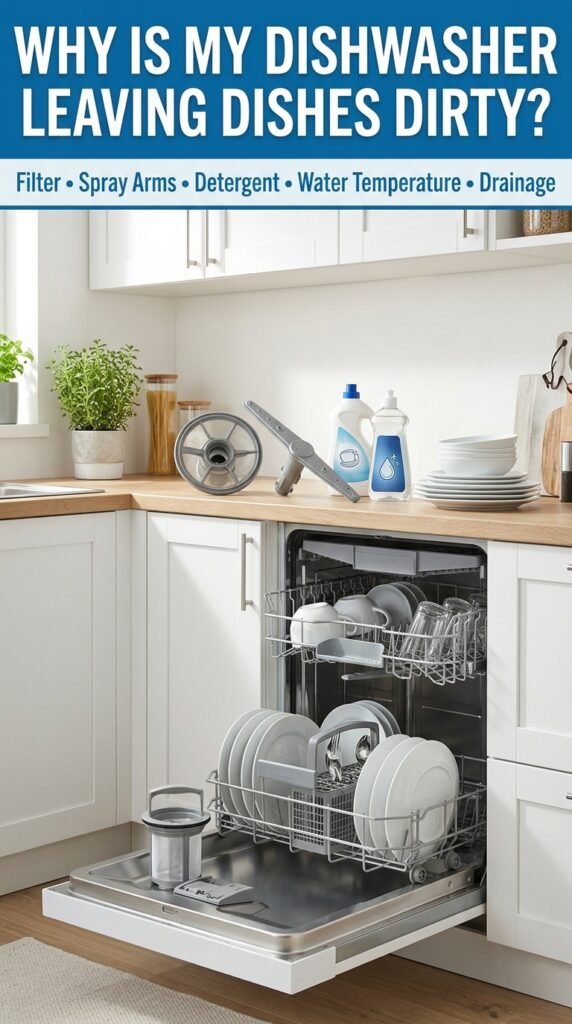
A Simple Dishwasher Troubleshooting Sequence
When a dishwasher leaves dishes dirty after a cycle, avoid changing several things at once. A systematic check makes it easier to identify the likely cause. Start with simple maintenance and loading issues before moving on to water supply, heating, drainage, or possible component problems.
Use this troubleshooting sequence:
- Check the load. Make sure dishes are not overcrowded and the spray arms can rotate freely.
- Inspect the spray arms. Look for blocked jets, debris, or mineral deposits.
- Clean the filter. Remove trapped food and debris according to the manufacturer’s instructions.
- Check the detergent dispenser. Make sure it opens fully and is not blocked by dishes.
- Check the detergent. Replace detergent that is old, damp, or clumped.
- Check the incoming water. Confirm the dishwasher is receiving the appropriate hot-water supply.
- Review the cycle. Choose a program that matches the load’s soil level.
- Check drainage. Look for significant standing water or visible drain restrictions.
- Consider hard water. Look for white film, cloudy glasses, or mineral deposits.
- Run a test load. After making one or two changes, run an appropriate cycle and compare the cleaning results.
This sequence covers the most common areas involved in dishwasher cleaning problems and can help distinguish routine maintenance issues from problems that may require professional service. Always follow the troubleshooting guidance for your specific dishwasher model.
Quick Symptom-to-Solution Guide
Different cleaning symptoms can point toward different parts of the dishwasher. Instead of immediately replacing a component, use the symptom as a starting clue. The table below is not a substitute for your model’s service manual, but it can help you decide which basic check makes the most sense first.
| Symptom | First things to check |
|---|---|
| Food left on plates | Filter, spray arms, loading, detergent, cycle |
| Greasy dishes after dishwasher | Water temperature, detergent, cycle |
| Dishwasher leaves dishes dirty | Filter, spray coverage, loading |
| Top rack stays dirty | Upper spray arm and loading |
| Bottom rack stays dirty | Lower spray arm, loading, cycle selection |
| Dishwasher detergent not dissolving | Water temperature, dispenser, spray-arm blockage |
| White film on dishes | Hard water, detergent, rinse aid |
| Cloudy glasses | Water conditions, detergent, rinse aid |
| Standing water | Filter, drain path, hose, pump |
| Dishes remain wet | Rinse aid, cycle, heating/drying operation |
The important point is that one symptom can have several causes. For example, detergent remaining in the dispenser does not automatically mean the detergent itself is defective; blocked spray arms or low incoming water temperature can also prevent proper dispensing and dissolution. Bosch Home
Dishwasher Maintenance That Helps Prevent Cleaning Problems
Regular dishwasher maintenance can help prevent many common cleaning problems. Keep the filter clean, inspect the spray arms for blocked jets, make sure the detergent dispenser is unobstructed, and load dishes with enough space for proper water circulation. Use the detergent recommended for your dishwasher and pay attention to changes in drainage, water temperature, or cleaning performance.
The appropriate maintenance schedule depends on your dishwasher model, household usage, water conditions, and the manufacturer’s recommendations. Bosch, for example, recommends regular cleaning of the filter and spray arms as part of dishwasher maintenance.
For model-specific procedures and maintenance intervals, use your dishwasher’s owner’s manual as the primary reference. Manufacturer support pages can also provide model-specific troubleshooting and cleaning instructions.
If you want more practical appliance and smart-home advice, explore SmartAirHQ for related guides and buying information.
Planning to upgrade another appliance? Our Best Washing Machine: How to Choose the Right One for Your Home guide covers capacity, wash cycles, detergent requirements, efficiency, installation space, and loading considerations.
When Should You Stop DIY Troubleshooting?
Basic dishwasher troubleshooting is appropriate for routine maintenance issues such as a dirty filter, blocked spray arms, poor loading, or an obstructed detergent dispenser. However, persistent cleaning problems after these checks may indicate an issue with water circulation, heating, drainage, sensors, the inlet valve, or another internal component.
If your dishwasher fills poorly, does not heat as expected, repeatedly fails to drain, displays an error code, or continues leaving dishes dirty after the basic checks are complete, consult the owner’s manual and the manufacturer’s support resources.
Do not attempt electrical or internal mechanical repairs unless you have the appropriate knowledge and the manufacturer provides a safe procedure. A useful rule is: handle routine maintenance yourself when it is clearly covered by the manufacturer, but seek professional service when the problem involves internal components or cannot be safely diagnosed.
Browse Amazon
If you need dishwasher-maintenance supplies, compare products based on the specific problem you are trying to solve. Look for compatible options such as dishwasher detergent, rinse aid, dishwasher cleaners, filter-cleaning tools, and spray-arm cleaning tools.
✨ Explore : Dishwasher Maintenance Products on Amazon
Choose products that are compatible with your dishwasher and follow the manufacturer’s recommendations. Prices, availability, specifications, and sellers can change, so check the current product information before purchasing.
Affiliate disclosure: This article contains affiliate links. If you purchase through qualifying links, SmartAirHQ may earn a commission at no additional cost to you.
Frequently Asked Questions About Dishwasher Cleaning Problems
Why Is My Dishwasher Not Cleaning Properly?
Common causes include a dirty filter, blocked spray arms, improper loading, detergent problems, low water temperature, poor drainage, or an unsuitable wash cycle. Start with these basic checks before assuming the dishwasher has a mechanical fault.
Why Is My Dishwasher Leaving Food on Dishes?
Food residue can result from restricted water circulation, blocked spray jets, a dirty filter, overcrowding, detergent problems, or an unsuitable cycle. Check these areas before considering a repair or replacement.
Why Is My Dishwasher Not Cleaning the Top Rack?
Check that the upper spray arm can rotate freely and that its jets are not blocked. Also make sure tall dishes or cookware in the lower rack are not interfering with the upper spray arm or water connection.
Why Is My Dishwasher Not Cleaning the Bottom Rack?
Inspect the lower spray arm for blockages and make sure large cookware or dishes are not preventing it from rotating. Also check whether a rack-specific cycle has been selected.
Why Is Dishwasher Detergent Not Dissolving?
Possible causes include low incoming water temperature, a blocked spray arm, an obstructed detergent dispenser, old or clumped detergent, or an interrupted cycle. Check these areas before replacing the dishwasher.
Why Does My Dishwasher Leave White Film on Dishes?
White film or cloudy glassware can be associated with hard-water minerals, detergent residue, or water and rinse-aid conditions. Check your home’s water hardness and follow your dishwasher manufacturer’s recommendations.
Should I Clean My Dishwasher Filter Regularly?
Yes. The filter collects food particles and debris, so regular cleaning can help maintain water circulation and cleaning performance. The correct cleaning method and cleaning frequency depend on your dishwasher model.
Can Low Water Temperature Make Dishes Dirty?
Yes. Water that enters the dishwasher too cold can reduce cleaning performance and make it harder for detergent to work effectively. Whirlpool recommends approximately 120°F (49°C) incoming water for its dishwasher guidance, but always check your model’s manual for its requirements.
When Should I Call a Dishwasher Repair Technician?
Consider professional service when basic troubleshooting does not solve the problem, particularly if the dishwasher has persistent drainage or heating problems, error codes, filling issues, circulation problems, or suspected internal component failure.
Final Thought: Start With the Simple Dishwasher Fixes
If you are asking “Why is my dishwasher not cleaning properly?”, do not assume the appliance has failed. Common causes include a dirty filter, blocked spray arms, poor loading, an obstructed detergent dispenser, unsuitable detergent, low water temperature, poor drainage, or an unsuitable wash cycle.
Work through the checks systematically: clean the filter, inspect the spray arms, improve loading, verify the detergent and dispenser, check the incoming water temperature, inspect drainage, and choose a cycle suited to the soil level. If the dishwasher still leaves dishes dirty after these basic checks, the problem may involve an internal component such as the circulation system, heating element, inlet valve, sensor, or pump.
The best troubleshooting approach is to identify the symptom, check the simplest likely cause first, and follow your dishwasher manufacturer’s instructions whenever a repair goes beyond routine maintenance. This can help prevent unnecessary part replacements and make it easier to decide when professional service is appropriate.


So useful information