Installing an EV home charging station can make electric vehicle ownership dramatically more convenient. Instead of planning trips around public chargers, you can plug in where you park and wake up with the range you need for everyday driving.
But choosing a home EV charger is only one part of the decision. You also need to consider your home’s electrical capacity, charging speed, installation location, connector compatibility, permits, weather exposure, and the potential cost of electrical upgrades.
This guide explains how to install an EV home charging station, what the installation process involves, what affects the total cost, and how to choose the best charger for your home and driving habits. It is designed to help you plan intelligently before calling an electrician or buying equipment.
Affiliate disclosure: This article contains affiliate links. If you purchase through qualifying links, SmartAirHQ may earn a commission at no additional cost to you.
The links throughout this guide are designed to help you browse relevant appliance categories. Prices, availability, specifications, and seller information can change, so verify the current product details before purchasing.
What Is an EV Home Charging Station and Do You Need One?
An EV home charging station, often called EVSE (Electric Vehicle Supply Equipment) or a home EV charger, safely delivers electricity to your electric vehicle. Most homeowners considering installation are looking for a faster and more convenient alternative to relying exclusively on a standard household outlet or public charging network.
The right choice depends on how far you drive, how long your vehicle is parked at home, and how quickly you need to replenish the battery. Some drivers can comfortably meet their daily needs with slower charging, while others benefit significantly from a dedicated Level 2 charging station.
Government energy guidance consistently recommends evaluating your driving habits, available electrical capacity, and charging location before selecting equipment. A dedicated charger should be installed and assessed by a qualified electrician according to applicable local electrical requirements. (Alternative Fuels Data Center)
Level 1 vs. Level 2 Home EV Charging
The first decision is understanding the difference between the two main types of residential charging.
| Charging Type | Typical Setup | Best For | Main Advantage | Main Limitation |
|---|---|---|---|---|
| Level 1 | Standard household outlet and compatible EV charging cord | Light daily driving and long overnight parking | Lower setup cost | Slower charging |
| Level 2 | Dedicated higher-voltage circuit and EV charging station | Regular driving and faster overnight charging | Faster, more flexible charging | Installation may require electrical work |
Level 1 charging can be practical for drivers with modest daily mileage and plenty of time to charge. Level 2 charging is usually the better fit when you want a dedicated, faster home charging solution. The actual charging rate also depends on the EV’s onboard charging capability, battery condition, and the equipment being used. (Energy.gov.au)
Requirements for Installing an EV Home Charging Station
Before purchasing a charger, evaluate the installation environment. A charger that looks ideal online may require more electrical capacity than your home currently has, or its cable length may not suit where your vehicle is parked.
A professional site assessment helps prevent expensive surprises after you have already purchased equipment. The goal is to confirm that the charger, electrical system, parking layout, and local requirements work together safely.
Electrical Panel Capacity and Load Calculation
Your home’s electrical panel must have enough available capacity to support EV charging alongside existing loads such as air conditioning, heating, cooking appliances, water heaters, and other major equipment.
An electrician can perform a load calculation to determine whether your existing service can support the planned charger. If capacity is limited, the project may require changes such as a panel upgrade, additional circuit capacity, or a charger with load-management features.
EV charging is treated as a significant electrical load, so this step should not be skipped. U.S. Department of Energy guidance notes that qualified electricians can add circuits for Level 2 charging and that installations must comply with applicable codes and regulations. (Alternative Fuels Data Center)
A Dedicated Electrical Circuit
A dedicated circuit is commonly required for a Level 2 home charging station. The charger should not simply share a circuit with unrelated household appliances.
The circuit, breaker, wiring, outlet, and charging equipment must be selected as a complete system appropriate for the charger’s electrical requirements and local code. Do not assume that an existing outlet is suitable merely because it physically matches a plug.
Your electrician should verify the entire installation rather than treating the outlet as the only consideration.
Parking Location and Charger Placement
Choose the installation location before buying equipment. Consider where the vehicle normally parks, where the charging port is located on the vehicle, and how the cable will reach it without creating unnecessary strain or a trip hazard.
A good location should provide:
- Convenient access to the vehicle’s charging port
- A cable length that reaches comfortably without stretching
- Protection from accidental vehicle impact where needed
- Appropriate weather protection for outdoor installations
- Clear access for maintenance and inspection
Outdoor charging is possible when equipment is designed and rated for outdoor conditions. If your charger will be exposed to rain, sunlight, or temperature changes, select equipment specifically intended for that environment. (Alternative Fuels Data Center)
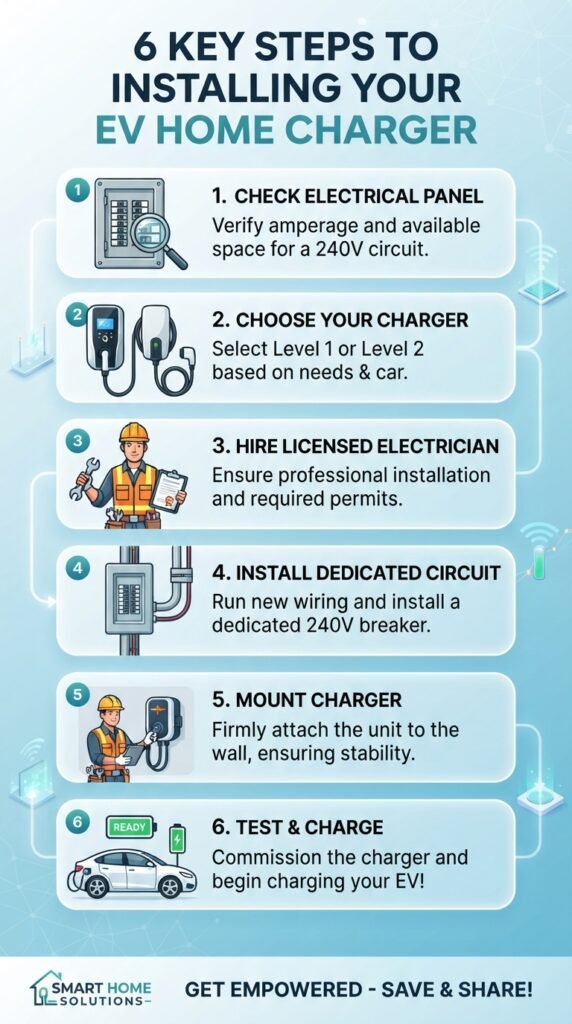
H2: How to Install an EV Home Charging Station Step by Step
The safest installation approach starts with planning and ends with testing. While homeowners can choose equipment and prepare the installation area, modifications to electrical systems should be handled by appropriately qualified professionals.
Here is the typical installation journey.
Step 1: Understand Your Daily Charging Needs
Start with your driving pattern rather than the largest charger available. Ask yourself:
- How many miles or kilometers do you typically drive each day?
- How many hours is the vehicle parked at home?
- Do you need to recharge quickly between trips?
- Will more than one EV eventually use the same electrical service?
- Do you expect to use off-peak electricity or solar power?
A charger that is perfectly matched to your routine can be more useful than paying for maximum charging capacity you rarely need.
Step 2: Confirm Your EV and Connector Compatibility
Check your vehicle’s charging port, maximum AC charging capability, and manufacturer recommendations. The charger and vehicle must be compatible, and the vehicle’s own charging limits can affect the speed you actually experience.
Do not choose a charger based solely on its maximum advertised output. A more powerful charger does not automatically make every EV charge faster.
Before purchasing, confirm:
- Connector compatibility
- Maximum vehicle AC charging rate
- Cable length
- Indoor or outdoor rating
- Installation method
- Smart features you actually plan to use
Step 3: Get a Professional Electrical Assessment
Ask a qualified electrician to inspect your electrical panel and proposed charger location. The assessment may include available service capacity, load calculations, panel space, wiring distance, grounding, and the condition of existing electrical infrastructure.
This is also the best time to identify potential upgrades. Getting this information before buying a charger helps you avoid choosing equipment that requires a more expensive installation than expected.
Step 4: Check Permits and Local Requirements
Electrical and building requirements vary by location. Depending on where you live, your installation may require permits, inspections, or compliance with specific electrical codes.
A qualified local installer can explain the requirements that apply to your property. The U.S. Alternative Fuels Data Center notes that charging equipment installations must comply with applicable regulations and may require permits from local authorities. (Alternative Fuels Data Center)
If you are in Pakistan, residential EV charging may also fall under applicable national and local requirements. Pakistan’s National Energy Efficiency & Conservation Authority (NEECA) provides information on EV charging infrastructure regulations and registered charging equipment, so check the requirements relevant to your location before proceeding. (NEECA)
Step 5: Choose Hardwired or Plug-In Installation
Many home chargers are available in hardwired or plug-in configurations.
A plug-in charger can offer flexibility when connected to an appropriately installed outlet. A hardwired charger connects directly to the electrical system and may be required or preferred for higher-power equipment depending on local requirements and manufacturer instructions.
Do not choose between these options based only on convenience. The charger’s power rating, installation environment, local code, and electrician’s recommendations all matter. EPA guidance notes that higher-powered residential charging equipment may require hardwiring and that professional installation improves safety. (US EPA)
Step 6: Install, Inspect, and Test the Charger
After electrical work and mounting are complete, the installation should be tested before regular use.
The final process typically includes:
- Mounting the charging equipment securely.
- Connecting it to the appropriate electrical circuit.
- Confirming protective and safety features.
- Completing required inspections.
- Testing communication and charging functions.
- Verifying that the cable reaches the vehicle safely.
Keep installation records, manuals, warranty information, and any inspection documentation for future reference.
How Much Does It Cost to Install an EV Home Charging Station?
The total cost of an EV charger installation varies because every home’s electrical system and parking layout is different. The charger itself is only one part of the project.
According to the U.S. Alternative Fuels Data Center, Level 2 charging equipment costs can vary substantially, and homes with adequate electrical service generally face lower installation costs than homes requiring major upgrades. (Alternative Fuels Data Center)
A practical way to estimate your project is to separate the cost into equipment and installation factors.
| Cost Factor | Why It Changes the Price |
|---|---|
| Charger price | Smart features, power level, build quality, and design |
| Distance from electrical panel | Longer wiring runs can increase labor and materials |
| Electrical panel capacity | Limited capacity may require upgrades |
| Circuit and wiring work | Depends on charger requirements and home layout |
| Permits and inspections | Vary by local authority |
| Indoor vs. outdoor installation | Outdoor protection may add complexity |
| Wall, trenching, or structural work | Difficult installation routes can increase labor |
The Cheapest Installation Is Not Always the Best Value
Choosing the lowest-priced charger without checking installation requirements can create problems later. A less expensive charger that requires extensive upgrades may ultimately cost more than a model better suited to your existing electrical system.
Instead, get the installation assessment first, then compare chargers that fit your actual electrical capacity and driving needs. This approach makes your budget more predictable.
What Features Should You Look for in the Best Home EV Charger?
The best EV charger is not automatically the fastest or most expensive. It is the one that fits your vehicle, home, charging schedule, and electrical infrastructure.
Focus on features that provide practical value rather than buying unnecessary technology.
Smart Charging and Scheduling
Smart chargers can provide useful features such as scheduled charging, app controls, energy monitoring, and notifications. These features can be especially useful if your electricity plan has different rates at different times or if you want to coordinate charging with solar generation.
If home energy visibility is important to you, our Smart Energy Monitor Buying Guide: 15 Best Home Power Trackers can help you understand the tools available for tracking household electricity use.
Smart charging can be valuable, but it should not replace proper electrical planning. A smart charger still needs a safe, correctly designed installation.
Load Management for Homes with Limited Capacity
Load management can be particularly useful when a home’s electrical capacity is limited or when multiple major electrical loads operate at the same time.
Some systems can adjust charging behavior to help manage overall household demand. This may be worth discussing with an electrician before deciding that a major service upgrade is the only option.
The correct solution depends on your home’s electrical system and local requirements, so professional evaluation remains essential.
Cable Length and Cable Management
A charging cable should reach the vehicle comfortably without being stretched tightly across walkways or parking areas.
Measure your parking setup before buying. Think about where the EV’s charging port is located and whether you may eventually park the vehicle differently.
Useful cable-management features can include:
- Wall-mounted holders
- Integrated cable hooks
- Weather-resistant storage
- Secure connector holsters
Good cable management improves convenience and can help reduce unnecessary wear.
Best Chargers for Home EV Charging: What to Compare Before Buying
Rather than choosing a charger based solely on brand recognition, compare the specifications that affect your own installation.
The best home EV charging station for one household may be completely unnecessary for another.
| Buying Factor | What to Check |
|---|---|
| Compatibility | Works with your EV and charging connector |
| Charging capability | Matches your vehicle and electrical setup |
| Installation type | Plug-in or hardwired requirements |
| Location rating | Suitable for indoor or outdoor installation |
| Smart features | Scheduling, app controls, monitoring |
| Cable length | Reaches your EV comfortably |
| Load management | Helpful for limited electrical capacity |
| Warranty and support | Clear manufacturer coverage and service |
| Future needs | Potential second EV or changing driving habits |
Browse Amazon
Ready to compare home EV charging equipment and related accessories? Browse options carefully and always verify compatibility, electrical requirements, seller information, and manufacturer specifications before purchasing.
Buy EV Charging Equipment on Amazon
EV Home Charger Shopping Links
These shopping links are intended to help you browse relevant Amazon product categories and compare available options. Product availability and specifications can change, so review the listing carefully and confirm compatibility with your vehicle and installation plan.
- 🛒 Shop Level 2 EV Home Chargers
- 🛒 Browse Smart EV Chargers
- 🛒 Compare Portable EV Chargers
- 🛒 Browse Outdoor EV Chargers
- 🛒 Shop Hardwired EV Chargers
- 🛒 Browse Plug-In EV Chargers
- 🛒 Shop EV Charger Cable Organizers
- 🛒 Browse EV Charging Cable Holders
- 🛒 Shop EV Charger Wall Mounts
- 🛒 Browse EV Charging Accessories
- 🛒 Compare Home Energy Monitoring Devices
- 🛒 Browse Electrical Cable Management Accessories
Amazon Store Button:
🛒 Visit the SmartAirHQ Amazon Storefront
Common EV Home Charger Installation Mistakes to Avoid
Most installation problems can be avoided by planning before buying. The following mistakes are especially common when homeowners focus only on charger price or maximum charging speed.
Buying the Charger Before Checking Electrical Capacity
A charger may look perfect on paper but exceed what your existing electrical system can comfortably support without modifications.
Avoid this mistake by getting an electrical assessment first. Knowing your available capacity helps you choose between different charger sizes, load-management options, and possible upgrades.
Using Extension Cords or Improvised Adapters
EV charging can involve sustained electrical loads. Improvised setups using unsuitable extension cords, power strips, or adapters can create unnecessary risks.
Follow the vehicle and equipment manufacturer’s instructions and use charging equipment designed for the intended application. Official guidance specifically recommends avoiding extension cords and power boards for routine EV charging. (Energy.gov.au)
Ignoring Outdoor Conditions
Not every charger is intended for outdoor exposure. Rain, heat, sunlight, dust, and physical damage can affect equipment over time.
If your driveway or parking space is outdoors, choose equipment rated for that environment and position it to reduce avoidable exposure and damage.
Choosing Maximum Power Without Considering Real Needs
More charging power is not automatically better. Your vehicle may have a lower maximum AC charging rate, or your daily driving pattern may not require rapid home charging.
Select charging capacity based on:
- Your vehicle’s capabilities
- Your typical daily mileage
- Overnight parking time
- Home electrical capacity
- Future vehicle plans
A properly matched charger is usually a better long-term choice than simply buying the biggest unit available.
How to Reduce the Running Cost of Home EV Charging
Installation cost is only one part of the ownership equation. Once your charger is installed, your electricity plan and charging habits can influence ongoing costs.
Smart scheduling may allow you to charge during lower-cost periods when your utility offers time-based pricing. Homes with solar generation may also explore charging strategies that align with available solar production.
Energy authorities note that off-peak charging and smart energy management can help drivers better manage charging costs where suitable electricity pricing or solar generation is available. (Energy.gov.au)
For readers building a broader smart-home energy strategy, visit SmartAirHQ.com to explore more guides and practical resources for managing energy and connected home technology.
If you are upgrading other electrical systems around your home, you can also explore the Lighting & Electrical category for related home electrical and lighting content.
When a Level 1 Charger May Be Enough
A dedicated Level 2 charger is convenient, but it is not mandatory for every EV owner.
Level 1 charging may be sufficient when:
- You drive relatively short distances most days.
- Your EV remains parked for long periods.
- Overnight charging comfortably restores the energy you use.
- Your existing electrical setup makes Level 2 installation expensive.
- You are temporarily charging at a property where permanent installation is not practical.
The best decision comes from comparing your daily energy needs with the time available for charging. Avoid assuming that every EV owner requires the same home charging setup.
Home EV Charging Safety and Maintenance Checklist
After installation, a small amount of routine attention can help keep the system reliable.
Periodically:
- Inspect the cable for visible damage.
- Check the connector for dirt or damage.
- Keep the charging area clear.
- Store the cable properly when not in use.
- Follow manufacturer cleaning and maintenance instructions.
- Install software updates when relevant to your charger.
- Contact a qualified professional if the charger repeatedly trips, overheats, behaves abnormally, or shows signs of physical damage.
Do not modify charging equipment or electrical components yourself unless you are appropriately qualified to perform the work.
EV Home Charging Station FAQs
Can I install an EV charger myself?
Choosing and mounting some equipment may appear straightforward, but installing a dedicated EV charging circuit involves electrical work that should be handled by a qualified professional. Local permits and inspection requirements may also apply.
Do I need a Level 2 charger at home?
Not necessarily. If Level 1 charging reliably meets your daily driving needs, a dedicated Level 2 charger may not be essential. Level 2 becomes more useful when you need faster charging or greater flexibility.
Will my electrical panel need an upgrade?
Possibly, but not always. A load calculation and electrical assessment can determine whether your existing panel and service have sufficient capacity for the planned charger.
Can an EV charger be installed outside?
Yes, provided the charging equipment is designed and rated for outdoor conditions and the installation follows applicable electrical requirements. (Alternative Fuels Data Center)
Does a more powerful charger always charge my EV faster?
No. Charging speed is limited by factors including your EV’s maximum AC charging capability and the electrical setup. A higher-rated charger cannot force a vehicle to accept more power than it is designed to handle.
What should I ask an EV charger installer?
Ask about available electrical capacity, required upgrades, circuit design, permits, inspections, installation location, equipment compatibility, and whether your preferred charger is appropriate for your vehicle and home.
Final Thoughts: Choosing the Right EV Home Charging Setup
Learning how to install an EV home charging station starts with understanding your own needs rather than immediately buying the most powerful charger available.
The smartest approach is simple: evaluate your driving habits, confirm your EV’s charging capability, have your electrical system assessed, check local requirements, and then choose equipment that fits the installation.
A well-planned home charging setup can provide everyday convenience without unnecessary upgrades or overspending. Start with a professional electrical assessment, compare compatible chargers carefully, and choose features that genuinely improve how you charge.
For broader home technology and energy guidance, explore SmartAirHQ.com.
“How to Install an EV Home Charging Station:
📌 Save on Pinterest
📌 (https://pin.it/3u0Db4nng)
Pinterest profile @smartairhq.