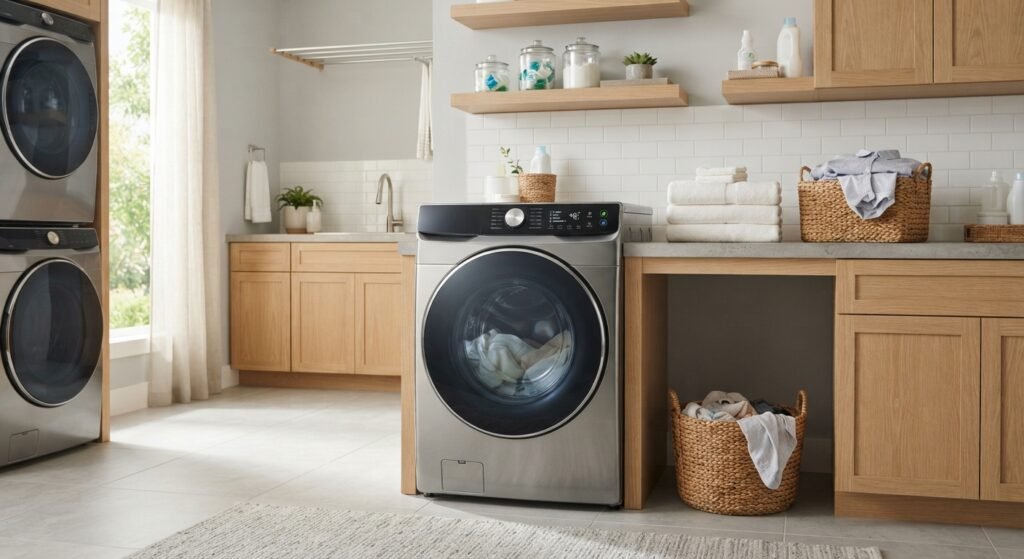
Choosing the best washing machine is less about finding the model with the longest feature list and more about matching the washer to your household, laundry habits, available space, and budget. The right capacity, loading style, and wash cycles can make everyday laundry easier, while the wrong combination can quickly become inconvenient.
This guide explains the most important washing machine types, how to choose the right washing machine capacity, and what to consider when comparing front-load and top-load models. You’ll also learn how spin speed, wash cycles, detergent requirements, inverter motors, energy efficiency, and water consumption can affect your buying decision.
The goal is simple: help you compare washing machines using practical criteria so you can choose a model that fits the way you actually do laundry.
Affiliate disclosure: This article contains affiliate links. If you purchase through qualifying links, SmartAirHQ may earn a commission at no additional cost to you.
For more practical appliance guides and buying advice, explore our Home Appliances category.
What Makes a Washing Machine a Good Choice?
There is no single washing machine that is automatically the best for every household. A washer that works well for a large family may be unnecessarily large for one or two people, while a compact machine may become inconvenient when you regularly wash bedding or larger loads.
A good choice balances capacity, loading style, cleaning needs, efficiency, available space, and the features you will actually use. Before comparing individual models, start by identifying the factors that matter most for your household.
| Buying Factor | Why It Matters |
|---|---|
| Load capacity | Determines how much laundry you can wash in one cycle |
| Front load vs. top load | Affects loading style, space requirements, cleaning, and overall operation |
| Spin speed | Influences how much water remains in clothes after the wash cycle |
| Wash cycles | Helps match washing settings to different fabrics and load types |
| Energy efficiency | Can affect electricity use during regular operation |
| Water consumption | Important when water usage is a priority for your household |
| Motor type | Motor design can affect noise, operation, durability, and energy use depending on the model |
| Space and installation | Determines whether the washer will fit your available laundry area |
| Detergent requirements | Some machines require or recommend specific detergent types or amounts |
A useful starting point is to determine your household’s typical laundry volume, available space, and preferred washer type before comparing brands, prices, or promotional features. This makes it easier to focus on machines that actually fit your needs rather than simply choosing the model with the longest feature list.
Choose the Right Washing Machine Type
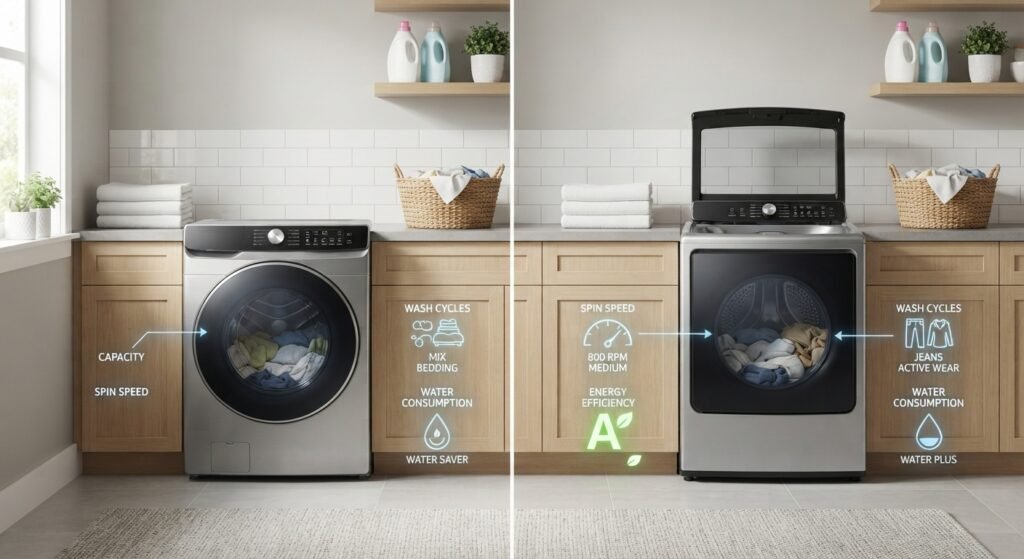
Washing machines come in several designs, but the main choice for most households is between front-load and top-load washing machines. Each type has different advantages depending on available space, laundry habits, convenience, and budget.
Front-Load Washing Machines
Front-load washers open from the front and typically use a horizontal drum. They are often chosen for their efficient use of water and space, especially when paired with a compatible dryer through stacking.
Best for: Households that prioritize water efficiency, stacking options, and thorough cleaning cycles.
Top-Load Washing Machines
Top-load washers open from the top and can be easier to load without bending down. Depending on the model, they may use either an agitator or an impeller to move clothes through the wash.
Best for: Users who prefer easier loading and a more traditional washer design.
Agitator vs. Impeller Top-Load Washers
If you choose a top-load washer, you may also need to decide between an agitator and an impeller design.
| Type | Main Characteristics | Consider If |
|---|---|---|
| Agitator | Uses a central mechanism to move clothes through the wash | You prefer a traditional washing action |
| Impeller | Uses a low-profile rotating mechanism to move clothes through the water | You want more usable drum space and a gentler design |
Which Washing Machine Type Should You Choose?
Choose based on your actual laundry needs rather than simply choosing the most feature-rich model. Consider available space, loading convenience, water and energy use, laundry volume, cleaning preferences, and budget before making your decision.
How to Choose the Right Washing Machine Capacity
Washing machine capacity should match the amount and type of laundry your household normally produces. Buying the largest washer available is not automatically the best choice. A larger drum can be useful for bulky loads, while a smaller household may get better value from a machine sized around its normal laundry routine.
Think about how often you wash clothes, whether you regularly clean towels or bedding, and whether you prefer doing several smaller loads or fewer larger loads. Before buying, also measure the installation area carefully. The washer needs to fit within the available width, depth, and height, while leaving enough room for doors, hoses, ventilation, and access.
Match Capacity to Your Laundry Routine
The most useful capacity is the one you can consistently use without overloading the drum or running unnecessarily small loads. If your household regularly washes bulky items such as towels, blankets, or bedding, additional usable drum space can be valuable. If most loads consist of everyday clothing, a very large machine may not provide a meaningful advantage.
ENERGY STAR recommends considering both washer capacity and how frequently you typically run small or large loads. Its certified clothes washers are available in different sizes and capacities, so capacity should be considered alongside the physical space available for installation.
Spin Speed Matters More Than You Might Think
Spin speed refers to how quickly the drum rotates during the extraction portion of a wash cycle. A higher spin speed can remove more moisture from clothes, which may be useful when you want laundry to come out less wet. However, maximum spin speed should not be the only factor you consider because different fabrics and garments may require gentler treatment.
The practical benefit can be especially noticeable when laundry is air-dried or transferred to a dryer. Removing more moisture before drying can reduce the amount of drying work required. ENERGY STAR also recommends using a high or extended spin option when appropriate to reduce moisture remaining in clothes.
When comparing washing machines, consider capacity and spin speed together rather than choosing a model based on either specification alone.
Look at Wash Cycles Instead of Counting Features
Modern washers can include numerous wash cycles, but more cycles do not necessarily mean a better machine. What matters is whether the available programs correspond to the laundry you actually wash. Useful cycles may include settings for everyday clothing, delicate fabrics, heavily soiled items, quick washing, or different temperature requirements.
Before purchasing, review the cycle names and determine whether they solve real laundry needs for your household. Also check whether cycle duration, temperature, spin options, and soil settings can be adjusted. A simple control system that you understand may be more useful than a complicated interface filled with rarely used programs.
Detergent Compatibility Should Be Part of the Decision
The right detergent matters because washing machines can be designed around specific washing conditions and detergent formulations. Always follow the detergent instructions and the washer manufacturer’s recommendations rather than assuming that using more detergent will produce cleaner clothes.
Using excessive detergent can leave unwanted residue, while using too little may affect cleaning performance. If you are considering a high-efficiency washer, check its instructions for the appropriate detergent type and dosing guidance. The washer’s manual should be your primary reference because detergent requirements can vary between models.
Inverter Motor: What Should You Look For?
An inverter motor is a motor system designed to vary operating speed rather than relying on a single fixed operating speed. In washing machines, this technology can be associated with controlled drum operation, and manufacturers may promote it as part of a broader approach to efficiency, noise management, and motor performance.
However, do not choose a washer solely because its specifications mention an inverter motor. Compare the complete machine, including its capacity, efficiency information, cycle options, warranty terms, dimensions, and intended use. A motor feature is most useful when it contributes to a machine that fits your overall requirements.
Energy Efficiency and Water Consumption
Energy efficiency and water consumption deserve attention because a washing machine is a frequently used household appliance. Instead of relying only on marketing descriptions, look for recognized efficiency information and compare models using consistent measures.
For U.S. shoppers, ENERGY STAR provides a useful reference for comparing certified clothes washers. Its buying guidance recommends checking the EnergyGuide label and considering measures such as Integrated Modified Energy Factor (IMEF) and Integrated Water Factor (IWF). A higher IMEF indicates greater energy efficiency, while a lower IWF indicates better water efficiency.
When comparing models, consider energy use, water consumption, capacity, and expected laundry frequency together rather than choosing a machine based on one specification alone.
Explore More Smart Energy Guides
If you’re interested in reducing household energy use and choosing more efficient appliances, explore our Smart Energy category for more practical guides and ideas.
How to Reduce Energy and Water Use
Choosing an efficient washer is only part of the equation. How you operate the appliance also affects resource use. Running appropriate loads, selecting suitable temperatures, and avoiding unnecessary hot-water cycles can make everyday laundry more efficient.
ENERGY STAR recommends running full loads when possible and notes that washing in cold water can reduce energy use because heating water represents a significant portion of a washer’s operating energy. It also recommends using higher spin settings when appropriate because removing more moisture before drying can reduce the work required later.
Using the washer according to the manufacturer’s recommended load sizes and cycle settings can also help you avoid unnecessary water and energy use.
If you also want to track electricity consumption from household appliances, see our Smart Energy Monitor Buying Guide.
Check the Installation Space Before Buying
A washing machine can have excellent specifications and still be the wrong choice if it does not fit your laundry area. Measure the available width, height, and depth before placing an order. Remember that the appliance also needs practical clearance for doors, hoses, electrical connections, ventilation, and movement during installation or servicing.
Consider how the door or lid opens as well. A front-load washer needs sufficient clearance in front of the machine, while a top-load washer requires enough vertical space to open its lid comfortably. If space is limited, compact, stackable, or combination designs may be worth considering.
Before buying, compare the washer’s listed dimensions with your actual installation space and check the manufacturer’s installation requirements. This can help prevent problems with fitting, access, and connections after delivery.
Special Washing Machine Designs for Small Spaces
Not every home has a dedicated laundry room. Apartments, small utility areas, and temporary living spaces may require a more specialized solution. Compact and portable washing machines can reduce space requirements, while stackable configurations can make better use of vertical space when compatible appliances and installation conditions allow it.
Compact Washing Machines
Compact models can be useful when floor space is limited. Before buying, check the machine’s dimensions and installation requirements to make sure it fits the available area.
Portable Washing Machines
Portable washers can be useful in apartments, temporary living spaces, or locations where a full-size washer is not practical. Check water connections, drainage requirements, capacity, and mobility before choosing one.
Washer-Dryer Combination Machines
Washer-dryer combination machines combine washing and drying functions in one appliance. They can save space by eliminating the need for separate appliances, although cycle times, capacity, and installation requirements can vary by model.
When choosing a small-space washing machine, prioritize dimensions, capacity, installation requirements, and everyday usability rather than simply choosing the smallest available model.
Washer-dryer combination appliances can also appeal to households that want washing and drying functions in one appliance. ENERGY STAR includes combination washer-dryer designs within its product guidance, although buyers should carefully compare dimensions, capacity, cycle requirements, and drying performance before choosing one. (ENERGY STAR)
A Simple Checklist for Choosing the Best Washing Machine
The easiest way to avoid an impulse purchase is to compare machines against the same criteria. Start with your laundry habits, then narrow your options based on capacity, installation requirements, efficiency, and features that provide a practical benefit.
Use this checklist before buying:
- Measure the installation area — Confirm width, depth, height, door or lid clearance, and space for hoses and connections.
- Estimate your normal load size — Consider everyday clothing as well as towels, bedding, and other bulky items.
- Choose front load or top load — Base the decision on loading preference, available space, and efficiency considerations.
- Review wash cycles — Focus on programs that match the laundry you actually wash.
- Compare spin speed options — Consider how much moisture you want removed before drying.
- Check detergent requirements — Follow the washer manufacturer’s instructions and recommended detergent guidance.
- Compare energy and water information — Use recognized labels and specifications where available.
- Consider the motor and operating features — Treat an inverter motor and other features as individual factors rather than the entire buying decision.
- Review the total cost — Consider the purchase price, expected operating costs, installation, and practical usefulness.
This approach helps you choose a washing machine based on your household needs rather than simply buying the model with the most advertised features.
Common Washing Machine Buying Mistakes to Avoid
Many washing machine buying mistakes happen when shoppers focus on one specification instead of considering the complete machine. A large capacity, high spin speed, or long list of wash programs does not automatically make a washer the right choice for every household.
1. Choosing Capacity Based Only on Size
A larger drum is not always better. Choose a capacity that matches your household’s normal laundry volume and the types of items you regularly wash.
2. Ignoring Installation Space
Do not rely only on the listed width. Check the washer’s width, depth, height, door or lid clearance, hoses, connections, and access space before buying.
3. Focusing Only on Spin Speed
A higher maximum spin speed can help remove moisture, but it should not be the only specification you compare. Consider fabric care, cycle options, and how you normally dry your clothes.
4. Paying for Unused Features
More wash cycles, smart functions, or additional settings are not automatically better. Prioritize features that solve real problems in your everyday laundry routine.
5. Ignoring Energy and Water Use
Purchase price is only part of the overall cost. Consider the washer’s energy and water information, especially if you expect to use it frequently.
6. Using the Wrong Detergent or Amount
Follow the manufacturer’s detergent recommendations and instructions for the specific washer. Using more detergent does not necessarily produce cleaner clothes.
7. Overlooking Installation Requirements
Check water connections, drainage, electrical requirements, ventilation, and any other installation instructions before purchasing.
8. Choosing Features Instead of Overall Fit
The best washing machine for your household is not necessarily the one with the most specifications. Compare capacity, washer type, space, efficiency, cycles, operating features, installation requirements, and total cost together before making a decision.
Front Load vs. Top Load: Which Is Better?
Neither loading style is universally better for every household. A front-load washer can be a good fit if efficiency, stacking potential, and loading access match your priorities. A top-load washer can be convenient if you prefer loading from above or want a different operating design. The right choice depends on your home, laundry habits, available space, and priorities.
| Consideration | Front Load | Top Load |
|---|---|---|
| Loading position | Front | Top |
| Stacking potential | Often suitable for compatible stacking configurations | Generally less suited to stacking |
| Agitator option | Not applicable to traditional front-load designs | Available on some models |
| Impeller option | Not applicable | Available on some models |
| Efficiency | Can be highly efficient depending on the model | Varies significantly by design and model |
| Loading convenience | May require more bending when loading and unloading | Allows loading from above |
| Best suited to | Households prioritizing space efficiency, stacking, and certain efficiency benefits | Households prioritizing top access and a traditional loading design |
ENERGY STAR’s guidance indicates that front-load washers can offer significant efficiency advantages over traditional top-load agitator models, while newer top-load impeller designs can also provide improved efficiency.
When comparing the two, look beyond the loading style and consider capacity, efficiency, installation space, cycle options, loading convenience, and overall operating needs.
How to Compare Two Washing Machines Side by Side
When two washing machines appear similar, compare them using the same criteria rather than focusing on a single headline feature. Start with capacity and dimensions, then compare energy and water information. After that, review wash programs, spin options, motor design, detergent requirements, installation needs, and features that affect everyday usability.
A simple comparison sheet can include:
- Capacity
- Dimensions
- Front load or top load
- Agitator or impeller, where applicable
- Spin speed options
- Wash cycles
- Energy-use information
- Water-use information
- Detergent requirements
- Motor type
- Installation requirements
- Warranty and manufacturer support
If you’re comparing other major household appliances, you can also explore our dishwasher troubleshooting guide.
For U.S. shoppers, the ENERGY STAR product finder can also help compare certified clothes washers and their efficiency information.
When comparing two specific models, look at the differences that matter to your household rather than simply choosing the washer with more features. A model with a higher price or longer feature list may not provide better value if those features do not match your laundry needs.
What Features Actually Matter Most?
The most useful washing machine features are the ones that solve a real, recurring need. Capacity matters if you regularly wash large or bulky loads. Spin speed can matter if you want clothes to come out with less moisture. Wash cycles are useful when your laundry includes different fabrics or levels of soil, while energy and water efficiency can matter if you use the washer frequently.
Other features should be judged by how often you will actually use them. A long list of smart functions, specialized cycles, or extra settings does not automatically make a washing machine a better choice.
Focus on daily usefulness rather than feature count. This makes it easier to compare models with different specifications and choose features that provide a practical benefit for your household.
Frequently Asked Questions About the Best Washing Machine
Choosing a washer often raises practical questions that are not answered by a product specification sheet. The answers below focus on common decisions shoppers face when comparing washing machine types, capacity, efficiency, and features. Keep in mind that exact operation, detergent requirements, cycle availability, and specifications vary by model, so the manufacturer’s documentation remains important.
Is a front load washing machine better than a top load model?
A front load washing machine is not automatically better for everyone. Front-load designs can provide strong efficiency and stacking advantages, while top-load models may be more convenient for people who prefer loading from above. Compare capacity, efficiency, available cycles, dimensions, and your preferred loading style before deciding.
What washing machine capacity should I choose?
Choose capacity according to the amount and type of laundry you normally wash. Consider everyday clothing as well as bulky items such as towels and bedding. Also consider the physical space available for the machine. Buying the largest washer available is unnecessary if your household normally handles smaller loads.
Does higher spin speed mean better washing?
Not necessarily. Spin speed mainly affects moisture extraction after the washing portion of the cycle. A higher setting can leave clothes with less remaining moisture, which may be useful before drying. However, different garments may require gentler settings, so having adjustable spin options can be more useful than simply choosing the highest number.
Are inverter motors worth considering?
An inverter motor can be a useful feature, but it should not be the sole reason you choose a washer. Compare the complete appliance, including capacity, efficiency information, cycle selection, dimensions, operating characteristics, and warranty. The value of the motor depends on how the overall machine fits your needs.
How can I reduce washing machine energy use?
Use appropriate loads, choose suitable wash temperatures, and avoid unnecessary hot-water cycles. ENERGY STAR recommends running full loads when possible and notes that cold-water washing can reduce energy consumption associated with heating water. Using an appropriate high-spin setting can also reduce moisture before drying.
Where can I compare energy-efficient washing machines?
For U.S. shoppers, official ENERGY STAR clothes washer resources provide buying guidance and a product finder for certified models. You can use these resources to review efficiency information and compare qualifying washers rather than relying only on manufacturer marketing descriptions.
🛒 Check Price on Amazon
🛍️ Shop current washing machine prices on Amazon
Prices, availability, specifications, and seller information can change, so verify the current product details before purchasing.
Final Thought: Choose the Washer That Fits Your Real Laundry Needs
The best washing machine is the one that fits your household rather than the one with the longest feature list. Start with capacity and installation space, then decide between front load and top load based on how you prefer to use your washer. From there, compare spin speed, wash cycles, detergent requirements, motor design, energy efficiency, and water consumption.
For U.S. shoppers, recognized efficiency resources such as ENERGY STAR can provide an additional way to compare models using standardized efficiency information.
Before buying, measure your space, think about your typical laundry loads, and compare the specifications that will affect your everyday experience. This simple process can make it easier to find a washer that provides the right balance of capacity, convenience, and efficiency.