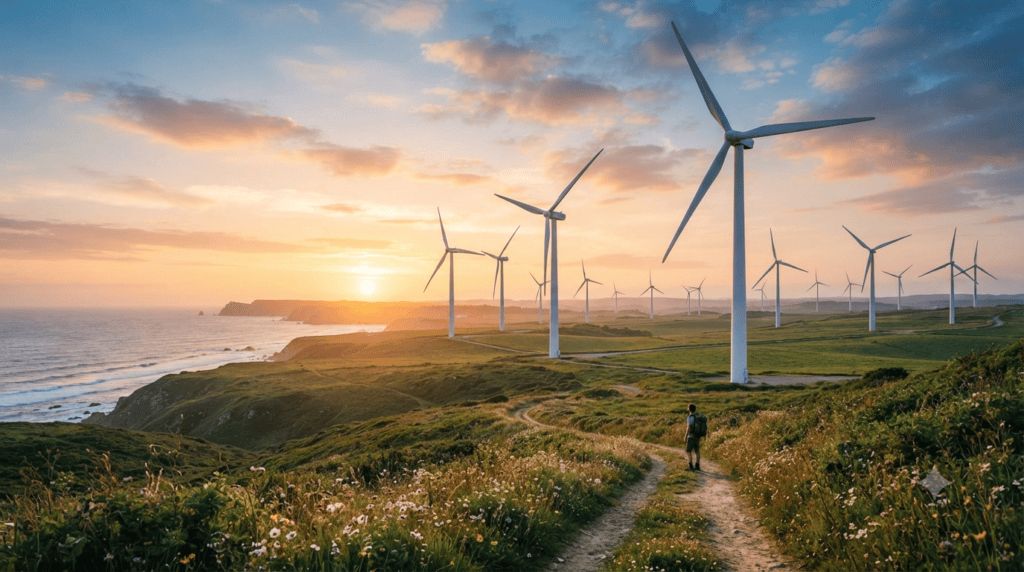
Wind turbines turn the kinetic energy of moving air into useful electrical power. They range from relatively small machines designed for homes, farms, and remote properties to enormous utility-scale turbines installed on land or offshore. Understanding how wind turbines work, how tall they are, what equipment they require, and when a wind turbine for home use makes sense can help you determine whether wind power is practical for your location.
At the simplest level, moving air pushes the aerodynamic blades, causing the rotor and shaft to rotate. This mechanical movement drives a wind turbine generator, which converts the rotational energy into electricity. The electricity then passes through appropriate electrical equipment before being used locally, stored in batteries, or delivered to the grid.
Whether you are researching large wind farms, offshore wind turbines, or small residential systems, one factor matters more than the turbine’s size or appearance: the quality and consistency of the wind resource at the actual installation site.
How Do Wind Turbines Work?
Wind turbines work by converting one form of energy into another. Moving air contains kinetic energy. When that air passes over specially shaped turbine blades, it creates aerodynamic lift and drag. The resulting forces make the rotor turn.
The rotor is connected to a generator either directly or through a shaft and gearbox, depending on the turbine design. The generator then converts the mechanical rotation into electrical energy.
According to the U.S. Department of Energy’s guide to how wind turbines work, wind turbines use aerodynamic forces on their rotor blades to convert wind energy into mechanical rotation and ultimately electricity.
The Basic Wind Turbine Process
- Wind moves across the blades.
- Aerodynamic forces make the rotor spin.
- The rotor turns a shaft or drives the generator.
- The generator converts mechanical rotation into electricity.
- Electrical equipment conditions and controls the power.
- The electricity is used, stored, or sent to the grid.
In simple terms, a wind turbine converts the kinetic energy of moving air into mechanical energy and then into electrical energy.
This is why a wind turbine is essentially the opposite of an electric fan. A fan uses electricity to create moving air, while a wind turbine uses moving air to produce electricity.
How Does a Wind Turbine Generate Electricity?
The electricity-generation process begins with the rotor. As wind passes over the blades, their aerodynamic shape creates lift and drag, causing the rotor to rotate. That rotation provides mechanical energy to the generator.
Inside the generator, electromagnetic principles convert mechanical rotation into electrical energy. Some turbines use a gearbox between the rotor and generator to increase rotational speed, while direct-drive designs connect the generator more directly to the rotor.
The electricity produced by the generator is then managed by electrical systems such as converters, transformers, switchgear, and controls. In a utility-scale wind farm, electricity from individual turbines is collected and transferred toward a substation before entering the transmission or distribution system.
For a smaller off-grid installation, the electricity may instead pass through a charge controller and battery system before an inverter converts it into the type of electricity required by household appliances.
What Are the Main Parts of a Wind Turbine?
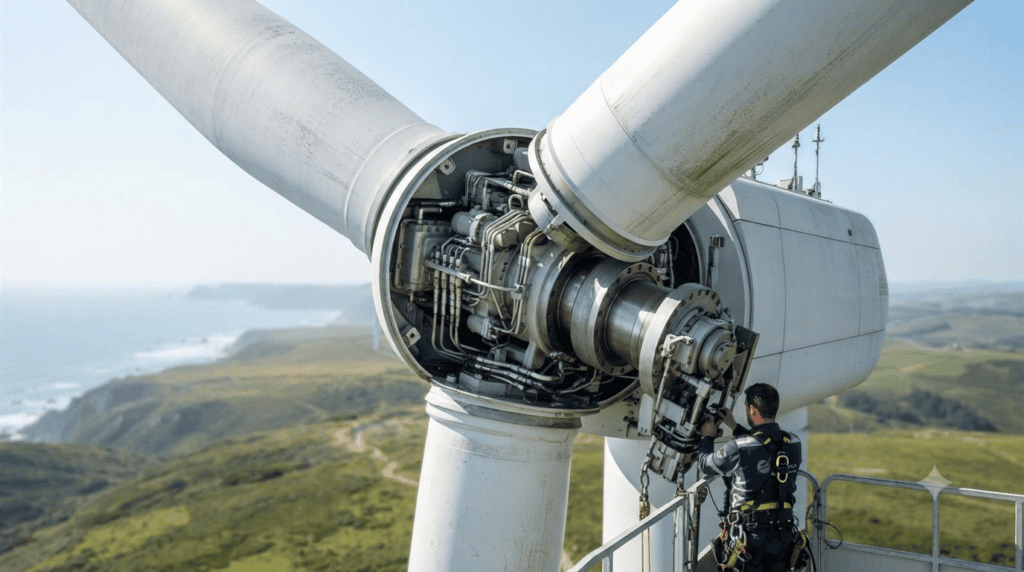
Although wind turbines vary considerably in size and design, most contain the same basic functional elements. The blades capture energy from the wind, the rotor transfers that energy into rotation, and the generator converts mechanical energy into electricity.
The nacelle contains many of the important mechanical and electrical components, while the tower raises the rotor into higher and less obstructed airflow.
| Component | Main purpose |
|---|---|
| Blades | Capture aerodynamic energy from moving air |
| Rotor | Connects the blades and transfers rotational motion |
| Nacelle | Houses major mechanical and electrical components |
| Generator | Converts mechanical rotation into electricity |
| Gearbox | In applicable designs, increases shaft speed for the generator |
| Tower | Positions the rotor higher above the ground |
| Controller | Manages turbine operation and protective functions |
| Anemometer | Measures wind speed |
| Wind vane | Helps determine wind direction |
| Transformer | Changes voltage for electrical transmission or distribution |
The exact arrangement depends on the turbine’s design and application. Modern utility-scale machines commonly use horizontal-axis designs, while smaller turbines may use different configurations depending on their intended purpose and operating environment.
How Tall Are Wind Turbines?
There is no single answer to how tall wind turbines are because turbine height varies with application, rotor size, location, and technology. A useful measurement is hub height, which is the distance from the ground to the center of the rotor.
Utility-scale land-based turbines have become substantially taller over time because stronger and more consistent winds are often available higher above the ground. The U.S. Department of Energy reported an average hub height of about 103.4 meters (339 feet) for utility-scale land-based turbines installed in the United States in 2023.
The total height from the ground to the highest blade tip is greater than the hub height because the rotor extends above and below the hub. Turbine height therefore needs to be considered together with rotor diameter when comparing the overall size of a wind turbine.
Small distributed wind turbines are much shorter. DOE’s WINDExchange resources note that small wind turbines are typically installed between approximately 15 and 40 meters high, although actual systems vary by site and application.
The reason for increasing height is straightforward: wind speeds generally increase with height, while trees, buildings, terrain, and other surface features can create turbulence and reduce wind quality closer to the ground. Raising the rotor can therefore provide access to stronger and more consistent airflow, potentially improving energy production.
What Types of Wind Turbines Are Available?
Wind turbines can be classified in two main ways: by rotor design and by how and where the turbine is used. The two primary rotor designs are horizontal-axis wind turbines (HAWTs) and vertical-axis wind turbines (VAWTs).
Horizontal-axis turbines are the familiar propeller-style machines commonly seen at large wind farms. They are widely used in modern commercial wind projects and typically rotate around a horizontal shaft. Vertical-axis turbines rotate around a vertical shaft and can accept wind from different directions without continuously turning the rotor to face the wind.
For most homeowners and general readers, however, the more useful distinction is between utility-scale, distributed, land-based, and offshore wind systems. These categories describe how wind energy is deployed rather than simply how the rotor is shaped.
Utility-Scale Wind Turbines
Utility-scale wind turbines are large machines designed to generate substantial amounts of electricity for the electrical grid. Multiple turbines are typically grouped together in a wind farm, with the electricity from individual turbines collected and transferred through electrical infrastructure toward the grid.
These turbines use large rotors, tall towers, and high-capacity generators to capture energy from available wind resources. Utility-scale projects require careful planning around wind conditions, land or water use, foundations, roads, electrical transmission, environmental considerations, construction logistics, and permitting.
Their scale makes them very different from a small turbine installed near a home, farm, or remote property.
Distributed Wind Turbines
Distributed wind turbines are installed at or near the location where the electricity will be used. They can serve homes, farms, businesses, schools, industrial facilities, and other local loads. Distributed systems may be connected to the local electricity network or operate in off-grid applications.
Unlike utility-scale wind, distributed wind is defined mainly by its application and relationship to the electricity user, not simply by turbine size. Some distributed systems are relatively small, while others can use larger multimegawatt turbines for facilities with substantial electricity demand.
Offshore Wind Turbines
Offshore wind turbines are installed in bodies of water, typically in areas with strong and relatively consistent wind resources. Offshore projects can use fixed-bottom foundations in shallower waters or floating platforms in deeper waters.
Offshore turbines can be extremely large because transportation and installation methods differ from land-based projects. Electricity generated offshore is transferred to shore through electrical transmission infrastructure before entering the grid.
Land-Based Wind Turbines
Land-based wind turbines are installed onshore and include both utility-scale wind farms and some distributed wind applications. They are commonly deployed in areas with suitable wind resources, available land, and access to electrical infrastructure.
For large projects, multiple turbines are connected as a wind farm so that the electricity they generate can be collected and delivered to the electrical grid.
Small Wind Turbines for Homes and Farms
A small wind turbine can be part of a distributed energy system that produces electricity near where it will be consumed. DOE describes distributed wind as turbines installed at or near the customer or energy user, including residential, agricultural, and small commercial applications.
A small system may work particularly well for a property with a strong, consistent wind resource and enough space for an appropriately tall tower. It can be used as a standalone system, connected to batteries, or integrated with other renewable-energy technologies.
For someone considering a wind turbine for home use, the key question is not simply whether a turbine can generate electricity. The better question is whether the site can provide enough useful wind, at a suitable height, to justify the equipment and installation costs.
Explore Smart Energy
Want to learn more about generating, monitoring, and using electricity efficiently? Explore our
Smart Energy guides for practical information on energy monitoring, renewable energy, smart power management, and home energy efficiency.
Can You Install a Wind Turbine for Home Use?
A wind turbine for home use can be practical in the right location, but a property simply feeling windy does not mean a residential turbine will produce enough electricity to justify its cost. A successful small wind system depends on the site’s wind resource, tower height, available space, local regulations, electrical requirements, equipment selection, and expected annual energy production.
The U.S. Department of Energy’s Small Wind Guidebook recommends evaluating the site’s wind resource, energy needs, available space, tower requirements, utility connection options, and economics before choosing a small wind system.
What to Check Before Installing a Home Wind Turbine
Before buying equipment, evaluate:
- Average wind speed at the proposed turbine height
- Wind consistency throughout the year
- Trees, buildings, hills, and other nearby obstructions
- Available tower height and land area
- Local zoning, setback, and permitting requirements
- Electrical connection and utility requirements
- Battery-storage requirements for off-grid systems
- Maintenance and access requirements
- Expected annual energy production rather than advertised peak power
A turbine’s rated power does not mean it will continuously produce that amount of electricity. Wind speed changes constantly, so actual energy production depends on the turbine’s power curve, rotor size, tower height, and the wind conditions at the installation site. DOE recommends comparing systems using estimated annual energy output rather than relying only on a turbine’s nameplate or rated capacity.
What About Rooftop Wind Turbines?
Installing a wind turbine directly on a house or other building may seem convenient, but rooftops can have turbulent airflow caused by the building and surrounding structures. Turbine vibration can also be transmitted into the building. These factors can reduce energy production and create noise or structural concerns.
For many residential applications, a properly sited ground-mounted tower may provide a better wind resource than a rooftop installation.
✨ Explore Small Wind Turbines on Amazon
If you are researching residential equipment, you can compare small wind turbine generators on Amazon by rated capacity, rotor design, voltage, and intended application.
Important: Product specifications and suitability vary considerably. Check the manufacturer’s power curve, recommended wind conditions, tower requirements, electrical components, and installation requirements before purchasing.
How to Determine Whether Your Property Has Enough Wind
A good wind resource assessment is one of the most important steps in evaluating a small wind project. Looking outside and seeing trees move is not enough. A turbine responds to the wind conditions at the rotor, and those conditions can differ significantly from what you experience at ground level.
Buildings, trees, hills, and other structures can disrupt airflow and create turbulence or wind shadows. These conditions can reduce useful energy production and may increase mechanical loading on the turbine.
A practical site assessment should consider:
- Wind speed: Average wind speed is more important than occasional strong gusts when estimating long-term energy production.
- Wind direction: Understanding prevailing wind directions can help determine suitable turbine placement and reduce the effects of nearby obstructions.
- Height: Wind conditions generally improve with elevation, although the amount of improvement depends on the local terrain and surrounding obstacles.
- Obstructions: Trees, buildings, and other structures can create turbulence and areas of reduced or disturbed airflow.
- Seasonal variation: Wind conditions can change throughout the year, so a site that seems windy during one season may produce less energy during another.
- Turbine power curve: Compare the site’s expected wind conditions with the turbine’s power curve to estimate how much electricity it may actually produce.
Using an Anemometer to Measure Wind
For an initial investigation, an anemometer can help you measure local wind speed. A handheld meter can provide useful preliminary information, but it should not be treated as a substitute for a properly designed long-term wind assessment.
One option available through Amazon is the BTMETER BT-100 anemometer.
Before purchasing a meter, check its measurement range, accuracy, measurement units, and intended use. For a serious wind project, measurements should represent the wind conditions at or near the planned turbine height and over an appropriate period rather than relying only on short-term readings.
The most important principle is simple: do not choose the turbine first and look for wind afterward. Evaluate the site first, estimate the available wind resource, and then select equipment that matches the actual conditions.
What Equipment Does a Small Wind Energy System Need?
A small wind installation is more than the turbine itself. Depending on the system design, it may include the wind turbine, tower, foundation, wiring, disconnects, controller, inverter, batteries, electrical protection equipment, and monitoring equipment.
The exact components depend on whether the system is grid-connected, off-grid, or part of a hybrid renewable-energy system that combines wind with solar, batteries, or another energy source.
Typical Off-Grid Wind System
A simplified off-grid arrangement may look like this:
Wind → Turbine → Controller → Battery Bank → Inverter → Household Loads
The turbine converts wind energy into electricity, while the controller manages the turbine’s electrical output and battery charging. The battery bank stores energy, and the inverter converts stored DC electricity into AC electricity suitable for compatible household loads.
Actual system designs can be more complex and may include braking or diversion equipment, disconnects, fuses or breakers, grounding, monitoring devices, and other protective components.
Grid-Connected Wind Systems
A grid-connected wind system follows a different electrical architecture. Instead of relying entirely on batteries, the system uses appropriate power electronics and electrical equipment to deliver electricity to on-site loads and, where permitted, the utility grid.
Grid-connected systems must comply with applicable electrical, interconnection, safety, and utility requirements. The exact requirements vary by location and utility.
What Specifications Should You Check?
When selecting a small wind turbine and its supporting equipment, pay attention to:
- Rated voltage
- Rated power
- Operating wind range
- Cut-in wind speed
- Rated wind speed
- Cut-out wind speed or protection behavior
- Controller compatibility
- Battery compatibility
- Inverter requirements
- Tower and foundation requirements
- Electrical protection and disconnect requirements
- Manufacturer installation specifications
These components should be selected as a compatible system, rather than independently. For example, a charge controller must be appropriate for the turbine’s electrical characteristics and the battery system. Depending on the turbine design, the system may also require specific braking, diversion, or overvoltage protection.
🔎 Find Small Wind Charge Controllers
If you are researching components, you can compare small wind turbine charge controllers on Amazon.
Before purchasing, verify the controller’s voltage and current ratings, turbine compatibility, battery compatibility, charging method, protection features, and manufacturer specifications. A controller designed for one wind turbine or battery configuration may not be suitable for another.
Why Tower Height Matters So Much
The tower is one of the most important parts of a small wind installation because a turbine can only capture the wind available at the height of its rotor. A turbine placed too close to buildings, trees, or other obstacles may operate in disturbed airflow and produce significantly less electricity than expected, even when the surrounding region has a good overall wind resource.
Raising the turbine can help move the rotor above some surface-level turbulence and into stronger, more consistent airflow. However, the amount of improvement depends on the site’s terrain, surrounding obstacles, tower height, and local wind conditions.
Is a Taller Wind Turbine Always Better?
Not necessarily. A taller tower can improve access to better wind, but it can also increase foundation, transportation, installation, structural, maintenance, and permitting requirements.
The tower must be properly designed for the turbine’s weight, rotor size, expected wind loads, and site conditions. The foundation and anchoring system must also be appropriate for the soil and installation environment.
For residential projects, proper turbine placement can be more important than simply choosing a larger generator. A smaller turbine installed at a well-exposed site may produce more useful electricity than a larger turbine operating in turbulent or obstructed airflow.
🛍️ Shop Small Wind Turbine Tower Kits
If you are researching installation equipment, you can compare small wind turbine tower kits on Amazon.
Tower components should never be selected based on price or appearance alone. Before purchasing, verify compatibility with the specific turbine, required tower height, structural and foundation specifications, wind-load requirements, installation method, and applicable local regulations.
How Wind Turbine Output Changes With Wind Speed
Wind turbines do not produce the same amount of electricity at every wind speed. They generally begin producing useful power after reaching a minimum operating wind speed, increase output as wind speed rises, reach rated output within their designed operating range, and eventually shut down when wind becomes too strong. The exact speeds vary by turbine model.
This is why advertised wattage can be misleading if it is viewed without the accompanying power curve. A turbine advertised as a certain number of watts may only reach that output under particular wind conditions.
For homeowners, the practical question is therefore:
How much energy will this turbine produce at my site’s typical wind speeds?
That is much more useful than asking only, “How many watts is the turbine?”
A good evaluation should compare the turbine’s power curve with measured or well-estimated wind conditions at the intended hub height. This helps avoid purchasing a high-rated turbine that spends most of its operating life below the wind speed needed to produce substantial power.
What Are the Advantages and Limitations of Wind Turbines?
Wind power has an important advantage: once a turbine is installed, it can convert the kinetic energy of moving air into electricity without burning fuel during operation. Wind turbines can also be deployed at different scales, from distributed systems serving individual properties to large wind farms supplying electricity to the grid.
However, wind is variable, and that variability affects electricity production. A turbine also requires a suitable location, structural support, electrical equipment, maintenance, and access for inspection and repairs. Large wind projects require substantial infrastructure, while small systems can face significant challenges when the available wind resource is weak, inconsistent, or turbulent.
| Potential Advantage | Important Limitation |
|---|---|
| Uses naturally occurring wind as an energy resource | Wind speed and energy production vary over time |
| Can generate electricity near the point of use | Good site selection and wind conditions are essential |
| Can be deployed at different scales | Towers and foundations require appropriate space |
| Can complement solar and other energy sources | Equipment requires inspection and maintenance |
| Can support grid-connected or off-grid applications | Installation can require significant upfront investment |
| Generates electricity without fuel combustion during normal operation | Output depends strongly on the available wind resource |
| Can produce electricity from a renewable energy resource | Turbines and supporting infrastructure require careful planning |
For residential systems, additional considerations can include tower height, local permitting, maintenance access, noise, visual impact, and the distance between the turbine and the electrical loads it serves.
The best wind project is therefore not necessarily the biggest one. It is the one that matches the available wind resource, site conditions, electrical requirements, budget, and installation constraints.
Why Texas Wind Turbines Are So Well Known
Texas is one of the most important examples of large-scale wind development in the United States. The state has extensive areas with strong wind resources, a large geographic area suitable for wind projects, and substantial wind-generation infrastructure. According to the U.S. Energy Information Administration (EIA), Texas produced more electricity from wind than any other U.S. state in 2025.
The Texas example also demonstrates an important principle: having strong wind resources is only part of the equation. Successful large-scale wind development requires suitable land, transmission infrastructure, roads and construction access, turbine technology, electrical equipment, and careful project planning. EIA data also show the significant scale of wind generation and infrastructure investment associated with Texas’s wind sector.
What Texas Wind Turbines Teach Homeowners
For homeowners, the lesson is not that every property in Texas—or any other windy region—is automatically suitable for a turbine.
Regional wind potential does not guarantee that a specific property has a productive turbine site. Local terrain, nearby buildings and trees, tower height, turbulence, and actual wind conditions at the proposed turbine location still matter.
This is why a residential wind project should begin with site assessment and wind-resource evaluation, rather than simply choosing a turbine based on the wind conditions of the surrounding region.
Common Mistakes to Avoid When Choosing Wind Turbines
One of the most common mistakes is focusing on a turbine’s advertised maximum or rated power instead of its expected annual energy production. A turbine may be capable of producing a large amount of power under specific high-wind conditions but generate relatively little electricity if the property rarely experiences those conditions.
For this reason, site quality should come before equipment size.
Other common mistakes include:
- Installing a turbine too close to buildings, trees, or other obstructions.
- Assuming that a windy day means the site has a strong annual wind resource.
- Ignoring the importance of tower height and turbine placement.
- Choosing a charge controller without checking turbine and battery compatibility.
- Underestimating foundation, tower, transportation, and installation requirements.
- Forgetting battery, inverter, and protection requirements in an off-grid system.
- Assuming a turbine will produce its rated power continuously.
- Ignoring the manufacturer’s power curve when estimating energy production.
- Failing to plan for inspection, maintenance, and repair access.
- Not checking local zoning, permitting, setback, or electrical requirements.
- Comparing turbines solely by advertised wattage.
- Choosing equipment before determining whether the site’s wind resource is suitable.
A particularly important mistake is buying the turbine before understanding the site’s wind conditions. The turbine is only one part of a complete energy system. A better approach is to evaluate the available wind resource first, estimate realistic energy production, and then select a turbine and supporting equipment that match the site.
Should You Combine Wind With Batteries or Solar?
Wind and solar can complement one another because their electricity-production patterns do not always occur at the same time. A hybrid renewable-energy system can combine a wind turbine, solar panels, batteries, and appropriate power electronics to provide electricity from multiple generation sources.
The U.S. Department of Energy recognizes wind and solar as technologies that can be integrated into hybrid renewable-energy systems. (energy.gov)
For an off-grid property, batteries can store electricity when generation exceeds immediate demand and provide stored energy when the wind or solar system produces less than the household requires. However, battery storage does not create additional energy; it stores electricity that has already been generated.
How Should a Battery Bank Be Sized?
Battery capacity should be matched to the system’s electrical loads, expected wind and solar production, desired backup duration, system voltage, and allowable depth of discharge.
Battery chemistry also matters. Different battery technologies have different charging requirements, usable capacity, operating characteristics, temperature limitations, and expected service life.
If you are researching storage options, you can compare renewable-energy batteries on Amazon.
Before purchasing, check the battery’s chemistry, nominal voltage, capacity, usable energy, discharge limits, charging requirements, temperature range, and compatibility with the inverter and charge-control equipment.
Is a Wind-and-Solar Hybrid System Worth It?
A hybrid system can make sense when the site’s wind and solar resources complement one another and the additional equipment provides enough practical value for the application.
However, adding more generation and storage components also increases system complexity, cost, maintenance requirements, and the need for compatible electrical equipment.
The better approach is to design the complete energy system around the site’s resources and electrical loads rather than purchasing individual components in isolation.
How to Choose the Right Wind Turbine
Choosing the right wind turbine should be treated as a site-matching exercise, not simply a product comparison. Start by determining what you want the system to accomplish. A small turbine might supplement household electricity, provide power for a remote structure, charge batteries, support agricultural equipment, or operate alongside solar generation. The intended use helps determine the appropriate turbine and overall system architecture.
Use this decision process:
- Define the electrical load. Determine how much electricity you actually need and which loads the system will serve.
- Assess the wind resource. Focus on average and consistent wind conditions at the intended hub height rather than occasional strong gusts.
- Evaluate the site. Identify trees, buildings, terrain, roads, available land, and other factors that could affect turbine placement.
- Choose the appropriate turbine type. Match the turbine design and configuration to the site’s conditions and intended application.
- Check the power curve. Estimate expected electricity production at the wind speeds the site is actually likely to experience.
- Select compatible electrical equipment. Make sure the turbine, controller, batteries, inverter, protection equipment, and wiring are designed to work together.
- Plan the tower and foundation. Consider tower height, structural requirements, foundation design, installation method, and site conditions.
- Check local requirements. Confirm zoning, setbacks, permitting, electrical, building, and utility requirements where applicable.
- Plan for maintenance. Make sure the turbine can be safely inspected, accessed, repaired, and serviced over its operating life.
- Compare expected energy production with total project cost. Include the turbine, tower, foundation, electrical equipment, installation, maintenance, and other required infrastructure.
When comparing turbines, do not rely on advertised rated wattage alone. A turbine with a higher rated capacity may produce less useful electricity at a particular property if the site’s wind conditions rarely reach the speeds required for substantial output.
The better approach is to estimate realistic annual energy production based on the site’s wind resource and the turbine’s power curve, then compare that expected production with the complete cost and requirements of the system.
This approach helps prevent one of the most expensive mistakes in small wind: buying equipment based on its advertised capacity without first determining whether the property can provide the wind needed to use that capacity.
Wind Turbines FAQs
Wind turbines raise several practical questions, especially for readers considering a home system. The answers depend on whether you are looking at a small distributed turbine or a large utility-scale machine. Both use the same fundamental principle—converting the kinetic energy of moving air into electricity—but their scale, installation requirements, electrical equipment, and economics can be very different.
How Do Wind Turbines Work?
Wind turbines use aerodynamic blades to capture energy from moving air. The blades rotate a rotor, which transfers mechanical energy to a generator. The generator converts that mechanical energy into electricity. Depending on the turbine design, a gearbox may be used between the rotor and generator, while direct-drive turbines connect the generator more directly to the rotating assembly.
How Does a Wind Turbine Generate Electricity at Home?
A residential turbine generates electricity using the same basic process as a large turbine: wind turns the blades, the rotor drives a generator, and the generator produces electricity. A home system then uses appropriate electrical equipment to deliver that electricity to household loads, batteries, or a compatible grid connection. The exact configuration depends on whether the system is grid-connected or off-grid.
How Tall Are Wind Turbines?
Wind turbine height varies considerably by turbine type and application. Small distributed turbines may have hub heights in the tens of meters, while modern utility-scale land-based turbines commonly have hub heights around or above 100 meters. The U.S. Department of Energy reported an average hub height of about 103.4 meters (339 feet) for utility-scale land-based turbines installed in the United States in 2023. The highest blade tip extends substantially above the hub. (energy.gov)
Are Offshore Wind Turbines Bigger Than Land-Based Turbines?
Offshore wind turbines can be extremely large because developers can take advantage of strong open-water wind resources and transport very large components by sea. Offshore projects may use fixed-bottom or floating foundations, depending on water depth and site conditions. Their size and marine environment require specialized installation, electrical, structural, and maintenance systems.
How Much Electricity Does a Wind Turbine Produce?
The amount of electricity a wind turbine produces depends on its rated capacity, wind speed, rotor size, turbine power curve, tower height, and site conditions. A turbine does not continuously produce its rated power because wind speeds change over time.
For residential applications, expected annual energy production is more useful than simply comparing advertised wattage. The turbine’s power curve and the actual wind resource at the proposed site should be considered when estimating output.
Can a Wind Turbine Power an Entire House?
A suitably sized and properly sited wind turbine can provide substantial electricity for a home, and in some cases it may generate enough annual energy to cover a large portion or potentially all of a household’s electricity consumption.
However, this depends heavily on the property’s wind resource, household energy demand, turbine size, and system design. Rated power is not the same as annual energy production. A realistic assessment should use the turbine’s power curve and expected site wind conditions rather than relying only on advertised wattage.
Are Wind Turbines Useful Without Batteries?
Yes, depending on the system design. Grid-connected wind turbines can supply electricity to the electrical system without requiring a household battery bank. Off-grid systems commonly use batteries because electricity generation and household demand rarely occur at exactly the same time.
The appropriate configuration depends on whether the property has grid access, how the electricity will be used, and how much energy storage is required.
Are Small Wind Turbines Worth It for Every Home?
No. A small wind turbine is most promising when the property has a suitable wind resource, sufficient tower height, adequate installation space, and a practical electrical system.
A location with weak or turbulent wind may produce disappointing results even when the turbine itself is technically capable of generating electricity. Site assessment should therefore come before purchasing the equipment.
Final Thought: Are Wind Turbines Right for You?
Wind turbines are a proven way to convert the energy of moving air into electricity, but the most important lesson is that wind power is fundamentally a site-dependent technology. Large turbines succeed by combining aerodynamic design, tall towers, large rotors, generators, electrical infrastructure, and carefully selected locations. Small turbines follow the same basic principles on a smaller scale.
If you are considering a wind turbine for home use, start with the wind resource rather than the product catalog. Evaluate the available wind conditions, consider the appropriate tower height, identify nearby obstructions, understand your electricity needs, and then select a turbine and electrical system that match those conditions.
For larger projects, the same principle helps explain the development of land-based and offshore wind turbines. Strong wind resources, larger rotors, taller towers, and appropriate infrastructure can increase energy capture when the site and project economics support them.
In short, the best wind turbine is not simply the one with the highest advertised wattage. It is the turbine that is correctly matched to the wind resource, site, tower, electrical system, and energy needs.