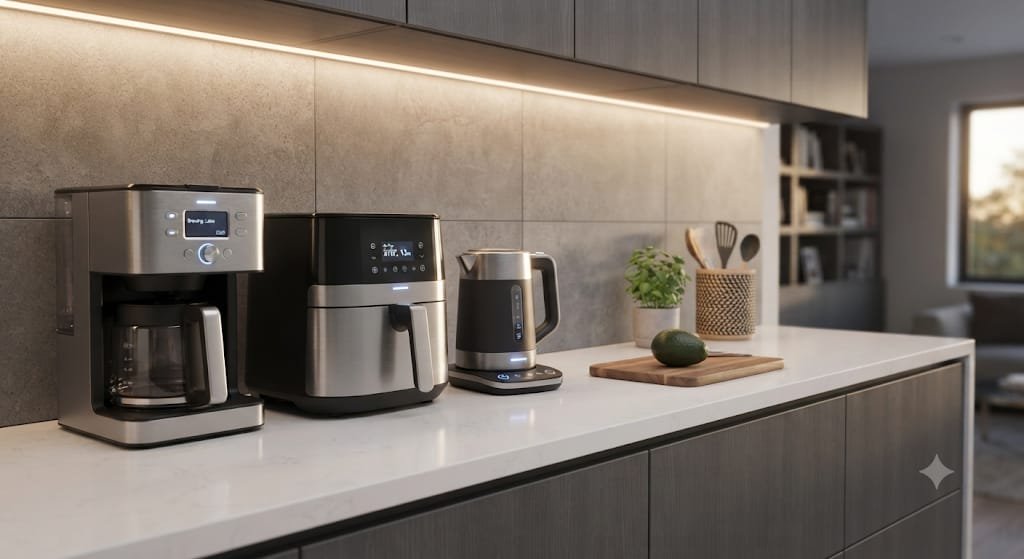
A modern kitchen does not need to look like a science lab to feel smarter. The best smart kitchen gadgets simply remove repetitive tasks, automate cooking steps, improve timing, or let you monitor an appliance from a phone or voice assistant. This Smart Kitchen Gadgets Buying Guide: 15 Must-Have Automated Appliances for 2026 focuses on practical appliances that can make everyday cooking easier without adding unnecessary complexity.
From smart air fryers and programmable pressure cookers to connected coffee makers, precision scales, and smart ovens, the right appliance depends on how you actually cook. Some gadgets are valuable because they automate temperature control, while others are useful because they offer scheduling, app control, recipe guidance, or remote monitoring.
The goal is not to fill every countertop with connected devices. It is to choose automation that solves a real kitchen problem.
🛒 Check Price on Amazon
The links throughout this guide are designed to help you browse relevant appliance categories. Prices, availability, specifications, and seller information can change, so verify the current product details before purchasing.
Affiliate disclosure: This article contains affiliate links. If you purchase through qualifying links, SmartAirHQ may earn a commission at no additional cost to you.
What Makes a Kitchen Appliance “Smart” or Automated?
A smart kitchen appliance typically combines traditional cooking functions with automation, digital controls, sensors, connectivity, or programmable settings. The word “smart” can mean different things from one product to another. One appliance may connect to Wi-Fi and a smartphone app, while another may simply use sensors and automatic programs to adjust cooking without requiring constant attention.
For buyers, the important distinction is not whether a product has the word “smart” on its packaging. It is whether its automation actually makes cooking easier. Useful features can include automatic temperature adjustment, programmable schedules, cooking notifications, recipe programs, voice control, remote monitoring, and automatic shutoff. Amazon’s Alexa ecosystem, for example, supports connected kitchen devices such as smart coffee makers that can be controlled through an app or compatible smart speaker. (Amazon Developer)
Before buying, ask one simple question: What repetitive task will this appliance automate for me? If the answer is unclear, a conventional appliance may offer better value.
How to Choose Smart Kitchen Gadgets Without Overspending
The most expensive kitchen gadget is not automatically the most useful. A better approach is to start with your cooking habits and identify where you lose the most time. If breakfast is rushed, automated coffee brewing may be more useful than a connected oven. If weeknight dinners are difficult, a programmable pressure cooker or smart air fryer may provide more practical value.
Consider these factors before purchasing:
- Automation: Look for useful presets, sensors, scheduling, or automatic controls.
- Connectivity: Decide whether Wi-Fi, Bluetooth, app control, or voice control actually matters to you.
- Capacity: Match the appliance to your household rather than buying the largest model available.
- Cleaning: Removable, dishwasher-safe components can make a major difference in daily use.
- Counter space: Smart functionality is not worth sacrificing valuable workspace.
- Energy use: Consider both the purchase price and operating cost.
- Reliability: An appliance should still be useful if you do not use every connected feature.
- Compatibility: Check whether the device works with your preferred phone, smart-home platform, and network.
- Privacy and software: Connected appliances may depend on apps, accounts, firmware, and internet connectivity.
The U.S. Department of Energy recommends considering both purchase price and operating costs when comparing appliances, while EnergyGuide and ENERGY STAR resources can help consumers evaluate energy consumption where applicable. (The Department of Energy’s Energy.gov)
15 Must-Have Smart Kitchen Gadgets and Automated Appliances
The following categories cover some of the most useful forms of kitchen automation. They are not all equally necessary for every household. Instead, think of this list as a buying framework: choose the appliances that solve the problems you encounter most often.
1. Smart Air Fryer
A smart air fryer is one of the easiest ways to introduce automation into everyday cooking. Depending on the model, useful features may include digital temperature control, programmable cooking times, recipe presets, app connectivity, scheduling, and voice-assistant compatibility. Some connected models can also send cooking notifications or allow you to monitor progress from a phone.
When shopping, prioritize basket capacity, temperature range, ease of cleaning, and controls you will actually use. A smart air fryer should make quick meals more convenient rather than simply adding another app to your phone. Some current smart air fryers also combine functions such as baking, drying, fermentation, and scheduled cooking. (Xiaomi Italia)
Check Price on Amazon — Smart Air Fryers
2. Smart Pressure Cooker
A smart pressure cooker combines automated cooking programs with the convenience of pressure cooking. It can be particularly useful for people who want to prepare soups, stews, grains, beans, and other meals with less hands-on monitoring. Depending on the model, automation may include preset programs, timers, temperature management, delayed cooking, and app-based controls.
The key buying consideration is whether the cooker provides intuitive controls and useful presets rather than a confusing collection of buttons. Capacity matters too. A compact model may suit one or two people, while families may benefit from a larger cooking chamber. Always follow the manufacturer’s instructions for pressure cooking and safety.
Check Price on Amazon — Smart Pressure Cookers
3. Smart Oven or Countertop Smart Oven
A smart oven can bring automation to baking, roasting, reheating, and other cooking tasks. Depending on the appliance, features may include guided cooking programs, digital temperature control, timers, food presets, app connectivity, or automatic adjustments based on the selected cooking mode.
This category is especially useful for households that want more control than a basic toaster oven provides but do not necessarily need a full-size replacement oven. Pay close attention to internal dimensions because countertop appliances can appear compact externally while offering very different usable cooking space. Also consider whether automated programs are genuinely helpful for the recipes you prepare most often.
Check Price on Amazon — Smart Ovens
4. Smart Microwave
A smart microwave can go beyond simple time-and-power controls by adding sensor cooking, programmable presets, app connectivity, voice control, or integration with other smart-home devices. For many households, the biggest benefit is not remote operation but more consistent automated heating.
Look for sensor-based cooking, easy-to-clean interiors, useful presets, and controls that are easy to understand. If you mainly use a microwave for reheating leftovers, you may not need an advanced connected model. If you frequently defrost, cook, reheat, and coordinate several kitchen tasks, automation can become more valuable.
Check Price on Amazon — Smart Microwaves
5. Smart Coffee Maker
A smart coffee maker can automate one of the most repetitive kitchen routines: preparing coffee. Depending on the design, you may be able to schedule brewing, control the machine from an app, or use compatible voice commands. Amazon’s Alexa Connect Kit specifically identifies connected coffee makers as an example of smart kitchen appliances that can be controlled through an app or smart speaker. (Amazon Developer)
When comparing models, focus on brew quality, carafe design, water reservoir size, cleaning requirements, scheduling, and whether the connected features are genuinely useful. A complicated setup is not an advantage if you simply want reliable coffee at a particular time each morning.
Check Price on Amazon — Smart Coffee Makers
6. Smart Electric Kettle
A smart electric kettle is particularly useful for tea drinkers, coffee enthusiasts, and anyone who frequently needs hot water. Automation can include temperature presets, keep-warm functions, scheduling, app controls, and sometimes voice integration.
Temperature control is more important than flashy connectivity. Different beverages can require different water temperatures, so a kettle with precise settings can be more useful than a basic on/off model. Also consider kettle capacity, boil speed, minimum fill level, lid design, and whether the controls remain convenient when you are standing in the kitchen rather than using the app.
Check Price on Amazon — Smart Electric Kettles
7. Smart Blender
A smart blender can automate blending programs for tasks such as smoothies, sauces, soups, and frozen drinks. Instead of manually adjusting the speed, preset programs can control blending patterns and timing. Some advanced models may also connect to apps or provide guided recipes.
For most buyers, motor performance, blade design, jar capacity, noise, cleaning, and warranty support should come before connectivity. Smart controls are valuable when they reduce guesswork. They are less valuable when they simply duplicate buttons already available on the blender itself.
Check Price on Amazon — Smart Blenders
8. Smart Food Processor
A smart or automated food processor can reduce repetitive preparation work such as chopping, slicing, shredding, mixing, and kneading. The automation may come from programmed processing settings, variable speeds, timers, or guided controls rather than internet connectivity.
Capacity and attachments are especially important in this category. Before purchasing, consider the tasks you perform regularly and check whether the included accessories support them. A processor with many attachments may sound versatile, but unused accessories can take up storage space. Choose the configuration that matches your cooking style rather than paying for functions you rarely need.
Check Price on Amazon — Smart Food Processors
9. Smart Kitchen Scale
A smart kitchen scale is a smaller gadget, but it can be extremely useful for accurate cooking and baking. Many connected scales can send measurements to an app, support nutritional tracking, or provide guided recipe functions. Even without advanced connectivity, precise digital measurement can improve consistency.
Look for a clear display, accurate measurements, useful units, a stable weighing surface, easy cleaning, and a compact design. If you bake regularly, measurement consistency may be more valuable than elaborate smart-home integration. A good scale should make portioning and recipe preparation easier rather than requiring a lengthy setup every time you use it.
Check Price on Amazon — Smart Kitchen Scales
10. Smart Sous Vide Cooker
A smart sous vide cooker automates precise water-bath cooking by maintaining a selected temperature for a specified period. It can be useful when you want repeatable results and minimal active monitoring. App connectivity can make it easier to set temperatures, timers, or monitor the cooking process.
When choosing one, pay attention to temperature accuracy, circulation performance, controls, attachment method, water-container compatibility, and app quality. The most useful automation is precise temperature maintenance. If the device’s app is unreliable or difficult to use, the core cooking function should still remain straightforward.
Check Price on Amazon — Smart Sous Vide Cookers
11. Smart Meat Thermometer
A smart meat thermometer can take much of the guesswork out of cooking meat. Instead of repeatedly opening an oven or grill to check temperature, connected probes can monitor food temperature and, depending on the system, send information to a smartphone or receiver.
Look for probe durability, temperature range, wireless range, charging method, display readability, and the quality of temperature alerts. This is a good example of why a smart gadget does not need to operate the appliance itself to provide automation. Monitoring and notifications can be just as useful as automatic cooking controls.
Check Price on Amazon — Smart Meat Thermometers
12. Smart Refrigerator
A smart refrigerator is a much larger investment than a countertop gadget, so the buying criteria should be more demanding. Connected features can include inventory management, notifications, temperature monitoring, diagnostics, and integration with other smart-home functions, depending on the model.
Start with the fundamentals: storage configuration, refrigerator and freezer capacity, temperature performance, cleaning, noise, energy use, and service availability. Connected features should come after those basics. The U.S. Department of Energy notes that refrigerators can be significant household energy users, making operating efficiency an important part of the long-term buying decision. (The Department of Energy’s Energy.gov)
Check Price on Amazon — Smart Refrigerators
13. Smart Dishwasher
A smart dishwasher can automate more than simply washing dishes. Depending on the model, connected features may include cycle notifications, remote monitoring, diagnostics, scheduling, and specialized wash programs. Some smart-home systems can also coordinate appliance operation around energy-management preferences.
Capacity and cleaning performance remain more important than connectivity. Consider the number of place settings, rack flexibility, filter design, noise, cycle options, drying performance, and water consumption. The Department of Energy recommends choosing appropriate capacity and using efficient cycles where available; running full loads can also improve resource efficiency. (The Department of Energy’s Energy.gov)
Check Price on Amazon — Smart Dishwashers
14. Smart Induction Cooktop
A smart induction cooktop can combine fast, precise heating with digital controls and, in some models, connected monitoring or automated cooking functions. Induction works by heating compatible cookware directly rather than relying on a conventional exposed heating element.
For buyers, cookware compatibility is an important consideration. You should also evaluate cooking-zone size, power levels, temperature controls, safety features, installation requirements, and cleaning. The U.S. Department of Energy notes that induction appliances can be more efficient than conventional smooth-top electric ranges because induction heats cookware directly. (The Department of Energy’s Energy.gov)
15. Smart Slow Cooker
A smart slow cooker is designed for people who want meals to cook with minimal supervision. Programmable temperature settings, timers, keep-warm functions, and app controls can make it easier to manage long cooking sessions while handling other responsibilities.
The best model depends on household size and the types of meals you prepare. Look for a removable cooking vessel, intuitive controls, reliable temperature management, easy cleaning, and a lid that seals securely. Connected features are useful when they make monitoring simpler, but a slow cooker should still be easy to operate manually.
Smart Kitchen Gadget Comparison: Which Appliance Fits Your Needs?
With 15 categories to choose from, it is easy to buy more technology than you actually need. A better strategy is to match the appliance to a specific problem. The table below provides a quick starting point for deciding where automation can have the greatest practical impact.
| Appliance | Best for | Most useful automation | What to prioritize |
|---|---|---|---|
| Smart air fryer | Quick meals | Presets, scheduling, app control | Capacity and cleaning |
| Smart pressure cooker | One-pot meals | Cooking programs and timers | Capacity and controls |
| Smart oven | Baking and roasting | Guided cooking and temperature control | Interior size |
| Smart microwave | Reheating and cooking | Sensor programs | Sensor performance |
| Smart coffee maker | Morning routines | Scheduling | Brew quality |
| Smart kettle | Tea and hot drinks | Temperature presets | Temperature control |
| Smart blender | Smoothies and sauces | Automated blending programs | Motor and cleaning |
| Smart food processor | Food prep | Programmed processing | Attachments |
| Smart kitchen scale | Baking and portions | App-guided measurement | Accuracy |
| Smart sous vide | Precision cooking | Temperature automation | Accuracy and circulation |
| Smart thermometer | Meat and grilling | Alerts and monitoring | Probe quality |
| Smart refrigerator | Food storage | Monitoring and notifications | Energy and capacity |
| Smart dishwasher | Dish cleaning | Scheduling and notifications | Cleaning performance |
| Smart induction cooktop | Precise stovetop cooking | Digital heat control | Cookware compatibility |
| Smart slow cooker | Long cooking | Scheduling and keep-warm | Capacity and controls |
Which Smart Kitchen Appliances Are Worth Buying First?
If you are building a smart kitchen from scratch, you do not need to purchase all 15 appliances. Start with the task that causes the most friction. For many households, that means choosing one appliance that saves hands-on time every day rather than buying several gadgets that are used occasionally.
A practical priority system looks like this:
- Choose a high-frequency appliance. Pick something you will use several times per week.
- Solve a specific problem. Focus on meal timing, food preparation, temperature control, or monitoring.
- Add automation only where it helps. App control is useful when it saves effort, not simply because it exists.
- Check capacity and kitchen space. Make sure the appliance fits both your cooking needs and countertop or cabinet space.
- Consider long-term ownership. Cleaning, replacement parts, software support, and energy consumption matter.
- Expand gradually. Once the first appliance proves useful, add another device that complements your routine.
This approach also prevents a common mistake: buying a gadget because it looks technologically impressive instead of because it solves a recurring problem.
Smart Features That Are Actually Worth Paying For
Not every connected feature deserves a premium. The most valuable features tend to be those that remove a repetitive action or provide information at exactly the right time. Scheduling can be useful for coffee makers and slow cookers. Temperature monitoring is valuable for ovens, sous vide devices, and thermometers. Automatic programs can simplify air frying, pressure cooking, blending, and other repetitive tasks.
Voice control can also be convenient when your hands are busy, but it should not be the deciding factor by itself. Similarly, smartphone notifications are useful when they tell you that food needs attention or a cycle has finished. A feature is worth paying for when it changes your routine for the better—not simply because it appears on a specification sheet.
Energy Efficiency Should Be Part of Your Smart Kitchen Buying Decision
Smart technology and energy efficiency are related, but they are not the same thing. A connected appliance is not automatically more efficient than a conventional appliance. Efficiency depends on the appliance’s design, operating mode, size, usage pattern, and other factors.
When comparing larger appliances, look beyond the purchase price. The Department of Energy emphasizes that appliances have both an upfront cost and an ongoing operating cost, while energy labels can help consumers compare similar models. (The Department of Energy’s Energy.gov)
For a smarter buying decision:
- Compare energy-use information where available.
- Choose a capacity appropriate for your household.
- Use efficient cooking modes when practical.
- Avoid running partially filled appliances when full-load operation is more efficient.
- Consider how often you will use the appliance.
- Do not pay a large premium for connectivity that you will never use.
Smart scheduling can sometimes help coordinate appliance operation around energy-management strategies, but availability and usefulness depend on the appliance, utility, and home setup. (The Department of Energy’s Energy.gov)
Common Mistakes to Avoid When Buying Smart Kitchen Gadgets
The biggest mistake is treating “smart” as a synonym for “better.” Connectivity can improve convenience, but it can also introduce additional setup, accounts, software, and dependencies. A kitchen appliance should first perform its basic job well.
Avoid buying an appliance solely because it has:
- A smartphone app you probably will not use
- Voice control without a practical purpose
- More presets than you need
- A larger capacity than your household requires
- Complicated controls that make simple cooking harder
- Features that duplicate functions you already own
Another mistake is ignoring maintenance. Removable components, washable parts, replacement accessories, and straightforward cleaning can have a bigger effect on your satisfaction than an impressive connected feature.
Finally, check what happens if the Wi-Fi connection disappears. For many appliances, basic controls should remain available even when connected features are unavailable. That is an important distinction between smart convenience and essential functionality.
How to Build a Practical Smart Kitchen Setup
A smart kitchen works best as a collection of complementary tools rather than a random collection of connected appliances. Start by identifying your daily routines. Morning coffee, weekday dinners, meal preparation, baking, and cleanup may each present different opportunities for automation.
For example, someone who regularly cooks quick meals might prioritize a smart air fryer and pressure cooker. A frequent baker may benefit more from a precise kitchen scale and temperature-controlled oven. Someone who spends little time at home during cooking may value scheduling and notifications more than extensive recipe features.
If you want to explore additional smart-home and kitchen technology content, visit SmartAirHQ for more related guides.
The key is to build around your routine, not around the number of devices you can connect.
How to Keep Smart Kitchen Appliances Simple and Reliable
Automation should reduce mental load, not create another technical project. Keep appliance apps organized, use simple routines, and avoid connecting every device merely because it supports smart-home integration. If a feature saves you time every week, keep it. If you never use it, turn it off or ignore it.
It is also sensible to keep important appliance information accessible, including manuals, model numbers, warranty details, and cleaning instructions. For connected appliances, software and account requirements may matter as much as physical controls. Before purchasing a major appliance, review the manufacturer’s support information and confirm that the features you care about are available in your region.
For energy-efficiency guidance and appliance information, the U.S. Department of Energy’s appliance resources are a useful external reference. (The Department of Energy’s Energy.gov)
Best Smart Kitchen Gadgets by Cooking Goal
Different cooking goals call for different types of automation. There is no universal “best” smart appliance because the right choice depends on what you cook, how often you cook, and how much hands-on attention you want to give each meal.
| If your priority is… | Consider starting with… |
|---|---|
| Faster everyday meals | Smart air fryer |
| One-pot cooking | Smart pressure cooker |
| Breakfast automation | Smart coffee maker |
| Precise baking | Smart kitchen scale |
| Precision meat cooking | Smart thermometer |
| Long unattended cooking | Smart slow cooker |
| Precise temperature cooking | Smart sous vide cooker |
| Countertop versatility | Smart oven |
| Easier food preparation | Smart food processor |
| Better beverage preparation | Smart kettle |
| Automated dish cleanup | Smart dishwasher |
| Connected food storage | Smart refrigerator |
The important point is to choose the category that addresses your biggest recurring problem. A $100 gadget you use several times each week can provide more practical value than a much more expensive appliance that sits unused.
Amazon Buying Guide for Smart Kitchen Appliances
When comparing smart kitchen gadgets on Amazon, avoid judging products solely by star ratings or the number of features listed on the product page. Read the specifications carefully and compare capacity, controls, cleaning requirements, connectivity, included accessories, and warranty information.
For connected products, check whether the app is required for important functions or simply provides optional convenience. Also confirm compatibility with your smartphone and preferred voice assistant if that matters to you.
For larger appliances, consider delivery, installation, dimensions, and return requirements before ordering. For smaller countertop appliances, check the footprint and storage requirements. Most importantly, compare several models within the same category rather than assuming the most feature-heavy option is the best choice.
Shop Smart Kitchen Gadgets on Amazon
Frequently Asked Questions About Smart Kitchen Gadgets
Smart kitchen appliances can seem complicated at first because “smart” covers everything from simple programmable controls to full Wi-Fi connectivity. The questions below address the practical issues buyers commonly face when deciding whether an automated appliance is actually worth adding to their kitchen.
What is the most useful smart kitchen gadget for everyday cooking?
There is no single best choice for everyone. A smart air fryer, pressure cooker, coffee maker, or slow cooker can be highly useful because these appliances automate common cooking tasks. Choose based on what you prepare most frequently.
Are smart kitchen appliances worth the extra cost?
They can be, but only when automation solves a real problem. Scheduling, temperature monitoring, automatic programs, and useful notifications can save time. Paying extra for connectivity you never use usually provides less value.
Do smart kitchen appliances need Wi-Fi?
Not always. Some smart appliances provide useful automation through built-in controls without internet access. Connected features such as remote monitoring, app control, or cloud-based recipes may require Wi-Fi or an account.
Are smart appliances automatically energy efficient?
No. Smart connectivity does not guarantee lower energy consumption. Compare energy information, appliance size, operating modes, and expected usage instead of assuming a connected model will cost less to operate. (The Department of Energy’s Energy.gov)
What should I check before buying a connected kitchen appliance?
Check the appliance’s core cooking performance first, followed by capacity, cleaning, controls, connectivity, app requirements, compatibility, warranty, and ongoing support. Make sure the smart features actually solve a problem you experience regularly.
Can smart kitchen gadgets work with voice assistants?
Some can. Compatibility varies by product and platform. Amazon’s Alexa ecosystem supports connected-device controls, including examples such as smart coffee makers. Always verify the specific model’s supported platforms before buying. (Amazon Developer)
Final Thoughts: Choose Automation That Makes Cooking Easier
The best smart kitchen gadgets are not necessarily the ones with the most technology. They are the appliances that quietly make everyday cooking easier: an air fryer that simplifies dinner, a coffee maker that follows a morning schedule, a thermometer that removes guesswork, or a pressure cooker that handles a meal with less supervision.
Use this Smart Kitchen Gadgets Buying Guide: 15 Must-Have Automated Appliances for 2026 as a framework rather than a checklist you must complete. Start with one home appliance that solves a frequent problem, evaluate whether its automation genuinely improves your routine, and expand your smart kitchen gradually.
For readers who enjoy discovering practical home technology and kitchen automation ideas, save this guide for future reference and share it on Pinterest. SmartAirHQ’s Pinterest presence is smartairhq, making this type of visual buying guide well suited to Pinterest search and traffic.
Suggested Pinterest text overlay:
15 Smart Kitchen Gadgets You’ll Actually Use
Suggested Pinterest URL: SmartAirHQ
Amazon affiliate disclosure: SmartAirHQ participates in the Amazon Associates Program and may earn from qualifying purchases made through eligible affiliate links. This does not increase the price you pay.