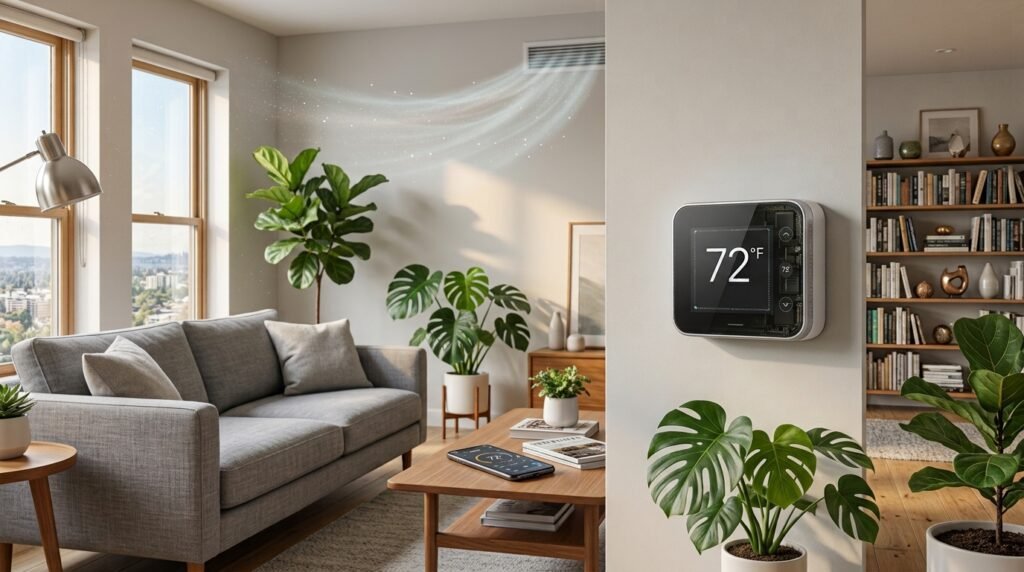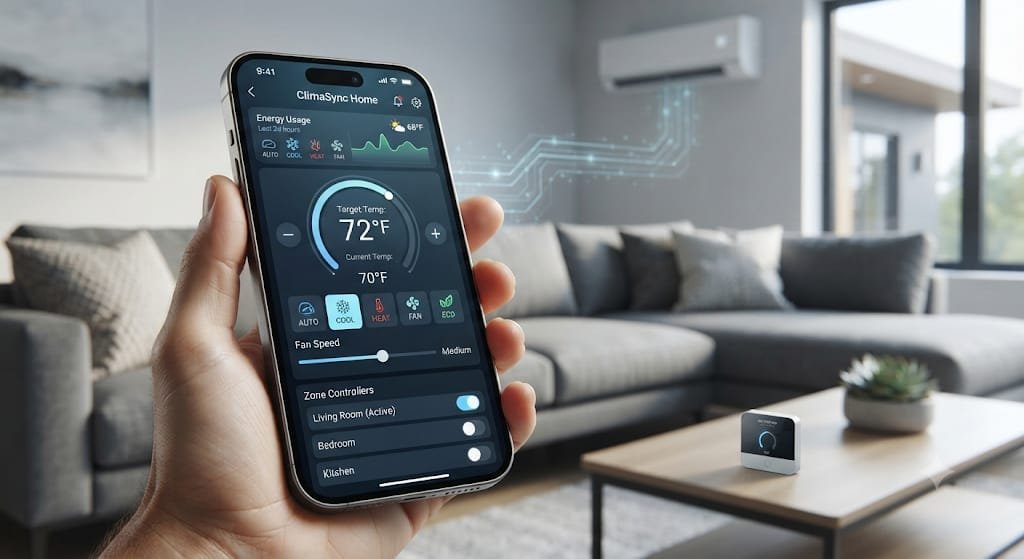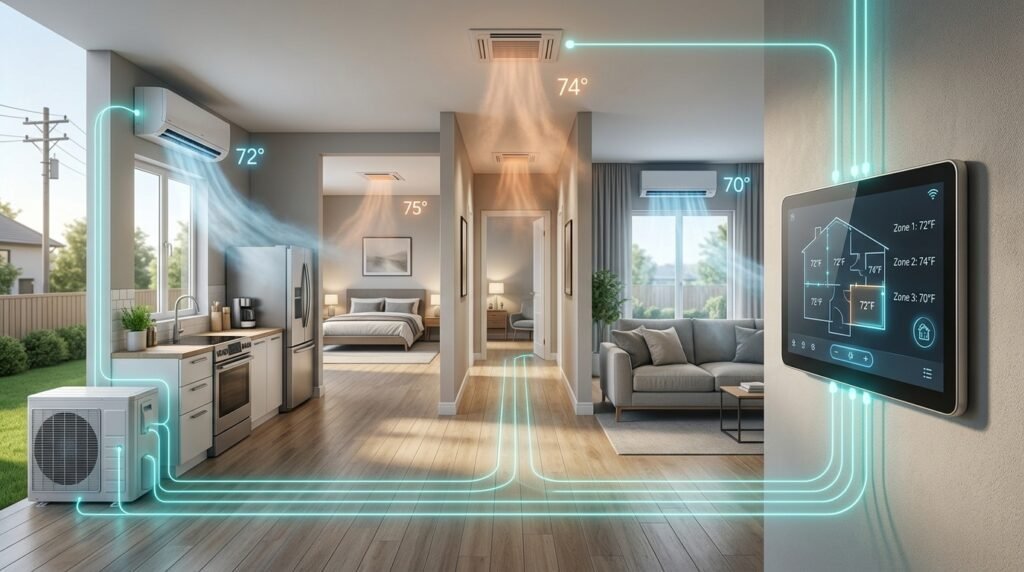
A comfortable home doesn’t need to have the same temperature in every room. Bedrooms, living areas, kitchens, upper floors, and sun-facing rooms often have different heating and cooling needs. A smart zone climate controller helps manage these differences by coordinating thermostats, temperature sensors, HVAC equipment, dampers, and automation for more personalized comfort.
Instead of treating your entire home as one temperature zone, a smart zoning system allows compatible areas to be controlled independently. However, the right setup depends on your HVAC equipment, ductwork, number of zones, sensor placement, wiring, and system compatibility.
The key is understanding that a smart zone climate controller is usually an integrated ecosystem rather than one universal device. The correct configuration depends on your HVAC equipment, ductwork, number of zones, sensors, wiring, and supported control technologies.
This guide explains the 10 essential systems that make precise home temperature management possible, how they work together, what to look for, and how branded solutions such as the Carrier Infinity System, Lennox iComfort S30/S40 family, and Daikin FIT multi-zone solutions fit into the broader picture.
We may link to relevant HVAC equipment, smart-home devices, sensors, and related product categories to help you explore potential options. Product prices, availability, specifications, and seller information may change, so verify current details before purchasing. Our recommendations should be evaluated based on compatibility, features, and your specific home requirements.
Affiliate Disclosure: This article contains affiliate links. If you purchase through qualifying links, SmartAirHQ may earn a commission at no additional cost to you.
What Is a Smart Zone Climate Controller?
A smart zone climate controller is a coordinated temperature-management system designed to give different areas of a home more individualized control. Instead of relying on one thermostat to represent the entire house, a zoning system can use multiple temperature readings and control points to determine where heating or cooling is needed. Depending on the installation, this may involve a central controller, room sensors, motorized dampers, communicating HVAC equipment, or separate indoor units.
The main advantage is better alignment between the HVAC system and how people actually use the home. A guest room may need less conditioning while a frequently occupied living room needs more attention. A second floor may also require a different schedule from the first floor. Smart zoning can account for these differences instead of treating the entire home as one uniform space.
ENERGY STAR notes that temperature and occupancy sensors can help address temperature differences between rooms and prioritize occupied areas in compatible smart-thermostat systems.
In simple terms:
Sensors measure → controller interprets → HVAC equipment responds → zones receive appropriate conditioning.
This coordination is what distinguishes a more advanced climate-management strategy from a basic programmable thermostat.
Smart Zone Climate Controller at a Glance
| Component | Main Function |
|---|---|
| Temperature sensors | Measure conditions in individual areas |
| Controller | Processes temperature and system information |
| Thermostats | Allow users to set and adjust temperature targets |
| Motorized dampers | Regulate airflow to different ducted zones |
| HVAC equipment | Provides heating or cooling |
| Automation | Adjusts operation based on schedules, sensors, or occupancy |
This combination can improve comfort and control, but the exact setup and compatibility vary by HVAC system, ductwork, equipment, and zoning design.
The 10 Essential Systems Behind Precise Home Temperature Management
The term smart zone climate controller may sound like a single product, but precise home temperature management typically relies on several interconnected systems. Some homes may need most of these components, while others may require only a few. The goal is not to install the maximum number of devices but to ensure that each component works together correctly.
A well-designed zoning system should begin with the home’s actual comfort problems. If a single thermostat is poorly positioned, relocating it or using a compatible remote sensor may solve the issue without requiring extensive zoning equipment. However, persistent floor-to-floor temperature differences, multiple occupied areas, or complex HVAC layouts may justify a coordinated zoning approach.
The following 10 essential systems cover the major components and technologies to evaluate when planning a more precise home temperature-management setup. Each system serves a specific purpose, and compatibility between components is essential for reliable operation, comfort, and potential energy savings.
1. Smart Thermostat or Central Climate Controller
A central thermostat or climate controller serves as the primary interface for managing a home’s heating and cooling system. It allows homeowners to set temperature targets, schedules, operating modes, and other comfort preferences. In a zoned installation, the controller may also coordinate information from room sensors, thermostats, and zone-control equipment.
The most important consideration is compatibility—not touchscreen size or the number of app features. Smart thermostats must work with the home’s heating and cooling equipment, particularly when the system uses variable-speed technology, multiple stages, heat pumps, or zoning controls.
Before purchasing a controller, verify the following:
- HVAC system type
- Heating and cooling stages
- Heat-pump configuration, if applicable
- Communicating versus conventional controls
- Required wiring
- Sensor compatibility
- Zoning capabilities
- Internet and app requirements
Best use: Choose the central controller as part of a compatible HVAC system rather than treating it as an isolated smart-home gadget.
🛒 Explore Smart Thermostats on Amazon
Browse Smart Thermostats on Amazon
2. Room Temperature Sensors
Room temperature sensors provide additional information from locations that may experience different conditions from the room containing the main thermostat. They can be useful in bedrooms, offices, upper floors, and frequently occupied areas where the primary thermostat may not accurately represent comfort conditions.
A sensor does not automatically create a complete HVAC zone. Its usefulness depends on how the compatible controller processes the information. Some systems can consider temperature readings, schedules, and occupancy data to support more targeted temperature management.
When choosing room sensors, consider:
- Installation and placement
- Wireless or wired connectivity
- Battery requirements
- Temperature accuracy
- Occupancy detection
- Compatibility with the controller
- Whether individual rooms can be prioritized
Position sensors where they can accurately measure the room conditions you want to monitor. Avoid placing them directly beside heat sources, in strong sunlight, or in unusually drafty locations.
Best use: Room sensors can help identify temperature differences and improve monitoring, but their control capabilities depend on the compatible thermostat or zoning system.
🛒 Explore Room Temperature Sensors on Amazon
Browse Room Temperature Sensors on Amazon
3. Zoning Control Panel
A zoning control panel coordinates multiple areas of a home’s HVAC system. In a traditional ducted zoning installation, it helps manage separate zones by coordinating thermostats or sensors, motorized dampers, and compatible HVAC equipment.
This is one of the key components in a ducted zoning system because the panel must work with the equipment and control configuration. A poorly matched panel can prevent reliable operation or limit the system’s intended functionality.
The Carrier Infinity System provides an example of a manufacturer-specific approach. Carrier offers compatible Infinity controls and zoning components designed to work within its supported HVAC ecosystem. Exact capabilities depend on the equipment, control model, and installation configuration.
The practical lesson is simple: A zoning control panel should be selected as part of a compatible HVAC system, not as an independent accessory.
Before purchasing, verify the control panel’s compatibility with the HVAC equipment, thermostats, dampers, and number of planned zones.
🛒 Explore HVAC Zone Control Equipment on Amazon
Browse HVAC Zone Control Equipment on Amazon
4. Motorized Zone Dampers
In ducted HVAC systems, motorized dampers help regulate airflow to individual zones. Depending on the control system’s design, dampers can open or close to direct conditioned air toward areas that require heating or cooling.
The damper is the physical link between control decisions and airflow management. A controller may detect that one room needs conditioning, but the system must also have an appropriate way to direct air while maintaining safe and suitable operating conditions.
Proper damper sizing, placement, and installation are important. An unsuitable zoning design can contribute to airflow restrictions, pressure problems, noise, uneven comfort, or excessive equipment cycling. For this reason, zoning should be designed around the ductwork and HVAC equipment rather than added without evaluating the existing system.
When discussing a zoning project with an HVAC professional, ask how the system will maintain appropriate airflow when only one or two zones require heating or cooling.
🛒 Explore Motorized HVAC Dampers on Amazon
Browse Motorized HVAC Dampers on Amazon
5. Variable-Speed HVAC Equipment
A zoning system may offer greater flexibility when the HVAC equipment can adjust its capacity to changing heating and cooling demands. Variable-speed or variable-capacity equipment can be relevant when different zones have changing requirements throughout the day.
However, zoning and HVAC equipment capacity should be evaluated together. If a small zone requests conditioning while the equipment is designed to serve the entire home, closing dampers alone does not automatically resolve the capacity or airflow mismatch.
The controller, ductwork, and HVAC equipment must operate within compatible control, airflow, and capacity limits. This is why homeowners should evaluate the complete system rather than choosing a smart controller separately from the furnace, air conditioner, or heat pump.
Before planning an upgrade, ask a qualified HVAC professional how the equipment will operate when only the smallest zone requests heating or cooling.
🛒 Explore HVAC Control Accessories on Amazon
Browse HVAC Control Accessories on Amazon
6. Multi-Zone Ductless Systems
Not every home needs traditional ductwork-based zoning. A multi-zone ductless mini-split system uses multiple indoor units connected to a compatible outdoor unit, allowing different areas of a home to receive individualized heating or cooling.
This approach can be useful for home additions, converted spaces, rooms without convenient ductwork, or properties where different areas have substantially different comfort requirements.
Daikin offers multi-zone systems designed to serve multiple indoor spaces through compatible equipment and controls. However, available features and independent temperature-control capabilities depend on the specific system configuration.
The important distinction is that ducted zoning and ductless multi-zone systems address similar comfort challenges through different HVAC designs. Choosing between them depends on the building layout, installation requirements, aesthetics, existing equipment, and professional HVAC assessment.
Best use: Consider ductless multi-zone systems when extending ductwork is impractical or when separate indoor units suit the home’s layout.
🛒 Explore Multi-Zone Mini-Split Accessories on Amazon
Browse Multi-Zone Mini-Split Accessories on Amazon
7. Communicating HVAC Controls
Communicating HVAC systems allow compatible equipment and controls to exchange operating information beyond the basic on/off signals used by conventional thermostat arrangements. Depending on the system, this can support more coordinated equipment operation and control functions.
This architecture is relevant when evaluating manufacturer-specific systems such as the Carrier Infinity System and Lennox iComfort S40. These ecosystems are designed around compatible equipment and accessories rather than functioning as universal thermostats that operate identically with every HVAC brand.
Lennox identifies the S40 as the successor to the iComfort S30. Homeowners replacing an older controller should verify current compatibility, available support, and equipment requirements before making a purchase.
The practical lesson is straightforward: A communicating HVAC controller should be selected according to the manufacturer’s supported system configuration.
Before upgrading, confirm equipment compatibility, wiring requirements, available features, and whether professional installation is needed.
🛒 Explore Smart HVAC Controllers on Amazon
Browse Smart HVAC Controllers on Amazon
8. Humidity and Indoor Comfort Monitoring
Temperature is only one part of indoor comfort. Humidity can affect how a room feels, even when the thermostat displays the desired temperature. A more complete climate-management strategy may therefore monitor humidity alongside temperature.
However, not every home requires dedicated humidity-control equipment. Before purchasing additional devices, identify whether the underlying issue involves temperature, humidity, airflow, insulation, or a combination of factors.
Some manufacturer HVAC ecosystems support humidity-related controls and equipment integration. Carrier, for example, offers comfort-management features within compatible Infinity system configurations. Available capabilities depend on the specific equipment and controls.
Best use: Use humidity monitoring to better understand indoor conditions before deciding whether additional humidity-control equipment is necessary.
🛒 Explore Indoor Humidity Sensors on Amazon
Browse Indoor Humidity Sensors on Amazon
9. Indoor Air Quality and Ventilation Integration
Modern home-comfort systems can extend beyond temperature management to include indoor air quality and ventilation. These functions are related to overall comfort, but they are not the same as the primary purpose of temperature zoning.
Compatible equipment and control platforms may provide access to additional comfort information or air-quality features. Lennox, for example, offers products within its broader home-comfort ecosystem, including compatible sensors and air-quality monitoring options.
For homeowners evaluating a smart zone climate controller, an important question is whether they need temperature management alone or a broader indoor-comfort platform.
If indoor air quality is a priority, consider which pollutants or conditions need monitoring and whether the selected equipment measures them. A temperature controller should not automatically be assumed to provide comprehensive air-quality monitoring or ventilation control.
🛒 Explore Indoor Air Quality Monitors on Amazon
Browse Indoor Air Quality Monitors on Amazon
10. Wi-Fi, Remote Access, and Home Automation
Connectivity can turn a local thermostat into a more convenient home-management tool. Depending on the platform, homeowners may be able to adjust settings remotely, review temperature information, manage schedules, or connect climate controls with other smart-home functions.
However, connectivity is a supporting feature rather than the defining characteristic of a smart climate controller. A system with a polished mobile app but poor HVAC compatibility may not be suitable for a particular zoning installation.
ENERGY STAR describes features associated with smart thermostats, including remote control, scheduling, and other connected functions. Availability varies by product and system.
Reliable network connectivity also matters. A controller or sensor that frequently loses its connection may provide an inconsistent smart-home experience. Check the manufacturer’s connectivity requirements and the location of your Wi-Fi equipment before purchasing additional networking hardware.
Best use: Evaluate connectivity after confirming HVAC compatibility, control functionality, and the reliability of your home network.
🛒 Explore Wi-Fi Range Extenders on Amazon
Browse Wi-Fi Range Extenders on Amazon
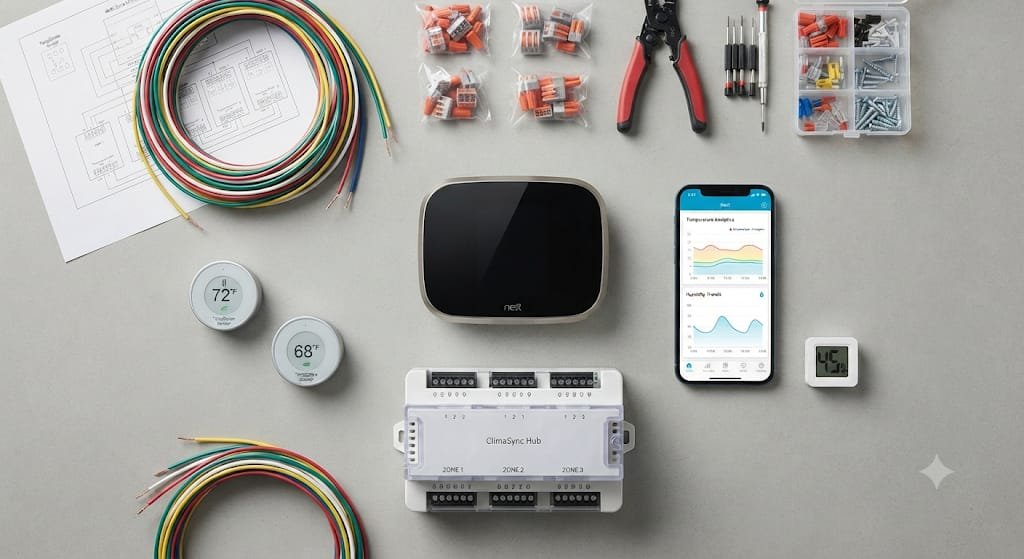
Brand Comparison: Carrier Infinity System vs. Lennox iComfort S30/S40 vs. Daikin Multi-Zone Solutions
Brand names can make HVAC shopping confusing because manufacturers use different terminology for thermostats, sensors, zoning systems, and communicating equipment. The most useful approach is to compare system architecture, compatibility, and installation requirements rather than assuming one branded controller will work with every HVAC system.
The Carrier Infinity System, Lennox iComfort family, and Daikin multi-zone solutions represent different approaches to coordinated home comfort. The correct equipment combination depends on the home’s layout, existing HVAC system, indoor and outdoor equipment, sensors, zoning components, and installation design.
Important: Daikin FIT equipment and Daikin multi-zone ductless systems should not automatically be treated as the same product architecture. Verify the exact model and supported configuration before making comparisons.
Comparison Table
| System or Ecosystem | What to Evaluate | Best Question to Ask |
|---|---|---|
| Carrier Infinity System | Compatibility between Infinity controls, sensors, zoning components, and HVAC equipment | Will all components communicate and operate as intended? |
| Lennox iComfort S30 / S40 | Existing versus new installations, equipment compatibility, sensors, and current control support | Is the controller appropriate for my specific Lennox equipment? |
| Daikin Multi-Zone Solutions | Indoor-unit requirements, outdoor-unit compatibility, controls, and room-by-room needs | Would a multi-zone system suit this home’s layout and comfort requirements? |
Carrier Infinity System
Carrier states that its Infinity System Control is designed for compatibility with Infinity equipment. Carrier also offers compatible zoning components and sensors for supported system configurations.
Lennox iComfort S30 / S40
Lennox identifies the S40 as the replacement for the S30. Homeowners with an existing S30 should distinguish between maintaining an existing installation and selecting a controller for a new project. The S40’s compatibility information should be checked against the specific HVAC equipment and accessories.
Daikin Multi-Zone Solutions
Daikin’s multi-zone approach uses compatible equipment designed to serve multiple indoor areas. The appropriate system depends on the building layout, indoor-unit requirements, control features, and installation design.
Before comparing a Daikin FIT product with a multi-zone ductless system, verify whether the equipment is designed for the same type of installation and zoning arrangement.
How to Choose the Right Smart Zone Climate Controller
Choosing the right smart zone climate controller starts with understanding the HVAC system you already have or plan to install. Purchasing a controller before confirming compatibility can create problems because some systems rely on manufacturer-specific communication protocols, sensors, zoning panels, or equipment controls.
Before purchasing anything, document your current setup. Identify the heating and cooling systems, number of stages, thermostat wiring, number of floors, rooms with comfort problems, and whether the home already has zoning dampers. If you are installing a new HVAC system, ask the contractor to explain the complete control architecture rather than quoting only the thermostat model.
8 Steps to Choose the Right Controller
- Identify the comfort problem. Determine which rooms or floors are consistently too warm or too cool.
- Map the HVAC system. Understand how air is currently distributed throughout the home.
- Determine whether zoning is necessary. Some problems may result from airflow issues, insulation, thermostat placement, or equipment sizing.
- Choose the control architecture. Consider ducted zoning, multi-zone ductless equipment, or a simpler sensor-based approach.
- Verify compatibility. Check the compatibility of every controller, sensor, damper, and HVAC component.
- Plan sensor locations. Place sensors where temperature information will be useful and representative.
- Check connectivity. Confirm that Wi-Fi or other required communication methods will work reliably.
- Arrange professional commissioning. Have the zoning system tested under different combinations of active zones to verify suitable operation.
ENERGY STAR recommends checking smart thermostat compatibility before purchasing. Variable-speed, multi-stage, and zoned HVAC systems may require additional compatibility checks and professional consideration.
What to Check Before Buying
| Requirement | Why It Matters |
|---|---|
| HVAC compatibility | Helps ensure the controller supports your equipment |
| Number of zones | Determines the required zoning capabilities |
| Sensor support | Helps establish whether additional room monitoring is possible |
| Wiring | Identifies installation requirements |
| Communication protocol | Determines compatibility between control components |
| Wi-Fi connectivity | Supports remote access and connected features |
| Professional installation | Helps ensure correct setup and system commissioning |
🛠️ Explore HVAC Tools & Repair Resources
Before starting an HVAC control or installation project, having appropriate maintenance tools and repair resources can be useful for planning and routine home upkeep.
Explore our Tools & Repair category for relevant tools and repair-related products.
🛒 Explore HVAC Thermostat Accessories on Amazon
If you are still comparing equipment categories, research compatible thermostat accessories before purchasing a specific controller. Always verify compatibility with your existing or planned HVAC system.
Browse HVAC Thermostat Accessories on Amazon
Smart Zoning Features That Actually Matter
A long list of features does not necessarily translate into better temperature control. For most homeowners, the most valuable features are the ones that improve the connection between measured room conditions and the HVAC system’s actual response.
Prioritize features according to your home’s specific needs. Room sensors can be useful when the main thermostat is located somewhere that does not represent the conditions in other areas. Occupancy detection may help when rooms have significantly different schedules. Remote access can be convenient for homeowners who frequently adjust settings, while humidity monitoring may provide additional insight when temperature alone does not explain comfort problems.
Key Features to Evaluate
- Multiple temperature sensors — Monitor conditions in different areas.
- Zone-specific temperature targets — Allow compatible zones to have different temperature settings.
- Scheduling — Automate temperature changes based on daily routines.
- Occupancy detection — Help compatible systems respond to room-use patterns.
- Remote access — Adjust settings and review information through a connected app.
- Humidity monitoring — Track another factor that can affect perceived comfort.
- Equipment diagnostics — Help identify certain system or equipment issues.
- Energy-use information — Provide additional insight into HVAC operation and consumption.
- Reliable connectivity — Support consistent communication between connected components.
- HVAC compatibility — Ensure the controller and accessories can work with the existing system.
ENERGY STAR identifies features such as scheduling, remote control, energy-related information, and sensor capabilities among functions available in connected smart thermostats. Available features vary by product and HVAC system.
The best feature is therefore not necessarily the most advanced one. It is the feature that addresses a real comfort, control, or monitoring need in your home.
Quick Feature Guide
| Feature | Most Useful When |
|---|---|
| Room sensors | Different rooms have different temperatures |
| Occupancy detection | Room usage changes throughout the day |
| Scheduling | Household routines are predictable |
| Remote access | You regularly adjust settings away from home |
| Humidity monitoring | Comfort problems may involve humidity |
| Equipment diagnostics | You want additional system-status information |
| Energy-use information | You want to understand HVAC operation |
| Reliable connectivity | Multiple connected devices are used |
Mistakes to Avoid When Setting Up Smart HVAC Zoning
Many zoning problems begin before installation. Homeowners may assume that adding several smart thermostats automatically creates independent HVAC zones, or that closing vents can accomplish the same thing as professionally designed zoning. Neither approach should be used without evaluating the HVAC system, ductwork, and equipment.
Another common mistake is choosing a controller based mainly on app features. A polished interface cannot compensate for incompatible HVAC equipment. Similarly, adding room sensors does not automatically mean that the HVAC system can independently heat or cool each room.
Avoid These Common Mistakes
- Assuming every smart thermostat works with every HVAC system
- Treating room sensors as complete zoning systems
- Adding dampers without evaluating duct airflow
- Ignoring equipment capacity when only a small zone is calling
- Installing sensors in unsuitable locations
- Choosing a controller before understanding the HVAC architecture
- Assuming Wi-Fi connectivity means HVAC compatibility
- Replacing a manufacturer-specific communicating controller with a generic thermostat without verifying compatibility
- Assuming closing supply vents is a substitute for properly designed zoning
- Ignoring professional commissioning after a zoning installation
The safest approach is to evaluate the controller, sensors, zoning hardware, ductwork, and HVAC equipment as one coordinated system. Compatibility and proper system design matter more than the number of smart features a product offers.
Safety note: HVAC zoning can affect airflow, equipment operation, and system performance. For significant modifications involving controls, dampers, wiring, or HVAC equipment, consult a qualified HVAC professional.
How to Improve Temperature Control Without Replacing the Entire HVAC System
Not every temperature imbalance requires a new HVAC installation. In many cases, the first step is understanding why the imbalance exists. A thermostat located in a hallway may not represent conditions in a bedroom, while direct sun exposure can make one room significantly warmer than another. Poor airflow, insulation, ductwork, or other building-envelope issues can also contribute to uneven comfort.
Start with measurement rather than replacement. Use compatible temperature sensors or monitoring devices to observe conditions in different rooms at different times of day. Compare those readings with thermostat settings and HVAC operating patterns. This can help determine whether the problem is isolated to one area or reflects a broader HVAC or building issue.
If the problem is limited, a compatible sensor-based smart thermostat may provide enough control. If multiple areas consistently require different temperatures, professionally designed zoning may be more appropriate. For rooms or additions without practical ductwork, a compatible multi-zone ductless system may also be worth evaluating.
Before purchasing major equipment, consider checking:
- Temperature differences between rooms
- Thermostat location
- Airflow from supply and return vents
- Insulation and obvious air-leakage issues
- Ductwork condition
- HVAC equipment capacity
- Whether the comfort problem occurs only at certain times of day
This gradual approach can help homeowners avoid purchasing expensive equipment that does not address the underlying cause.
🛒 Explore Home Temperature Monitoring Devices
Basic temperature-monitoring devices can help homeowners gather useful information before discussing a larger HVAC project.
Browse Home Temperature Monitoring Devices on Amazon
How to Set Up a Smart Zone Climate Controller for Better Comfort
A successful installation is less about connecting devices and more about commissioning the entire system correctly. Each zone should have a clear purpose, each sensor should represent a useful location, and the HVAC equipment should be capable of responding to the resulting demand.
A practical setup process looks like this:
- Define the zones. Group rooms that genuinely share similar comfort requirements.
- Identify the control point for each zone. This may be a thermostat, sensor, or compatible indoor unit.
- Confirm equipment compatibility. Verify the controller, HVAC equipment, sensors, dampers, wiring, and communication methods before installation.
- Install sensors strategically. Avoid locations affected by direct sunlight, drafts, appliances, vents, or unusual heat sources.
- Configure schedules. Base them on actual occupancy rather than creating unnecessary complexity.
- Test individual zones. Confirm that each zone responds appropriately to its own temperature requirements.
- Test multiple zones simultaneously. Make sure the HVAC equipment responds properly when several areas call for heating or cooling.
- Check low-demand operation. Confirm how the system behaves when only a small zone requires conditioning.
- Review comfort over time. Adjust schedules, sensor priorities, and temperature targets based on real observations.
Important Commissioning Checks
Before considering a zoning installation complete, verify that:
- Each thermostat or sensor reports accurate conditions.
- Dampers open and close as intended, where applicable.
- The HVAC system maintains appropriate airflow during different zone combinations.
- Heating and cooling equipment responds correctly to changing demand.
- Remote controls and schedules work as expected.
- No zone creates excessive noise, airflow restriction, or unusual system cycling.
For significant HVAC modifications involving wiring, dampers, control panels, or equipment configuration, professional installation and commissioning can help ensure the system operates within the manufacturer’s requirements.
The final step is often overlooked. A smart climate system should be treated as an adjustable control strategy, not a device that never needs refinement. Monitor comfort after installation and make gradual adjustments based on actual room conditions and household routines.
12 Amazon Shopping Categories for Smart Climate-Control Projects
The following links are organized as broad Amazon shopping categories, not recommendations that a particular product will work with your HVAC equipment. Because compatibility varies by system, use these pages to research available options and always confirm specifications before purchasing.
1. Smart Thermostats
Browse Smart Thermostats on Amazon
2. Room Temperature Sensors
Browse Room Temperature Sensors on Amazon
3. HVAC Zone-Control Equipment
Browse HVAC Zone-Control Equipment on Amazon
4. Motorized HVAC Dampers
Browse Motorized HVAC Dampers on Amazon
5. Smart HVAC Controllers
Browse Smart HVAC Controllers on Amazon
6. Multi-Zone Mini-Split Accessories
Browse Multi-Zone Mini-Split Accessories on Amazon
7. Humidity Sensors
Browse Indoor Humidity Sensors on Amazon
8. Indoor Air-Quality Monitors
Browse Indoor Air-Quality Monitors on Amazon
9. Wi-Fi Range Extenders
Browse Wi-Fi Range Extenders on Amazon
10. HVAC Thermostat Accessories
Browse HVAC Thermostat Accessories on Amazon
11. Home Temperature Monitoring Devices
Browse Home Temperature Monitoring Devices on Amazon
12. Smart-Home Climate-Control Accessories
Browse Smart-Home Climate-Control Accessories on Amazon
Before purchasing, verify the exact model, voltage, wiring requirements, communication protocol, HVAC compatibility, and installation requirements. Some products may require professional installation or may only work within a specific manufacturer’s ecosystem.
Affiliate disclosure: This article contains affiliate links. If you purchase through qualifying links, SmartAirHQ may earn a commission at no additional cost to you.
Where to Research Smart Home Climate-Control Options
A smart zone climate controller is only one part of a broader home-comfort strategy. For additional HVAC, air-quality, energy, and smart-home guidance, you can explore the SmartAirHQ website and browse relevant categories as your research expands.
For independent energy-efficiency guidance, the U.S. Environmental Protection Agency’s ENERGY STAR smart thermostat resources provide useful information about smart thermostat features, compatibility considerations, connected controls, sensors, installation, and certified products.
A good research process combines manufacturer documentation with independent guidance. Manufacturer information is particularly important when confirming compatibility because branded HVAC control systems can have equipment-specific requirements. Independent resources can then help you compare features, understand installation considerations, and evaluate whether a particular approach fits your home’s needs.
Smart Zone Climate Controller FAQ
The most common questions about smart zoning usually come down to one issue: whether a homeowner needs a complete zoning system or simply better temperature sensing and scheduling. The answer depends on the home’s layout, HVAC architecture, comfort problems, and budget. The questions below address the practical issues that matter most before purchasing or installing a controller.
Is a smart zone climate controller the same as a smart thermostat?
Not necessarily. A smart thermostat can control heating and cooling and may use sensors, schedules, occupancy information, or remote access. A complete smart zoning system can involve additional equipment such as a zoning panel, motorized dampers, multiple sensors, or separate indoor units. The thermostat may serve as the user interface, while the broader zoning system provides the physical and control infrastructure.
Can one smart thermostat control multiple rooms?
It depends on the system. A thermostat with remote temperature sensors may use readings from several locations to make better control decisions, but that does not automatically mean each room has an independently controlled HVAC zone. True multi-zone control generally requires compatible zoning equipment or separate indoor units designed to provide independent conditioning.
Are Carrier Infinity and Lennox iComfort systems universal?
No. Manufacturer-specific communicating systems should not be treated as universal controllers. Carrier describes its Infinity System Control as designed for compatible Infinity equipment, while Lennox identifies the S40 as a controller for compatible Lennox communicating equipment. Always check the exact HVAC model numbers and the manufacturer’s current compatibility information before changing controls.
Is the Lennox iComfort S30 still relevant?
The S30 remains relevant for homeowners who already have one, while Lennox identifies the S40 as its replacement. Existing S30 owners should distinguish between maintaining their current system and selecting equipment for a new installation. Check current Lennox support documentation and compatibility information before replacing an existing controller.
Does zoning automatically reduce energy costs?
Not automatically. Zoning can allow a home to condition areas according to occupancy and demand, but actual energy performance depends on the HVAC equipment, controls, building characteristics, settings, weather, and installation. A poorly designed zoning system can also create airflow or equipment-operation problems. The objective should be appropriate comfort and control, with energy performance evaluated as part of the complete system design.
Should I install a smart thermostat myself?
Some basic thermostat installations may be suitable for experienced homeowners, but compatibility becomes more complicated with variable-speed, multi-stage, communicating, or zoned HVAC equipment. For complex systems, professional installation and commissioning can help ensure that the controller, sensors, zoning components, and HVAC equipment operate correctly together.
What is the most important feature in a smart climate controller?
Compatibility is more important than any individual smart feature. A controller should work correctly with the HVAC equipment, sensors, zoning components, and communication system in the home. Once compatibility is established, features such as room sensing, scheduling, occupancy detection, remote access, humidity monitoring, and diagnostics can be evaluated according to the homeowner’s actual needs.
Final Thought: Build the Climate-Control System Around the Home
A smart zone climate controller should be selected based on the home’s actual comfort needs, HVAC architecture, and compatibility requirements—not simply the length of its feature list. The goal is to create a control system that accurately understands temperature differences and coordinates the HVAC equipment appropriately.
For some homes, that may mean a smart thermostat with strategically placed room sensors. Others may benefit from a complete ducted zoning system with a central control panel and motorized dampers. Homes without suitable ductwork may be better candidates for a compatible multi-zone ductless approach.
Branded ecosystems such as the Carrier Infinity System, Lennox iComfort S30/S40, and Daikin multi-zone solutions demonstrate why compatibility and system design matter when selecting climate-control equipment.
Before buying, start with the problem:
Which rooms are uncomfortable? Why are they uncomfortable? And what does the existing HVAC system need to change?
Once those questions are answered, selecting the appropriate sensors, controller, zoning equipment, and HVAC architecture becomes much easier. For complex installations, professional assessment and commissioning can help ensure that the complete system operates as intended.
Smart Zone Climate Controller: Better Home Comfort
A smart zone climate controller can help manage temperature differences throughout your home by coordinating compatible thermostats, room sensors, zoning controls, motorized dampers, and multi-zone HVAC systems. Understanding how these technologies work together can help you create more precise, comfortable, and efficient home temperature control.
For More Precise Home Comfort
Explore more HVAC, smart-home, energy, and indoor-comfort guides at SmartAirHQ.com.