Climate control boosts poultry farm productivity by helping poultry farmers manage temperature, ventilation, humidity, and air quality more effectively. A well-managed poultry-house environment can support bird welfare, environmental consistency, and efficient farm management.
Poultry farming depends on more than quality feed, clean water, and healthy birds. The environment inside a poultry house plays an important role in bird comfort, growth, feed efficiency, and overall farm performance.
Temperature fluctuations, excessive humidity, poor ventilation, and heat stress can create challenges for poultry farmers. A properly designed climate-control system helps farmers monitor and manage these conditions according to the birds’ age, housing design, and production requirements.
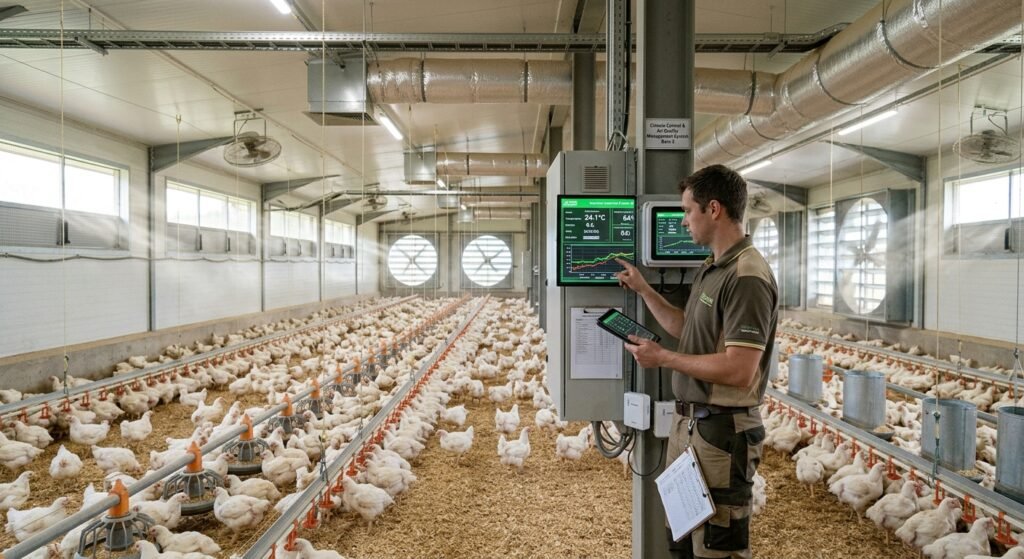
From ventilation fans and temperature sensors to automated environmental controllers, modern poultry farms can use climate-control technology to improve environmental management.
In this guide, you’ll learn how climate control improves poultry farm productivity, which systems matter most, how to monitor poultry-house conditions, and how smart technology can support more efficient farm management.
Affiliate Disclosure: This article may contain affiliate links. If you purchase through qualifying links, SmartAirHQ may earn a commission at no additional cost to you. We recommend evaluating equipment based on your farm’s requirements, compatibility, and manufacturer guidance.
Climate Control Boosts Poultry Farm Productivity by helping farmers manage temperature, ventilation, humidity, and air quality more effectively.
Effective ventilation is one of the key ways Climate Control Boosts Poultry Farm Productivity, particularly when poultry houses require better airflow and heat management.
Proper environmental monitoring also shows how Climate Control Boosts Poultry Farm Productivity through more consistent temperature and humidity management.
Climate Control Boosts Poultry Farm Productivity
Climate control in poultry farming refers to managing the environmental conditions inside poultry housing to support bird health, comfort, and production performance.
The main elements include:
- Temperature
- Relative humidity
- Ventilation and air movement
- Air quality
- Heating and cooling
- Moisture management
- Environmental monitoring
The specific settings depend on the type of poultry, bird age, stocking density, building design, and local climate.
For example, newly hatched chicks have different environmental needs from mature birds. A climate-control strategy that works for adult layers may not be appropriate for brooding chicks.
The University of Georgia Extension identifies temperature, humidity, ventilation, and air quality as important factors in brooding management and poultry performance.
Why Climate Control Matters for Poultry Farm Productivity
Climate control can influence productivity through several connected factors.
1. Supports Healthy Bird Growth
Birds need suitable environmental conditions to grow and maintain normal physiological functions.
When temperatures become unsuitable, birds may spend more energy coping with environmental stress rather than maintaining normal production performance.
During brooding, inadequate environmental management can contribute to poorer growth, feed conversion, and increased health challenges.
2. Helps Manage Heat Stress
Heat stress occurs when birds cannot effectively lose enough body heat.
As temperatures rise, birds may pant, increase water consumption, and reduce feed intake. Severe heat stress can lead to mortality.
Providing appropriate ventilation, cool drinking water, and suitable cooling strategies can help reduce heat-related risks.
3. Improves Air Quality
Poultry-house ventilation helps remove moisture, carbon dioxide, ammonia, dust, and other contaminants.
Poor ventilation can allow unwanted gases and moisture to accumulate, potentially affecting bird welfare and performance.
4. Supports Better Litter Management
Humidity and ventilation influence litter moisture.
Excessively wet litter can contribute to ammonia production and other housing-management problems. Managing moisture through ventilation, drinker maintenance, and appropriate litter practices is therefore important.
5. Helps Farmers Make Better Decisions
Sensors and environmental controllers can provide information about temperature, humidity, and other conditions.
This allows farmers to identify changing conditions and respond more systematically instead of relying only on occasional manual observations.
Poultry House Temperature and Humidity Management
The following table provides general management considerations, not universal temperature prescriptions. Actual targets should be established using bird age, breed, production type, housing conditions, and qualified poultry-management guidance.
Poultry House Climate Management
| Poultry Stage / Condition | Climate-Control Focus | What Farmers Should Monitor |
|---|---|---|
| Newly hatched chicks | Appropriate brooding warmth | Chick behavior, floor temperature, air temperature |
| Growing broilers | Temperature adjustment and ventilation | Bird distribution, panting, feed and water intake |
| Adult laying hens | Stable environmental conditions | Temperature, humidity, air quality, production performance |
| Hot weather | Heat-stress prevention | Air movement, temperature, humidity, water availability |
| Cold weather | Moisture removal without chilling | Minimum ventilation, litter moisture, bird comfort |
| High-humidity conditions | Moisture management | Relative humidity, wet litter, condensation, ventilation |
Why this matters: Poultry climate control should be adjusted to actual flock conditions. A single temperature number cannot adequately manage every poultry house.
How Temperature Affects Poultry Productivity
Temperature is one of the most important environmental variables in poultry housing.
Birds produce body heat, and the housing environment affects how effectively they can maintain their body temperature.
During Brooding
Young chicks are particularly vulnerable to unsuitable temperatures because their ability to regulate body temperature is not fully developed.
Farmers should monitor:
- Air temperature
- Floor temperature
- Chick distribution
- Activity and feeding behavior
- Signs of chilling or overheating
Poor brooding management can affect chick development and later flock performance.
During Hot Weather
High temperatures can increase the risk of heat stress.
Useful management measures may include:
- Adequate airflow at bird level
- Appropriate ventilation capacity
- Reliable water availability
- Cooling systems suited to local conditions
- Monitoring temperature and humidity together
During Cold Weather
Cold-weather ventilation must balance fresh-air exchange with heat retention.
Reducing ventilation excessively can allow moisture and contaminants to accumulate. Conversely, poorly directed incoming air may create chilling or uneven environmental conditions.
The Role of Ventilation in Poultry Farm Productivity
Ventilation is more than simply bringing fresh air into a poultry house.
An effective ventilation system should help:
- Supply fresh air.
- Remove excess moisture.
- Control heat buildup.
- Reduce the accumulation of unwanted gases.
- Distribute air appropriately throughout the house.
The ventilation design depends on building size, climate, bird numbers, equipment, and production system.
Natural Ventilation
Natural ventilation uses openings and environmental airflow to exchange air.
It may be suitable for some poultry housing designs, but performance can depend heavily on outdoor weather and building configuration.
Mechanical Ventilation
Mechanical systems use fans and air inlets to control air movement.
They can provide more structured airflow management, particularly in enclosed or controlled poultry houses.
Tunnel Ventilation
Tunnel ventilation moves air through the poultry house, often using multiple fans and carefully designed air inlets.
It may be used in hot-weather management systems, but its effectiveness depends on complete system design, maintenance, and operating conditions.
Climate-Control Systems and Their Productivity Benefits
Poultry Climate-Control Equipment
| Climate-Control System | Main Function | Potential Productivity Benefit |
|---|---|---|
| Ventilation fans | Move and exchange air | Supports air quality and heat management |
| Temperature sensors | Measure environmental temperature | Helps identify unsuitable conditions |
| Humidity sensors | Track relative humidity | Supports moisture-management decisions |
| Environmental controllers | Automate selected equipment responses | Helps maintain more consistent operating conditions |
| Heating systems | Provide warmth when needed | Supports appropriate brooding and cold-weather management |
| Evaporative cooling | Uses water evaporation to cool incoming air | May support heat management under suitable conditions |
| Air inlets | Direct incoming air | Supports appropriate airflow distribution |
| Backup power systems | Maintain critical equipment during outages | Can reduce risks associated with equipment failure |
Note: Actual benefits depend on equipment sizing, installation, maintenance, environmental conditions, and correct operation. No individual system guarantees improved productivity.
How Humidity Control Improves Poultry House Conditions
Humidity affects how birds lose heat and how moisture behaves inside the poultry house.
Both excessively high and excessively low relative humidity can create management challenges.
High Humidity
Excess humidity can contribute to:
- Wet litter
- Increased moisture accumulation
- Ammonia-related challenges
- Reduced effectiveness of some cooling approaches
Low Humidity
Very dry conditions may contribute to dusty environments.
Dust management is important because poultry-house air quality affects both bird welfare and workers’ environmental exposure.
Why Sensors Matter
A humidity sensor can help farmers identify changes that may not be obvious through visual inspection alone.
However, sensor readings should be interpreted alongside:
- Litter condition
- Bird behavior
- Air temperature
- Ventilation operation
- Water-system performance
Signs of Poor Climate Control in a Poultry Farm
Recognizing environmental problems early can help farmers investigate and respond appropriately.
Potential warning signs include:
- Birds panting during hot conditions
- Birds clustering together during cold conditions
- Uneven distribution throughout the house
- Wet or caked litter
- Excessive dust
- Unusual ammonia odor
- Condensation on building surfaces
- Uneven temperature readings
- Ventilation equipment operating inconsistently
These signs do not always identify a single cause. Farmers should investigate environmental measurements, equipment condition, flock health, and management practices together.
If birds show severe distress or mortality, contact a qualified poultry veterinarian or relevant animal-health professional promptly.
Smart Climate-Control Technology for Poultry Farms
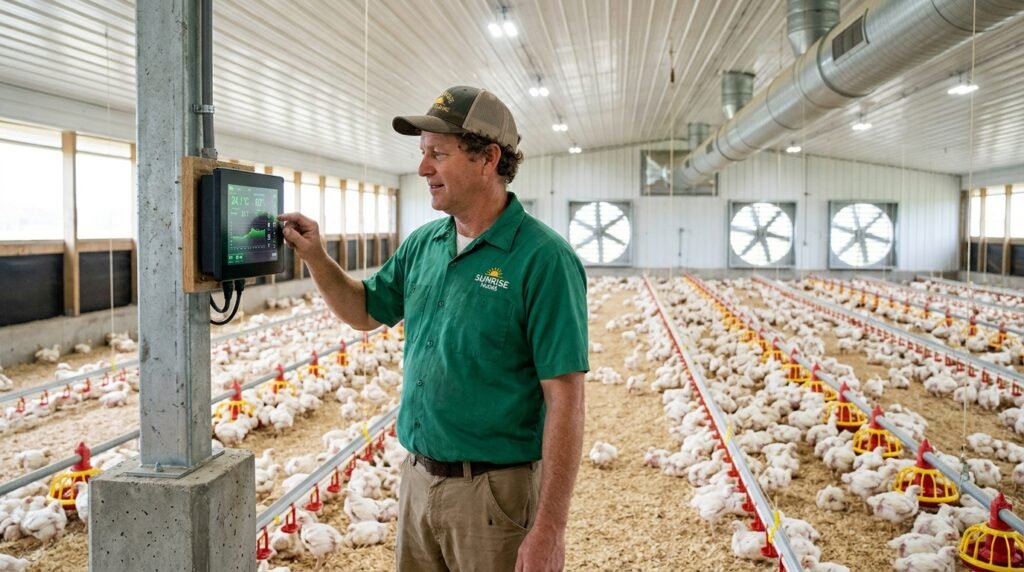
Modern environmental monitoring systems can help farmers collect information and respond to changing conditions.
Depending on the system, smart poultry-house technology may include:
- Temperature sensors
- Relative humidity sensors
- Ammonia monitoring
- Automated fan control
- Heating and cooling control
- Environmental alerts
- Data logging
- Backup alarms
How Automated Controllers Work
A typical environmental controller receives information from sensors and uses configured settings to control compatible equipment.
For example:
- A temperature sensor detects changing conditions.
- The controller compares the reading with the configured target.
- The controller activates or adjusts compatible equipment.
- The farmer monitors the result and checks flock conditions.
The exact operation depends on the equipment and control strategy.
Important: Automation should support, not replace, regular inspections and responsible farm management.
Benefits of Data Monitoring
Environmental records may help farmers:
- Identify recurring temperature fluctuations
- Review equipment performance
- Compare conditions across production periods
- Detect potential problems earlier
- Improve maintenance planning
The value of monitoring depends on sensor accuracy, correct installation, data interpretation, and timely action.
How Climate Control Can Improve Feed Efficiency
Feed efficiency is an important economic consideration in poultry production.
Environmental stress can affect bird behavior, feed intake, and production performance. For example, heat stress is associated with reduced feed intake in poultry.
Maintaining appropriate environmental conditions may help support normal feeding behavior and growth.
However, climate control alone does not guarantee improved feed conversion or lower feed costs. Results depend on many factors, including:
- Genetics
- Feed quality
- Bird health
- Water availability
- Stocking density
- Environmental management
- Farm operating practices
Farmers should evaluate climate-control investments using actual production records rather than assuming a fixed percentage improvement.
Climate Control and Poultry Farm Energy Efficiency
Climate-control systems consume energy, particularly fans, heaters, cooling equipment, and automated systems.
An efficient approach balances environmental requirements with responsible energy use.
Ways to Evaluate Energy Performance
Farmers can monitor:
- Electricity consumption
- Heating-fuel consumption
- Fan operating hours
- Equipment maintenance
- Environmental conditions
- Production performance
A system that reduces energy use but compromises bird welfare or air quality is not necessarily an appropriate improvement.
Smart Energy Monitoring Opportunity
Smart energy monitors may help farm operators understand equipment electricity consumption.
For example, monitoring electricity use by ventilation equipment can support maintenance and energy-management decisions.
Affiliate opportunity for SmartAirHQ: Relevant energy-monitoring equipment can be evaluated where the product is genuinely suitable for agricultural applications. Avoid recommending ordinary household devices for industrial farm environments without confirming their specifications and safety suitability.
How to Choose a Climate-Control System for a Poultry Farm
Choosing a system requires more than selecting the cheapest fan, sensor, or controller.
Consider the following factors.
1. Farm Size and Bird Capacity
The system should be appropriate for the building’s dimensions, bird population, and ventilation requirements.
2. Local Climate
Outdoor temperature, humidity, seasonal conditions, and weather patterns influence climate-control needs.
3. Poultry Type and Age
Broilers, layers, breeders, and young chicks have different management requirements.
4. Equipment Compatibility
Check whether sensors, controllers, fans, and other components work together correctly.
5. Maintenance Requirements
Consider cleaning, inspection, replacement parts, and service availability.
6. Backup Systems
Critical environmental equipment may require backup power, alarms, or emergency procedures appropriate to the farm.
7. Operating Costs
Evaluate installation costs, electricity consumption, maintenance, and expected service life.
13 Potential Product and Affiliate Opportunities for SmartAirHQ
These are potential product categories to investigate, not a recommendation to purchase every item. Each category should be relevant to the article’s audience and supported by appropriate product selection.
Potential Product Categories
SmartAirHQ may recommend relevant poultry climate-control products and equipment to help farmers evaluate suitable solutions for their specific needs.
1. Poultry-House Temperature Sensors
Monitor temperature conditions inside poultry houses to help maintain a more consistent environment for birds.
HOPOCO 200W Chicken Coop Heater Compatible with Timers & Temp Controllers 🛍️ Shop: Poultry Temperature Sensors on Amazon
UL-certified Inside Radiant Pet Warmer, Auto Shutoff, Mounting Flexibility, Remote Control, Safe Winter Warmth, Black
2. Relative Humidity Meters
Track indoor humidity levels and identify conditions that may contribute to moisture, litter, or bird-comfort problems.
🔎 Find Explore Humidity Meters on Amazon Temp-Pro Temp-Air Digital Hygrometer Indoor Thermometer Humidity Monitor
Humidity Meter Room Thermometer Humidity Gauge with Temperature
3. Wireless Soil Moisture Meter for Plants,4 Sensors Included, Supports 12 Zone
⭐ Explore :TDR sensors track soil moisture, temperature and sunlight up to 230 ft; Soil Moisture Meter the indoor display gives custom low-water alerts.
4. Agricultural Environmental Controllers
Automate temperature, ventilation, humidity, and other environmental functions based on configured conditions.
🏠 Find: Compare Agricultural Environmental Controllers on Amazon
5. Poultry Ventilation Fans
Support airflow and ventilation inside poultry houses, particularly during periods of increased heat or humidity.
🛒 Check : 8” Upgraded Shutter Exhaust Fan with Thermostat & Remote, 760CFM Wall Mounted Attic Exhaust Fan, Auto On/Off by Temperature for Garage, Greenhouses, Sheds, Chicken Coops & Basement Ventilation Fans on Amazon
6. Airflow Measurement Equipment
Measure airflow conditions to help evaluate ventilation performance and identify potential airflow problems.
Pro HVAC Anemometer,CFM Air Flow Meter for Wind Speed/Wind Temp/Wind Flow
Handled Wind Speed Meter 0.001~100mph with 600-Record Data LCD Backlight Max/Min/Avg AP-846A
✨ Explore : Airflow Measurement Equipment on Amazon
7. Ammonia Monitoring Equipment
Help monitor ammonia conditions in poultry-house environments and support better air-quality management.
🛒 Check Ammonia Monitoring Equipment on Amazon
8. Poultry-House Heating Equipment
Provide supplemental heat when needed, particularly during brooding and colder weather conditions.
🔗 See : 600W Chicken Coop Heater, Carbon Fiber Chicken Heater for Coop with Adjustable Heating Settings & Hanging Height (600W)Poultry Heating Equipment on Amazon
9. Evaporative Cooling Equipment
Help reduce heat inside poultry houses by supporting evaporative cooling and improved environmental management.
🛍️ Shop : Compare Evaporative Cooling Equipment on Amazon.
10. Backup Power Equipment
🔎 Find : Help keep essential climate-control and monitoring equipment operating during power interruptions.
2500W Sump Pump Battery Backup System, Pure Sine Wave Power Inverter with Charger, Backup System for Power Outage, LCD Screen Remote Controller, Automatic Switching for Grid and Battery Backup Power Solutions on Amazon.
11. Data-Logging Environmental Monitors
Record temperature, humidity, and other environmental measurements to help farmers review conditions over time.
Ethernet Server Room Temperature Monitor (Swiss Sensors) PoE Server Rack Temperature Humidity Sensor with Web Interface, SNMP Modbus MQTT Support, Dual Power, IP55, Data Logging, Alarm & Relay Output Check Environmental Data Loggers on Amazon.
12. Poultry-House Maintenance Tools
Support routine inspection, cleaning, maintenance, and troubleshooting of poultry-house equipment.
⭐ Explore : Poultry-House Maintenance Tools on Amazon
13. Energy-Monitoring Equipment Suitable for Farms
Track electricity consumption from ventilation, heating, cooling, and other farm equipment to identify energy-use patterns.
🏠 Find : Explore Energy Monitoring Equipment on Amazon
How SmartAirHQ Can Help You Find the Right Poultry Climate-Control Products
SmartAirHQ may recommend relevant poultry climate-control products, comparison guides, and educational resources to help farmers evaluate equipment for their specific needs.
Potential resources may include:
- Product comparison guides
- Relevant affiliate product recommendations
- Educational buying guides
- Manufacturer and technology resources
- Sponsored product reviews with clear disclosures
Important: Product availability, specifications, compatibility, and affiliate eligibility should always be verified before making a recommendation. Household products should not be presented as professional poultry-farm equipment unless they are specifically designed and rated for the intended application.
How SmartAirHQ Can Help You Find the Right Poultry Climate-Control Products
SmartAirHQ may recommend relevant poultry climate-control products, comparison guides, and educational resources to help farmers evaluate equipment for their specific needs.
Potential resources may include:
- Product comparison guides
- Relevant affiliate product recommendations
- Educational buying guides
- Manufacturer and technology resources
- Sponsored product reviews with clear disclosures
Important: Product availability, specifications, compatibility, and affiliate eligibility should always be verified before making a recommendation. Household products should not be presented as professional poultry-farm equipment unless they are specifically designed and rated for the intended application.
Recommended Internal Links
Where relevant, connect this article to other SmartAirHQ resources using natural anchor text:
- Smart Energy Monitor Buying Guide → https://smartairhq.com/smart-energy-monitor-buying-guide/
- Climate Control → https://smartairhq.com/category/climate-control/
- SmartAirHQ → https://smartairhq.com/
Only add an internal link when the destination genuinely helps the reader. Additional poultry-specific articles can be linked here as the site develops more topical coverage.
Frequently Asked Questions
1. How does climate control improve poultry farm productivity?
Climate control helps manage environmental conditions such as temperature, humidity, and ventilation. Appropriate management can support bird welfare, air quality, and production performance.
2. Why is ventilation important in poultry farming?
Ventilation supplies fresh air and helps remove excess moisture, heat, and unwanted gases. The required ventilation strategy depends on the housing system and flock conditions.
3. Can climate control reduce poultry heat stress?
Appropriate ventilation, airflow, cooling strategies, and water management can help reduce heat-stress risks. The effectiveness depends on local conditions and system design.
4. What sensors are useful for poultry-house climate monitoring?
Temperature and relative humidity sensors are common monitoring tools. Some farms may also use ammonia and other air-quality monitoring equipment.
5. Is automated climate control suitable for small poultry farms?
It can be suitable for some small farms, depending on the equipment, budget, housing design, and management needs. The system should be appropriately sized and maintained.
6. Does climate control guarantee higher poultry production?
No. Climate control is one component of poultry management. Production also depends on genetics, feed, water, health, stocking density, and other factors.
7. How can farmers monitor poultry-house humidity?
Farmers can use suitable humidity sensors and combine readings with litter inspection, ventilation assessment, and observations of flock conditions.
8. How often should poultry climate-control equipment be checked?
Inspection frequency should follow manufacturer recommendations, farm operating procedures, and the importance of each system. Critical equipment may require routine checks and emergency planning.
Conclusion: Why Climate Control Matters for Poultry Farms
Climate control is an important part of modern poultry-farm management.
By managing temperature, ventilation, humidity, and air quality, farmers can support a more suitable environment for their birds. Monitoring technology and automated equipment may also help improve environmental oversight and maintenance decisions.
However, successful poultry production requires a complete management approach. Climate-control equipment should be selected and operated according to flock requirements, housing design, local conditions, and professional guidance.
For SmartAirHQ, this topic also creates opportunities to develop relevant educational resources, equipment guides, technology partnerships, and future farm-management tools.
The next step is to connect practical climate-control knowledge with reliable technology and useful resources for poultry farmers.