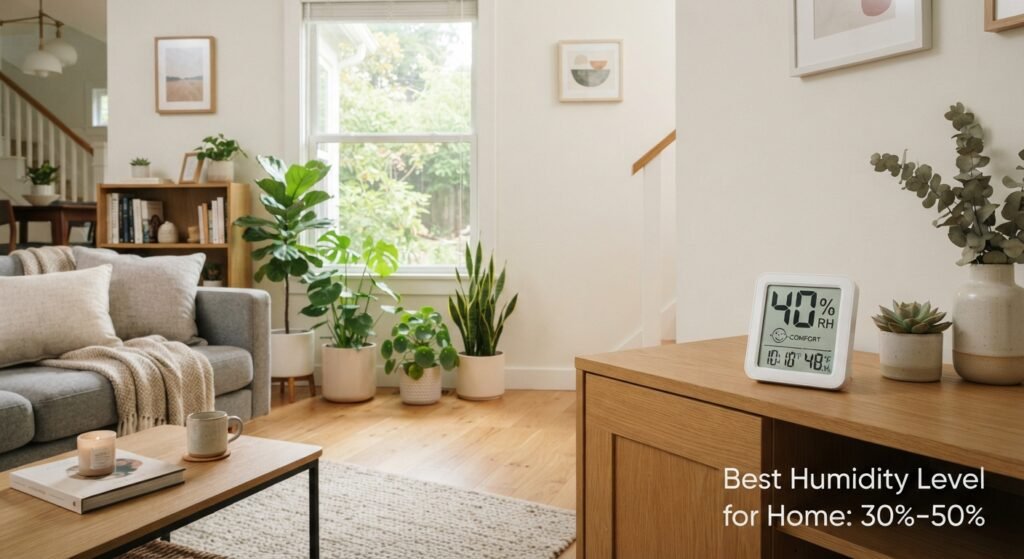
The ideal humidity level for most homes is between 30% and 50% relative humidity (RH). The U.S. Environmental Protection Agency (EPA) recommends keeping indoor humidity below 60%, ideally between 30% and 50% if possible, to help control moisture and reduce conditions that can contribute to mold growth.
If your home feels unusually dry, damp, or stuffy, indoor humidity may be contributing to the discomfort. A digital hygrometer or indoor humidity monitor can help you check your home’s RH level, while a humidifier or dehumidifier can help adjust moisture when levels are consistently too high or too low.
This guide explains the ideal humidity level for your home, how to measure relative humidity, what different humidity readings mean, and how to manage indoor air that is too dry or too humid. You’ll also learn when a humidifier, dehumidifier, or humidity-monitoring solution may be useful for maintaining a more comfortable indoor environment.
What is the best humidity level for home?
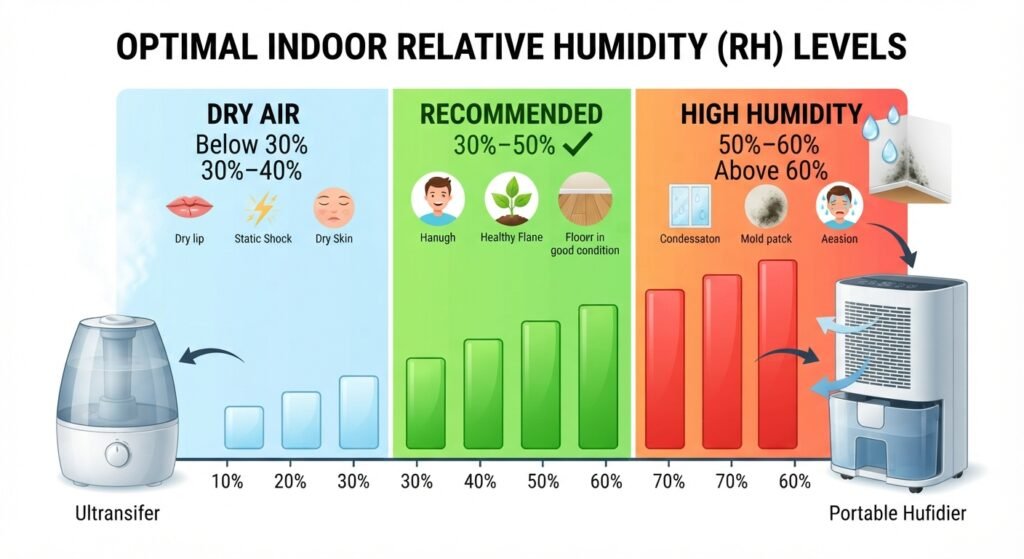
For most homes, a relative humidity level of 30% to 50% is a practical target. Relative humidity (RH) describes the amount of moisture in the air compared with the maximum amount of moisture the air can hold at a given temperature. The U.S. Environmental Protection Agency (EPA) recommends keeping indoor humidity between 30% and 50% when possible and below 60% to help manage excess moisture and conditions that can contribute to mold growth.
| Indoor Relative Humidity | What It Generally Indicates | What to Watch For |
|---|---|---|
| Below 30% | Very dry indoor air | Dryness and discomfort may become noticeable |
| 30–50% | Recommended target range | Generally suitable for managing indoor moisture |
| 50–60% | Increasingly humid | Watch for condensation and excess moisture |
| Above 60% | High indoor humidity | Greater moisture and mold-control concerns |
A digital hygrometer or smart humidity monitor can help you determine where your home falls within this range. If readings remain below or above the recommended range, you may need to consider moisture-control options such as a humidifier or dehumidifier, depending on the conditions in your home.
There is no single humidity level that feels perfect for every person or building. Indoor temperature, ventilation, outdoor weather, construction, and personal comfort can all affect how humidity feels. However, 30% to 50% RH provides a useful starting range for managing indoor moisture and maintaining comfortable indoor conditions.
Why 30% to 50% Is a Good Target
This range provides a practical balance between excessive dryness and excess moisture. Very dry conditions can make indoor air uncomfortable, while excessive moisture can contribute to condensation and create conditions that support mold growth.
The goal is not to maintain one exact number throughout the day. Indoor humidity naturally changes with weather, cooking, showering, ventilation, heating, and air conditioning. A digital hygrometer or humidity monitor can help you identify these patterns and determine whether your home actually needs additional humidification or dehumidification.
For ongoing monitoring, consider checking humidity in the rooms where moisture problems are most likely to occur, such as bedrooms, bathrooms, basements, and kitchens. Consistent readings can help you determine whether you need a temporary adjustment or a longer-term humidity-control solution.
What Is the Ideal Indoor Humidity for a House?
For most homes, an indoor humidity reading within the recommended range is generally considered comfortable and reasonable. You do not need to maintain one exact percentage throughout the day because indoor conditions naturally change with weather, cooking, bathing, heating, and air conditioning.
For example, if a humidity monitor consistently reads 42%, there is usually no reason to adjust humidity simply because the reading is not exactly 40%. An occasional reading around 52% also does not automatically indicate a serious problem.
Pay more attention to persistent high readings, visible condensation, damp surfaces, musty odors, or recurring moisture problems. These signs can indicate an underlying moisture issue that may require better ventilation, leak repair, dehumidification, or further investigation.
Normal Humidity Level Indoors
Indoor humidity naturally changes throughout the day as people shower, cook, wash dishes, dry clothes, open windows, use heating or cooling systems, and respond to outdoor weather conditions.
Because of these changes, one reading does not always represent your home’s typical moisture level. Occasional fluctuations are normal, but repeatedly elevated readings or ongoing moisture problems deserve closer attention.
A humidity monitor with historical or continuous readings can be useful when humidity changes throughout the day. Tracking patterns may help you identify whether moisture increases after showers, cooking, weather changes, or HVAC operation and whether the issue is temporary or persistent. This can help you decide whether ventilation or another moisture-control measure needs attention.
Why Indoor Humidity Levels Matter
Indoor humidity affects more than whether a room feels comfortable. Moisture in the air also influences condensation and the potential for mold growth. According to the EPA, mold control depends heavily on controlling moisture because mold spores can begin growing when they land on damp surfaces.
High humidity can also become noticeable through condensation on windows, walls, or pipes. Condensation occurs when warm, humid air contacts a sufficiently cold surface. If you repeatedly see moisture collecting indoors, check your humidity level with a reliable monitor and investigate the underlying moisture source rather than relying on appearance alone.
Low humidity creates a different indoor environment. When humidity drops too far, air can feel uncomfortably dry, particularly during periods when heating or other conditions reduce moisture indoors.
The goal is not simply to maximize or minimize humidity, but to keep moisture at a reasonable level. Persistent condensation, dampness, or excessive dryness may indicate that ventilation or moisture control needs attention.
Signs Your Home Has Too Much Humidity
Excess humidity is often easier to recognize when you know what to look for. A consistently high reading on a hygrometer or humidity monitor is one clue, but physical signs can provide additional information. The EPA identifies condensation on windows, walls, and pipes as a possible sign of high indoor humidity.
Common signs include:
- Indoor humidity readings repeatedly above 60%
- Condensation collecting on windows
- Damp walls, pipes, or other surfaces
- Persistent moisture after showers or cooking
- A damp or musty environment
- Recurring moisture-related problems
- Visible mold or mildew growth
These signs do not necessarily mean humidity is the only cause. Leaks, poor ventilation, cold surfaces, and other moisture sources can also contribute. If high readings continue, monitor the affected area and investigate the source before choosing a moisture-control solution. Depending on the cause, improving ventilation or using a dehumidifier may help manage excess indoor moisture.
Why High Humidity Can Encourage Mold Growth
Mold requires moisture to grow. The EPA explains that controlling indoor moisture is a key part of controlling indoor mold. Mold spores are common in the environment, but they can begin growing when they land on wet or damp surfaces.
This is why controlling humidity is more effective than simply reacting to visible mold after it appears. If you repeatedly notice moisture, monitor indoor humidity and identify the underlying source. That could involve improving ventilation, repairing a leak, using air conditioning, or using a dehumidifier when appropriate.
A humidity monitor can help you track whether moisture levels remain consistently high, especially in rooms where condensation or dampness is recurring. However, reducing humidity alone will not fix an active leak or other underlying moisture source.
For detailed moisture-control guidance, see the EPA’s guide to mold, moisture, and your home.
Signs Your Indoor Air Is Too Dry
Low humidity can make a home feel noticeably dry, particularly during periods when heating or other conditions reduce moisture indoors. Common signs may include dry skin, irritated eyes, static electricity, or general discomfort caused by dry air.
Because comfort alone cannot reliably indicate humidity, a digital hygrometer or humidity monitor can help confirm whether moisture levels are actually low.
If readings consistently fall below the preferred range, consider the cause before adding moisture. If the home remains unusually dry after checking different rooms and times of day, controlled humidification may be appropriate.
When a Humidifier Makes Sense
A humidifier adds moisture to indoor air, so it is most useful when humidity is consistently too low. Rather than running one continuously, use measured humidity levels to determine when additional moisture is actually needed.
The EPA recommends using a humidifier or vaporizer to increase humidity when needed while maintaining appropriate indoor humidity. A properly sized unit can make it easier to control moisture without unnecessarily raising humidity too high.
When choosing a humidifier, consider room size, humidification method, humidity controls, noise level, water capacity, cleaning requirements, and operating costs. Features such as automatic humidity controls can help maintain a more consistent level.
Regular maintenance is also important. Follow the manufacturer’s cleaning and water-handling instructions carefully because a poorly maintained humidifier can become a source of unwanted biological contamination. Continue checking indoor humidity even when the unit has built-in controls.
How to Measure Indoor Humidity Accurately
The simplest way to measure indoor humidity is with a hygrometer, digital humidity meter, or smart humidity monitor. These devices display relative humidity and often show room temperature as well.
Place the meter in a representative part of the room rather than immediately beside a humidifier, shower, kitchen stove, window, radiator, or air-conditioning outlet. These locations can produce readings that do not represent the general room.
For a clearer picture of your home’s moisture levels:
- Check humidity at different times of day.
- Compare readings in rooms that have different conditions.
- Look for repeated readings rather than relying on one measurement.
- Pay attention to condensation or damp surfaces alongside humidity readings.
- Track readings over several days when possible.
- Use the results to decide whether moisture control needs adjustment.
When choosing a humidity monitor, consider measurement accuracy, display readability, temperature readings, battery life, room placement, and historical or smart-home tracking. A basic hygrometer may be enough for simple monitoring, while a smart monitor can provide additional tracking and alert features.
For many homeowners, a humidity meter is a useful first purchase because it helps determine whether moisture actually needs to be added or removed before investing in a humidifier or dehumidifier.
Amazon Options for Monitoring Indoor Humidity
If you need a simple way to monitor indoor moisture levels, you can browse hygrometers, digital humidity meters, and smart humidity monitors on Amazon. Choose a device based on whether you need basic room readings or additional features such as temperature tracking, historical data, alerts, or smart-home connectivity.
🛒 Browse on Amazon:
Hygrometers & Indoor Humidity Meters
🛒 Browse on Amazon:
Digital Thermometer Hygrometer Meters
🛒 Browse on Amazon:
Smart Home Humidity Monitors
For readers who want smart monitoring, app-based tracking, or advanced indoor-air-quality features, comparable products may also be available directly from manufacturers and other home-technology retailers.
These links are provided for browsing relevant monitoring categories. Prices, availability, specifications, and sellers can change, so verify current product details before purchasing.
How to Lower Humidity in Your Home
If indoor humidity is consistently high, start by reducing the amount of moisture entering the indoor environment. Bathrooms, kitchens, clothes dryers, cooking, dishwashing, and other activities can add water vapor to indoor air. The EPA recommends ventilation and moisture control as important ways to reduce indoor humidity.
Practical steps include:
- Use bathroom exhaust fans while showering.
- Vent kitchen moisture outdoors where practical.
- Make sure clothes dryers are properly vented.
- Use air conditioning when appropriate.
- Improve ventilation when outdoor conditions allow.
- Repair plumbing leaks and other water sources.
- Use a dehumidifier when additional moisture removal is needed.
- Monitor humidity to confirm whether these changes are working.
If humidity remains high despite these steps, look for hidden or persistent moisture rather than simply increasing dehumidifier capacity. Persistent high readings may justify investigating ventilation, leaks, drainage, insulation, or HVAC-related issues before choosing a larger moisture-control system.
When a Dehumidifier Is Useful
A dehumidifier removes moisture from indoor air and can be useful when a space remains damp despite normal ventilation and moisture-control measures.
When choosing a dehumidifier, consider room size, moisture level, water-removal capacity, energy use, noise level, drainage options, and automatic humidity controls. Selecting a unit appropriate for the space can help avoid unnecessary energy use or inadequate moisture removal.
🛒 Browse on Amazon:
🛒 Browse on Amazon:
🛒 Browse on Amazon:
🛒 Browse on Amazon:
For readers looking for smart controls, higher-capacity systems, or whole-home moisture management, comparable options may also be available from manufacturers, HVAC suppliers, and other home-technology retailers.
A dehumidifier cannot replace fixing a plumbing leak, roof leak, drainage problem, or other underlying water source. If humidity remains persistently high after basic measures, professional inspection may be more appropriate than simply purchasing a larger unit.
How to Increase Humidity When Indoor Air Is Too Dry
When indoor humidity is consistently low, increasing moisture may improve comfort. A humidifier can provide controlled moisture when other conditions are not keeping the indoor environment comfortable.
The goal is to add enough moisture to improve conditions without creating excessive humidity. Avoid running a humidifier continuously without checking the result.
When selecting a humidifier, consider room size, humidification method, humidity controls, noise level, water capacity, cleaning requirements, and operating costs. A properly sized unit can make it easier to maintain consistent conditions.
🛒 Browse on Amazon:
🛒 Browse on Amazon:
🛒 Browse on Amazon:
🛒 Browse on Amazon:
🛒 Browse on Amazon:
🛒 Browse on Amazon:
For readers comparing smart humidifiers, advanced controls, or whole-home systems, comparable products may also be available directly from manufacturers and other home-technology retailers.
A humidity monitor remains useful even when a humidifier has built-in controls. Follow the manufacturer’s cleaning and maintenance instructions to keep the unit operating properly.
How to Keep Humidity Within the Ideal Range
Maintaining a good humidity level is easier when you monitor conditions regularly rather than adjusting moisture only after a problem develops. Check different rooms and times of day to identify patterns.
A practical routine is to:
- Monitor humidity regularly.
- Check rooms where moisture problems are most likely.
- Look for condensation or damp surfaces.
- Use exhaust fans during cooking and showering.
- Address leaks and other moisture sources promptly.
- Recheck humidity after using a humidifier or dehumidifier.
The EPA recommends using exhaust fans during activities such as cooking and showering and addressing moisture problems promptly. If humidity remains consistently high or low despite these basic measures, further investigation may be appropriate.
A Simple Humidity-Control Routine
A practical humidity-control routine is:
- Measure the room’s relative humidity.
- Compare the reading with the recommended range.
- Identify the cause if humidity remains outside that range.
- Improve ventilation where appropriate.
- Use a dehumidifier when additional moisture removal is needed.
- Use a humidifier when indoor air remains consistently too dry.
- Recheck the humidity after making changes.
- Watch for condensation on windows, walls, pipes, and other cold surfaces.
For more consistent results, a humidity monitor with continuous or historical readings can help when conditions change throughout the day. This measure → adjust → recheck approach helps prevent overcorrection and makes it easier to determine whether simple ventilation or a moisture-control appliance is sufficient.
Common Mistakes When Managing Indoor Humidity
One common mistake is assuming that comfort alone tells you whether humidity is appropriate. A room can feel comfortable while humidity is outside the preferred range, and a room that feels dry does not automatically require a humidifier. A reliable humidity monitor provides a better starting point for deciding whether an adjustment is actually needed.
Another mistake is focusing only on the humidity percentage while ignoring the source of moisture. If a room repeatedly becomes damp because of a leak or inadequate ventilation, a dehumidifier may reduce humidity temporarily without solving the underlying issue.
Other common mistakes include:
- Running a humidifier without monitoring RH.
- Ignoring recurring condensation.
- Allowing leaks to continue.
- Neglecting humidifier cleaning and maintenance.
- Assuming every room has the same humidity level.
- Trying to maintain one exact percentage at all times.
- Treating visible mold without correcting the moisture source.
- Increasing humidifier or dehumidifier capacity without first identifying why humidity remains outside the desired range.
The EPA emphasizes that moisture control is central to mold control, so addressing the source is more important than simply masking the symptoms. If humidity remains difficult to control despite basic ventilation and moisture-management steps, further investigation may be more appropriate than simply running a larger appliance.
Best Humidity Level for Home by Room
The same general humidity range can serve as a practical reference throughout a home, but individual rooms can experience different moisture conditions. Bathrooms and kitchens may temporarily become more humid because showering and cooking add water vapor. Bedrooms, living rooms, basements, and other spaces can also develop different moisture patterns because of ventilation, temperature, occupancy, and building conditions.
Rather than assigning a completely different target to every room, use the recommended range as a baseline and pay closer attention to rooms where moisture conditions change more frequently.
| Room | What to Monitor |
|---|---|
| Bedroom | Overnight humidity, comfort, and condensation |
| Living room | General indoor RH and ventilation |
| Bathroom | Humidity spikes, ventilation, and condensation |
| Kitchen | Moisture from cooking, dishwashing, and ventilation |
| Basement | Persistent dampness, high humidity, and musty conditions |
| Laundry area | Moisture from clothes drying and ventilation |
| Home office | General humidity, comfort, and temperature |
Comparing readings between rooms can help identify where moisture behaves differently. Basements, bathrooms, laundry areas, and other moisture-prone spaces may need closer attention than general living areas.
A room with persistent condensation, dampness, or unusually high humidity deserves investigation even if the home’s overall humidity appears reasonable. Depending on the cause, the solution may involve better ventilation, a dehumidifier, leak repair, or further HVAC or moisture-control assessment.
Amazon Store for Humidity-Control Products
If you are comparing humidity monitors, humidifiers, or dehumidifiers, you can browse the SmartAirHQ Amazon shopping destination for relevant products and categories.
🛒 Browse the SmartAirHQ Amazon Store
Use the product-category links throughout this guide to compare equipment based on your specific needs. Prices, availability, specifications, features, and seller information can change, so review the current Amazon listing before purchasing.
Affiliate Disclosure: Some links in this article are affiliate links. If you make a qualifying purchase through these links, SmartAirHQ may earn a commission at no additional cost to you.
Compare Humidity-Control Products
Before purchasing, consider the type of problem you are trying to solve:
- Humidity monitors: Measure and track indoor relative humidity.
- Humidifiers: Add moisture when indoor air is consistently too dry.
- Dehumidifiers: Remove excess moisture when indoor humidity remains too high.
- Smart humidity products: May offer app tracking, alerts, historical readings, or automatic controls.
Use the relevant category links throughout this guide to compare available products rather than relying on a single product or model. Always check current specifications and seller information before purchasing.
Frequently Asked Questions About Home Humidity
Questions about indoor humidity usually come down to whether moisture levels are too high, too low, or within a reasonable range. The answers below address common questions homeowners have when monitoring indoor air and deciding whether changes to ventilation, humidification, or dehumidification are needed.
What is the best humidity level for home?
For most homes, 30% to 50% relative humidity (RH) is a practical target range. The EPA recommends keeping indoor humidity below 60%, ideally between 30% and 50% when possible, to help control moisture and conditions that can contribute to mold growth.
Is 60% humidity too high in a house?
60% RH is at the upper end of the EPA’s indoor humidity guidance. If your home regularly reaches or exceeds this level, monitor the humidity and look for sources of excess moisture, such as poor ventilation, leaks, or recurring condensation. Persistent high readings may indicate that additional moisture control is needed.
Is 40% humidity good for a house?
Yes. 40% RH falls within the commonly recommended indoor range. If your home consistently measures around 40% and you are not experiencing condensation, dampness, or other moisture problems, there is generally no need to adjust the humidity simply to reach a different number.
What humidity level is too high for a home?
Indoor humidity that consistently exceeds 60% is above the EPA’s preferred moisture-control guidance. Persistent high readings can contribute to condensation and conditions favorable to mold growth. Use a reliable humidity monitor to confirm whether the problem is recurring before choosing a dehumidifier or another moisture-control solution.
Should I use a humidifier or dehumidifier?
A humidifier adds moisture when indoor humidity is consistently too low, while a dehumidifier removes moisture when humidity remains too high. A digital hygrometer or humidity monitor can help determine which type of adjustment is appropriate instead of relying only on how the room feels.
Does condensation mean my home’s humidity is too high?
Condensation can be a sign of excess indoor moisture, particularly when it repeatedly appears on windows, walls, or pipes. However, condensation also depends on surface temperature and other conditions. If it keeps occurring, measure indoor humidity and investigate the moisture source rather than simply treating the visible water.
Where should I place a humidity meter?
Place a humidity meter in a representative location where it can measure the room’s general air conditions. Avoid placing it directly beside a humidifier, shower, cooking appliance, radiator, window, or air-conditioning outlet, because localized conditions can affect the reading. If different rooms have noticeably different conditions, consider monitoring more than one area.
Want More Control Over Your Home Climate?
Humidity is only one part of indoor comfort. If you’re also looking for smarter ways to control your home’s temperature and climate automatically, explore our guide to Smart AC Controllers for Climate Control. It explains how smart AC controllers work, what features to look for, and how they can help you manage your indoor environment more conveniently.
Related Resources
Looking for more practical guides on maintaining and troubleshooting home equipment? Explore our Tools & Repairs category for additional maintenance, troubleshooting, tools, and repair resources.
Keep Your Home Near the Ideal Humidity Range
The best humidity level for home is generally 30% to 50% relative humidity. Instead of chasing one perfect number, use this range as a practical target and pay attention to how humidity changes across different rooms and conditions.
A digital humidity monitor or hygrometer can help you determine whether your indoor moisture level actually needs adjustment. If humidity remains too high, focus on ventilation, moisture sources, air conditioning, or a dehumidifier. If it remains too low, controlled use of a humidifier can help bring moisture back toward a comfortable range.
Most importantly, control the source of moisture. Persistent condensation, leaks, damp materials, or visible mold should not be addressed simply by changing a humidity setting. If basic adjustments do not resolve consistently high or low readings, investigate the underlying cause before choosing a larger or more powerful moisture-control solution.
A simple measure → adjust → recheck routine can make humidity management easier and more predictable while helping you choose the right solution for your home.