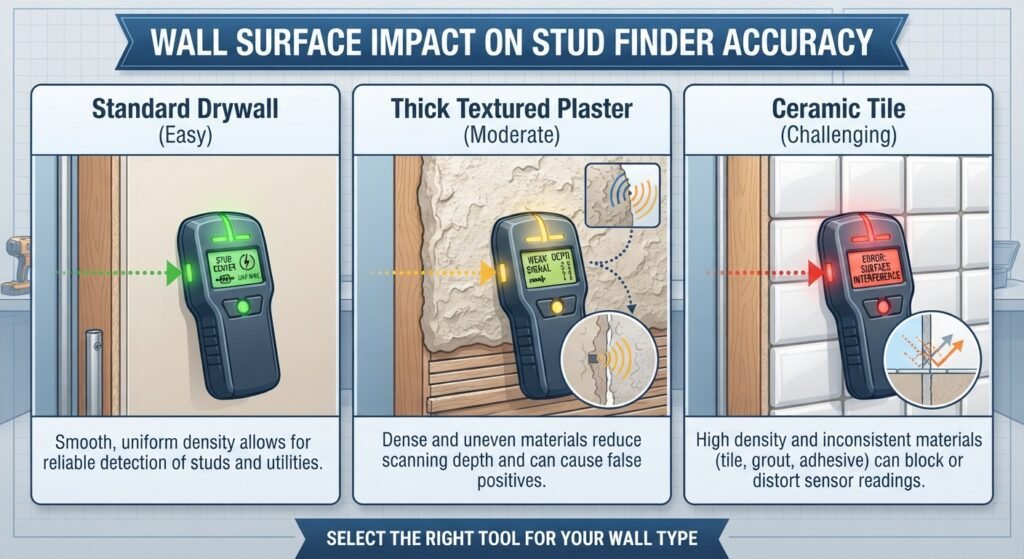
Finding a stud sounds simple until a wall gives you inconsistent readings, especially when drywall is thick, textured, plaster-covered, or layered over another material. The best stud finder is not necessarily the one with the longest advertised detection depth. The right choice depends on the wall you are scanning, whether you need to locate the stud center or edges, and whether you also want help identifying metal or live wiring.
For most homeowners, a reliable electronic scanner with clear center-finding is the most versatile choice. For difficult walls, professional renovation work, or situations where electrical and metal detection matter, a more capable wall scanner can make the job easier. This guide explains what to look for, how different types compare, and how to use a stud finder accurately.
What makes the best stud finder?
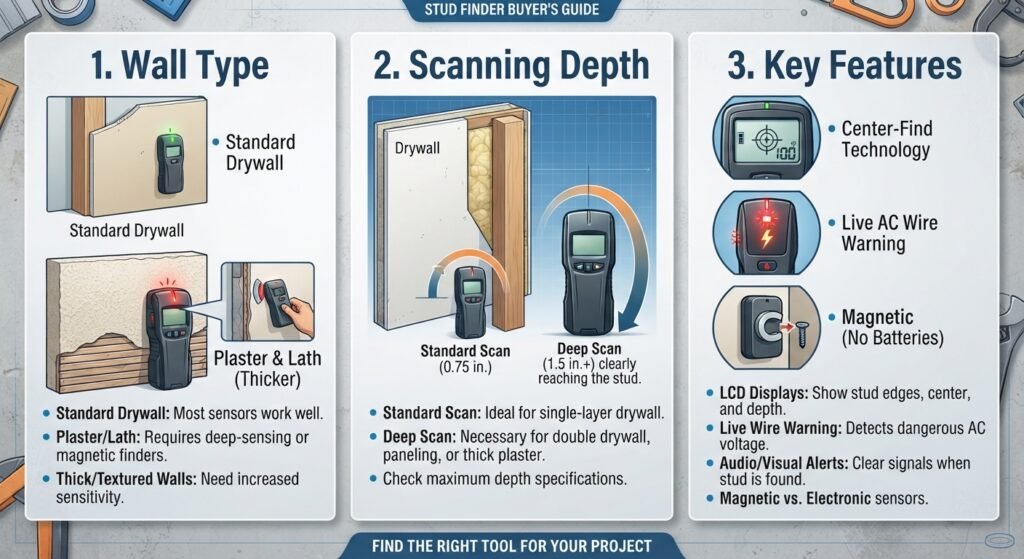
The best stud finder should make it easier to identify a safe, usable drilling location rather than simply producing a signal. Accuracy, consistency, ease of calibration, wall compatibility, and the ability to distinguish a stud from other objects all matter. A tool that works beautifully on ordinary drywall may behave differently on plaster, thick wall coverings, plywood, or walls containing pipes and wiring.
For general home projects, prioritize a model that clearly identifies the center or edges of a stud, provides understandable visual or audible feedback, and is simple enough to use repeatedly. If you regularly work on renovation projects, consider a multifunction wall scanner capable of detecting wood, metal, and electrical wiring as well.
Electronic vs. magnetic stud finders
Magnetic and electronic stud finders solve the same basic problem in different ways. Magnetic models detect metal fasteners such as nails or screws associated with studs, while electronic scanners analyze changes in the material behind the wall. Magnetic tools can be inexpensive and straightforward, but they may be less useful where fasteners are difficult to detect or where the wall construction is unusual.
(Outdoor Life)
Electronic models generally provide more information. Depending on the design, they may identify the stud’s edge or center and may also offer metal or live-wire detection. That additional information can be valuable when you are preparing to mount cabinets, shelves, TVs, or other items where knowing the usable stud area matters.
Check Price on Amazon
Affiliate disclosure: This article contains affiliate links. If you purchase through qualifying links, SmartAirHQ may earn a commission at no additional cost to you.
Center finding is usually more useful than simply finding an edge
A stud’s edge tells you where the structural member begins, but its center gives you a more useful target for many fastening jobs. Some modern scanners are specifically designed to identify the center, while others identify both edges so that you can determine the center yourself.
For example, the DEWALT DW0150 is designed around center detection and includes directional indicators and a center-marking channel. (DeWalt) This type of feedback can simplify the final marking step, particularly for homeowners who do not regularly work with wall framing.
Best stud finder for home use
For ordinary household projects, look for a balance of simplicity and capability rather than buying the most complicated scanner available. Hanging shelves, mounting a television, installing cabinets, securing a mirror, and attaching wall brackets usually require dependable stud-location information more than an extensive collection of professional scanning modes.
A good home-use model should be comfortable to hold, easy to understand, and predictable on standard drywall. It should also give you enough information to verify the reading before drilling. The important point is that no stud finder should replace common-sense verification, particularly when electrical wiring or plumbing may be present.
A practical home-use setup should ideally offer:
- Wood-stud detection
- Clear center or edge indication
- A readable display or obvious visual signal
- Straightforward calibration or automatic calibration
- Some form of live-wire warning when available
- A comfortable shape for repeated scanning
- A useful detection depth for your particular wall
If you frequently work on home-improvement projects, it is also worth exploring other practical devices in the [Smart Gadgets] category for complementary tools and equipment.
Why the M210 stud finder gets attention
The Franklin Sensors ProSensor M210 is designed around a broad sensing area rather than a narrow single-sensor approach. Franklin Sensors says the M210 uses 13 sensors and a 21-LED display to show the full width of a detected stud, along with a built-in bubble level and live-wire sensing. (Franklin Sensors)
That approach can be particularly useful when you want to understand where the stud begins, where it ends, and where its center lies. The wider display also reduces the need to interpret a single small signal. For readers searching specifically for an M210 stud finder, it is a strong example of a stud finder designed around whole-stud visualization rather than a simple edge signal.
Shop Franklin ProSensor M210 on Amazon
What to look for when shopping on Amazon
Searching for the Best stud finder Amazon results can produce a huge range of inexpensive scanners, magnetic tools, professional wall detectors, and products with very similar-looking descriptions. The safest way to compare them is to look beyond the number of features and ask whether those features actually solve your wall-scanning problem.
Pay particular attention to whether the product identifies the center or edges, what types of materials it is designed to detect, whether it requires calibration, and whether its instructions explain limitations. Amazon ratings can help you identify recurring user experiences, but they should not be treated as a substitute for understanding the tool’s intended application.
Bosch stud finder options for more demanding projects
A Bosch stud finder can make sense when your requirements go beyond locating a wooden stud in ordinary drywall. Bosch’s GMS 120-27 Professional detector is designed to identify metal, live wires, and wooden studs, making it more of a multifunction wall scanner than a basic stud locator. Bosch also describes it as being designed for demanding job-site use. (Bosch Professional)
The GMS 120-27 can therefore be attractive to contractors, renovators, and experienced DIY users who want one tool to investigate several types of objects behind a wall. Bosch’s own instructions also emphasize verifying what has been detected before drilling because a non-metallic signal is not automatically proof that the object is a wooden stud. (Bosch Professional)
Shop Bosch GMS 120-27 on Amazon
Bosch stud finder review: what matters in real use
A useful Bosch stud finder review should consider more than detection depth. The important question is how well the scanner fits the type of wall and job you actually have. The GMS 120-27, for example, provides separate detection capabilities for wooden studs, metals, and live wires. Bosch says its maximum detection depths vary according to the material being detected. (Bosch Professional)
That multifunction approach is valuable for renovation work because a wall can contain more than framing. However, a multifunction scanner also requires you to understand its modes and interpret its readings correctly. If your only task is hanging a picture on standard drywall, a simpler center-finding tool may be easier and more economical.
Best professional stud finder characteristics
The best professional stud finder should be selected according to the work environment rather than marketing language. Professional users may need greater versatility because they encounter different wall materials, metal components, wiring, thick surfaces, and irregular construction.
Look for:
- Consistent readings across different surfaces
- Wood and metal detection
- Live-wire detection where appropriate
- Clear center or edge information
- A durable housing
- Easy-to-understand controls
- Reliable performance without unnecessarily complicated operation
- Documentation that explains the scanner’s limitations
The Bosch GMS 120-27 is one example of a professional-oriented detector that combines wood, metal, and live-wire detection in one tool. (Bosch Professional)
Shop professional Bosch stud finders on Amazon
Best stud finder for plaster walls
Plaster walls are one of the biggest challenges for stud finders because the wall construction can be substantially different from modern drywall. Traditional plaster may be combined with lath or other layers, producing a surface that is harder for some electronic scanners to interpret consistently.
Independent testing has found lath-and-plaster walls particularly challenging for stud finders. In testing reported by Outdoor Life, the Franklin Sensors ProSensor M210 struggled at times but produced the most reliable results among the tested models on that surface. (Outdoor Life)
This is why the best stud finder for plaster walls should not be chosen solely by its advertised maximum depth. A broad sensing area, appropriate scanning mode, and the ability to verify the result are often more important than a single specification.
Shop stud finders for plaster-wall projects on Amazon
How to improve accuracy on difficult walls
When scanning plaster or another challenging surface, slow down instead of repeatedly sweeping the tool quickly across the wall. Follow the manufacturer’s instructions for calibration or initialization, keep your hand position consistent, and scan the area from more than one direction.
Once you find a promising location, move beyond the first positive reading. Scan horizontally to establish the stud’s position and then repeat the process vertically. If the tool identifies an object that could also be wiring, piping, or another material, treat the reading as a warning that requires further verification rather than automatically assuming it is a stud.
Best stud finder for thick walls
Thicker walls require special attention because detection performance depends on both the scanner and the construction of the wall. A product may have a dedicated deep-scan mode, but deeper scanning can also make interpretation more difficult because there may be more material between the sensor and the object.
Zircon, for example, offers scanners with DeepScan modes intended for thicker surfaces. Its MultiScanner A250 provides stud edge and center finding, metal detection, AC scanning, and a DeepScan mode designed to extend stud-detection capability on thicker surfaces. (Zircon)
For anyone searching for the best stud finder for thick walls, therefore, look specifically for a model whose instructions discuss deeper or thicker-wall scanning rather than assuming every electronic stud finder performs equally well.
Shop deep-scan stud finders on Amazon
Why detection depth should not be your only buying criterion
A larger detection-depth number looks impressive, but it does not automatically mean that a tool will be more accurate on your particular wall. Detection depends on the material, the object’s size, the wall’s density, and the scanner’s technology.
For example, Zircon’s MultiScanner A250 has different published capabilities for wood or metal studs, metal targets, and live AC wiring. (Zircon) Bosch similarly lists different maximum depths for different target materials with the GMS 120-27. (Bosch Professional)
The better question is: Can this tool reliably identify the object I need to locate through my wall construction?
How to use a stud finder correctly
Even the best stud finder can give a misleading result when it is used incorrectly. Wall scanners are measuring physical conditions behind a surface, so your scanning technique affects the reading. The safest workflow is to prepare the area, follow the tool’s instructions, scan slowly, identify the target, and then verify the location before drilling.
For important installations, avoid relying on one quick pass. A good reading should make sense in relation to nearby framing, fasteners, corners, doors, windows, or other known features. Bosch’s instructions, for example, recommend crosswise measurements when the course of a detected object is unknown. (Bosch Professional)
A simple step-by-step scanning method
Start with a clean section of wall and remove anything that could interfere with the tool if the manufacturer’s instructions advise doing so. Then use the scanner according to its specified mode and movement direction.
- Prepare the scanner according to its instructions.
- Place or hold it against the wall as directed.
- Scan slowly across the suspected stud area.
- Watch for the strongest or center indication, depending on the tool.
- Mark the location lightly with a pencil.
- Scan again from another direction to confirm the result.
- Check for potential wiring or other objects before drilling.
- Choose the fastening point only after you are satisfied that the location is appropriate.
This process is simple, but repeating the scan is one of the easiest ways to reduce mistakes.
Common stud-finder mistakes to avoid
One of the most common mistakes is treating every electronic signal as proof of a wooden stud. Objects such as metal, pipes, or electrical wiring can produce signals, and some scanners may identify non-metallic objects that are not framing. Bosch specifically warns that certain objects can be indicated during wood detection and recommends checking other sources of information before drilling. (Bosch Professional)
Other mistakes include moving too quickly, ignoring the manufacturer’s calibration procedure, scanning only once, and assuming a published maximum depth applies equally to every material. A stud finder is a locating aid, not a guarantee that a particular drilling point is safe.
Popular stud finder categories worth comparing
There is no single design that is perfect for every wall or project. A homeowner mounting a lightweight shelf has different requirements from a contractor working around wiring, metal components, and thick wall assemblies. Comparing the major categories first makes it easier to narrow the field before you worry about individual models.
| Stud finder type | Best suited to | Main advantage | Main limitation |
|---|---|---|---|
| Magnetic | Simple drywall projects | Simple and inexpensive | Relies on detectable metal fasteners |
| Basic electronic | General home use | Easy stud detection | Fewer advanced functions |
| Center-finding electronic | Shelves, TVs, brackets | Helps identify usable center | Can require careful scanning |
| Multifunction wall scanner | Renovation work | Detects several object types | More complex |
| Deep-scan model | Thick wall surfaces | Designed for deeper scanning | Readings can require more interpretation |
| Professional scanner | Frequent construction work | Greater versatility | Usually more than casual DIY users need |
The most important comparison is not which category sounds most advanced. It is which category matches your wall and the job you are about to perform.
Shop general electronic stud finders on Amazon
Shop magnetic stud finders on Amazon
Shop center-finding stud finders on Amazon
Shop multifunction wall scanners on Amazon
Best Stud Finder Home Depot and other retailer comparisons
Searching for the Best Stud Finder Home Depot carries the same basic lesson as shopping on Amazon: compare the tool’s actual detection method and intended use rather than choosing by retailer ranking alone. Retail availability can change, and the same product may be sold through multiple channels, so the underlying specifications and manufacturer instructions are more useful for an evergreen buying decision.
For example, Zircon’s official product information distinguishes between center finding, edge finding, metal scanning, and AC detection across its MultiScanner range. (Zircon) Those distinctions are more meaningful than simply choosing the scanner with the longest feature list.
Shop Home Depot stud finders on Amazon for comparison
For broader home-improvement technology and practical equipment, you can also visit [SmartAirHQ.com] to explore related guides.
12 Amazon searches for comparing stud finders
Instead of assuming that one product works for everyone, use these searches to compare different types of stud finders based on your project. The links use the provided Amazon Associates tracking ID and are intended as shopping resources; availability and pricing can change.
Franklin Sensors ProSensor M210
Franklin Sensors ProSensor MAX
What professional users discuss when choosing a stud finder
Searches such as best professional stud reddit often reflect a different concern from ordinary consumer searches: users want dependable results in imperfect real-world conditions. That is a useful perspective, but community recommendations should be treated as experience reports rather than universal proof. Wall construction varies considerably, so a tool that performs well for one user may not be the best fit for another.
A professional buyer should therefore combine practical user experience with manufacturer documentation. Look for repeated comments about false readings, difficult surfaces, calibration, handling, and the usefulness of the display. Then compare those experiences with the type of walls and projects you actually encounter.
When a multifunction scanner is worth the extra capability
A multifunction scanner becomes more valuable when the question is not simply “Where is the stud?” but “What exactly is behind this wall?” Tools such as the Bosch GMS 120-27 and Zircon MultiScanner A250 combine stud detection with additional detection capabilities. (Bosch Professional)
That can be useful before drilling into a wall where pipes, metal components, or electrical wiring could complicate the job. However, additional modes do not eliminate the need for careful verification. The scanner’s warnings and readings should be considered part of a broader assessment of the wall rather than a substitute for knowing the building’s construction.
Frequently asked questions about the best stud finder
Choosing a stud finder often raises the same practical questions: whether electronic models are better than magnetic ones, whether plaster can be scanned reliably, how much detection depth is enough, and whether a professional scanner is necessary for household projects. The answers depend largely on wall construction and intended use, but a few principles can make the buying decision much easier.
What is the best stud finder for most homeowners?
For most homeowners, a center-finding electronic model with clear feedback is a practical starting point. If you regularly encounter thick, plaster, or unusual walls, consider a scanner with broader sensing or additional detection modes.
Is the M210 a good stud finder for home projects?
The M210 is designed with a broad sensing area, 13 sensors, full-width stud indication, a bubble level, and live-wire sensing. (Franklin Sensors) Those features make it particularly interesting for users who want more information than a basic edge-finding scanner provides.
Is Bosch a good choice for professional use?
Bosch’s GMS 120-27 is designed as a professional detector for locating wooden studs, metal, and live wires. (Bosch Professional) Whether it is the right choice depends on the materials and scanning conditions encountered in the user’s work.
What is the best stud finder for plaster walls?
There is no universal winner for every plaster wall. Lath-and-plaster construction can be difficult for electronic scanners, so broad sensing, suitable scanning modes, and repeated verification are important. Independent testing has identified the M210 as a relatively reliable option among tested models on lath and plaster. (Outdoor Life)
How deep should the best stud finder scan?
Choose detection depth based on the actual wall construction. A deeper rating is useful only if the scanner can interpret the material accurately at that depth. Manufacturers often publish different detection limits for wood, metal, and wiring, so compare the specification that matches your intended target. (Bosch Professional)
Can a stud finder detect electrical wires?
Some multifunction electronic scanners include live-wire or AC detection. Bosch’s GMS 120-27 and several Zircon MultiScanner models provide electrical detection capabilities. (Bosch Professional) Always follow the manufacturer’s instructions and do not treat a stud-finder warning as the only safety check before drilling.
Final thought: choosing the best stud finder for your wall
The best stud finder is the one that matches the wall you are actually scanning and the job you need to complete. For straightforward household projects, prioritize simple and reliable center or edge detection. For plaster, thick walls, renovation work, or situations where metal and wiring matter, a more capable multifunction scanner can provide useful additional information.
The M210 stands out for its broad full-stud sensing approach, while the Bosch GMS 120-27 and multifunction Zircon scanners demonstrate why some users benefit from wood, metal, and electrical detection in one tool. (Franklin Sensors)
Before buying, identify your wall type, decide whether you need center or edge detection, consider whether deep scanning or additional object detection matters, and learn the tool’s limitations. That approach is more reliable than choosing a stud finder based on a single specification or a generic “best” label.